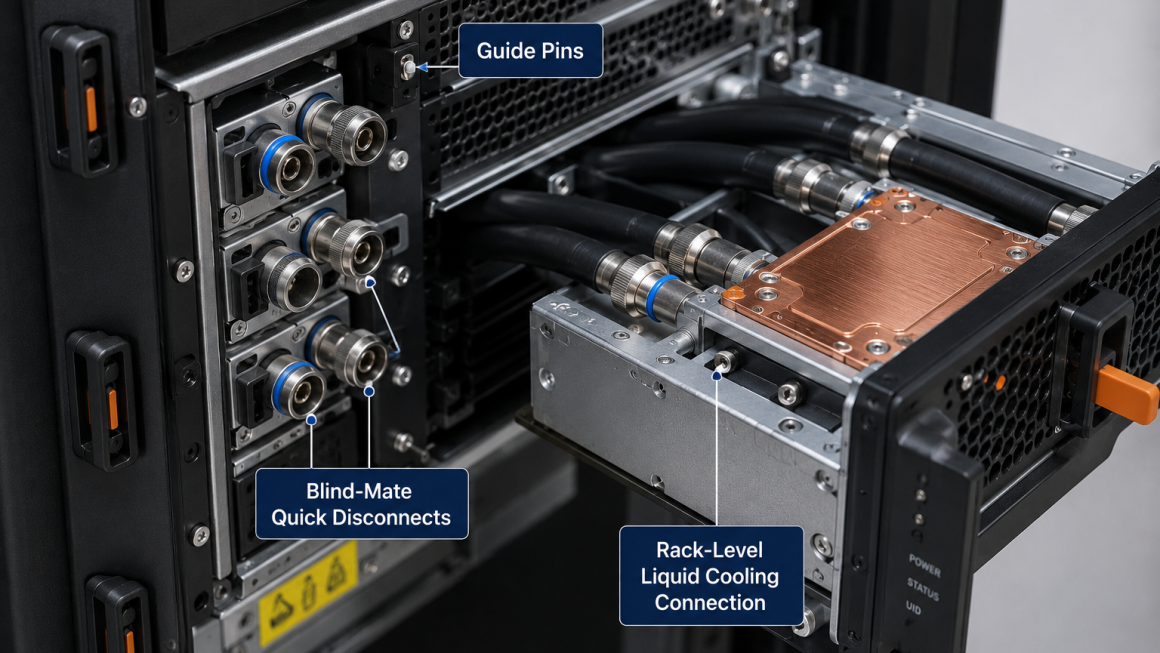
Why Blind-Mate Connections Are Becoming Essential
As AI servers, high-performance computing (HPC), and liquid-cooled data centers continue to increase in power density, traditional manual hose and cable connections are becoming less practical.
Modern rack architectures are moving toward modular designs that enable faster installation, simplified maintenance, and reduced downtime.
One enabling technology is the Blind-Mate Quick Disconnect (QD).
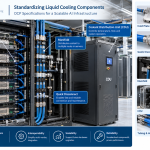
Combined with precision guide pins and modular chassis designs, blind-mate connections allow cooling and electrical interfaces to engage automatically as server modules are inserted into a rack.
This approach supports higher service efficiency while improving system reliability.
The Challenge of Rack-Level Liquid Cooling
Air cooling alone is no longer sufficient for many AI and HPC platforms.
Cold plate liquid cooling has become increasingly common for:
- AI GPU servers
- High-performance computing clusters
- Edge AI infrastructure
- High-density storage systems
These systems require reliable coolant distribution throughout the rack while allowing individual server modules to be replaced quickly.
Conventional hose connections can increase installation time and maintenance complexity.
Blind-mate QDs address this challenge by simplifying coolant connections.
What Is a Blind-Mate Quick Disconnect?
A blind-mate quick disconnect is a coupling designed to connect automatically without requiring direct visual alignment.
When a server tray or module is inserted into the chassis:
- Guide pins align the module.
- The quick disconnect engages automatically.
- Coolant flow is established.
- Sealing is maintained with minimal fluid loss.
This process reduces manual operations and supports tool-free maintenance in many applications.
The Role of Guide Pins in Chassis Integration
Guide pins are an important mechanical component that ensures repeatable positioning during installation.
Their functions include:
- Accurate module alignment
- Protection of connectors
- Reduction of insertion forces
- Prevention of mechanical damage
Without proper alignment, blind-mate couplings may experience excessive wear or sealing issues.
Guide pins help maintain consistent engagement over repeated service cycles.
Benefits for Rack-Level Liquid Cooling
Faster Module Replacement
Server modules can be removed and installed without disconnecting multiple hoses manually.
This reduces maintenance time and minimizes service interruptions.
Improved Reliability
Precise alignment reduces stress on cooling connectors, electrical interfaces, and mechanical structures.
Consistent positioning also helps extend component service life.
Reduced Coolant Leakage
Modern blind-mate QDs are designed to minimize fluid loss during connection and disconnection.
This helps maintain system cleanliness while protecting sensitive electronic components.
Higher Rack Density
Blind-mate interfaces eliminate the need for additional clearance required by conventional hose connections.
This supports more compact chassis layouts and higher computing density.
Applications
Blind-mate quick disconnects are increasingly used in:
AI GPU Servers
High-power GPU systems require efficient liquid cooling while supporting rapid hardware replacement.
Cold Plate Cooling Systems
Cold plates remove heat directly from processors and accelerators.
Blind-mate QDs simplify coolant connections between removable server modules and rack manifolds.
High-Performance Computing (HPC)
HPC clusters benefit from modular cooling systems that reduce maintenance time while supporting continuous operation.
Edge Computing Infrastructure
Compact edge data centers often require modular cooling solutions that simplify deployment and field service.
Key Design Considerations
When designing blind-mate cooling systems, engineers typically evaluate:
Mechanical Alignment
Guide pins and chassis structures should ensure repeatable positioning under normal manufacturing tolerances.
Sealing Performance
Quick disconnects should provide reliable sealing over repeated connection cycles while minimizing coolant loss.
Pressure Rating
Couplings must accommodate the operating pressure of the liquid cooling system.
Material Compatibility
Materials should be compatible with commonly used coolants and provide long-term resistance to corrosion and wear.
Service Life
Applications involving frequent maintenance require durable couplings capable of supporting thousands of insertion cycles.
Supporting the Future of Modular Data Centers
The rapid growth of AI infrastructure is accelerating the adoption of modular server architectures.
Future rack designs are expected to feature:
- Higher cooling capacity
- Tool-free module replacement
- Integrated liquid manifolds
- Smarter alignment mechanisms
- Standardized blind-mate interfaces
- Increased rack power density
These developments will make blind-mate quick disconnect technology an increasingly important part of next-generation liquid-cooled server systems.
Blind-mate quick disconnects, together with guide pins and precision chassis alignment, are helping reshape rack-level liquid cooling for AI servers and high-performance computing platforms.
By enabling faster module replacement, reducing coolant leakage, improving alignment accuracy, and supporting modular chassis integration, these technologies contribute to more reliable and serviceable liquid-cooled infrastructure.
As rack power densities continue to rise, blind-mate connection systems will play an increasingly important role in delivering efficient, scalable, and maintainable cooling solutions for future data centers.
What is a blind-mate quick disconnect?