


Why Fast and Reliable Integration Matters
As Battery Energy Storage Systems (BESS) become larger and more modular, equipment manufacturers are placing greater emphasis on installation efficiency, serviceability, and operational reliability.
Modern battery racks are no longer assembled entirely through manual cable connections. Instead, many designs incorporate mechanical alignment features and blind-mate connection technologies that simplify module installation while reducing the risk of human error.
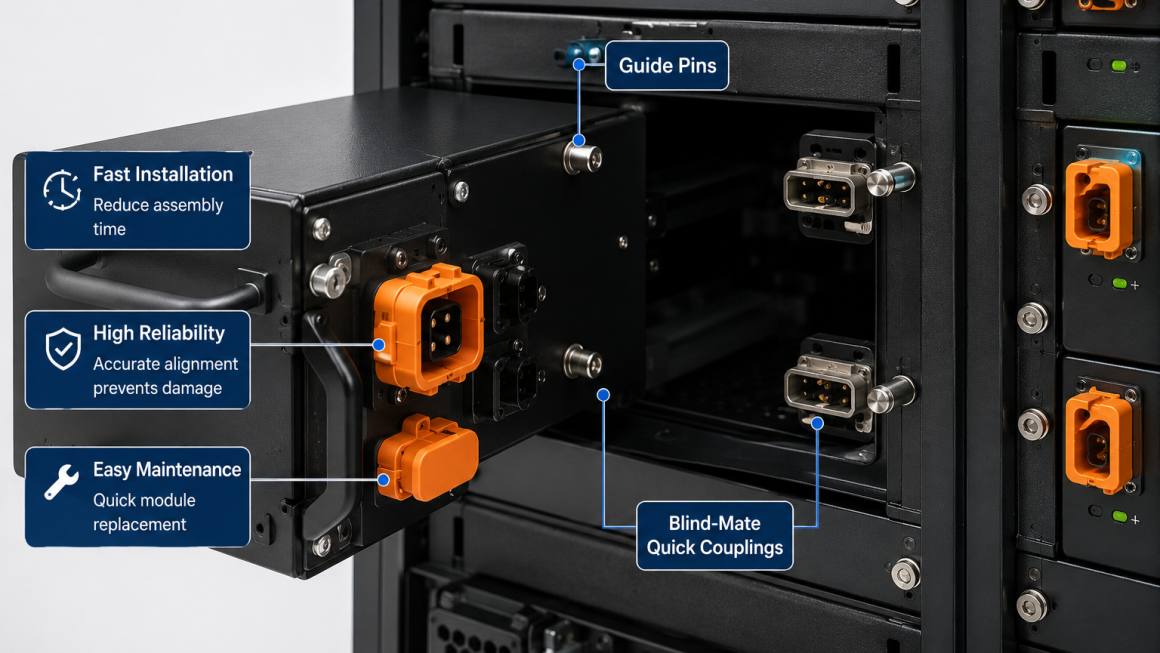
Among these solutions, guide pins and blind-mate quick couplings play an important role in supporting modular battery rack and chassis integration.
What Are Guide Pins?
Guide pins are precision alignment components used to position battery modules accurately during installation.
Rather than relying solely on manual positioning, guide pins help direct the module into the correct location before electrical or fluid connections are engaged.
Typical functions include:
- Module alignment
- Positioning accuracy
- Load guidance during installation
- Protection of connectors from misalignment
By ensuring repeatable positioning, guide pins help improve assembly quality and reduce installation time.
What Are Blind-Mate Quick Couplings?
Blind-mate quick couplings are connection systems designed to engage automatically as a module is inserted into its designated position.
Unlike conventional connectors that require manual alignment, blind-mate designs allow operators to install modules without direct access to the connection interface.
These systems are commonly used for:
- Electrical power connections
- Signal interfaces
- Liquid cooling circuits
- Pneumatic systems
The result is faster installation and easier maintenance in densely packed battery racks.
Why They Are Important in Utility-Scale BESS
Large battery energy storage systems may contain hundreds or even thousands of battery modules.
Manual connection of every interface increases:
- Installation time
- Labor costs
- Maintenance complexity
- Risk of connector damage
Guide pins and blind-mate quick couplings help address these challenges by supporting standardized module installation and replacement.
This is particularly valuable in utility-scale energy storage projects where system availability is a priority.
Key Benefits
Faster Installation
Modules can be positioned and connected with fewer manual adjustments, reducing assembly time during manufacturing and field installation.
Improved Alignment Accuracy
Guide pins ensure consistent positioning, minimizing the likelihood of connector damage caused by improper alignment.
Simplified Maintenance
When battery modules require replacement, blind-mate interfaces enable faster removal and reinstallation without extensive disassembly.
This can help reduce maintenance downtime and improve service efficiency.
Enhanced System Reliability
Proper alignment reduces mechanical stress on electrical connectors and cooling interfaces, contributing to more stable long-term operation.
Integration with Cooling and Electrical Systems
Modern battery racks often combine multiple connection types within a single module.
Examples include:
Electrical Interfaces
Blind-mate electrical connectors simplify high-voltage and low-voltage connections while reducing manual wiring requirements.
Liquid Cooling Connections
Quick couplings support coolant circulation between battery modules and cooling systems with minimal installation effort.
Leak-resistant designs are particularly important for liquid-cooled BESS applications.
Communication Interfaces
Signal connectors enable communication between battery modules and the battery management system (BMS), supporting monitoring and control functions.
Design Considerations
Successful chassis and rack integration requires attention to several engineering factors.
Mechanical Tolerance
Guide pins and coupling interfaces should accommodate normal manufacturing tolerances while maintaining reliable engagement.
Durability
Repeated installation and removal cycles require components with good wear resistance and long service life.
Environmental Protection
Depending on the installation environment, components may require protection against:
- Dust
- Moisture
- Corrosion
- Vibration
- Temperature fluctuations
Service Accessibility
Well-designed integration systems allow maintenance personnel to replace modules quickly while minimizing the risk of damaging surrounding equipment.
Supporting Modular Battery Architecture
The battery industry is moving toward increasingly modular designs.
Modular battery architecture offers several advantages:
- Easier transportation
- Faster deployment
- Flexible capacity expansion
- Simplified maintenance
- Improved manufacturing efficiency
Guide pins and blind-mate quick couplings are key enabling technologies that support this modular approach.
Future Trends
As battery energy storage systems continue to evolve, integration technologies are expected to become even more standardized.
Future developments may include:
- Higher-density connector systems
- Integrated power and signal interfaces
- Smarter alignment mechanisms
- Advanced liquid cooling couplings
- Tool-free module replacement
These innovations are expected to further improve manufacturing efficiency and reduce lifecycle maintenance costs.
Guide pins and blind-mate quick couplings have become important components in modern battery rack and chassis integration.
By improving alignment accuracy, simplifying installation, and supporting modular battery architecture, these technologies help enhance both manufacturing efficiency and long-term system reliability.
As utility-scale Battery Energy Storage Systems continue to expand, reliable mechanical and electrical integration will remain an essential part of designing safer, more serviceable, and more efficient energy storage platforms.