
Why Weather is the Ultimate Operational Risk for Modern BESS & Solar Farms
When managing a utility-scale Photovoltaic (PV) plant or a Battery Energy Storage System (BESS), weather isn’t just an environmental backdrop—it is a direct financial variable.
Unexpected thermal spikes can trigger battery micro-short circuits and send HVAC cooling costs through the roof. Unpredicted cloud cover or sandstorms cause sudden generation drops, leading to massive grid Deviation Penalties .
To maintain compliance with strict international grids and safeguard multimillion-dollar battery health, plant operators require localized, zero-latency environmental intelligence. Our modular weather instrumentation series bridge the gap between volatile atmospheric conditions and predictable asset return on investment (ROI).
Part 1: The Core Building Blocks (High-Precision Individual Hardware)
For engineering teams looking to upgrade existing SCADA setups or replace degraded field sensors, we provide laboratory-grade, factory-calibrated individual hardware nodes ready for industrial integration.
1. Universal Industrial Data Logger (The Station Brain)
The central hub of our monitoring architecture. It aggregates analog and digital signals from all outdoor sensors, standardizing raw data into grid-ready communication streams.
-
Core Protocols: Native support for Modbus RTU/TCP, DNP3, and SDI-12, ensuring seamless handshake with mainstream BESS EMS (Energy Management Systems) and utility SCADA software.
-
Technical Resilience: Built-in surge protection, non-volatile data storage flash memory (preventing data loss during communication blackouts), and rugged IP65 enclosure.
2. 6-in-1 Solid-State Ultrasonic Weather Sensor (Wind & Ambient Triad)
Traditional mechanical cup-and-vane anemometers freeze, suffer from bearing wear, and require annual calibration. Our solid-state node has zero moving parts, slashing field O&M overhead to near zero.
-
Monitored Metrics: Wind Speed, Wind Direction, Ambient Temperature, Relative Humidity, Barometric Pressure, and Precipitation.
-
Technology: Ultrasonic soundwave transience for instant wind vector calculations, performing flawlessly in low-threshold wind environments and freezing high-altitude conditions.
3. Secondary Standard Pyranometer (Solar Irradiance Node)
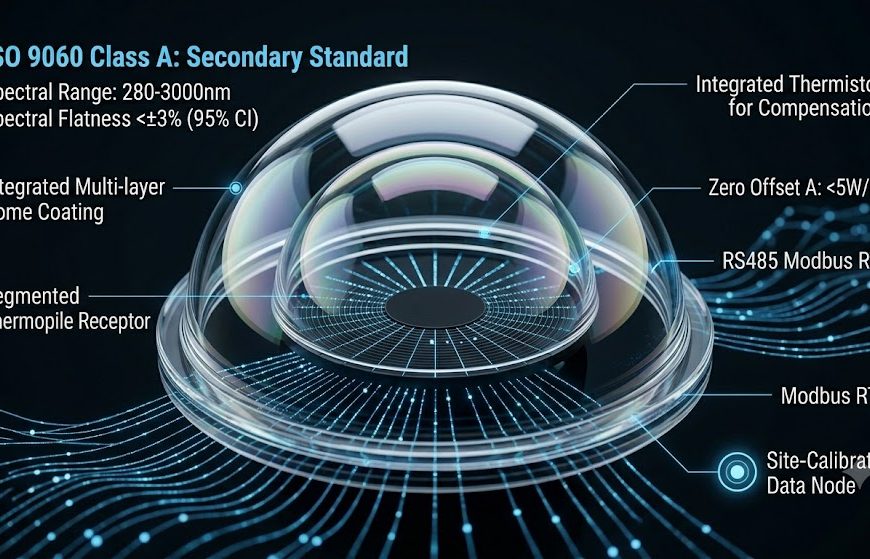
To calculate your plant’s Performance Ratio (PR), you must know exactly how much solar energy hits your arrays. Our pyranometer complies strictly with ISO 9050 / ISO 9060 Class A (Secondary Standard) criteria.
-
Spectral Range: 280 to 3000 nm, capturing full-spectrum global horizontal irradiance (GHI) or plane-of-array (POA) tilting irradiance.
-
Thermal Stability: Built-in temperature compensation network ensuring consistent micro-volt output under brutal desert UV exposure.
4. Magnetic PV Panel Back-Surface Temperature Sensor
Battery charging algorithms and solar cell efficiency curves drift dramatically based on actual hardware heat.
-
Design: High-accuracy RTD/PT100 or PT1000 element embedded in a shielded, weather-resistant magnetic patch that adheres directly to the back of a PV module or BESS container exterior wall without structural drilling.
Part 2: The Plug-and-Play Retrofit Solution (The Integrated Station)
The “Legos” System Integration for Aftermarket BESS Upgrades
Did your original BESS or Solar OEM deliver a containerized system without a grid-compliant weather station? Are you facing unexpected O&M penalties or liquid-cooling blind spots because your system “cannot see” the coming heatwave?
You don’t need to hire expensive local automation engineers to source and code individual components from scratch. We have done the engineering work for you.
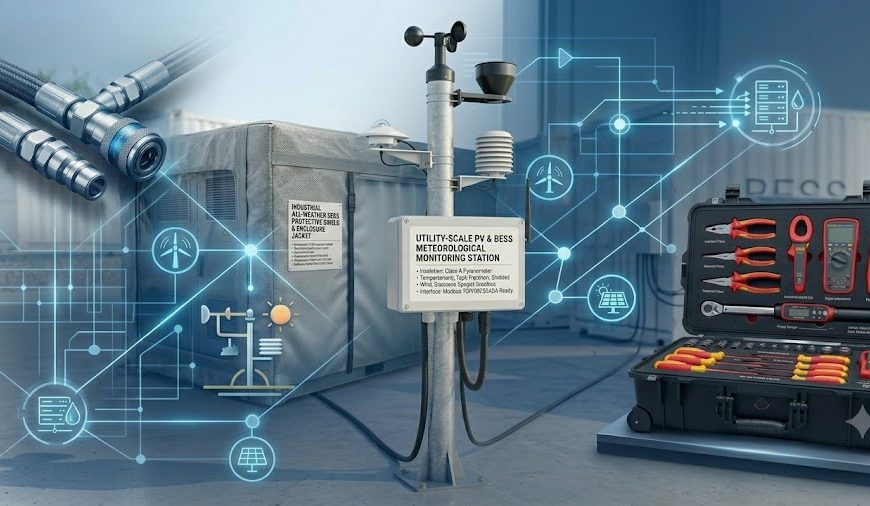
Our Turnkey Meteorological Integration Station combines all the core individual modules above into a single, pre-wired, pre-configured “Site-Ready Box.”
Why Global EPCs Choose Our Integrated Station Box:
-
30-Minute DIY Deployment: Ships as a comprehensive kit including a pre-wired NEMA 4X/IP65 heavy-duty stainless steel control enclosure, pre-fabricated marine-grade cabling with quick-snap aviation plugs, and an expandable rugged mounting tripod/mast.
-
Adaptive Variable Configuration: While our standard unit leverages high-precision multi-sensor matrices, the central data logger brain is modular. We can seamlessly hot-swap the processing core or upgrade sensors to top-tier international brands (such as Campbell Scientific data loggers or Vaisala sensors) depending on your specific local utility bankability audits.
-
Pre-Cooling Intelligence for BESS: By integrating directly with your local BESS liquid cooling or HVAC PLC via Modbus TCP, the station acts as an early-warning radar. If a sudden ambient temperature surge or high-irradiance wave is detected, the HVAC unit shifts to proactive variable-frequency cooling before the internal battery racks hit critical thermal thresholds.
Technical Specification Matrix
| Operational Metric | Individual Component Specification | Integrated Station Level Advantage |
| Communication Interface | RS485 / RS232 / RJ45 Ethernet | Pre-mapped Modbus Map, Instant SCADA Handshake |
| Wind Measurement | Ultrasonic (0 to 60 m/s, ±3% Accuracy) | Zero Moving Parts, No Wear, Salt-Spray Resistant |
| Solar Irradiance | ISO 9060 Class A Thermopile Pyranometer | Dual-Sensor Support (GHI + POA Tilting Monitor) |
| Power Supply | 100-240 VAC Power Supply Input | Dual-Power Redundancy: 3W Solar Panel + Battery Backup |
| Field Installation | Individual Bracket Mount | All-in-One Expansion Mast with Quick Aviation Couplers |
| Environmental Target | -40°C to +80°C Operational Range | Full System NEMA 4X Climate Protection & Surge Isolation |
Upgrade Your Field Intelligence Today
Stop letting blind-spot weather variables eat into your power generation revenue or threaten your lithium rack stability. Whether you need a replacement Class-A pyranometer for an existing plant or a complete, plug-and-play retrofit weather station kit to stop grid penalties on an active BESS site, we deliver factory-direct engineering precision with global compliance.
📩 Contact our Technical Infrastructure Sales Division today. Submit your current SCADA communication protocol or cabinet dimensions, and our team will issue a customized system architecture proposal within 24 hours.