

Why Battery Rack Design Is More Than a Steel Structure
As utility-scale Battery Energy Storage Systems (BESS) continue to grow in capacity, battery racks have evolved from simple support frames into critical structural platforms that influence system safety, thermal performance, maintenance efficiency, and long-term reliability.
A modern battery rack is no longer designed solely to hold battery modules.
Instead, it serves as the foundation for integrating electrical, thermal, mechanical, and fire protection systems into a complete energy storage solution.
For project developers and system integrators, rack design has become an essential part of overall BESS engineering.
The Role of Battery Racks in Utility-Scale BESS
Inside a utility-scale battery container, racks provide organized support for multiple battery modules while maintaining structural stability throughout the system’s operational life.
A well-designed battery rack should:
- Support heavy battery loads
- Maintain structural rigidity
- Allow efficient airflow
- Facilitate cable routing
- Simplify maintenance access
- Improve overall system safety
As battery energy density increases, these requirements become even more demanding.
Engineering Challenges in Large-Scale Battery Rack Design
Modern battery racks must withstand more than static mechanical loads.
They also operate under challenging environmental conditions.
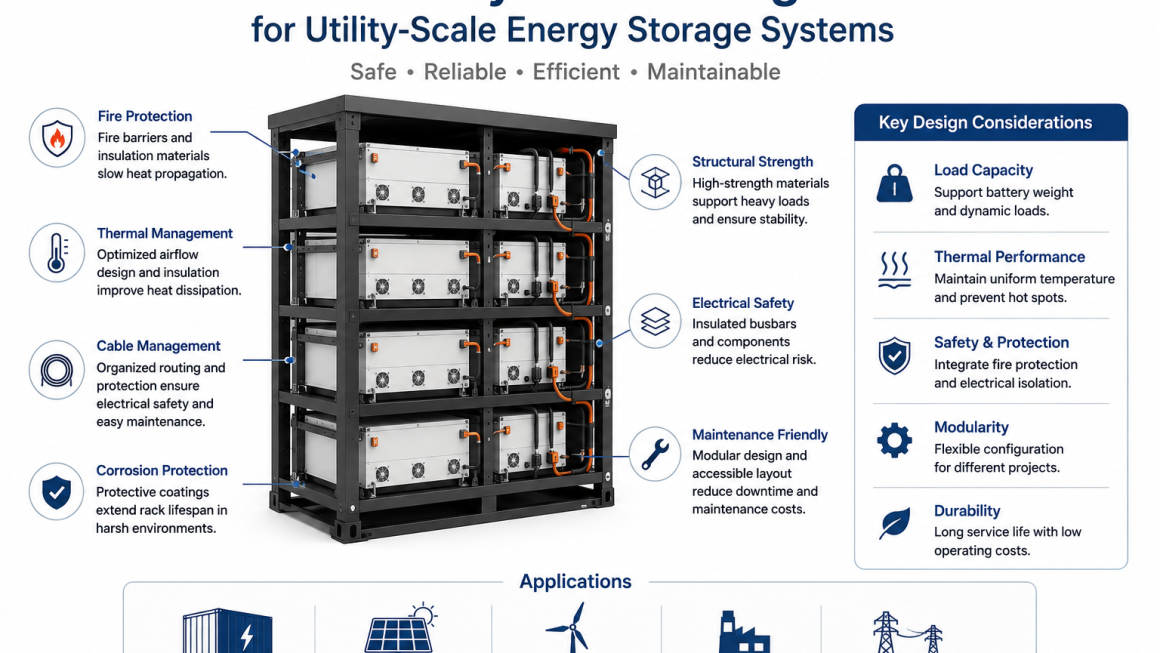
Thermal Management
Battery modules continuously generate heat during charging and discharging.
Without proper rack design, localized hot spots may develop, affecting battery performance and lifespan.
Design considerations include:
- Airflow pathways
- Ventilation clearance
- Heat dissipation
- Thermal insulation between modules
Fire Protection
Although thermal runaway events are uncommon, rack structures increasingly incorporate passive fire protection features.
Examples include:
- Fire-resistant partitions
- Thermal barrier panels
- Insulation materials
- Flame-resistant structural components
These features help delay heat propagation between adjacent battery modules.
Cable Management
Large utility-scale systems contain hundreds of power and communication cables.
Proper cable routing improves:
- Maintenance efficiency
- Electrical safety
- Cooling performance
- Mechanical protection
Cable trays, brackets, and protective sleeves are commonly integrated into rack systems.
Corrosion Resistance
Battery racks may operate in:
- Coastal regions
- Desert environments
- Industrial facilities
- High-humidity climates
Protective coatings help prevent corrosion and extend structural service life.
Key Design Considerations
Successful battery rack design requires balancing several engineering objectives.
Structural Strength
Rack systems must safely support battery weight while resisting vibration and transportation loads.
Typical materials include:
- Carbon steel
- Galvanized steel
- Stainless steel
- Aluminum alloys
Material selection depends on project requirements and environmental conditions.
Thermal Performance
Good thermal design improves battery consistency and system efficiency.
Common approaches include:
- Ventilated rack layouts
- Heat-resistant insulation
- Thermal separation between modules
- Optimized airflow channels
Electrical Safety
Battery racks also support electrical safety by accommodating:
- Busbar insulation
- Cable protection systems
- Grounding components
- Electrical isolation barriers
These features help reduce the risk of electrical faults.
Ease of Maintenance
Utility-scale projects prioritize low operating costs.
Rack layouts should provide:
- Easy module replacement
- Accessible cable routing
- Clear inspection pathways
- Reduced maintenance downtime
A maintenance-friendly design lowers lifetime operating expenses.
Protective Materials Used in Modern Battery Rack Systems
As battery technology evolves, racks increasingly integrate specialized protective materials rather than relying solely on metal structures.
Examples include:
Thermal Insulation Materials
Used to reduce heat transfer between battery modules.
Typical materials include:
- Aerogel insulation
- Ceramic fiber boards
- High-temperature insulation panels
Fire Barrier Materials
Installed between modules or structural sections to slow thermal propagation.
Common options include:
- Mica sheets
- Fire-resistant composite boards
- High-temperature insulation barriers
Cable Protection Components
Power cables require protection against:
- Heat
- Abrasion
- Dust
- Moisture
- Mechanical wear
Protective sleeves and cable management systems improve both reliability and service life.
Industrial Protective Coatings
Coating systems help battery racks resist:
- Corrosion
- UV exposure
- Chemicals
- Salt spray
- Weathering
These coatings are particularly valuable for outdoor and coastal installations.
Future Trends in Battery Rack Design
The next generation of utility-scale battery racks is expected to incorporate:
- Lightweight structural materials
- Modular construction
- Smart monitoring sensors
- Integrated cooling channels
- Advanced thermal barriers
- Multifunctional protective materials
Rather than acting solely as support structures, battery racks are becoming integrated engineering platforms that contribute directly to system performance and safety.
Battery rack design plays a far greater role than simply supporting battery modules.
In modern utility-scale Battery Energy Storage Systems, rack structures influence thermal management, fire safety, cable organization, corrosion resistance, and long-term reliability.
By integrating advanced protective materials, thermal insulation, cable protection systems, and durable coating technologies into rack design, manufacturers can improve both system safety and operational efficiency.
As BESS projects continue to increase in scale, battery rack design will remain a key element in building safer, more reliable, and more maintainable energy storage systems.