
Understanding the Real Challenge of Thermal Runaway
As Battery Energy Storage Systems (BESS) continue to increase in capacity, thermal runaway remains one of the most critical safety concerns facing the industry.
Significant investments have been made in:
- Fire suppression systems
- Gas detection systems
- Ventilation systems
- Container-level safety solutions
While these technologies play an important role, they often address the problem after thermal runaway has already begun.
The most effective strategy is prevention.
And prevention starts at the module level.
Rather than focusing only on suppressing a thermal event, modern BESS designs increasingly emphasize limiting heat propagation before it spreads throughout the system.
What Happens During Thermal Runaway?
Thermal runaway occurs when a battery cell generates heat faster than the system can dissipate it.
The resulting temperature increase may trigger:
- Electrolyte decomposition
- Internal short circuits
- Gas generation
- Combustion reactions
Once initiated, temperatures can rise rapidly and affect neighboring cells.
The primary risk is not a single cell failure.
The real danger is thermal propagation.
A localized event can spread from:
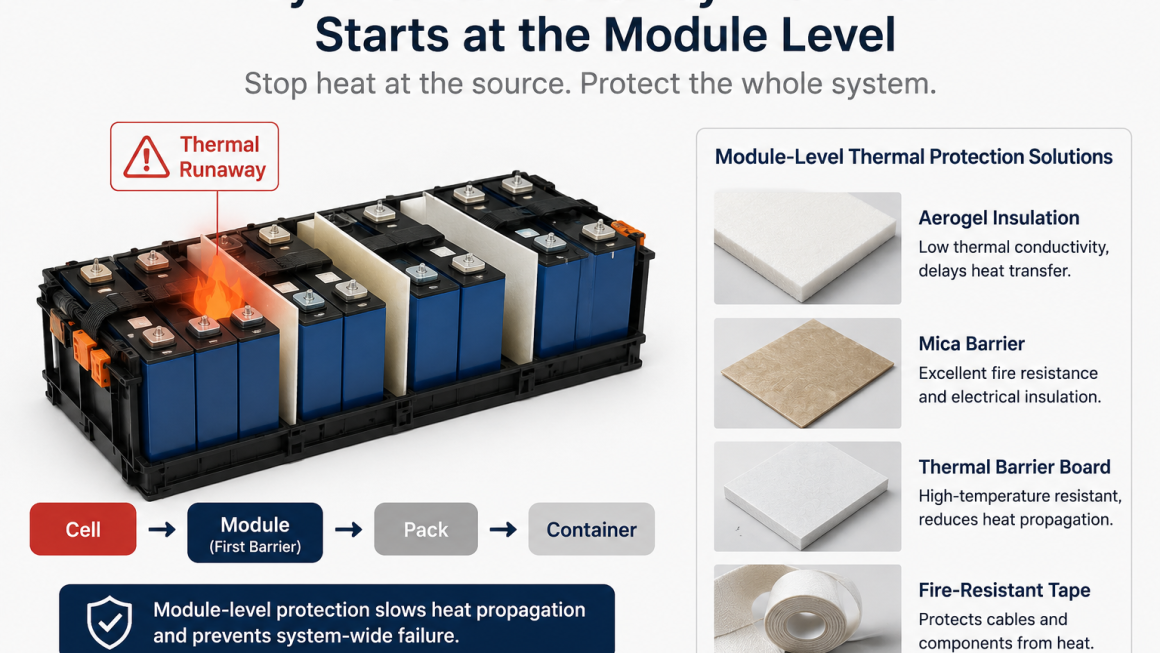
Cell → Module → Pack → Container
The larger the affected area becomes, the more difficult mitigation becomes.
Why Module-Level Protection Matters
A battery module acts as the first barrier against thermal propagation.
If heat can be contained within the affected module, the consequences of a cell failure may be significantly reduced.
Module-level protection aims to:
- Slow heat transfer
- Delay propagation
- Protect adjacent cells
- Increase response time for safety systems
Every additional minute gained can help prevent a small incident from becoming a system-wide event.
The Challenge of Heat Transfer Between Cells
Inside modern battery modules, cells are packed closely together to maximize energy density.
While this improves storage capacity, it also creates pathways for heat transfer.
Heat spreads through:
Conduction
Direct contact between cells and structural components.
Convection
Movement of hot gases within the module.
Radiation
Thermal energy emitted from overheated surfaces.
Without proper thermal barriers, these mechanisms can rapidly transfer heat to neighboring cells.
Module-Level Thermal Protection Solutions
To reduce propagation risks, battery manufacturers increasingly incorporate dedicated thermal protection materials into module designs.
These materials serve as thermal barriers between cells and critical components.
Solution 1: Thermal Insulation Materials
Thermal insulation materials help slow heat transfer during abnormal temperature events.
Common options include:
- Aerogel insulation
- Ceramic fiber materials
- High-temperature insulation pads
- Microporous insulation boards
Benefits include:
- Low thermal conductivity
- Lightweight construction
- High temperature resistance
These materials help create valuable response time during a thermal event.
Solution 2: Mica-Based Fire Barriers
Mica materials are widely used in battery safety systems.
Advantages include:
- Excellent flame resistance
- Electrical insulation
- High-temperature stability
- Resistance to thermal shock
Mica barriers are often installed between cells, modules, or structural components to delay thermal propagation.
Solution 3: Thermal Barrier Composites
Advanced thermal barrier composites combine multiple protective functions.
These materials may provide:
- Heat insulation
- Flame resistance
- Mechanical protection
- Electrical isolation
As battery systems become more compact, multifunctional materials are becoming increasingly important.
Solution 4: Structural Protection Components
Thermal runaway prevention is not limited to insulation materials alone.
Structural elements can also contribute.
Examples include:
- Module partitions
- Fire-resistant covers
- Insulated mounting systems
- Heat-resistant cable routing components
Together, these elements help isolate affected areas and reduce heat transfer pathways.
Why Container-Level Protection Alone Is Not Enough
Many energy storage projects rely heavily on container-level safety systems.
Examples include:
- Aerosol suppression systems
- Water-based suppression systems
- Gas detection systems
- Ventilation systems
While these technologies remain important, they are often reactive measures.
By the time container-level systems activate:
- A thermal event has already occurred
- Multiple cells may already be involved
- Thermal propagation may have begun
This is why prevention at the module level is increasingly viewed as the first line of defense.
The Industry Shift Toward Multi-Layer Protection
Modern battery safety strategies increasingly follow a layered approach.
Layer 1: Cell Design
Reduce the probability of failure.
Layer 2: Module-Level Protection
Limit heat propagation.
Layer 3: Pack-Level Protection
Isolate affected modules.
Layer 4: Container-Level Safety Systems
Mitigate large-scale incidents.
Each layer reduces risk and improves overall system resilience.
Future Trends in Module-Level Thermal Protection
As energy storage systems continue to grow in scale, manufacturers are exploring new materials and designs.
Emerging solutions include:
- Aerogel composite barriers
- Lightweight ceramic insulation systems
- Advanced fire-resistant composites
- Multi-functional thermal management materials
The objective is not simply to withstand heat but to actively slow thermal propagation while maintaining energy density and system efficiency.
Thermal runaway remains one of the most significant safety challenges in Battery Energy Storage Systems.
While container-level fire protection systems are essential, the most effective strategy begins much earlier.
By focusing on module-level thermal protection, manufacturers can reduce propagation risks, increase response time, and improve overall system safety.
As BESS deployments continue to expand worldwide, thermal runaway prevention is increasingly shifting from reactive fire suppression to proactive thermal management at the module level.
Why does thermal runaway prevention start at the module level?
How do thermal barriers prevent battery thermal propagation?
What materials are used for module-level fire protection in BESS?
How does aerogel help improve battery safety?
What is the difference between module-level and container-level protection in energy storage systems?