

The Hidden Challenge Inside Modern Energy Storage Systems
As Battery Energy Storage Systems (BESS) become larger and more powerful, attention is often focused on batteries, PCS units, and thermal management systems. However, one critical component frequently receives less attention: the power cable network.
Every charge and discharge cycle generates heat. Combined with high ambient temperatures, solar radiation, and confined installation spaces, cables in energy storage systems can be exposed to prolonged thermal stress.
Without proper protection, excessive heat can significantly reduce cable lifespan, increase maintenance requirements, and introduce safety risks throughout the entire system.
For developers and system integrators, understanding the relationship between temperature and cable reliability is becoming increasingly important.
High-Temperature Environments in Energy Storage Projects
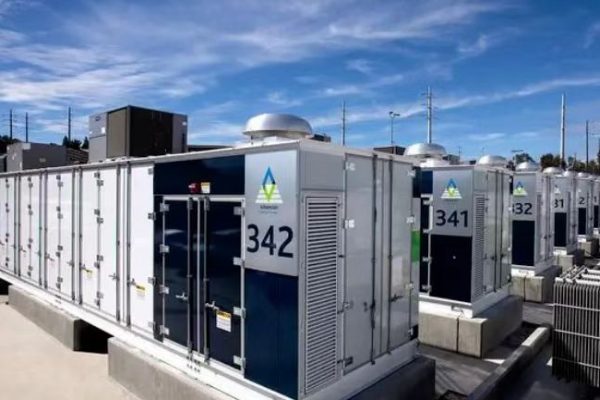
Many utility-scale and commercial BESS installations operate in environments where heat is unavoidable.
Typical examples include:
- Desert solar-plus-storage projects
- Outdoor containerized battery systems
- Industrial facilities with elevated ambient temperatures
- Tropical and subtropical regions
- Utility-scale storage plants exposed to direct sunlight
- Installations with limited ventilation around cable routing areas
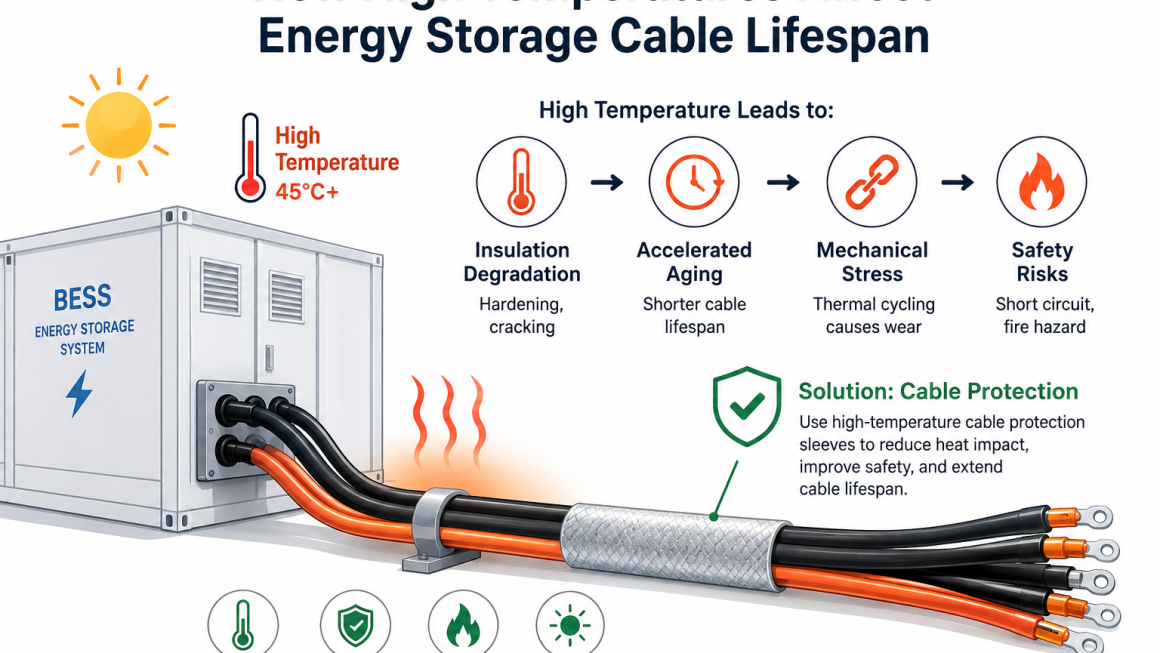
In some locations, ambient temperatures may exceed 45°C (113°F), while temperatures inside equipment enclosures can rise even higher during peak operation.
Under these conditions, cable materials experience continuous thermal aging.
How Heat Accelerates Cable Degradation
Power cables are designed to operate within specific temperature ranges. When those limits are exceeded for extended periods, the aging process accelerates.
Common effects include:
Insulation Hardening
Heat gradually changes the physical properties of polymer insulation materials.
Over time:
- Flexibility decreases
- Brittleness increases
- Cracking becomes more likely
- Electrical performance declines
As insulation quality deteriorates, the risk of leakage current and electrical faults rises.
Jacket Deterioration
The outer cable jacket acts as the first line of defense against environmental exposure.
High temperatures can cause:
- Surface cracking
- Material shrinkage
- Reduced UV resistance
- Loss of mechanical strength
Once the outer layer is compromised, cables become more vulnerable to additional environmental damage.
Increased Electrical Losses
Elevated temperatures increase conductor resistance.
Higher resistance leads to:
- Greater power losses
- Additional heat generation
- Reduced system efficiency
This creates a cycle in which rising temperatures further contribute to cable stress.
Thermal Cycling Creates Long-Term Mechanical Stress
Energy storage systems rarely operate at a constant temperature.
During charging, discharging, and standby periods, cables repeatedly heat and cool.
This process, known as thermal cycling, causes:
- Expansion and contraction of conductors
- Movement at cable connection points
- Increased strain on cable supports
- Wear at bends and routing locations
Although these changes may be small during a single cycle, years of operation can result in significant mechanical fatigue.
Safety Risks Associated with Overheated Cables
Cable degradation is not only a maintenance concern.
In severe cases, excessive heat can contribute to:
- Insulation failure
- Arc faults
- Short circuits
- Fire propagation
Because energy storage systems contain large amounts of stored electrical energy, maintaining cable integrity is a critical safety requirement.
This is particularly important in high-capacity BESS projects where downtime and safety incidents can have significant operational and financial consequences.
Extending Cable Lifespan Through Thermal Protection
The most effective approach is to address thermal risks during the design phase rather than after failures occur.
Several strategies can improve cable longevity.
Optimized Cable Routing
Proper routing can help reduce heat accumulation.
Best practices include:
- Avoiding unnecessary cable bundling
- Maintaining airflow around cable runs
- Separating cables from major heat sources
- Reducing exposure to direct solar radiation
Improved Thermal Management
System-level thermal control can reduce the temperature surrounding cable infrastructure.
Examples include:
- Ventilation systems
- Passive cooling designs
- Thermal barriers
- Reflective shielding materials
Protective Cable Sleeves
Protective sleeves provide an additional layer of defense against both thermal and mechanical stress.
Depending on application requirements, cable protection sleeves can offer:
- Heat insulation
- Radiant heat reflection
- Abrasion resistance
- Flame resistance
- UV protection
These solutions are increasingly used in modern ESS installations where reliability and long service life are essential.
Cable Protection Products for High-Temperature BESS Applications
Different operating environments require different levels of protection.
Common solutions include:
Fiberglass Insulation Sleeves
Suitable for general thermal protection and cable organization.
Key advantages:
- Lightweight
- Flexible
- Cost-effective
Aluminum Foil Fiberglass Sleeves
Designed to reduce radiant heat exposure.
Commonly used in:
- Outdoor energy storage systems
- Battery containers
- Solar-plus-storage projects
Advantages include:
- Reflective thermal barrier
- Improved temperature resistance
- Enhanced cable protection under sunlight
Silicone-Coated Fiberglass Sleeves
Used in demanding environments where higher thermal resistance is required.
Benefits include:
- Higher operating temperatures
- Improved durability
- Better environmental protection
Braided Protective Sleeves
Ideal for protecting cables against abrasion and vibration.
Often used for:
- Power cables
- Signal cables
- Control wiring
Choosing the Right ESS Cable Protection Solution
When selecting protection materials for energy storage projects, engineers should evaluate:
- Operating temperature range
- Exposure to radiant heat
- UV resistance requirements
- Mechanical wear conditions
- Flame-retardant performance
- Installation flexibility
A properly selected cable protection solution can significantly extend service life while reducing maintenance costs throughout the project lifecycle.
Heat is one of the most significant factors affecting cable reliability in Battery Energy Storage Systems.
Continuous exposure to elevated temperatures accelerates insulation aging, increases electrical losses, and creates long-term mechanical stress. Over time, these effects can shorten cable lifespan and compromise system safety.
By implementing proper thermal management practices and integrating specialized ESS cable protection products, project developers can improve reliability, enhance safety, and maximize the operational life of critical power infrastructure.
As energy storage deployments continue to expand into increasingly demanding environments, cable protection is becoming an essential component of long-term system performance.