


When comparing battery energy storage systems, buyers often focus on battery capacity, power rating, efficiency, warranty, and price. However, one technical parameter can significantly affect how much energy a battery can deliver during normal operation: Depth of Discharge (DoD).
DoD describes how much of a battery’s available capacity has been discharged relative to its reference capacity. It is closely related to State of Charge (SOC), which indicates how much energy remains in the battery.
For commercial and industrial energy storage projects, residential battery systems, and off-grid applications, understanding DoD is important for evaluating usable capacity, operating flexibility, battery life, and total cost of ownership.
A battery advertised with a capacity of 100 kWh does not necessarily provide 100 kWh of usable energy under every operating condition. The permitted operating window, system losses, reserve requirements, temperature, discharge rate, and battery management strategy all influence the energy available to the end user.
This guide explains what buyers should know about DoD, how it affects battery performance, and which questions should be asked before purchasing an energy storage system.
1. What Is Depth of Discharge (DoD)?
Depth of Discharge indicates the proportion of a battery’s reference capacity that has been discharged.
It is commonly expressed as a percentage.
For example:
- 10% DoD means 10% of the reference capacity has been discharged.
- 50% DoD means half of the reference capacity has been discharged.
- 80% DoD means 80% of the reference capacity has been discharged.
- 100% DoD means the full reference capacity has been discharged.
The relationship between DoD and State of Charge is commonly expressed as:
DoD (%) = 100% − SOC (%)
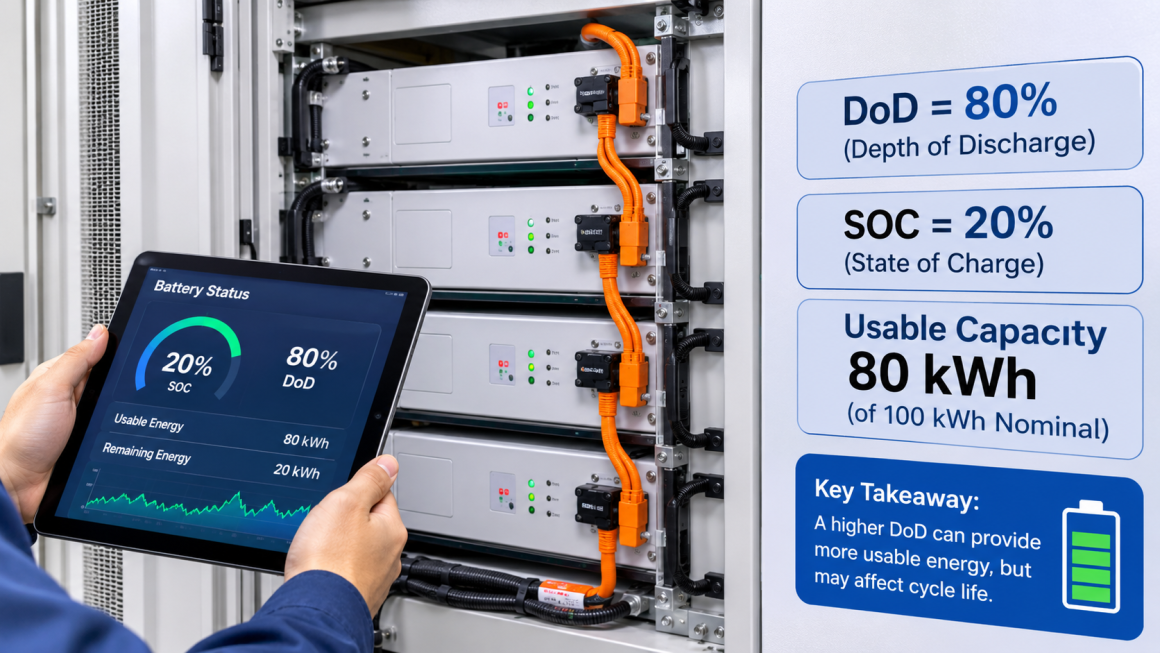
For example, if a battery starts at 100% SOC and discharges to 20% SOC, its DoD is 80%.
This relationship is useful for understanding battery operation, but buyers should remember that the SOC displayed by a battery management system may be an estimated value rather than a direct measurement of remaining energy.
The manufacturer’s SOC definition and operating limits should therefore be reviewed.
2. How to Calculate DoD
The basic DoD calculation is:
DoD (%) = Discharged Energy / Reference Battery Capacity × 100%
For example, consider a battery with a reference capacity of 100 kWh.
If it delivers 80 kWh during a discharge cycle:
DoD = 80 kWh / 100 kWh × 100% = 80%
The remaining nominal energy would be 20 kWh, assuming the capacity reference and measurement conditions are consistent.
Example: Comparing Different DoD Levels
| Reference battery capacity | Discharged energy | DoD | Remaining energy |
|---|---|---|---|
| 100 kWh | 40 kWh | 40% | 60 kWh |
| 100 kWh | 60 kWh | 60% | 40 kWh |
| 100 kWh | 80 kWh | 80% | 20 kWh |
| 100 kWh | 90 kWh | 90% | 10 kWh |
These figures illustrate the basic relationship. Actual deliverable energy may differ due to conversion losses, temperature, discharge rate, battery condition, and operating restrictions.
3. DoD vs. SOC: What Is the Difference?
DoD and SOC describe the battery’s energy condition from two different perspectives.
- SOC (State of Charge): How much charge remains relative to the defined capacity reference.
- DoD (Depth of Discharge): How much of that reference capacity has been discharged.
They are complementary indicators.
| Parameter | SOC | DoD |
|---|---|---|
| Meaning | Remaining charge proportion | Discharged capacity proportion |
| Typical reference | 100% when fully charged | 0% when fully charged |
| Example | 20% SOC | 80% DoD |
| Main use | Monitoring remaining battery charge | Evaluating discharge depth and operating limits |
For buyers, both values matter.
SOC helps operators understand when the battery needs charging. DoD helps evaluate how deeply the battery is being cycled and whether the operating strategy is consistent with the manufacturer’s recommendations.
4. Why Does DoD Matter for Battery Life?
DoD is closely related to battery degradation and cycle life.
In general, deeper discharge cycles can create greater electrochemical stress than shallower cycles, depending on battery chemistry, cell design, temperature, charging conditions, and operating current.
However, the relationship is not identical for every battery.
A battery operating at 80% DoD does not necessarily have a fixed cycle life, and it is not accurate to assume that reducing DoD by a certain percentage will always increase cycle life by a predictable amount.
Manufacturers normally specify cycle-life performance under defined test conditions.
These conditions may include:
- Battery chemistry and cell design
- Charging and discharging rates
- Operating temperature
- Charge and discharge voltage limits
- DoD range
- Rest periods between cycles
- Capacity retention threshold
- Test method and cycle definition
Buyers should compare cycle-life figures only when the underlying test conditions are sufficiently similar.
Why deeper discharge may increase battery stress
Depending on the chemistry and cell design, deeper cycling may expose the battery to a wider voltage range and greater electrochemical changes.
The impact can be influenced by:
- Electrode stress: Changes in electrode state during charging and discharging can contribute to degradation.
- Voltage limits: Operating close to the manufacturer’s lower or upper voltage limits may affect long-term performance.
- Temperature: Higher operating temperatures can accelerate several degradation mechanisms.
- Current rate: High discharge currents may increase internal heating and voltage drop.
- Operating consistency: Repeatedly using an aggressive operating window may affect long-term capacity retention.
DoD should therefore be evaluated together with temperature, C-rate, charging strategy, and the battery manufacturer’s operating recommendations.
5. What Is the Difference Between Nominal Capacity and Usable Capacity?
This is one of the most important issues for buyers.
Nominal capacity describes the rated battery capacity under specified conditions. Usable capacity refers to the energy that the system permits the user to access within its defined operating limits.
For example, a battery system may have:
- Nominal capacity: 100 kWh
- Maximum permitted DoD: 90%
- Theoretical usable DC energy within that DoD window: 90 kWh
This does not mean the system will deliver 90 kWh of AC electricity to the load.
Additional losses and restrictions may apply, including:
- Battery internal losses
- Power conversion system losses
- Auxiliary consumption
- Temperature-related derating
- Minimum SOC reserve
- Power limitations during operation
Example: Comparing Battery Capacity and Usable Energy
| Item | System A | System B |
|---|---|---|
| Nominal battery capacity | 100 kWh | 120 kWh |
| Permitted DoD | 80% | 90% |
| Theoretical usable DC energy | 80 kWh | 108 kWh |
| Conversion and system losses | Not included | Not included |
Although System B has a higher nominal capacity, buyers should still compare the complete system performance, including rated output power, efficiency, operating conditions, warranty, and actual usable energy at the point of connection.
A larger battery is not automatically the more economical choice.
6. What DoD Should Buyers Look For?
There is no single ideal DoD for every energy storage application.
The appropriate operating range depends on the battery chemistry, manufacturer specifications, system design, and project economics.
6.1 Residential energy storage
Residential users may prioritize:
- Daily energy availability
- Backup reserve
- Long-term battery life
- Quiet and reliable operation
- Compatibility with solar generation
- Warranty conditions
A system designed for daily solar self-consumption may use a different SOC strategy from one intended primarily for backup power.
6.2 Commercial and industrial BESS
Commercial and industrial projects often use batteries for:
- Peak shaving
- Load shifting
- Demand charge management
- Renewable energy integration
- Backup power
- Grid services
For these applications, the selected DoD affects the amount of energy available during each dispatch cycle.
A project designed for frequent daily cycling may need a different operating strategy from one that is mainly reserved for emergency backup.
6.3 Off-grid and remote energy systems
Off-grid systems require particular attention to reserve capacity.
The battery may need to maintain sufficient SOC to support critical loads during periods of low solar generation, poor weather, or delayed fuel supply.
In these applications, using the maximum permitted DoD at all times may not be the best operating strategy.
A reserve strategy can help maintain supply continuity.
Example: Typical DoD Evaluation by Application
| Application | Key consideration | Buyer priority |
|---|---|---|
| Residential solar storage | Daily charging and discharging | Usable energy and warranty |
| Industrial peak shaving | Repeated dispatch cycles | Lifecycle economics |
| Commercial backup | Emergency energy reserve | Reliability and availability |
| Off-grid microgrid | Variable renewable generation | Energy security |
| Telecom backup | Long standby periods and backup events | Readiness and service life |
These are application considerations, not universal recommended DoD settings. The final operating window must follow the battery manufacturer’s specifications and project requirements.
7. DoD and Battery Warranty: What Should Buyers Check?
A battery’s advertised cycle life is only meaningful when the operating conditions are understood.
For example, a manufacturer may advertise a certain number of cycles under a specified DoD, temperature, and discharge rate.
However, the warranty may define different operating restrictions or capacity-retention requirements.
Buyers should review the following items carefully.
7.1 Cycle-life test conditions
Ask the supplier:
- At what DoD was the cycle-life test conducted?
- What charging and discharging rates were used?
- At what temperature?
- What capacity retention level defines the end of life?
- Was the test conducted at cell, module, or system level?
7.2 Warranty operating window
Confirm:
- Permitted SOC range
- Maximum and minimum operating limits
- Whether continuous operation at maximum DoD is permitted
- Any temperature-related restrictions
- Any limits on annual energy throughput
- Whether the warranty specifies both time and throughput conditions
7.3 Capacity retention
A battery’s capacity gradually decreases during operation.
A warranty may specify that the battery retains a certain percentage of its initial capacity after a defined period or energy throughput.
Buyers should understand whether the stated retention level applies to the cell, battery module, DC battery system, or complete AC-connected system.
The measurement boundary matters.
8. DoD Is Not the Only Factor Affecting Battery Degradation
Buyers should avoid evaluating battery life based on DoD alone.
Several operating conditions interact.
| Factor | Possible impact | What buyers should verify |
|---|---|---|
| Temperature | High temperatures may accelerate degradation | Operating and cooling limits |
| C-rate | High current may increase heating and stress | Continuous and peak charge/discharge rates |
| SOC range | Operating window influences electrochemical conditions | Manufacturer-approved SOC limits |
| Cycle frequency | Frequent cycling affects cumulative throughput | Expected annual cycles |
| Calendar aging | Degradation occurs over time, even with limited cycling | Calendar-life warranty |
| Charging strategy | Charging behavior affects battery condition | Charge limits and control strategy |
| System design | Cooling, monitoring, and protection affect operation | Thermal management and BMS functions |
A battery may experience both cycle aging and calendar aging.
Cycle aging is associated with charging and discharging activity, while calendar aging occurs over time and is influenced by factors such as temperature and SOC.
For this reason, buyers should assess the expected operating profile rather than relying on a single cycle-life number.
9. How DoD Affects Total Cost of Ownership
A battery with a higher permitted DoD may offer more usable energy from the same nominal capacity.
This can reduce the nominal battery capacity required for a particular energy-delivery target.
However, higher usable capacity should not be considered independently from battery life and warranty.
Buyers should compare the cost of energy delivered over the expected project life.
A simplified approach is:
Lifetime Energy Throughput = Usable Energy per Cycle × Number of Equivalent Full Cycles
For example, assume a battery has 100 kWh of nominal capacity.
- At 80% DoD, theoretical usable DC energy is 80 kWh per full cycle.
- At 90% DoD, theoretical usable DC energy is 90 kWh per full cycle.
If both operating strategies had the same number of cycles, the second would deliver more energy.
But in a real project, the cycle life may differ between operating windows, and usable energy may decline as the battery ages.
A more meaningful economic comparison should consider:
- Initial system cost
- Usable energy at commissioning
- Expected capacity degradation
- Annual energy throughput
- Round-trip efficiency
- Replacement or augmentation costs
- Warranty coverage
- Maintenance and operating costs
- Electricity tariff and revenue assumptions
The buyer should compare the cost per delivered kWh over the expected service life, rather than choosing a battery solely because it advertises a higher DoD.
10. Questions Buyers Should Ask Battery Suppliers
Before purchasing an energy storage system, buyers can use the following checklist.
Technical specifications
- What is the nominal battery capacity?
- What is the guaranteed usable capacity?
- What is the maximum permitted DoD?
- What is the recommended daily operating SOC range?
- What are the minimum and maximum operating temperatures?
- What are the continuous and peak charge/discharge rates?
- Is usable capacity specified at the DC or AC side?
Battery life and warranty
- What is the cycle-life rating and its test condition?
- What capacity retention is guaranteed?
- Is there an annual energy throughput limit?
- Are there restrictions on operating at high DoD?
- What are the warranty conditions for frequent cycling?
- How is battery degradation monitored?
System operation
- Can the SOC reserve be configured?
- How does the BMS enforce operating limits?
- Can the EMS optimize the SOC window according to the application?
- How does the system respond when the battery reaches its minimum SOC?
- Is there sufficient reserve for backup or critical loads?
These questions help buyers compare products based on actual operating capability rather than marketing specifications alone.
11. Practical Example: Selecting a Battery for Daily Peak Shaving
Consider an industrial facility that requires approximately 80 kWh of usable DC battery energy for a planned peak-shaving event.
Two battery configurations are being evaluated.
| Parameter | Option A | Option B |
|---|---|---|
| Nominal capacity | 100 kWh | 100 kWh |
| Permitted DoD | 80% | 90% |
| Theoretical usable DC energy | 80 kWh | 90 kWh |
| Target energy requirement | 80 kWh | 80 kWh |
On paper, both options meet the target energy requirement within their stated DoD limits.
However, Option A operates at its maximum permitted DoD to deliver the target, while Option B has more theoretical energy available within its permitted window.
This does not automatically make Option B the better investment.
The project team should also compare:
- Cycle-life performance under the respective operating conditions
- Warranty energy throughput
- Conversion efficiency
- Battery degradation assumptions
- Available discharge power
- Operating temperature
- Future expansion requirements
If the facility requires daily peak shaving, the long-term energy throughput and warranty conditions may be more important than the initial difference in usable capacity.
This example illustrates why DoD should be considered as part of a complete system evaluation.
12. How GR-NEWenergy Supports Reliable Energy Storage Installation and O&M
Battery performance depends on cell chemistry, battery management, power conversion, thermal management, and operating strategy.
Cable protection accessories do not directly increase battery DoD, extend electrochemical cycle life, or change the battery’s rated capacity.
However, a reliable installation environment is important for the overall energy storage system.
GR-NEWenergy focuses on installation and O&M-related products that help protect and organize cable infrastructure in energy storage projects.
Depending on the application, our solutions may include:
- Braided cable sleeves for cable bundle protection
- Self-wrapping sleeves for accessible cable management
- High-temperature fiberglass sleeves for specified thermal exposure
- Aluminum foil and thermal protection materials
- Corrugated conduits for cable routing
- Cable glands and grommets for cable entry management
- Cable clamps and fastening accessories
- Replacement and retrofit protection kits
For systems operating outdoors or in demanding industrial environments, selecting suitable cable protection materials can help address mechanical abrasion, dust exposure, UV exposure, and other environmental conditions within the product’s specified performance limits.
A well-organized cable installation also makes inspection, maintenance, and replacement work easier.
Our role is to support the physical installation and maintenance side of energy storage projects, complementing the battery and power system supplied by qualified equipment manufacturers and system integrators.
Depth of Discharge is an important parameter when selecting a battery energy storage system.
It determines how much of the reference battery capacity can be used within the permitted operating window and influences the relationship between nominal capacity, usable energy, battery degradation, and project economics.
However, a higher DoD is not automatically better.
Buyers should evaluate DoD together with cycle-life test conditions, operating temperature, charge and discharge rates, SOC reserve, warranty throughput, and actual system efficiency.
The most suitable battery is not necessarily the one with the highest advertised DoD. It is the one that can meet the project’s energy and power requirements reliably and economically throughout its expected service life.
For a well-designed energy storage project, understanding DoD is an important step toward making a more informed purchasing decision.
Questions
1. What does 80% DoD mean in a battery?
An 80% DoD means that 80% of the battery’s defined reference capacity has been discharged. If the reference capacity is 100 kWh, this corresponds to 80 kWh of discharged energy under the same measurement basis.
2. Is a higher DoD always better?
No. A higher permitted DoD can provide more usable energy from the same nominal capacity, but its effect on cycle life, degradation, and warranty depends on battery chemistry, design, and operating conditions.
3. What is the relationship between DoD and SOC?
DoD and SOC are complementary indicators. Under a consistent capacity reference, DoD equals 100% minus SOC. For example, 80% DoD corresponds to 20% SOC.
4. Does DoD affect battery cycle life?
Yes. DoD is one of the factors that can influence cycle aging. Deeper cycling may increase battery stress, but the actual effect depends on chemistry, temperature, C-rate, voltage limits, and other operating conditions.
5. What is the difference between nominal capacity and usable capacity?
Nominal capacity is the rated capacity under specified conditions. Usable capacity is the energy available within the permitted operating window. System losses and reserve requirements may further reduce the energy delivered to the load.
6. What DoD should I choose for a commercial BESS?
There is no universal value. The appropriate operating range depends on the battery manufacturer’s specifications, project dispatch requirements, warranty conditions, expected cycle frequency, and economic model.
7. Does a battery reach 0% SOC at 100% DoD?
Not necessarily in the way a user may interpret the display. A manufacturer’s 100% DoD rating may refer to the full specified usable capacity window, while the BMS may retain internal voltage and safety limits. Buyers should confirm how the manufacturer defines its capacity reference and DoD.
8. Can a battery operate at maximum DoD every day?
Only if the manufacturer permits that operating strategy under the applicable conditions. Buyers should confirm cycle-life data, warranty restrictions, throughput limits, and temperature requirements before planning continuous operation at maximum DoD.
9. Does DoD affect battery efficiency?
DoD does not directly define round-trip efficiency. However, operating SOC range and discharge conditions can influence battery voltage, current, and system losses. Buyers should compare efficiency data measured under clearly defined conditions.
10. Should buyers compare DoD or cycle life first?
Both are important. DoD indicates the usable operating window, while cycle life describes durability under specified test conditions. A meaningful comparison requires both values and their associated test and warranty conditions.
Q: What is Depth of Discharge (DoD) in a battery?
A: Depth of Discharge is the percentage of a battery’s reference capacity that has been discharged. An 80% DoD means that 80% of the defined reference capacity has been used.
Q: How does DoD affect battery life?
A: DoD is one of several factors affecting battery degradation. Deeper cycling may increase electrochemical stress, but the actual impact depends on battery chemistry, temperature, charging and discharging rates, voltage limits, and operating strategy.
Q: What is the difference between battery DoD and SOC?
A: SOC indicates the remaining charge, while DoD indicates the discharged proportion. Under a consistent reference, 80% DoD corresponds to 20% SOC.
Q: Is a battery with 100% DoD better than one with 80% DoD?
A: Not necessarily. A higher permitted DoD can provide more usable energy, but buyers should also compare cycle life, warranty throughput, temperature limits, system efficiency, and total lifecycle cost.
Q: How should buyers compare usable battery capacity?
A: Buyers should compare nominal capacity, permitted DoD, guaranteed usable DC energy, AC energy delivered to the load, conversion losses, reserve settings, and the conditions under which the capacity is specified.
Q: What should buyers check in a BESS warranty?
A: Important items include cycle-life test conditions, capacity retention, permitted SOC range, temperature limits, annual energy throughput, operating restrictions, and warranty duration.