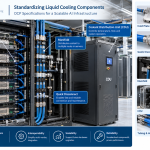

As AI workloads continue to increase computing power density, liquid cooling is becoming a critical part of modern data center infrastructure.
High-performance GPUs, AI accelerators, and densely populated server racks generate substantial heat. Traditional air cooling may become increasingly difficult to implement efficiently at higher rack power densities, making direct-to-chip liquid cooling an important option for next-generation AI data centers.
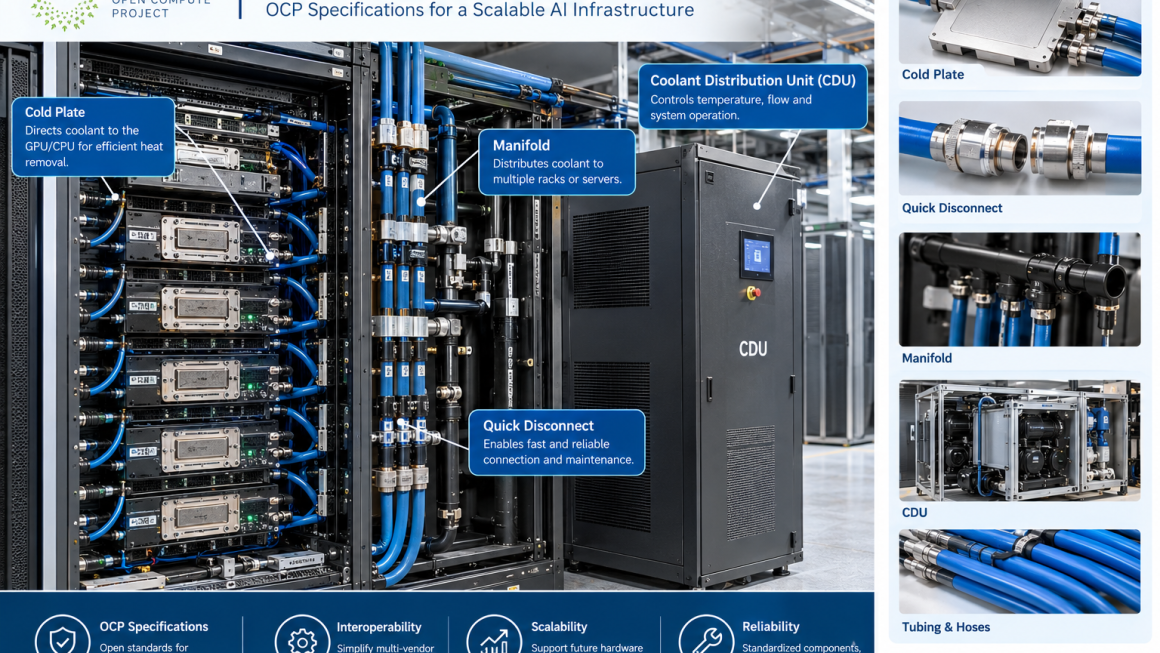
However, deploying liquid cooling at scale involves more than selecting a cold plate or a coolant distribution unit (CDU). The entire cooling loop must work as an integrated system, including cold plates, tubing, manifolds, quick disconnects, coolant distribution equipment, sensors, and control interfaces.
This is where the Open Compute Project (OCP) liquid cooling specifications become relevant.
OCP provides an open collaboration framework for developing technical specifications, interface recommendations, design guidance, and best practices that help the industry address liquid cooling integration challenges.
For data center operators, system integrators, and infrastructure suppliers, standardization can help reduce integration complexity, improve interoperability, and support more scalable deployment strategies.
The key question is not simply whether a liquid cooling component meets a particular specification.
It is whether the component can operate reliably within the complete cooling architecture.
What Is OCP Liquid Cooling Standardization?
The Open Compute Project is an industry initiative that develops and shares open data center hardware designs, specifications, and engineering practices.
Within OCP, the Cooling Environments Project addresses advanced cooling technologies, including cold-plate cooling, coolant distribution units, immersion cooling, door heat exchangers, and heat reuse.
Its cold-plate workstream covers technical requirements and recommendations across the technology cooling system, from cold plates to CDUs, including tubing, manifolds, and quick disconnects.
The objective is to support an open ecosystem in which components from different suppliers can be evaluated against common technical requirements.
For liquid cooling, standardization can address several areas:
- Mechanical and fluid connection interfaces
- Component dimensions and integration requirements
- Coolant compatibility
- Operating conditions and performance requirements
- Installation and maintenance procedures
- Reliability and system integration risks
These areas are particularly important for AI infrastructure, where hardware generations, rack architectures, and cooling requirements can change rapidly.
Why Standardization Matters for AI Data Centers
1. Reducing Multi-Vendor Integration Complexity
A large AI data center may involve server manufacturers, rack suppliers, CDU manufacturers, piping contractors, and cooling component suppliers.
Without clearly defined interfaces and requirements, each integration can require additional engineering work.
For example, a cold plate may meet the thermal requirements of a processor but still be unsuitable for a particular installation because of its connection geometry, pressure-drop characteristics, coolant compatibility, or mechanical clearance.
Standardized interfaces and documented performance requirements can make these differences easier to identify before procurement and installation.
The result is a more structured process for evaluating multi-vendor equipment.
2. Supporting Scalable Rack Deployment
AI data centers rarely remain static. Operators may add racks, replace servers, increase accelerator density, or deploy new hardware generations.
Standardized component interfaces can simplify these changes by reducing the number of custom adaptations required between compatible components.
For example, a facility may seek to reuse an existing coolant distribution architecture while introducing a new generation of liquid-cooled servers.
Whether this is possible depends on the actual interface, hydraulic, thermal, and control requirements. Nevertheless, standardization provides a common basis for evaluating the proposed upgrade.
3. Improving Serviceability
Liquid cooling introduces maintenance requirements that differ from conventional air-cooled infrastructure.
Technicians may need to isolate cooling circuits, disconnect liquid lines, replace components, inspect seals, and restore the system to service.
Well-defined connection interfaces and service procedures can help reduce installation errors and simplify component replacement.
However, standardization alone does not eliminate leakage risk. Correct installation, compatible materials, appropriate pressure ratings, and verified maintenance procedures remain essential.
Key Liquid Cooling Components Covered by OCP Workstreams
OCP’s cooling-related work addresses multiple components and integration layers. The following are important areas for infrastructure designers and procurement teams to evaluate.
1. Cold Plates
Cold plates transfer heat from processors, GPUs, or other heat-generating components into a circulating coolant.
Their performance depends on factors such as:
- Thermal resistance
- Heat transfer capacity
- Coolant flow rate
- Pressure drop
- Internal channel design
- Coolant properties
- Mechanical mounting and contact quality
For AI accelerators, cold plate selection must reflect the actual thermal load and operating conditions of the target hardware.
A cold plate that performs well in one configuration cannot automatically be assumed to deliver the same performance in another.
OCP’s cold-plate work provides a framework for developing common requirements and technical guidance across this component category.
2. Quick Disconnects and Liquid Connectors
Quick disconnects (QDs) allow liquid cooling circuits to be connected and disconnected during installation, servicing, or hardware replacement.
Their importance increases as rack density rises and maintenance windows become more demanding.
Key selection considerations include:
- Connection compatibility
- Flow capacity
- Pressure rating
- Leakage performance
- Pressure drop
- Coolant compatibility
- Connection and disconnection forces
- Expected service life
Blind-mate connectors may also be used where components need to connect automatically during rack or server installation.
However, different quick-disconnect designs are not automatically interchangeable. Buyers should verify the exact specification revision, connector type, dimensional requirements, and approved operating conditions.
3. Tubing and Manifolds
Tubing transports coolant between system components, while manifolds distribute coolant to multiple cold plates or cooling branches.
Their design influences hydraulic balance, installation flexibility, serviceability, and system pressure drop.
Important considerations include:
- Internal diameter
- Flow capacity
- Pressure and temperature ratings
- Coolant compatibility
- Bending radius
- Mechanical support
- Leak resistance
- Branch-flow distribution
In high-density AI racks, an unsuitable tubing or manifold design can create uneven flow distribution or excessive pressure losses.
Standardized design requirements can help system integrators compare components and evaluate how they will perform within the complete loop.
4. Coolant Distribution Units (CDUs)
A CDU transfers heat between the technology cooling system (TCS) and the facility cooling system (FCS), according to the system architecture.
Depending on the design, a CDU may control coolant flow, monitor temperatures, manage pressure, and provide operational data to the wider facility.
Selection criteria can include:
- Cooling capacity
- Flow rate
- Pressure-drop characteristics
- Supply and return temperatures
- Heat exchanger performance
- Pump configuration
- Control and monitoring interfaces
- Redundancy requirements
- Maintenance access
A CDU should not be selected solely on its advertised cooling capacity.
Its operating envelope must match the actual rack requirements and facility-side cooling conditions.
5. Coolant and Wetted Materials
Coolant selection is an important part of liquid cooling system design.
Different coolant formulations may have different thermal properties, viscosity, corrosion behavior, and material compatibility.
The fluid must be suitable for the cold plates, tubing, connectors, seals, pumps, and other wetted components.
Procurement teams should verify:
- Approved coolant formulation
- Operating temperature range
- Viscosity over the operating range
- Corrosion-control requirements
- Compatibility with wetted materials
- Fluid cleanliness requirements
- Maintenance and replacement procedures
A component’s mechanical compatibility does not guarantee chemical compatibility with the selected coolant.
For this reason, coolant and wetted-material requirements should be reviewed at the system level.
Standardization Does Not Automatically Mean Interchangeability
One of the most important distinctions in OCP-based liquid cooling design is the difference between standardization and complete interoperability.
A component may conform to a particular interface specification while still having operating limits that differ from those of another component.
For example, two liquid connectors may have compatible connection geometry but different pressure ratings, flow characteristics, sealing materials, or approved coolant conditions.
Likewise, two CDUs may use compatible monitoring interfaces while having different cooling capacities or hydraulic operating ranges.
Before approving a component substitution, engineering teams should verify three levels of compatibility.
Mechanical compatibility: Do the dimensions, mounting arrangements, and connection interfaces match?
Fluid and thermal compatibility: Are the coolant, flow rate, pressure, temperature, and heat-transfer requirements satisfied?
Operational compatibility: Can the component communicate with the control system and operate within the required fault, monitoring, and maintenance procedures?
Only when the relevant requirements have been checked should components be treated as suitable for integration.
How to Evaluate OCP Specifications During Procurement
A practical procurement process should begin with the system requirements rather than with a list of individual components.
Step 1: Define the Cooling Architecture
Identify whether the project uses direct-to-chip cooling, immersion cooling, rear-door heat exchangers, or a hybrid configuration.
Different cooling approaches require different components and integration methods.
Step 2: Establish Thermal and Hydraulic Requirements
Document the expected heat load, coolant supply and return temperatures, flow requirements, allowable pressure drop, and operating pressure.
These parameters should be based on the actual IT equipment and facility design.
Step 3: Identify Applicable Specifications
Review the relevant OCP documents for the target component and system architecture.
Check the document title, revision, publication status, and scope. Do not assume that every OCP workstream has a finalized specification for every component.
Step 4: Verify Component-Level Compliance
Request technical documentation from suppliers, including applicable interface drawings, performance data, material information, and test results.
Where a supplier claims compliance, clarify which requirements have been verified and how that verification was performed.
Step 5: Validate System-Level Integration
Evaluate the complete cooling loop, including connectors, hoses, manifolds, cold plates, CDUs, controls, and facility interfaces.
A component-level compliance statement is not a substitute for system integration testing.
Step 6: Confirm Maintenance and Replacement Procedures
Document isolation, draining where required, connection and disconnection, leak inspection, coolant replenishment, and post-maintenance verification procedures.
This is especially important for facilities that require rapid server replacement and predictable maintenance windows.
A Practical OCP Liquid Cooling Evaluation Checklist
| Evaluation Area | What to Verify |
|---|---|
| Specification scope | Applicable OCP document and revision |
| Mechanical interfaces | Dimensions, mounting, and connection geometry |
| Thermal performance | Heat load and operating temperature range |
| Hydraulic performance | Flow rate and pressure drop |
| Pressure rating | Maximum permitted operating conditions |
| Coolant compatibility | Approved fluid and wetted materials |
| Quick disconnects | Connection type and leakage performance |
| Tubing and manifolds | Routing, support, flow distribution, and service access |
| CDU integration | Cooling capacity, controls, and facility interfaces |
| Monitoring | Temperature, pressure, flow, and leak detection where required |
| Reliability | Applicable qualification and test evidence |
| Maintenance | Isolation, replacement, and recovery procedures |
| Interoperability | Verified compatibility across the complete system |
The checklist should be adapted to the selected architecture and the requirements of the individual project.
The Role of Standardization in Future AI Infrastructure
As AI server platforms evolve, liquid cooling infrastructure must accommodate higher thermal loads, changing rack configurations, and more complex operating requirements.
Open specifications can help suppliers develop compatible product families and allow operators to evaluate alternatives more systematically.
The benefits extend beyond the initial installation.
A well-documented, standards-oriented cooling architecture can support:
- More predictable procurement
- Easier component qualification
- Reduced custom integration work
- More structured maintenance procedures
- Better planning for future upgrades
- Improved coordination between IT and facility teams
However, standardization is only one part of the solution. Thermal engineering, hydraulic design, material selection, manufacturing quality, commissioning, and preventive maintenance remain essential.
Standardizing liquid cooling components through the Open Compute Project helps address one of the key challenges in AI data center infrastructure: integrating multiple components and suppliers into a reliable, scalable cooling system.
Cold plates, quick disconnects, tubing, manifolds, CDUs, coolants, and associated interfaces all contribute to overall system performance.
OCP specifications and technical guidance can provide a common framework for evaluating these components, but they do not automatically guarantee that every compliant component will work with every other component.
For data center operators, integrators, and procurement teams, the most effective approach is to combine applicable OCP specifications, component-level verification, system-level compatibility testing, and clearly documented maintenance procedures.
The objective is not merely to standardize individual parts.
It is to build a liquid cooling ecosystem that can support reliable operation, multi-vendor integration, and future AI infrastructure upgrades.