



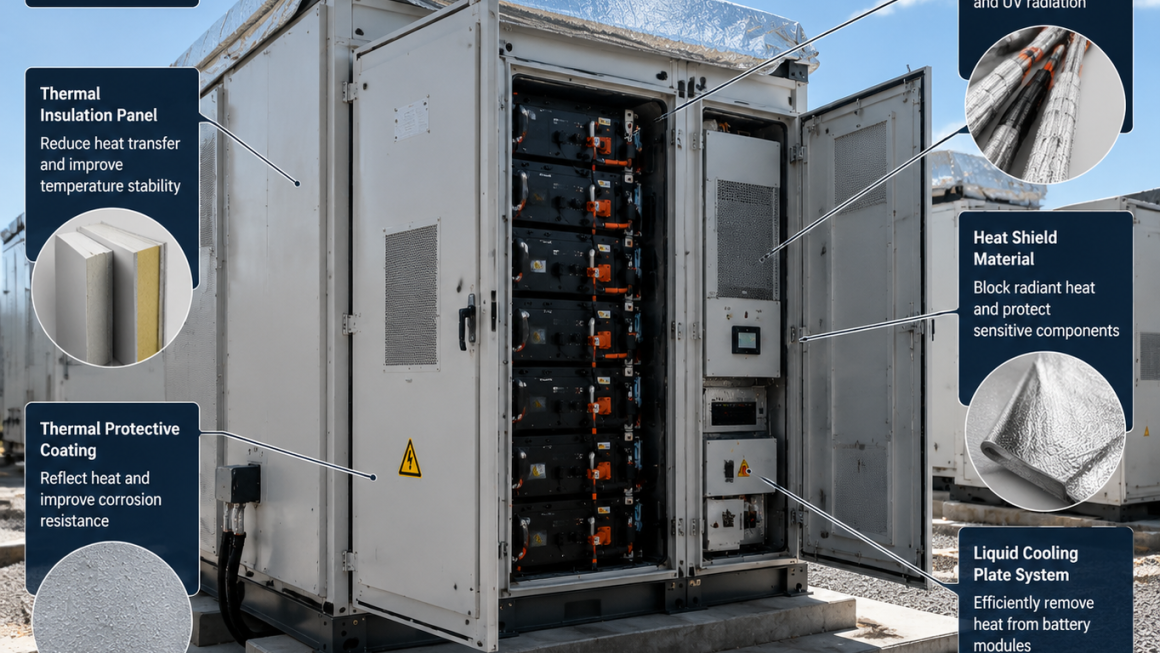
Thermal Protection in Outdoor BESS Requires a Product-Level Approach
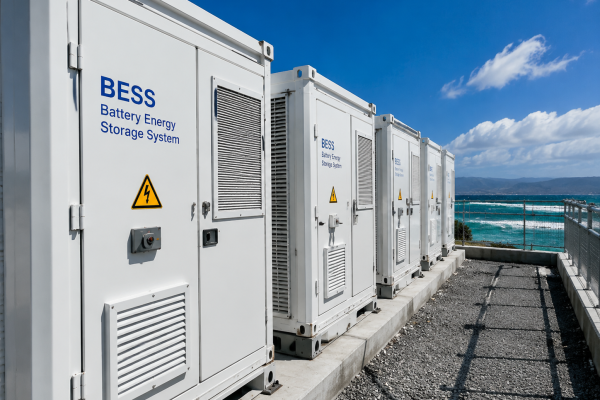
Outdoor Battery Energy Storage Systems (BESS) operate under challenging environmental conditions.
Unlike indoor installations, outdoor systems must continuously manage:
- Solar radiation
- High ambient temperatures
- Temperature cycling
- Dust exposure
- Humidity
- Wind and rain
Excessive heat can reduce battery performance, accelerate component aging, and increase cooling requirements.
However, there is no single thermal protection product that can solve every challenge.
The most effective approach is a combination of different thermal protection products designed for specific heat sources and environmental conditions.
What Are the Main Heat Sources in Outdoor BESS?
Before selecting thermal protection products, engineers need to understand where heat comes from.
Solar Heat Exposure
Outdoor containers and cabinets absorb significant heat from sunlight.
Surface temperatures can become much higher than ambient air temperature, especially in hot climates.
Internal Heat Generation
BESS components generate heat during operation:
- Battery cells
- PCS systems
- Power electronics
- Cables
- Cooling equipment
Heat Accumulation
Poor ventilation or insufficient thermal design may cause heat to accumulate inside enclosures.
This can increase:
- Cooling workload
- Energy consumption
- Component stress
Product Solution 1: Reflective Thermal Protection Covers
How They Work
Reflective covers reduce solar heat absorption by reflecting infrared radiation away from the equipment surface.
Typical structures include:
- Aluminum reflective layers
- Fiberglass insulation layers
- UV-resistant outer coatings
Advantages
- Reduce external heat gain
- Passive operation
- No additional energy consumption
- Easy installation and retrofit
Applications
Suitable for:
- Outdoor BESS containers
- Battery cabinets
- PCS enclosures
- Remote energy storage sites
Product Solution 2: Thermal Insulation Panels
How They Work
Thermal insulation materials reduce heat transfer between the external environment and internal equipment.
Common materials include:
- Aerogel insulation
- Ceramic fiber materials
- Composite insulation boards
- High-temperature polymer insulation
Advantages
- Reduce heat transfer
- Improve temperature stability
- Support extreme climate applications
Applications
Used in:
- Container walls
- Battery compartments
- High-temperature zones
Product Solution 3: Cable Thermal Protection Sleeves
Why Cable Protection Is Important
Cables are often exposed to:
- Direct sunlight
- High ambient temperatures
- Hot equipment surfaces
Cable overheating may accelerate insulation aging.
Common Cable Protection Products
Fiberglass Sleeves
Features:
- High-temperature resistance
- Flame resistance
- Mechanical protection
Aluminum Foil Fiberglass Sleeves
Features:
- Infrared reflection
- Heat shielding
- UV resistance
Suitable for outdoor exposed cable assemblies.
PET Braided Sleeves
Features:
- Flexible installation
- Abrasion protection
- Lightweight design
Product Solution 4: Thermal Shield Materials
Thermal shields create a barrier between heat sources and sensitive components.
Applications include:
- PCS protection
- Battery module separation
- High-temperature areas
Materials may include:
- Aluminum heat shields
- Ceramic insulation layers
- Composite thermal barriers
Advantages
- Localized heat protection
- Lightweight design
- Easy integration
Product Solution 5: Liquid Cooling Systems and Cooling Plates
Passive protection cannot remove internally generated heat.
For high-power BESS applications, active cooling becomes necessary.
Liquid Cooling Products Include:
- Aluminum cooling plates
- Cooling manifolds
- Quick disconnect couplings
- Fluid connectors
- Heat exchangers
Advantages
- High heat transfer efficiency
- Uniform temperature control
- Supports high energy density systems
Product Solution 6: Thermal Protective Coatings
Surface coatings provide another layer of protection.
Common coating functions include:
- Heat reflection
- UV resistance
- Corrosion protection
Applications
Used on:
- Metal enclosures
- Aluminum structures
- Outdoor components
Product Solution 7: Ventilation and Enclosure Thermal Design
The enclosure itself is also a thermal protection product.
Important design elements include:
- Airflow channels
- Heat dissipation structures
- Ventilation openings
- Pressure control systems
Comparing Different Thermal Protection Products
| Product | Main Function | Best Application |
|---|---|---|
| Reflective Cover | Reduce solar heat absorption | Outdoor containers |
| Insulation Panel | Reduce heat transfer | Battery compartments |
| Cable Sleeve | Protect cables from heat | Outdoor cable routing |
| Heat Shield | Local heat isolation | PCS and hot zones |
| Liquid Cooling Plate | Remove internal heat | High-power ESS |
| Thermal Coating | Surface protection | Cabinets and structures |
| Ventilation Design | Improve heat removal | Complete systems |
How to Select the Right Thermal Protection Solution?
The best product depends on:
Climate Conditions
Examples:
- Desert → Heat reflection + insulation
- Coastal → Heat protection + corrosion resistance
- Tropical → Heat + humidity protection
System Power Density
Higher power systems require:
- Liquid cooling
- Advanced thermal materials
- Better heat dissipation
Installation Environment
Different applications require different solutions:
- Utility-scale BESS
- Commercial ESS
- Industrial microgrids
- Remote renewable projects
The Future of Outdoor BESS Thermal Protection
Future thermal protection products will focus on:
- Multi-functional materials
- Lightweight composite structures
- Thermal and corrosion combined protection
- Smart temperature monitoring
- Passive cooling technologies
The goal is not simply to block heat, but to create a complete environmental protection system.
The best thermal protection method for outdoor energy storage systems is not a single product.
A reliable solution combines:
- Reflective covers for solar protection
- Insulation materials for heat reduction
- Cable sleeves for component protection
- Thermal shields for localized heat control
- Liquid cooling systems for internal heat removal
- Protective coatings for long-term durability
By selecting the right combination of products according to climate, system design, and operating conditions, outdoor BESS installations can achieve higher reliability, longer service life, and lower maintenance requirements.