
Payment terms are often one of the most sensitive issues in international B2B projects.
Clients naturally want flexible payment terms, lower upfront commitments, and greater protection before making payment. Suppliers, on the other hand, need sufficient financial security to purchase materials, reserve production capacity, manufacture customized products, and manage logistics.
This creates a practical challenge:
How can suppliers accommodate reasonable client payment demands without taking on excessive financial and operational risk?
The answer is not simply to require full payment in advance or to accept every customer request.
A more sustainable approach is to design payment terms around project risk, production stage, customization level, and mutual commitments.
Why Payment Terms Matter in Industrial Projects
For standard products, payment risk may be relatively easy to manage.
For customized industrial components, energy storage accessories, cable protection systems, thermal protection products, and other project-specific materials, the situation can be very different.
Before shipment, a supplier may already have incurred costs for:
- Raw materials
- Custom tooling
- Engineering work
- Prototype production
- Testing
- Special packaging
- Production capacity reservation
- Quality inspection
- Export documentation
Once these costs have been incurred, recovering the investment may be difficult if the customer changes specifications, delays the project, or cancels the order.
Payment terms therefore need to reflect the actual commercial risk of the project.
Client Payment Demands vs. Supplier Security
The two sides often have different priorities.
| Client Perspective | Supplier Perspective |
|---|---|
| Minimize upfront payment | Secure production costs |
| Pay after inspection | Avoid manufacturing without payment security |
| Reduce financial exposure | Recover material and production costs |
| Maintain cash flow | Maintain working capital |
| Request credit terms | Control credit risk |
| Confirm product quality first | Avoid customized inventory risk |
Neither side’s concern is inherently unreasonable.
The objective should be to create a structure in which both parties have appropriate protection at each stage of the transaction.
A Payment Structure Should Follow Project Risk
One of the most practical principles in B2B payment management is:
The higher the supplier’s irreversible cost, the stronger the payment protection should be.
For example, a standard product that can easily be resold may require less payment protection than a highly customized component manufactured specifically for one customer.
A project involving:
- Custom dimensions
- Special materials
- Non-standard tolerances
- Customized surface treatment
- Customer-specific tooling
- Special packaging
may require a different payment structure from a standard stock item.
This is why payment terms should not be determined only by the customer’s preferred method.
Common B2B Payment Structures
Several payment structures can be used depending on the project.
1. Full Payment Before Production
This structure provides the highest level of supplier payment security.
It can be appropriate for:
- Small orders
- Customized products
- Special materials
- First-time customers
- Low-resale-value products
The disadvantage for the customer is the higher upfront financial commitment.
2. Deposit + Balance Before Shipment
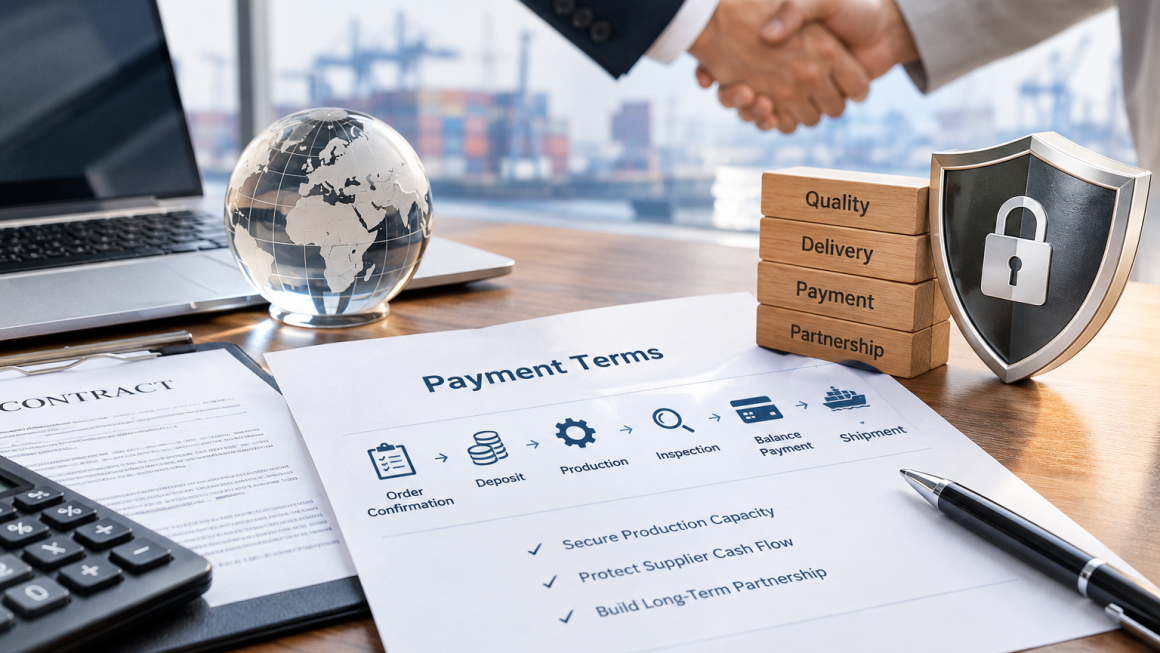
A deposit is paid when the order is confirmed, with the remaining balance paid after production and before shipment.
For example:
Order confirmation → Deposit → Production → Inspection → Balance → Shipment
This structure creates a reasonable link between the customer’s payment and the supplier’s production commitment.
It is commonly suitable for customized industrial products and project-based orders.
3. Deposit + Balance After Inspection
In some projects, the customer may require inspection or approval before making the final payment.
A possible structure is:
Deposit → Production → Inspection → Approval → Balance → Shipment
This gives the customer greater confidence in product conformity while still providing the supplier with protection through the initial deposit.
The inspection criteria should be clearly defined before production begins.
4. Milestone-Based Payment
For larger projects, payment can be linked to clearly defined project milestones.
For example:
Contract signing → Engineering → Prototype → Validation → Pilot production → Final production
Each stage can have a corresponding payment.
This structure can be particularly useful when the project involves significant engineering or development work.
Payment Security Is More Than a Deposit
A deposit alone does not solve every commercial risk.
A strong B2B transaction should establish several layers of protection.
These may include:
Purchase Order
The customer’s formal purchase order establishes the commercial commitment.
Proforma Invoice
The PI confirms:
- Product specification
- Quantity
- Price
- Incoterms
- Payment terms
- Delivery conditions
Technical Confirmation
Specifications should be confirmed before production.
This may include:
- Dimensions
- Material grade
- Tolerances
- Surface treatment
- Packaging
- Testing requirements
Approval of Samples
For customized products, an approved sample can significantly reduce disputes later.
Inspection Procedure
Both parties should understand:
- What will be inspected
- When inspection occurs
- Which standards apply
- What constitutes acceptance
Shipping Documentation
The supplier should provide the agreed documentation before or together with shipment.
These mechanisms create a commercial framework that reduces uncertainty for both sides.
Why “Pay After Delivery” Can Be Difficult for Suppliers
Customers sometimes request:
“We will pay after receiving the goods.”
From the customer’s perspective, this reduces financial risk.
For a supplier, however, the situation can be very different.
The supplier may already have paid for:
- Raw materials
- Labor
- Manufacturing
- Packaging
- Domestic transportation
- Export processing
If the customer receives the goods before payment, the supplier may effectively finance the transaction.
For large companies with established credit arrangements, this may be manageable.
For smaller specialized manufacturers, however, repeated unpaid or delayed invoices can create significant working-capital pressure.
Therefore, payment-after-delivery should be evaluated based on the customer’s creditworthiness, order size, project history, and contractual protection.
How to Respond to a Client Request for Better Payment Terms
Instead of simply rejecting the customer’s request, suppliers can restructure the transaction.
For example, if a customer requests:
100% payment after delivery
the supplier could propose:
30% deposit → Production → Inspection → 70% before shipment
Or for a larger project:
20% contract payment → 30% after prototype approval → 30% after production → 20% before shipment
The exact percentages should be determined according to the project’s risk rather than treated as a universal formula.
This approach changes the conversation from:
“We cannot accept your payment terms.”
to:
“How can we structure the payment milestones so that both sides are adequately protected?”
Use Inspection to Reduce Customer Payment Concerns
One reason customers request delayed payment is often uncertainty about product quality.
Instead of transferring all quality risk to the payment terms, suppliers can introduce stronger verification procedures.
For example:
- Confirm technical specifications
- Produce a sample
- Conduct dimensional inspection
- Provide material certificates
- Provide test reports where applicable
- Obtain sample approval
- Start batch production
- Conduct final inspection
- Share inspection documentation
- Arrange shipment after payment
This gives the customer greater visibility while protecting the supplier from producing a large customized order without sufficient commitment.
Payment Terms and Trust Should Develop Together
A first transaction does not necessarily need to use the same payment structure as a long-term relationship.
For example:
First Order
More conservative payment terms may be appropriate.
Sample Stage
The customer evaluates quality, communication, documentation, and delivery performance.
Pilot Order
Both sides gain more information about actual project execution.
Repeat Orders
If the relationship develops successfully, the parties may consider more flexible payment arrangements.
This creates a gradual transition:
Trust → Transaction history → Risk reduction → Greater payment flexibility
Rather than giving substantial credit before a commercial relationship has been established.
Protecting Both Sides Through Clear Contracts
Payment terms should be clearly stated in the commercial documents.
Important points include:
- Payment percentage
- Payment timing
- Currency
- Bank charges
- Production start conditions
- Inspection conditions
- Shipping conditions
- Cancellation terms
- Change-order procedures
- Delivery responsibilities
- Late-payment consequences
For customized products, the agreement should also clarify what happens if the customer changes specifications after production has started.
This is particularly important because customized inventory may have limited resale value.
Payment Security for International B2B Transactions
International transactions introduce additional considerations.
Suppliers and customers should clarify:
- Incoterms
- Currency risk
- Bank transfer procedures
- Export documentation
- Customs responsibilities
- Insurance
- Freight arrangements
- Sanctions and compliance requirements where applicable
For larger transactions, companies may also consider financial instruments such as letters of credit, bank guarantees, trade credit insurance, or other structured payment mechanisms, depending on the countries and financial institutions involved.
The appropriate mechanism depends on transaction size, cost, banking arrangements, and commercial risk.
A Practical Payment Risk Assessment
Before agreeing to unusual payment terms, suppliers can evaluate several factors.
Customer Risk
- Is this a new or existing customer?
- Does the customer have an established purchasing history?
- Is the buyer a manufacturer, distributor, contractor, or trading company?
- Is the customer requesting credit for a small or large order?
Product Risk
- Is the product standard or customized?
- Can it be resold?
- Does it require special raw materials?
- Is custom tooling required?
Project Risk
- Is the project already approved?
- Is the order a sample, pilot, or production order?
- Are specifications finalized?
- Is the delivery schedule confirmed?
Financial Risk
- How much working capital must the supplier commit?
- How long will the supplier’s money be tied up?
- What happens if payment is delayed?
This creates a more objective basis for deciding payment terms.
A Simple B2B Payment Decision Framework
A practical approach can be summarized as:
Low product risk + established customer → More flexible terms may be possible
High customization + new customer → Stronger upfront payment protection
Large project + multiple milestones → Milestone-based payment
Quality uncertainty → Sample approval and inspection before final payment
High financial exposure → Consider additional payment security
The key is to match payment conditions with actual transaction risk.
Payment Security Should Not Damage Customer Relationships
Payment protection is important, but it should not become unnecessarily confrontational.
A professional supplier can explain:
“Our payment structure is designed around the material and production commitment required for this project. We are happy to discuss milestone payments that give your team greater visibility while allowing us to secure production and delivery.”
This type of communication emphasizes risk sharing rather than distrust.
The goal is not to make the customer carry all the risk.
The goal is to prevent either party from carrying an unreasonable level of risk.
Balancing client payment demands with supplier security is an important part of sustainable B2B project management.
The most effective payment structure is rarely simply “payment in advance” or “payment after delivery.”
Instead, it should reflect:
- Customer relationship
- Product customization
- Production cost
- Project stage
- Inspection requirements
- Order value
- Working-capital exposure
- International trade conditions
A well-designed payment structure can protect supplier cash flow while giving customers greater confidence and transparency.
Ultimately, the strongest B2B relationships are built when payment terms, quality assurance, production commitments, and project milestones are aligned from the beginning.
The objective is not to eliminate commercial risk.
It is to allocate risk fairly, transparently, and proportionally between both parties.