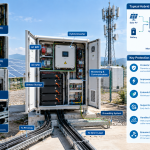
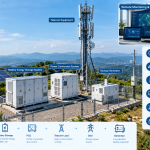
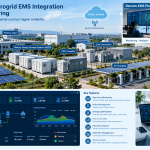
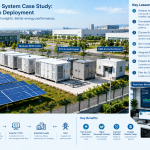
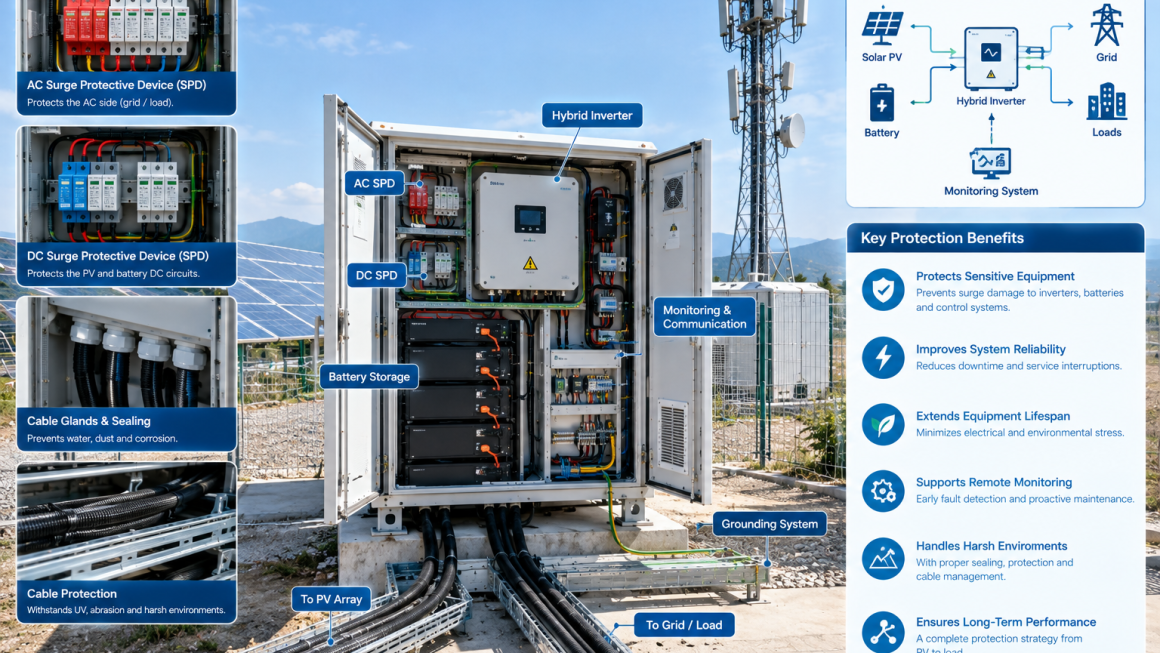
Hybrid inverters sit at the center of many modern energy systems, connecting photovoltaic generation, battery storage, the utility grid, and electrical loads within a single architecture. Because they connect multiple electrical domains, they can also become particularly exposed to transient overvoltage.
Lightning strikes, switching operations, grid disturbances, motor loads, long cable runs, and even nearby electrical events can generate voltage surges that travel through AC or DC wiring. If these transients are not properly controlled, they can damage sensitive inverter electronics, communication interfaces, sensors, battery-related equipment, and other connected components.
For hybrid PV and energy storage systems, surge protection should therefore be treated as part of the overall system reliability strategy rather than as an optional accessory.
This article explains how surge protection works around hybrid inverters, where surge protective devices (SPDs) are typically installed, how AC and DC protection differ, and what installation factors should be considered for long-term energy storage reliability.
1. Why Hybrid Inverters Need Surge Protection
A hybrid inverter may simultaneously connect:
- PV arrays
- Battery energy storage
- Utility grid
- Backup generators
- AC loads
- Communication networks
- Monitoring and control equipment
This creates several possible pathways through which transient overvoltage can enter the system.
For example, a typical hybrid energy system may look like:
PV Array → DC Protection → Hybrid Inverter → AC Protection → Distribution → Loads
while the battery is connected directly to the inverter through a separate DC circuit.
A surge entering through any of these interfaces can potentially propagate into the inverter.
The risk is particularly important because modern hybrid inverters contain power semiconductor devices, control boards, communication interfaces, sensors, and switching electronics. These components can be sensitive to high-voltage transients even when the surge duration is extremely short.
The objective of surge protection is not necessarily to eliminate every transient. Instead, the protection system should provide a controlled path for excessive transient energy while limiting the voltage that reaches sensitive equipment.
2. What Causes Surges in Hybrid Energy Systems?
Surges can originate from several different sources.
2.1 Lightning
Lightning is one of the most significant surge sources for outdoor PV and energy storage installations.
A direct lightning strike is an extreme event, but direct strikes are not the only concern.
A nearby lightning strike can induce transient voltages into:
- PV cables
- AC cables
- grounding conductors
- communication cables
- metallic structures
Large PV arrays installed on rooftops, open fields, commercial buildings, and remote facilities can therefore have significant exposure to lightning-induced transients.
2.2 Utility Grid Switching
Not all surges are caused by lightning.
Utility networks routinely perform switching operations involving:
- Transformers
- Circuit breakers
- Capacitor banks
- Large industrial loads
- Distribution equipment
These operations can produce transient overvoltages that travel through the AC connection into the inverter.
For grid-connected hybrid systems, AC-side surge protection is therefore important even when the installation is not located in a particularly lightning-prone area.
2.3 Motor and Industrial Loads
Large motors, pumps, compressors, HVAC systems, and other inductive loads can generate switching transients.
This becomes particularly relevant in commercial and industrial energy storage systems where the inverter may share an electrical network with high-power equipment.
A system can therefore experience repeated smaller transients rather than one large event.
Over time, repeated electrical stress may contribute to equipment degradation.
2.4 Long Cable Runs
Cable length can significantly influence surge behavior.
Large solar farms, telecom sites, microgrids, and distributed energy systems may have long DC or AC cable routes.
Long conductors can:
- increase inductive effects
- create additional coupling paths
- increase exposure to induced transients
- complicate equipotential bonding
The longer the cable route, the more important coordinated surge protection becomes.
3. Where Should Surge Protection Be Installed?
Surge protection should be considered at the interfaces where external electrical circuits enter sensitive equipment.
A simplified hybrid system may contain several protection zones:
PV Array → DC SPD → Hybrid Inverter ← Battery
Grid → AC SPD → Hybrid Inverter → AC Loads
Additional SPDs may be required depending on the communication architecture and installation environment.
The exact configuration depends on system voltage, grounding arrangement, cable length, local electrical standards, lightning protection design, and equipment manufacturer requirements.
The important principle is to protect each relevant interface rather than assuming that one SPD somewhere in the system protects everything.
4. DC Surge Protection on the PV Side
The PV side is one of the most important areas for surge protection.
Solar modules are typically installed outdoors and may be exposed to:
- Lightning
- Rain
- UV radiation
- Temperature cycling
- Long cable runs
- Electromagnetic coupling
A DC SPD can be installed in the PV protection system to limit transient voltage before it reaches the inverter’s DC input.
Depending on system architecture, protection may be required near the PV array, at the inverter input, or at other strategically selected points.
The installation distance between the protected equipment and the SPD is also important.
An SPD located too far from the sensitive equipment may not provide the desired clamping performance because the connecting conductors themselves have inductive impedance during a fast transient.
5. AC Surge Protection Around the Hybrid Inverter
The AC side has a different surge environment.
The inverter may be connected to:
- Utility grid
- Building distribution system
- Backup generator
- Critical loads
- Transfer switches
- Distribution panels
An AC SPD can help limit transient overvoltage entering or propagating through these circuits.
For example:
Utility Grid → Main Distribution → AC SPD → Hybrid Inverter
and:
Hybrid Inverter → AC Distribution → Critical Loads
Depending on the system architecture, protection may be required at multiple distribution points.
This is particularly relevant for larger commercial systems where the inverter is physically separated from the main electrical panel.
6. DC and AC SPDs Are Not Interchangeable
One common mistake is assuming that any surge protective device can be used anywhere in a hybrid energy system.
DC and AC systems have different electrical characteristics.
PV and battery circuits may operate at substantial DC voltage, while grid-connected systems may use single-phase or three-phase AC.
An SPD must therefore be selected according to the circuit it protects.
Important parameters can include:
- Maximum continuous operating voltage
- Nominal system voltage
- Short-circuit current capability
- Voltage protection level
- Surge current rating
- Number of poles
- Grounding configuration
- Response characteristics
- Applicable standards
- Environmental conditions
The SPD must also be compatible with the system’s grounding arrangement.
7. Type 1, Type 2 and Type 3 Surge Protection
Surge protection is commonly divided into different protection classes.
Type 1 SPD
Type 1 devices are generally associated with installations where a significant risk of partial lightning current entering the electrical installation exists.
They are often considered as part of the building-level lightning protection strategy.
Type 2 SPD
Type 2 protection is commonly used for transient overvoltage protection within electrical distribution systems.
For many PV, battery storage, and commercial electrical installations, Type 2 SPDs form an important part of the protection architecture.
Type 3 SPD
Type 3 devices are generally installed closer to sensitive end-use equipment.
They provide additional protection for equipment that is particularly sensitive to residual transient voltage.
The exact combination of SPD types should be determined from the complete electrical and lightning protection design rather than simply adding more SPDs.
8. Surge Protection Is More Than Installing an SPD
An SPD alone does not create a complete surge protection system.
The effectiveness of surge protection depends heavily on the installation.
Several factors matter.
8.1 Short Connection Lengths
SPD connection conductors should generally be kept as short and direct as practical.
During a fast transient, conductor inductance can create additional voltage.
A simplified relationship is:
V = L × di/dt
where:
- V = induced voltage
- L = conductor inductance
- di/dt = rate of current change
Because surge current can change extremely quickly, even relatively small conductor inductance can contribute meaningful voltage.
This is one reason SPD installation layout matters.
8.2 Proper Grounding
A surge protection system requires an effective current path.
The grounding and bonding system should provide:
- Low impedance
- Appropriate conductor sizing
- Short current paths
- Reliable mechanical connections
- Proper equipotential bonding
A high-quality SPD connected to a poorly designed grounding system may not provide the expected protection.
9. Cable Routing Matters
Cable routing is frequently underestimated in energy storage installations.
PV DC cables, battery cables, AC cables, communication cables, and grounding conductors should be routed with the complete surge protection architecture in mind.
Where practical, cable routes should avoid unnecessary large loops.
High-voltage and communication circuits should also be physically organized to reduce unwanted coupling.
For outdoor installations, the cable system should additionally account for:
- UV exposure
- Rain
- Dust
- Sand
- Mechanical abrasion
- Temperature cycling
- Rodent damage
- Corrosive environments
This is where cable protection becomes part of the overall electrical reliability strategy.
10. Cable Protection and Surge Protection Work Together
An SPD protects against electrical transients.
Cable protection addresses the physical environment in which the electrical circuit operates.
The two functions are different, but complementary.
For example, a PV or battery cable may pass through an outdoor cable tray and then enter an inverter enclosure.
The cable may require protection against:
- Mechanical damage
- Abrasion
- Heat
- UV
- Dust
- Moisture
- Vibration
Suitable solutions may include:
- Braided cable sleeves
- Self-wrapping cable protection
- High-temperature sleeves
- Fiberglass sleeves
- Aluminum-foil fiberglass protection
- Cable glands
- Sealing accessories
- Entry protection systems
Protecting the cable physically helps preserve the electrical insulation and mechanical integrity of the circuit that the SPD is intended to protect.
11. Cable Glands and Enclosure Sealing
Surge protection should also be considered together with enclosure design.
Hybrid inverter and battery systems may be installed in:
- Outdoor cabinets
- Containerized BESS
- Utility rooms
- Rooftop equipment areas
- Telecom shelters
- Remote microgrid sites
Cable entries can become weak points for environmental protection.
Poorly sealed cable penetrations can allow:
- Dust
- Sand
- Moisture
- Humidity
- Salt-laden air
to enter an enclosure.
This may accelerate corrosion or create insulation and electrical reliability problems.
Appropriate cable glands and sealing systems therefore support the broader protection strategy.
12. Surge Protection in Harsh Environments
Environmental conditions can significantly influence long-term SPD and inverter reliability.
Desert and Dusty Sites
Desert installations may experience:
- High solar radiation
- Extreme temperature changes
- Fine dust
- Sand
- Low humidity
- Strong wind
Dust accumulation can affect cooling systems, connectors, cabinets, and cable entry points.
Coastal Sites
Coastal installations introduce additional concerns:
- Salt mist
- Humidity
- Corrosion
- Condensation
Metallic cable glands, connectors, brackets, and enclosures should be selected accordingly.
High-Humidity Environments
Condensation can be especially problematic when equipment experiences large temperature changes.
Environmental sealing and appropriate enclosure design can therefore be as important to long-term reliability as the electrical protection components themselves.
13. Communication Lines Also Need Protection
Modern hybrid energy systems depend heavily on communication.
Typical interfaces include:
- RS485
- Ethernet
- CAN
- Digital I/O
- Remote monitoring
- Weather sensors
- Metering
- EMS connections
A surge entering through a communication line may damage the inverter’s communication interface even when the main power circuits are protected.
For outdoor or long-distance communication connections, suitable signal-line surge protection may therefore be necessary.
This is particularly important for remote microgrids and distributed energy storage systems where communication cables may extend between physically separated buildings or equipment.
14. Coordinated Surge Protection
A system with several SPDs should be designed as a coordinated protection network.
For example:
PV Array
↓
PV DC SPD
↓
Hybrid Inverter
↓
AC SPD
↓
Distribution Panel
↓
Critical Loads
Additional protection can be provided at selected downstream equipment where required.
The objective is to prevent one SPD from carrying an inappropriate amount of transient energy or creating coordination problems with another protective device.
SPD selection should therefore consider the complete system rather than treating every device independently.
15. Surge Protection and Battery Storage
The battery itself is not necessarily the only concern.
A battery energy storage system may contain:
- Battery modules
- BMS
- DC distribution
- Contactors
- Sensors
- Temperature monitoring
- Communication interfaces
- Cooling equipment
- Fire detection
- Auxiliary power
Transient overvoltage can affect several of these subsystems.
The battery enclosure and its associated cable routes should therefore be considered as part of the overall surge protection architecture.
For containerized BESS, the protection strategy may involve multiple interfaces between:
Grid ↔ PCS ↔ Battery ↔ Auxiliary Systems ↔ Monitoring
The exact protection arrangement depends on the system architecture.
16. Hybrid Inverter Protection Is Also a Maintenance Issue
Surge protection devices are not completely maintenance-free.
Depending on the SPD design, some devices include visual status indicators or remote alarm contacts.
These can provide information about the condition of the protection device.
A maintenance program can include:
- Visual inspection
- SPD status verification
- Grounding connection inspection
- Cable connection inspection
- Enclosure inspection
- Cable gland inspection
- Environmental condition checks
- Replacement of damaged protection components
- Remote alarm monitoring
For remote energy systems, integrating SPD status into the monitoring platform can make maintenance more proactive.
17. Remote Monitoring of Surge Protection
Modern energy management systems can monitor more than battery SOC and inverter power.
Where supported by the hardware, remote monitoring may also include:
- SPD status
- Protection alarms
- Inverter fault codes
- Communication status
- Temperature
- Humidity
- Cabinet conditions
- Door status
- Insulation monitoring
This creates a more complete picture of system health.
For remote telecom towers, microgrids, PV+BESS sites, and distributed commercial systems, early identification of protection-device failure can reduce the risk of operating without effective surge protection.
18. Common Surge Protection Mistakes
Several recurring mistakes can reduce the effectiveness of a surge protection strategy.
Mistake 1: Installing only one SPD
One SPD does not necessarily protect every electrical interface.
Mistake 2: Using the wrong SPD type
AC and DC circuits require appropriately rated protection devices.
Mistake 3: Long SPD connection wires
Excessive conductor length can increase inductive voltage during fast transients.
Mistake 4: Poor grounding
An SPD needs a low-impedance discharge path.
Mistake 5: Ignoring communication cables
Communication interfaces can also be exposed to transient events.
Mistake 6: Ignoring cable routing
Poor routing can increase coupling and create unnecessary exposure.
Mistake 7: Ignoring environmental protection
Dust, moisture, corrosion, and mechanical damage can gradually compromise electrical protection.
Mistake 8: No maintenance plan
A protection device that has already reached its service limit should not be assumed to remain effective indefinitely.
19. A Practical Surge Protection Checklist
Before commissioning a hybrid inverter system, the following questions are useful:
Electrical Protection
- What are the AC and DC system voltages?
- What is the grounding arrangement?
- Where can transient overvoltage enter?
- Are PV DC circuits protected?
- Is the AC interface protected?
- Are communication lines exposed?
- Are SPDs correctly rated?
Installation
- Are SPD connection paths short?
- Are grounding connections properly bonded?
- Are cable routes organized?
- Are power and communication cables appropriately separated?
- Are protection zones coordinated?
Environmental Protection
- Is the installation exposed to lightning?
- Is it located in a desert or dusty environment?
- Is salt mist a concern?
- Is condensation possible?
- Are cable entries properly sealed?
- Are cables protected from UV and mechanical damage?
Maintenance
- Can SPD status be inspected?
- Are remote alarm contacts available?
- Is SPD condition included in the maintenance schedule?
- Can technicians easily access the protection devices?
- Are replacement components standardized?
20. Designing Surge Protection as Part of System Reliability
For hybrid inverter systems, surge protection should not be viewed as an isolated component-selection exercise.
A more complete reliability model is:
Surge Protection + Grounding + Cable Protection + Sealing + Environmental Protection + Monitoring + Maintenance
Each layer addresses a different failure mechanism.
For example:
- SPD limits transient voltage.
- Grounding provides the discharge path.
- Cable protection reduces physical damage.
- Cable glands and sealing reduce environmental exposure.
- Enclosure protection limits dust and moisture ingress.
- Monitoring identifies abnormal conditions.
- Maintenance restores protection after component degradation or surge events.
This layered approach is particularly valuable for distributed BESS, telecom energy storage, remote microgrids, commercial PV systems, and hybrid solar-storage installations.
Surge protection is an important part of hybrid inverter system reliability because the inverter sits at the intersection of multiple electrical circuits.
PV arrays, battery systems, utility connections, generators, loads, and communication networks can all create potential pathways for transient overvoltage.
Effective protection therefore requires more than simply installing an SPD.
A reliable approach combines correctly selected AC and DC surge protection with proper grounding, short connection paths, coordinated protection zones, appropriate cable routing, communication-line protection, environmental sealing, physical cable protection, and regular maintenance.
For outdoor and remote energy systems, the combination of electrical protection and environmental protection becomes especially important. Protecting the inverter is not only about controlling voltage surges; it is also about maintaining the physical and electrical integrity of the entire infrastructure surrounding it.
When hybrid inverter systems are designed with these layers together, surge protection becomes part of a broader strategy for improving uptime, reducing avoidable equipment damage, and supporting long-term energy storage O&M reliability.
FAQs
What is surge protection for a hybrid inverter?
Surge protection limits transient overvoltage reaching the hybrid inverter and other connected equipment. It commonly involves AC and DC surge protective devices, grounding, bonding, and coordinated protection at electrical interfaces.
Does a hybrid inverter need both AC and DC surge protection?
Depending on the system architecture and applicable electrical standards, both AC and DC circuits may require protection because they represent different pathways for transient overvoltage.
Can one SPD protect the entire hybrid energy system?
Generally, a single SPD should not automatically be assumed to protect every circuit. PV, AC, battery, and communication interfaces may require separately designed protection.
Is grounding important for surge protection?
Yes. The SPD needs an effective low-impedance path to discharge transient energy. Poor grounding can significantly reduce the effectiveness of the protection system.
Do communication cables need surge protection?
They can. Long or outdoor communication connections may be exposed to induced transient voltages, particularly in remote PV, BESS, telecom, and microgrid installations.
Does cable protection help with surge protection?
Cable protection does not replace an SPD, but it supports overall system reliability by protecting cables from UV, abrasion, heat, moisture, dust, sand, and other environmental stresses.
How often should surge protection devices be inspected?
Inspection intervals depend on the equipment, installation environment, applicable standards, and manufacturer recommendations. Outdoor and lightning-exposed systems generally require more attention to protection-device status and grounding conditions.
What should be considered when installing surge protection for outdoor BESS?
Consider AC and DC protection, grounding, cable routing, SPD coordination, communication interfaces, enclosure sealing, dust and moisture protection, corrosion resistance, physical cable protection, and remote monitoring.