
Energy storage systems have evolved significantly over the past decade.
Early battery energy storage projects were often designed as highly integrated systems in which batteries, power conversion equipment, thermal management, electrical protection, and control systems were tightly combined into a relatively fixed architecture.
As energy storage projects have become larger and more geographically distributed, this approach has increasingly faced challenges related to scalability, manufacturing, transportation, installation, maintenance, and system flexibility.
The industry is therefore moving toward modular energy storage architectures.
A modular energy storage system divides a large system into standardized and independently manageable units. These modules can be manufactured, transported, installed, monitored, maintained, and expanded more efficiently.
The evolution is not simply about making battery systems smaller.
It represents a broader shift toward standardization, scalability, serviceability, intelligent control, and lifecycle-oriented system design.
What Is a Modular Energy Storage Architecture?
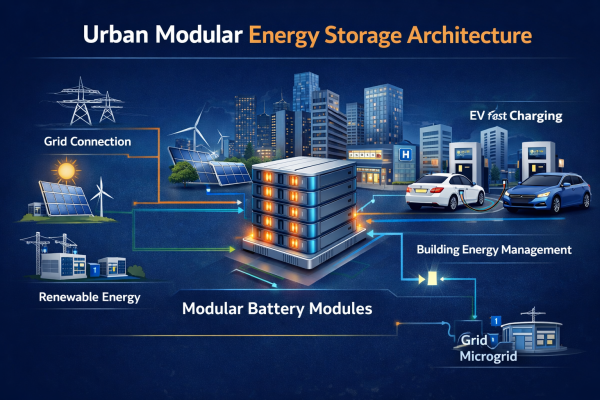
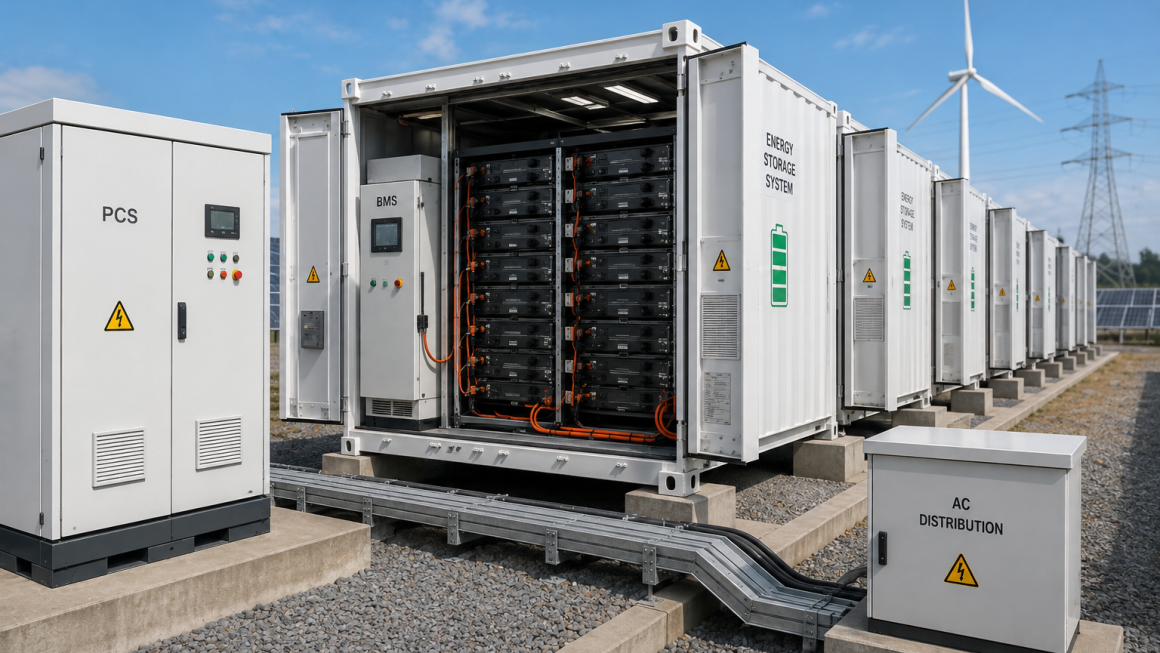
A modular energy storage architecture consists of multiple standardized energy storage units that work together as a larger system.
A simplified architecture may include:
Battery Module → Battery Rack → Battery Container → Power Conversion System → Grid
Depending on the project, additional layers may include:
- Thermal management
- Fire protection
- Battery monitoring
- Energy management
- Electrical protection
- Communication systems
- Cable protection
- Environmental monitoring
- Auxiliary power systems
Instead of designing one large system as a single inseparable unit, engineers can divide the energy storage installation into functional modules.
This creates a system that can be scaled according to project requirements.
For example, a project may begin with a certain number of battery containers and later add additional units as electricity demand increases.
From Centralized Systems to Modular Architectures
The evolution of energy storage architecture can be broadly divided into several stages.
Stage 1: Highly Centralized Energy Storage
Early systems often emphasized centralized equipment and relatively fixed configurations.
The advantages included:
- Simplified system architecture
- Centralized monitoring
- Fewer major equipment interfaces
- Straightforward control logic
However, centralized designs can become difficult to scale.
If one major component experiences a failure, a large portion of the system may be affected.
Maintenance can also require access to large integrated equipment.
Stage 2: Rack-Based Battery Systems
The next step was greater internal modularization.
Battery cells were assembled into modules, modules into racks, and racks into larger battery systems.
This improved:
- Manufacturing consistency
- Serviceability
- Battery replacement
- Electrical organization
- Thermal management
- System monitoring
The rack became an important building block for modern BESS architecture.
Stage 3: Containerized Energy Storage
Containerized BESS further standardized the system.
Battery racks and supporting equipment could be integrated into standardized containers that could be manufactured and tested before transportation to the project site.
This approach simplified deployment for large-scale projects.
A containerized system can be treated as a repeatable building block.
For example:
1 Container → 5 MWh
can become:
10 Containers → 50 MWh
and:
100 Containers → 500 MWh
The exact capacity varies by technology and system design, but the architectural principle remains the same: repeatable modules can be combined to create larger systems.
Why Modular BESS Architecture Is Becoming More Important
Several market trends are accelerating the adoption of modular energy storage.
Rapid Growth in Energy Storage Capacity
Renewable energy projects increasingly require large amounts of energy storage.
A single project may require hundreds of megawatt-hours or even gigawatt-hours of storage capacity.
Building such systems as one enormous integrated unit is impractical.
Modular architectures allow developers to divide the project into manageable blocks.
Different Project Sizes
Energy storage applications range from small commercial systems to utility-scale installations.
A modular platform can potentially serve different project sizes by changing the number of deployed modules.
This reduces the need to create a completely new architecture for every project.
Faster Deployment
Standardized modules can be manufactured and tested in controlled factory environments.
At the project site, installation becomes more focused on:
- Positioning
- Electrical connections
- Communication
- Cable routing
- Commissioning
- System integration
This can reduce the amount of complex assembly required onsite.
Modularity at Different Levels
One important characteristic of modern BESS is that modularity exists at multiple levels.
Cell-Level Modularity
Battery cells are the fundamental electrochemical units.
Multiple cells are connected to form a battery module.
Module-Level Modularity
Battery modules can be monitored and managed individually.
This provides greater visibility into battery performance.
Rack-Level Modularity
Multiple modules are assembled into racks.
Racks can become independent electrical and thermal management units.
Container-Level Modularity
Multiple racks and supporting systems can be integrated into standardized containers.
Site-Level Modularity
Multiple containers can be connected to create a large-scale energy storage plant.
This hierarchical structure allows the system to scale while maintaining a relatively standardized architecture.
Modular Architecture and Scalability
Scalability is one of the most important advantages of modular energy storage.
A conventional system may need to be redesigned when capacity requirements change.
A modular system can often increase capacity by adding additional units.
This creates two important forms of scalability:
Capacity scalability
Additional battery modules or containers increase total energy capacity.
Power scalability
Additional power conversion equipment can increase the system’s ability to charge or discharge at higher power levels.
The two should not always be treated as the same design parameter.
Energy capacity is typically measured in MWh, while power capacity is measured in MW.
A modular architecture allows project developers to optimize these parameters according to the application.
Modularity and Battery Reliability
Modularity can also improve system resilience.
In a highly centralized architecture, a major equipment failure can potentially affect a significant portion of the system.
In a modular architecture, individual modules can potentially be isolated.
For example:
Module Failure → Module Isolation → Remaining Modules Continue Operating
The actual impact depends on system architecture, protection design, control logic, and redundancy.
Nevertheless, modularity can provide more opportunities for fault isolation.
This is particularly valuable for utility-scale BESS where availability is a critical performance metric.
Modularity and Maintenance
Maintenance is another major reason for the evolution toward modular architectures.
Large energy storage systems may contain thousands or millions of battery cells.
Maintenance teams therefore need ways to identify and isolate problems efficiently.
A modular architecture can make maintenance more structured.
Instead of treating the entire BESS as one large asset, operators can monitor:
- Individual cells
- Battery modules
- Battery racks
- Containers
- PCS units
- Cooling systems
- Auxiliary equipment
This hierarchical monitoring structure can help maintenance teams identify the location of abnormal conditions more quickly.
Modular Architecture and Predictive Maintenance
The development of AI and advanced analytics is further increasing the value of modular systems.
Each module can generate operational data such as:
- Voltage
- Current
- Temperature
- SOC
- SOH
- Charge/discharge cycles
- Alarm status
- Communication status
When this information is combined across thousands of modules, operators can identify patterns that may indicate degradation or abnormal operation.
This creates a connection between modular architecture and predictive maintenance.
The system can potentially move from:
Failure → Repair
toward:
Data → Diagnosis → Prediction → Planned Maintenance
Thermal Management in Modular Energy Storage
Thermal management becomes increasingly important as energy density rises.
Each battery module generates heat during charging and discharging.
If heat is not effectively removed, battery temperature can increase and create differences between modules.
This can affect:
- Battery performance
- Degradation
- Efficiency
- Available capacity
- Safety
Modular architectures allow thermal management to be designed around smaller functional units.
Depending on the system, thermal management may use:
- Air cooling
- Liquid cooling
- Cold plates
- Cooling channels
- Heat exchangers
- Thermal interface materials
The objective is not simply to keep the entire container cool.
A well-designed system must maintain acceptable temperature distribution across individual battery modules and racks.
Modularity and Cable Management
As BESS becomes more modular, the number of electrical and communication interfaces can increase.
This creates new challenges for cable management.
Each battery rack may require multiple connections for:
- DC power
- Communication
- Monitoring
- Sensors
- Auxiliary power
- Grounding
Large containerized systems can therefore contain significant cable density.
Cable routing, cable protection, sealing, strain relief, and connector protection become important parts of modular system design.
A modular architecture should therefore consider cable infrastructure from the beginning rather than treating cable protection as a final installation detail.
Standardization as a Key Advantage
One of the biggest advantages of modular energy storage is standardization.
A standardized module can be:
- Manufactured repeatedly
- Factory tested
- Transported efficiently
- Installed using repeatable procedures
- Monitored using standardized interfaces
- Maintained using common spare parts
Standardization can improve both manufacturing efficiency and field service.
It can also simplify the training required for installation and maintenance teams.
Factory Integration and Quality Control
Modular systems are particularly compatible with factory-based manufacturing.
Instead of assembling every component at the project site, manufacturers can pre-integrate modules under controlled conditions.
Factory testing can include:
- Electrical testing
- Communication testing
- Thermal system testing
- Insulation testing
- Functional testing
- Control verification
- Leak testing where liquid cooling is used
More testing before shipment can reduce the amount of troubleshooting required during site commissioning.
Transportation and Installation Advantages
Large energy storage projects can be difficult to transport and install.
Modular architecture divides the system into standardized transportable units.
This allows project developers to consider:
- Container dimensions
- Weight
- Road transportation
- Crane requirements
- Site access
- Installation sequence
- Cable connection points
The physical design of the module therefore influences the entire logistics strategy.
Good modular architecture considers transportation before the equipment reaches the factory.
Modular Energy Storage and Project Expansion
Energy storage demand can change over time.
A customer may initially require a relatively small system but expect electricity demand or renewable generation to increase in the future.
A modular architecture can support phased expansion.
For example:
Phase 1 → Initial BESS Deployment
Phase 2 → Additional Battery Modules
Phase 3 → Additional Power Conversion Capacity
Phase 4 → Expanded EMS and Grid Integration
This approach can reduce the need for a large initial investment while maintaining a pathway for future expansion.
However, expansion must be considered during the original electrical, thermal, civil, and control design.
Challenges of Modular Energy Storage
Modularity is not automatically better in every situation.
There are also challenges.
More Interfaces
More modules can mean more electrical, mechanical, and communication interfaces.
Each interface introduces another potential failure point.
More Cables
Modular systems can require more cable connections and therefore more cable management.
Communication Complexity
Hundreds or thousands of modules require reliable communication and monitoring infrastructure.
Thermal Coordination
Individual module cooling must work together with container-level thermal management.
Control Complexity
The EMS and BMS must coordinate a larger number of distributed assets.
Spare Parts Management
Standardization can simplify maintenance, but large fleets may still require significant spare inventory.
The best architecture therefore balances modularity with system simplicity.
The Role of EMS in Modular Energy Storage
As modular BESS architectures become more sophisticated, the Energy Management System becomes increasingly important.
The EMS can coordinate energy flow across multiple modules and containers.
It may determine:
- Which battery modules should charge
- Which modules should discharge
- How much power each module should provide
- When modules should remain idle
- How renewable generation should be used
- When grid power should be purchased
- How peak demand should be managed
The EMS therefore acts as an important coordination layer above the individual battery systems.
AI-enabled EMS platforms can further improve this process by forecasting energy demand, electricity prices, renewable generation, and battery behavior.
The Future: Software-Defined Modular Energy Storage
The next stage of modular energy storage may increasingly combine physical modularity with software-defined control.
Instead of simply adding more hardware, future systems may dynamically allocate energy resources according to real-time conditions.
A conceptual architecture could look like:
Modular Battery Hardware
↓
Distributed BMS
↓
Edge Intelligence
↓
AI Optimization
↓
EMS
↓
Grid / Renewable Energy / Loads
This architecture allows the physical system to remain standardized while software determines how the available energy resources should be used.
From Modular Hardware to Modular Energy Platforms
The long-term evolution of BESS is likely to move beyond modular battery containers.
The broader concept is a modular energy platform.
Such a platform may combine:
- Modular battery storage
- Modular PCS
- Modular thermal management
- Modular protection
- Modular cable systems
- Intelligent EMS
- Predictive maintenance
- Digital twins
- Remote O&M
This approach allows energy storage systems to become more adaptable throughout their lifecycle.
Conclusion
The evolution of modular energy storage architectures reflects the changing requirements of the energy storage industry.
The industry has moved from relatively centralized systems toward increasingly modular structures based on battery modules, racks, containers, and repeatable system blocks.
The major advantages of modular BESS architecture include scalability, standardization, easier transportation, faster deployment, fault isolation, improved maintenance, and greater flexibility.
At the same time, modularity introduces new requirements for cable management, thermal control, communication, system integration, and intelligent energy management.
The future of energy storage is therefore unlikely to be defined by modular hardware alone.
The next generation of BESS will increasingly combine modular physical architecture with intelligent software, AI-powered EMS, predictive maintenance, advanced thermal management, and lifecycle-oriented O&M strategies.
For energy storage developers and system integrators, the key question is no longer simply how much battery capacity a system can provide.
It is increasingly about how efficiently the system can be expanded, operated, maintained, protected, and optimized throughout its entire lifecycle.
That is the real value of modular energy storage architecture.
Frequently Asked Questions
What is a modular energy storage architecture?
A modular energy storage architecture divides a large energy storage system into standardized units such as battery modules, racks, containers, and power conversion units. Multiple units can operate together as one larger system.
What are the main benefits of modular BESS?
The main benefits include scalability, standardized manufacturing, easier transportation, simplified installation, improved maintenance, fault isolation, and the ability to expand system capacity over time.
Is modular BESS easier to maintain?
Modular systems can simplify maintenance because individual modules, racks, or containers can be monitored and potentially isolated. This allows maintenance teams to focus on specific components rather than the entire system.
How does modular architecture improve BESS scalability?
Additional standardized battery or power conversion modules can be added to increase system capacity or power. This allows energy storage projects to expand according to future demand.
Does modular BESS improve reliability?
Modularity can improve resilience by allowing certain components or modules to be isolated when faults occur. However, actual reliability depends on the electrical architecture, protection system, control strategy, thermal management, and component quality.
Why is thermal management important in modular energy storage?
Battery temperature directly affects performance, degradation, efficiency, and safety. Modular thermal management helps maintain appropriate temperature conditions across battery modules and racks.
How does modular architecture affect cable protection?
More modular equipment can create more electrical and communication interfaces. Proper cable routing, mechanical protection, sealing, strain relief, and connector protection therefore become increasingly important.
What is the future of modular energy storage?
Future BESS architectures are likely to combine modular battery hardware with intelligent EMS, AI-based optimization, predictive maintenance, digital twins, advanced thermal management, and standardized O&M strategies.