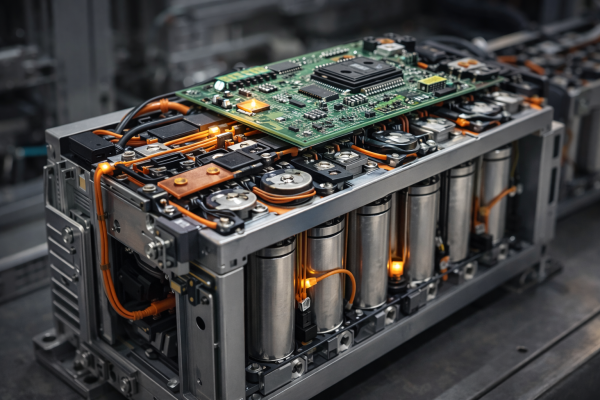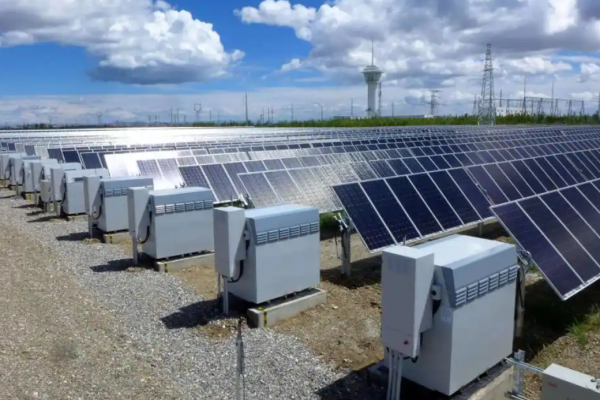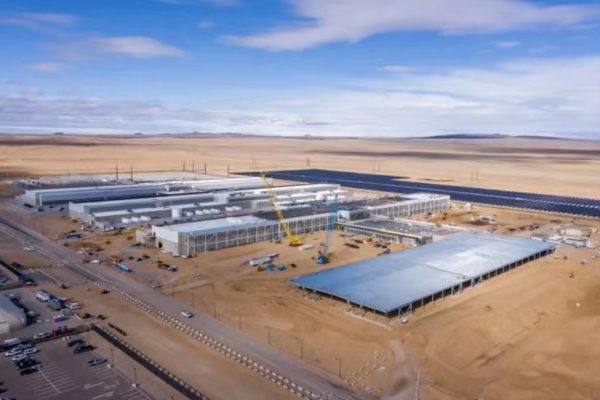
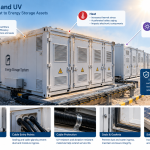
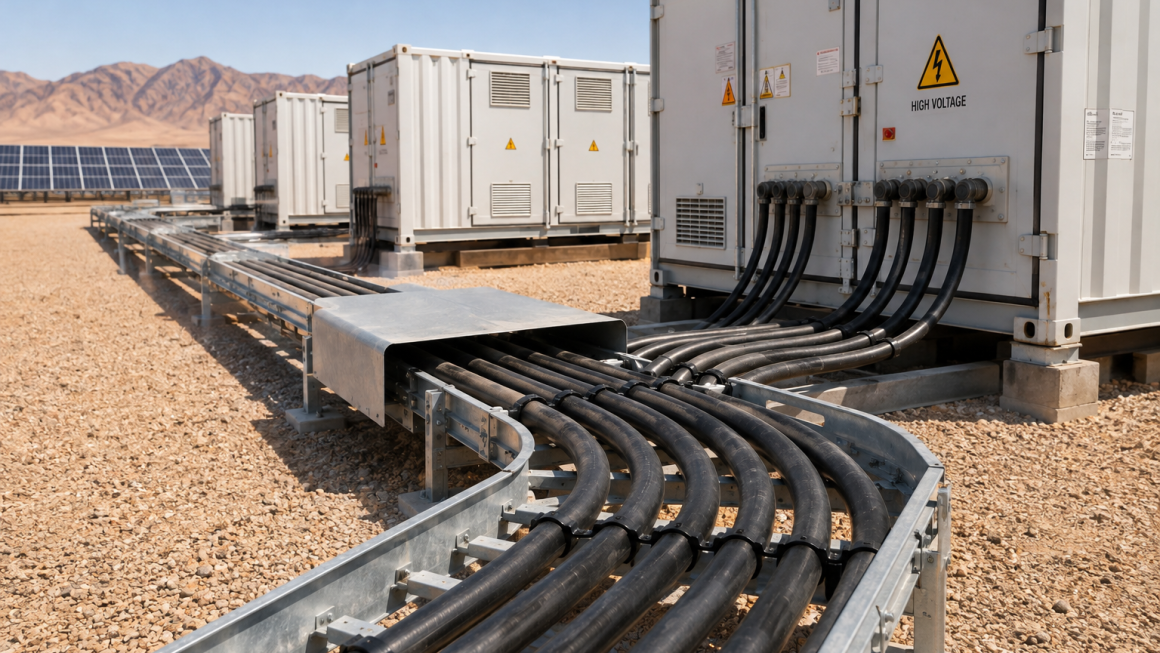
Energy storage systems are increasingly being deployed in desert and other arid regions where abundant solar resources make large-scale renewable energy projects economically attractive. However, desert environments create some of the harshest operating conditions for energy storage cables and cable assemblies.
Extreme heat, intense ultraviolet (UV) radiation, airborne dust, sand abrasion, temperature cycling, and occasional heavy rain can gradually damage cable insulation, connectors, glands, and sealing components.
For battery energy storage systems (BESS), cable protection is therefore not simply an installation detail. It is an important part of long-term system reliability, electrical safety, and maintenance planning.
A properly designed cable protection strategy should address temperature, UV exposure, dust and sand ingress, mechanical damage, moisture, connector protection, and long-term material degradation simultaneously.
Why Desert Environments Are Challenging for Energy Storage Cables
Desert conditions combine several environmental stresses that can act on cable systems at the same time.
The major risks include:
- Extreme ambient temperatures
- High solar radiation
- UV exposure
- Dust and fine sand
- Wind-driven sand particles
- Large day-night temperature variations
- Low humidity followed by sudden moisture exposure
- Mechanical abrasion
- Thermal expansion and contraction
- Difficult maintenance conditions
A cable that performs reliably in a mild indoor environment may experience significantly different aging behavior when installed outdoors in a desert BESS project.
The problem is not necessarily one dramatic failure event.
Instead, cable systems may experience gradual degradation over months or years until insulation, sealing, connectors, or mechanical supports can no longer provide the required level of protection.
1. Extreme Heat and Cable Temperature
High ambient temperature is one of the most obvious challenges in desert energy storage installations.
Outdoor surfaces exposed to direct sunlight can become significantly hotter than the surrounding air. Cable temperature is affected not only by ambient temperature but also by:
- Solar radiation
- Electrical current
- Cable size
- Installation method
- Air circulation
- Cable grouping
- Enclosure temperature
- Nearby heat sources
When cable operating temperature increases, the insulation material can age faster.
Continuous exposure to elevated temperature can contribute to:
- Insulation hardening
- Loss of mechanical flexibility
- Cracking
- Increased aging rate
- Reduced service life
- Connector degradation
Cable selection should therefore consider the actual thermal environment rather than relying only on nominal ambient temperature.
2. UV Radiation Can Degrade Cable Insulation
Desert installations often receive intense sunlight throughout the year.
UV radiation can gradually degrade exposed polymeric materials.
Depending on the material, long-term UV exposure may cause:
- Surface discoloration
- Loss of flexibility
- Surface cracking
- Brittleness
- Reduced mechanical strength
- Premature insulation aging
This is particularly important for cable sections installed between battery containers, PCS equipment, combiner boxes, transformers, and other outdoor equipment.
UV-resistant cable jackets can reduce the risk, but cable routing and mechanical protection are equally important.
Where cables are exposed to direct sunlight, additional protection such as UV-resistant conduits, protective sleeves, cable trays, or covered routing systems may be appropriate.
3. Dust and Sand Ingress
Dust is another major concern for desert energy storage systems.
Fine particles can enter:
- Cable glands
- Connector interfaces
- Junction boxes
- Enclosures
- Cable conduits
- Protective sleeves
- Ventilation openings
Sand and dust accumulation can create both mechanical and electrical concerns.
Fine particles can also combine with moisture or condensation to form deposits around electrical interfaces.
Over time, contamination may increase the risk of corrosion, insulation degradation, connector problems, or maintenance difficulties.
This is why sealing is an essential part of cable protection in desert BESS installations.
4. Wind-Driven Sand Can Cause Mechanical Abrasion
Desert environments are not simply “hot and dry.”
Wind-driven sand can act as an abrasive material.
Cables installed in exposed areas may experience repeated contact with:
- Sand particles
- Metal structures
- Cable trays
- Support brackets
- Sharp edges
- Moving equipment
Repeated movement caused by wind, thermal expansion, or equipment vibration can accelerate jacket wear.
Protective conduits, abrasion-resistant sleeves, flexible cable protection systems, and appropriate cable routing can reduce this risk.
The objective is to prevent the cable jacket from becoming the first line of defense against continuous mechanical abrasion.
5. Temperature Cycling and Thermal Expansion
Desert environments can experience substantial differences between daytime and nighttime temperatures.
This repeated temperature cycling causes materials to expand and contract.
Cable assemblies may therefore experience repeated movement at:
- Cable glands
- Connector interfaces
- Termination points
- Cable supports
- Flexible conduits
- Sealing interfaces
If the protection system does not accommodate movement properly, mechanical stress can accumulate.
For this reason, cable protection systems should be designed not only for maximum temperature but also for repeated thermal cycling.
Flexible protection components can be particularly useful where cables connect equipment that may move slightly relative to one another.
6. Protecting Cable Glands and Sealing Points
Cable glands are often overlooked when discussing cable protection.
However, the cable gland is one of the key interfaces between a cable and an electrical enclosure.
A properly selected gland can help provide:
- Mechanical strain relief
- Environmental sealing
- Dust protection
- Moisture protection
- Cable retention
- Protection against cable movement
In desert environments, gland selection should consider the required ingress protection level, temperature range, cable diameter, material compatibility, and installation conditions.
For outdoor BESS applications, the sealing interface should remain reliable despite temperature cycling and long-term environmental exposure.
7. Connector Protection Is Equally Important
Connectors are another potential weak point in outdoor energy storage cable assemblies.
Even when the cable itself is highly durable, the connector interface may be exposed to environmental stresses.
Potential risks include:
- Dust contamination
- Sand ingress
- UV exposure
- Corrosion
- Thermal cycling
- Mechanical impact
- Improper mating
- Water ingress during occasional rainfall
Protective caps, sealed connectors, suitable housings, and appropriate strain relief can reduce these risks.
Connector protection should be considered as part of the complete cable assembly rather than as an isolated component.
8. Cable Routing Matters in Desert BESS Projects
The best cable protection product cannot compensate for poor cable routing.
During system design, cables should be routed away from unnecessary sources of:
- Direct solar radiation
- Excessive heat
- Sharp edges
- Standing water
- Mechanical traffic
- Moving components
- High-abrasion areas
Cable trays and support systems should also prevent excessive bending and mechanical stress.
Where cables cross exposed areas, additional mechanical protection may be required.
Good routing reduces the environmental load placed on the cable before protective accessories are even installed.
9. Choosing the Right Cable Protection Materials
Material selection is critical for desert applications.
Different protection materials offer different combinations of temperature resistance, UV resistance, flexibility, abrasion resistance, and chemical resistance.
Common cable protection approaches include:
UV-Resistant Protective Sleeves
These can provide an additional barrier against sunlight and mechanical abrasion.
They are useful for exposed cable sections where flexibility must be maintained.
Protective Conduits
Conduits can provide mechanical protection and reduce direct exposure to sunlight, dust, and sand.
The appropriate conduit type depends on temperature, flexibility requirements, installation method, and environmental exposure.
Cable Trays
Cable trays can organize large numbers of cables and keep them away from direct ground contact.
For outdoor installations, tray material and surface treatment should be selected according to the local corrosion and temperature environment.
Cable Glands
Cable glands provide sealing and strain relief at enclosure entry points.
In desert applications, their environmental sealing performance is particularly important.
Sealing Accessories
Additional sealing components can help protect cable entry points, connectors, and enclosure interfaces against dust and moisture.
10. Corrosion Still Matters in Desert Environments
It may seem that corrosion is primarily a coastal or humid-environment problem.
However, desert installations can also experience corrosion.
Possible sources include:
- Condensation
- Occasional rainfall
- Temperature cycling
- Contaminated dust
- Industrial pollutants
- Saline dust in some regions
- Electrochemical interactions between dissimilar metals
This is particularly relevant for metal cable glands, brackets, cable trays, connectors, and fasteners.
Material compatibility and appropriate surface treatment should therefore be considered when designing outdoor cable protection systems.
11. Designing for Dust Protection
Dust protection should be considered at the system level.
A typical strategy can include:
Cable → Protective Sleeve/Conduit → Cable Gland → Sealed Enclosure → Protected Connector
Each interface should provide an appropriate level of environmental protection.
A failure at one interface can compromise the overall protection system.
For example, a highly durable cable installed through a poorly sealed cable entry can still allow dust to enter the enclosure.
This is why cable protection and sealing should be treated as an integrated design problem.
12. Protecting Cables During Installation
Cable damage does not always occur during operation.
Installation activities can also create long-term problems.
Common installation risks include:
- Excessive pulling force
- Over-bending
- Crushing
- Contact with sharp edges
- Incorrect gland installation
- Improper tightening
- Insufficient strain relief
- Leaving cables directly on the ground
- Poor separation from heat sources
In large BESS projects, installation quality can vary significantly because of site conditions and contractor practices.
Clear installation procedures and inspection checkpoints can therefore be valuable.
13. Inspection and Maintenance in Desert BESS Projects
Desert energy storage systems require regular inspection because environmental exposure is continuous.
Maintenance teams should periodically inspect:
Cable Jackets
Look for:
- Cracks
- Brittleness
- Abrasion
- Discoloration
- Surface damage
Cable Glands
Check for:
- Loose fittings
- Damaged seals
- Visible gaps
- Dust accumulation
- Mechanical stress
Connectors
Inspect for:
- Corrosion
- Contamination
- Loose connections
- Damaged locking mechanisms
- Signs of overheating
Protective Components
Check:
- Conduit integrity
- Sleeve condition
- Cable tray supports
- Fasteners
- Protective covers
- Sealing components
Early detection can prevent relatively small cable protection problems from becoming major electrical maintenance issues.
14. A Layered Cable Protection Strategy
For harsh desert environments, a layered protection strategy is generally more robust than relying on a single component.
A practical approach can include:
Layer 1 — Cable Selection
Select cable insulation and jacket materials appropriate for the expected temperature and environmental exposure.
Layer 2 — Mechanical Protection
Use conduits, sleeves, trays, or protective channels where abrasion or impact is possible.
Layer 3 — UV Protection
Protect exposed cable sections from prolonged direct sunlight where necessary.
Layer 4 — Sealing
Use appropriate cable glands and sealing components at enclosure and equipment interfaces.
Layer 5 — Routing
Keep cables away from excessive heat, sharp edges, traffic areas, and other environmental hazards.
Layer 6 — Inspection
Establish periodic inspection and maintenance procedures.
This layered approach provides multiple barriers against environmental degradation.
15. Why Cable Protection Is Important for BESS Reliability
A battery energy storage system is a complex combination of electrical, mechanical, thermal, and control systems.
Cable assemblies connect many of these subsystems.
A cable problem can therefore have consequences beyond the cable itself.
For example:
Cable degradation → Increased electrical resistance → Localized heating → Connector stress → Equipment fault → Maintenance or downtime
Similarly:
Poor sealing → Dust/moisture ingress → Connector contamination → Electrical instability → Equipment shutdown
Cable protection should therefore be considered part of overall BESS reliability engineering.
16. Cable Protection for Large-Scale Desert Energy Storage
Utility-scale BESS projects can contain thousands of cable connections distributed across battery containers, PCS units, transformers, switchgear, and auxiliary systems.
In these projects, small weaknesses can become large maintenance challenges because of the scale of the installation.
A well-designed cable protection strategy should therefore be standardized wherever practical.
This can include:
- Standard cable routing methods
- Standard gland specifications
- Standard protective sleeves
- Standard sealing procedures
- Installation inspection checklists
- Preventive maintenance schedules
- Spare protection components
Standardization can make future maintenance faster and reduce variation between installation teams.
Protecting energy storage cables in desert environments requires more than selecting a cable with a high temperature rating.
The complete system must address heat, UV radiation, dust, sand abrasion, thermal cycling, moisture, corrosion, mechanical stress, and sealing.
For BESS projects in desert regions, effective cable protection typically combines appropriate cable materials with protective conduits or sleeves, reliable cable glands, environmental sealing, proper routing, and regular inspection.
The most effective approach is a layered cable protection strategy in which each component addresses a specific environmental risk.
As large-scale solar-plus-storage projects continue to expand in hot and arid regions, cable protection will become increasingly important for maintaining long-term electrical reliability and reducing avoidable O&M costs.
For energy storage developers, integrators, and operators, designing cable protection from the beginning of a project is generally more effective than treating cable damage as a maintenance problem after installation.
Frequently Asked Questions
What are the main risks to energy storage cables in desert environments?
The main risks include extreme heat, UV radiation, dust, wind-driven sand, mechanical abrasion, temperature cycling, moisture ingress, corrosion, and connector or cable gland degradation.
How can BESS cables be protected from desert heat?
Cable protection can include appropriately rated cable materials, UV-resistant protective sleeves, conduits, proper routing, sufficient spacing, and installation methods that reduce unnecessary heat exposure.
Does desert dust damage energy storage cables?
Yes. Fine dust and sand can accumulate around cable glands, connectors, junction boxes, and enclosure interfaces. Proper sealing and environmental protection can reduce dust ingress.
Are cable glands important for outdoor BESS?
Yes. Cable glands provide cable retention, strain relief, and environmental sealing where cables enter electrical enclosures. Their performance is particularly important in harsh outdoor environments.
How can cables be protected from UV radiation?
UV-resistant cable jackets can be combined with protective conduits, sleeves, covered cable routing, or other shielding methods to reduce long-term exposure to direct sunlight.
How often should BESS cables be inspected in desert environments?
Inspection frequency should be based on the project’s environmental conditions, equipment design, manufacturer requirements, and O&M strategy. Harsh desert sites generally require more attention to cable jackets, glands, connectors, and protective components than controlled indoor installations.
What is the best cable protection strategy for desert BESS?
There is no single component that provides complete protection. A layered approach combining suitable cables, mechanical protection, UV protection, sealing, proper routing, and preventive inspection provides a more comprehensive solution.