



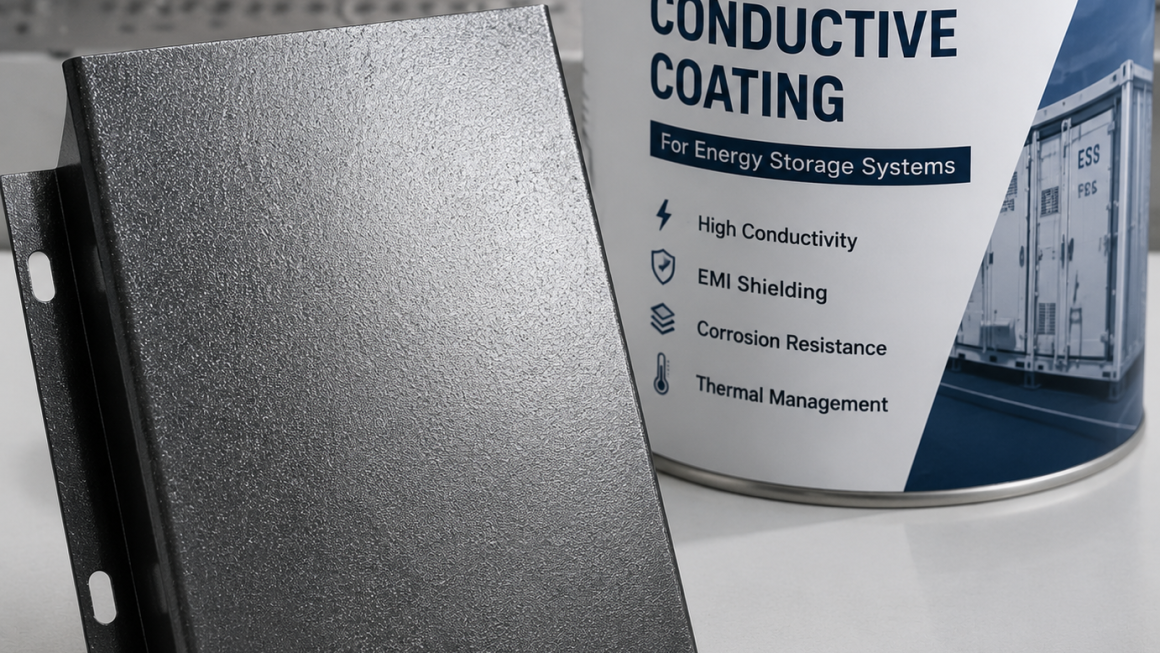
Why Conductive Coatings Are Becoming Critical in Energy Storage Systems
As Battery Energy Storage Systems (BESS) continue to evolve toward higher energy density, larger capacity, and more compact designs, electrical and thermal management challenges are becoming increasingly complex.
In modern systems, conductivity is no longer limited to cables and busbars. Instead, conductive coatings are increasingly used as a functional layer across structural components, enclosures, and thermal interfaces.
These coatings provide distributed electrical pathways while also contributing to EMI shielding, grounding stability, and thermal performance optimization.
Where Conductive Coatings Are Used in BESS
Conductive coatings are now applied across multiple system levels:
Battery Modules
- Module casings
- Structural frames
- Thermal interface surfaces
These coatings help maintain consistent electrical grounding and reduce localized resistance buildup.
Battery Racks and Cabinets
- Rack structures
- Enclosure inner surfaces
- Cable routing frames
Conductive coatings support system-level grounding continuity and improve electromagnetic shielding performance.
PCS and Power Electronics Enclosures
Power Conversion Systems (PCS) generate strong electromagnetic interference during operation.
Conductive coatings help:
- Reduce EMI leakage
- Improve shielding effectiveness
- Stabilize grounding paths
Cable Management Systems
In high-density installations, conductive coatings may also be applied to:
- Cable trays
- Metal conduits
- Support structures
This improves overall grounding consistency and system safety.
Key Functions of Conductive Coatings
Conductive coatings in energy storage systems are not only about conductivity—they serve multiple engineering purposes.
Electrical Grounding
They provide a continuous conductive path across structural components, reducing grounding discontinuities caused by paint layers or insulation barriers.
EMI Shielding
As PCS and inverter systems operate at higher switching frequencies, electromagnetic interference becomes a significant issue.
Conductive coatings help absorb or dissipate EMI energy across large surface areas.
Static Dissipation
In dry environments or high-voltage systems, static charge accumulation can pose risks.
Conductive coatings allow controlled discharge pathways, reducing static buildup.
Corrosion Protection (Hybrid Systems)
Modern formulations often combine conductivity with corrosion-resistant matrices, especially in outdoor BESS environments.
How Conductive Coatings Work
Conductive coatings typically rely on a percolation network formed by conductive fillers embedded in a resin matrix.
Common conductive materials include:
- Graphene
- Carbon nanotubes (CNTs)
- Carbon black
- Conductive graphite
- Metallic particles (in some hybrid systems)
When these fillers reach a critical concentration, they form continuous conductive pathways across the coating layer.
This allows both electrical conductivity and surface-level functional protection.
Conductive Coatings vs Traditional Metal Grounding
Traditional grounding relies on:
- Metal cables
- Bolted connections
- Busbars
However, in modern compact systems, these approaches have limitations:
| Aspect | Traditional Grounding | Conductive Coatings |
|---|---|---|
| Continuity | Discrete points | Continuous surface |
| Weight | Higher | Very low |
| Installation complexity | High | Low |
| EMI shielding | Limited | Broad-area shielding |
| Design flexibility | Low | High |
Conductive coatings therefore act as a distributed grounding layer rather than a point-based solution.
Challenges in Conductive Coating Design
Despite their advantages, conductive coatings require careful engineering control.
Conductivity vs Adhesion Trade-off
Higher conductivity often requires higher filler loading, which can reduce coating flexibility and adhesion strength.
Environmental Stability
Outdoor BESS applications require coatings to withstand:
- UV exposure
- Moisture
- Temperature cycling
- Salt spray environments
Mechanical Durability
Coatings must resist abrasion and mechanical wear, especially in rack-mounted or serviceable components.
Compatibility with Substrates
Different substrates (steel, aluminum, composites) require tailored formulation strategies.
Role of Advanced Materials: Graphene and CNTs
Advanced nanomaterials are increasingly used to enhance conductive coating performance.
Graphene
- High conductivity
- Large surface area
- Excellent corrosion barrier properties
Carbon Nanotubes (CNTs)
- Excellent conductive network formation
- High aspect ratio
- Effective at low loading levels
Hybrid Systems
Combining graphene + CNTs often improves:
- Conductivity stability
- Mechanical strength
- Percolation efficiency
These systems are especially suitable for next-generation energy storage coatings.
Future Trends in Conductive Coatings for BESS
The evolution of conductive coatings is moving toward multifunctional systems:
- Conductivity + corrosion protection
- Conductivity + thermal management
- EMI shielding + mechanical durability
- Low-VOC / sustainable formulations
- Sprayable or scalable industrial coatings
In future BESS designs, conductive coatings will likely become a standard functional layer, not an optional material.
Conductive coatings are becoming an important enabling technology in modern Battery Energy Storage Systems.
They extend beyond simple conductivity and now play a role in grounding, EMI shielding, static control, and system-level electrical stability.
As energy storage systems continue to increase in scale and complexity, conductive coatings—especially those based on graphene and carbon nanomaterials—will become a key part of integrated system design rather than a secondary surface treatment.
This shift reflects a broader industry trend: from component-level functionality to system-level material engineering.