Why Galvanic Corrosion Is a Hidden Risk in Liquid Cooling Systems
Liquid cooling has become a preferred thermal management solution for AI servers, high-performance computing (HPC), Battery Energy Storage Systems (BESS), and industrial power electronics. By circulating coolant through cold plates, manifolds, pumps, and heat exchangers, these systems efficiently remove heat from high-power components.
However, as liquid cooling loops become more complex, another engineering challenge emerges: galvanic corrosion.
Unlike mechanical wear or leakage, galvanic corrosion develops gradually when dissimilar metals are electrically connected in the presence of a conductive coolant. If left unaddressed, it can damage connectors, reduce coolant flow, increase maintenance requirements, and shorten the lifespan of the cooling system.
Understanding and preventing galvanic corrosion is therefore an essential part of reliable liquid cooling design.
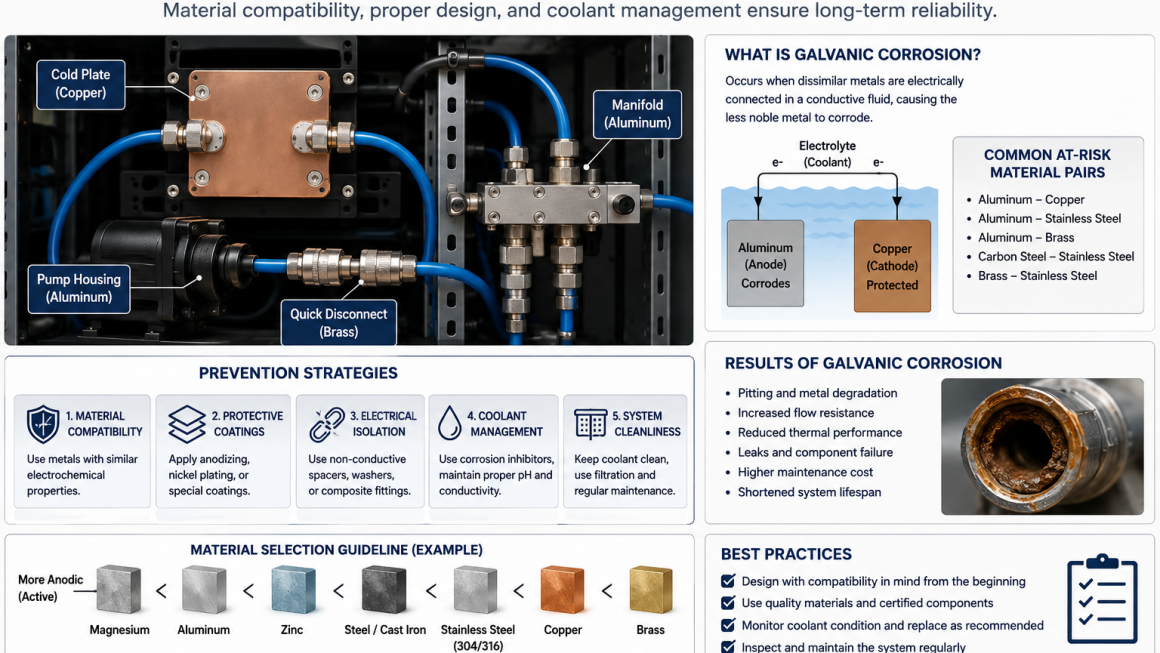
What Is Galvanic Corrosion?
Galvanic corrosion is an electrochemical process that occurs when three conditions exist simultaneously:
- Two different metals are in electrical contact.
- A conductive liquid acts as an electrolyte.
- The metals have different electrochemical potentials.
Under these conditions, the less noble metal becomes the anode and corrodes preferentially, while the more noble metal acts as the cathode.
In liquid cooling systems, water or water-glycol mixtures can provide the electrolyte needed for this reaction.
Where Galvanic Corrosion Occurs in Liquid Cooling Loops
Galvanic corrosion can develop at several locations within a cooling circuit.
Quick Disconnect Couplings
Quick disconnects (QDs) often connect components made from different materials.
Improper material combinations may accelerate corrosion around sealing and flow interfaces.
Cold Plates
Cold plates are frequently manufactured from aluminum or copper.
Connecting them directly to components made from different metals increases corrosion risk unless appropriate design measures are used.
Manifolds and Distribution Blocks
Manifolds distribute coolant throughout rack-level cooling systems.
Mixed-metal manifolds require careful material compatibility analysis to prevent long-term degradation.
Heat Exchangers
Heat exchangers often contain multiple metallic components operating under continuous coolant circulation, making corrosion control particularly important.
Pumps, Valves, and Fittings
Small fittings and threaded connections are common locations where galvanic corrosion begins if incompatible materials are used.
Common Material Combinations
Not all metal combinations present the same level of risk.
Examples include:
- Aluminum and copper
- Aluminum and stainless steel
- Brass and aluminum
- Carbon steel and stainless steel
The greater the difference in electrochemical potential, the higher the likelihood of galvanic corrosion.
Careful material selection during the design phase helps minimize these risks.
Consequences of Galvanic Corrosion
Although galvanic corrosion often develops slowly, its long-term effects can be significant.
Potential consequences include:
- Reduced coolant flow due to corrosion products
- Surface pitting and localized metal loss
- Increased maintenance frequency
- Seal degradation
- Leakage at connectors
- Reduced heat transfer efficiency
- Shortened component service life
In high-density liquid cooling systems, even small amounts of corrosion can affect overall reliability.
Engineering Strategies to Prevent Galvanic Corrosion
Effective corrosion control combines material selection, system design, and coolant management.
Select Compatible Materials
Whenever possible, use metals with similar electrochemical characteristics.
Reducing the potential difference between connected components lowers the driving force for galvanic corrosion.
Apply Protective Surface Treatments
Surface treatments create a barrier between the metal and the coolant.
Common solutions include:
- Anodizing for aluminum
- Nickel plating
- Electroless nickel coatings
- Conversion coatings
- High-performance protective coatings
Proper coating selection improves both corrosion resistance and durability.
Use Non-Conductive Isolation Components
Electrical isolation breaks the galvanic circuit.
Examples include:
- Polymer spacers
- Insulating washers
- Composite fittings
- Non-metallic connectors
These components prevent direct electrical contact between dissimilar metals.
Select the Appropriate Coolant
Coolant chemistry has a significant influence on corrosion behavior.
Many industrial coolants include corrosion inhibitors designed to protect mixed-metal systems.
Maintaining the correct coolant concentration and replacing degraded coolant at recommended intervals helps preserve long-term performance.
Minimize Moisture Contamination
Contaminants introduced during maintenance or operation can alter coolant conductivity.
Proper filtration, sealing, and regular coolant monitoring help reduce this risk.
Material Selection for Reliable Liquid Cooling Systems
Choosing suitable materials is one of the most effective ways to reduce corrosion risk.
Aluminum
- Lightweight
- Excellent thermal conductivity
- Requires protective surface treatment
- Common in cold plates and lightweight manifolds
Brass
- Good machinability
- Reliable sealing performance
- Suitable for many industrial cooling applications
- Moderate corrosion resistance
Stainless Steel
- Outstanding corrosion resistance
- High mechanical strength
- Preferred for demanding environments
- Higher material and manufacturing cost
Material selection should always consider the complete cooling loop rather than evaluating components individually.
Designing for Long-Term Reliability
Preventing galvanic corrosion requires a system-level approach.
Engineers should evaluate:
- Material compatibility
- Coolant chemistry
- Surface protection
- Electrical isolation
- Maintenance procedures
- Expected operating environment
Addressing these factors during the design phase reduces lifecycle costs and improves long-term reliability.
Future Trends
As liquid cooling becomes standard in AI infrastructure, data centers, and energy storage systems, corrosion prevention technologies continue to advance.
Emerging developments include:
- Advanced ceramic and nano-coatings
- Hybrid composite manifolds
- Smart corrosion monitoring sensors
- Improved corrosion-inhibiting coolants
- Lightweight electrically isolated connector systems
These innovations support higher reliability while reducing maintenance requirements.
Galvanic corrosion is one of the most important long-term reliability challenges in liquid cooling fluid loops.
Although it develops gradually, corrosion can affect quick disconnects, cold plates, manifolds, heat exchangers, and other critical cooling components.
By combining compatible materials, protective coatings, electrical isolation, optimized coolant chemistry, and thoughtful system design, engineers can significantly reduce corrosion risks and extend the service life of liquid cooling systems.
As liquid cooling technologies continue to expand across AI, HPC, and Battery Energy Storage Systems, effective galvanic corrosion prevention will remain a fundamental element of robust thermal management design.