Why Coastal BESS Projects Face Higher Reliability Challenges
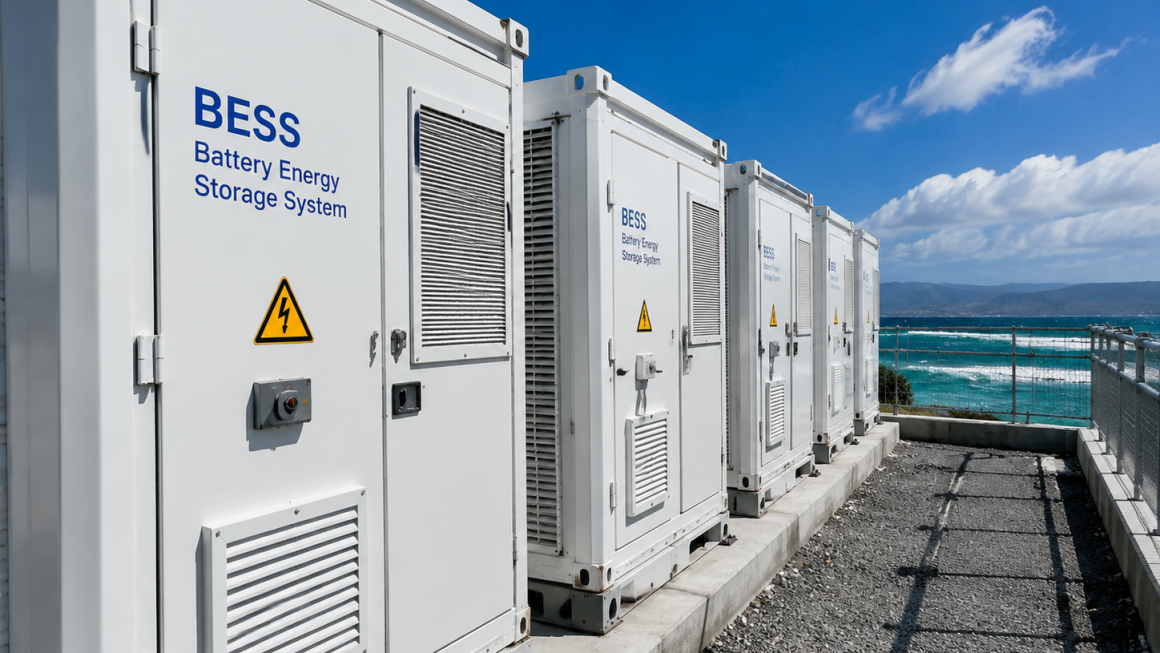
Battery Energy Storage Systems (BESS) are increasingly deployed in coastal environments to support renewable energy integration, offshore wind projects, island microgrids, and industrial power systems.
However, coastal locations introduce a unique reliability challenge: salt spray corrosion.
Unlike sudden mechanical failures, corrosion develops gradually over years of operation. Salt particles carried by marine air can accumulate on equipment surfaces, penetrate protective layers, and accelerate the degradation of metals, electrical connections, and sealing components.
For coastal energy storage projects, corrosion protection is not an optional improvement—it is a fundamental requirement for long-term reliability.
What Makes Coastal Environments So Aggressive?
Coastal areas combine several environmental stresses that accelerate material degradation.
Salt Spray Exposure
Sea water contains dissolved salts, mainly sodium chloride (NaCl).
When salt particles settle on equipment surfaces and combine with moisture, they create a conductive electrolyte layer that accelerates electrochemical corrosion.
High Humidity
Coastal regions typically experience higher humidity levels.
Moisture increases the conductivity of surface contaminants and extends the time during which corrosion reactions can occur.
Temperature Cycling
Daily temperature changes create repeated expansion and contraction of materials.
This can damage:
- Protective coatings
- Sealing interfaces
- Cable jackets
- Mechanical joints
allowing salt and moisture to reach sensitive areas.
UV Radiation
Outdoor BESS equipment is exposed to strong sunlight.
UV radiation can degrade:
- Polymer coatings
- Cable insulation
- Protective covers
reducing environmental protection over time.
How Salt Spray Affects BESS Components
Corrosion does not only affect the external container. It can impact many critical components throughout the system.
Battery Enclosures
Energy storage containers and cabinets rely on protective coatings to prevent corrosion.
If coatings are damaged:
- Rust can develop
- Structural strength may decrease
- Water resistance may be reduced
Long-term corrosion can affect enclosure durability and maintenance requirements.
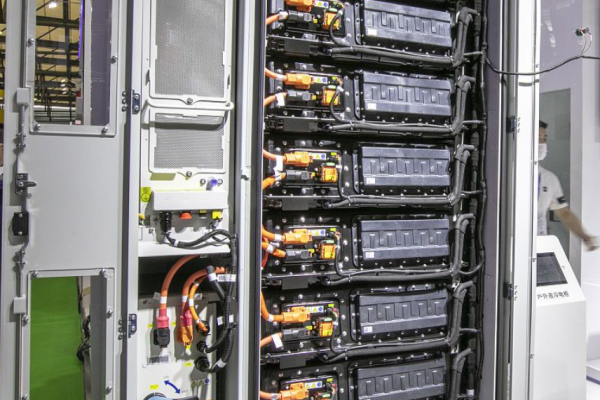
Cable Assemblies
Outdoor cables are exposed to:
- Salt particles
- UV radiation
- Humidity
- Temperature fluctuations
Without proper protection, cable systems may experience:
- Insulation aging
- Moisture penetration
- Reduced mechanical strength
Protective cable sleeves and sealed routing systems help improve service life.
Electrical Connectors
Connectors are among the most sensitive components.
Corrosion may cause:
- Increased contact resistance
- Additional heat generation
- Signal instability
- Electrical failure
Reliable coastal designs require corrosion-resistant materials and effective sealing.
Battery Racks and Structural Frames
Rack structures must maintain mechanical stability throughout decades of operation.
Corrosion protection helps prevent:
- Structural weakening
- Fastener degradation
- Mechanical deformation
Liquid Cooling Components
Modern BESS increasingly adopts liquid cooling.
Components such as:
- Quick disconnect couplings
- Manifolds
- Valves
- Pipes
require careful material selection to avoid corrosion and leakage risks.
Galvanic Corrosion: A Hidden Risk in Coastal BESS
Many modern energy storage systems use multiple metals:
- Aluminum
- Copper
- Stainless steel
- Brass
When different metals contact each other in a salty environment, galvanic corrosion may occur.
This can accelerate degradation at:
- Mechanical joints
- Electrical connections
- Cooling interfaces
Preventing galvanic corrosion requires:
- Compatible material selection
- Protective coatings
- Electrical isolation
- Proper sealing
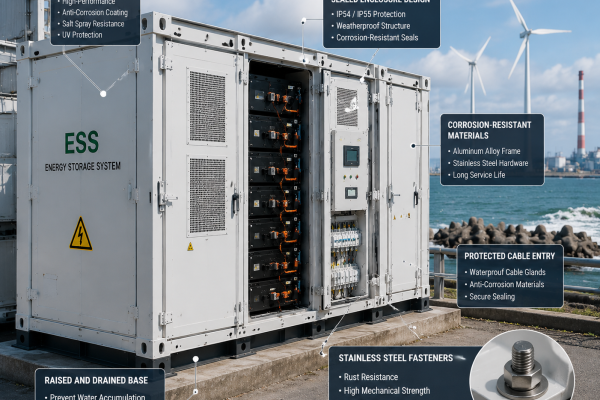
Corrosion Protection Strategies for Coastal Energy Storage
A reliable coastal BESS protection strategy usually combines multiple layers.
1. Corrosion-Resistant Materials
Material selection is the first defense.
Common choices include:
Aluminum
Advantages:
- Lightweight
- Naturally forms oxide protection
- Good corrosion resistance
Often used for:
- Frames
- Covers
- Structural components
Stainless Steel
Advantages:
- Excellent corrosion resistance
- High mechanical strength
Used for:
- Fasteners
- Critical connectors
- Fluid components
Engineering Polymers
Used for:
- Cable protection
- Sealing components
- Insulating structures
2. Protective Coating Systems
Industrial coatings create a barrier between metal surfaces and the environment.
Common solutions include:
- Epoxy coatings
- Polyurethane top coatings
- Zinc-rich coatings
- Ceramic protective coatings
The coating system must balance:
- Corrosion resistance
- UV resistance
- Mechanical durability
3. Cable Protection Solutions
Cable systems require additional environmental protection.
Typical solutions include:
- UV-resistant cable sleeves
- Fiberglass protective sleeves
- Aluminum foil composite sleeves
- Sealed cable glands
- Flexible protective conduits
These solutions reduce exposure to salt, moisture, and mechanical damage.
4. Enclosure and Sealing Design
A good enclosure design minimizes environmental intrusion.
Important factors include:
- Proper IP protection level
- Sealed cable entry points
- Drainage design
- Pressure equalization
Coastal BESS Protection Architecture
A robust coastal energy storage system often follows a layered protection approach:
External Layer
Protection against:
- Salt spray
- UV
- Rain
- Wind
Solutions:
- Anti-corrosion coatings
- Protective covers
- Weather-resistant materials
Structural Layer
Protection for:
- Frames
- Racks
- Mounting structures
Solutions:
- Corrosion-resistant metals
- Surface treatments
- Mechanical reinforcement
Functional Layer
Protection for:
- Cables
- Connectors
- Cooling systems
Solutions:
- Cable sleeves
- Sealed connectors
- Compatible fluid loop materials
Testing Standards for Coastal Applications
Before deployment in marine environments, materials and components are often evaluated through:
- Salt spray testing
- Humidity testing
- UV aging testing
- Temperature cycling
- IP protection testing
These evaluations help verify long-term durability.
Future Trends in Coastal BESS Protection
As energy storage expands into marine and coastal environments, protection technologies are evolving toward:
- Nano-enhanced coatings
- Lightweight corrosion-resistant structures
- Multi-functional protective layers
- Smart corrosion monitoring systems
- Integrated thermal and corrosion protection
Future BESS designs will increasingly combine environmental protection with thermal and mechanical reliability.
Salt spray corrosion is one of the most important long-term reliability challenges for coastal energy storage projects.
Although corrosion develops slowly, it can affect enclosures, cables, connectors, racks, and liquid cooling systems throughout the BESS lifecycle.
By combining corrosion-resistant materials, protective coatings, cable protection solutions, sealing technologies, and system-level design strategies, engineers can significantly improve the durability and reliability of coastal BESS installations.
As renewable energy projects continue moving toward coastal and marine environments, corrosion protection will become an essential part of next-generation energy storage infrastructure.