
Why These Three Concepts Are Often Confused
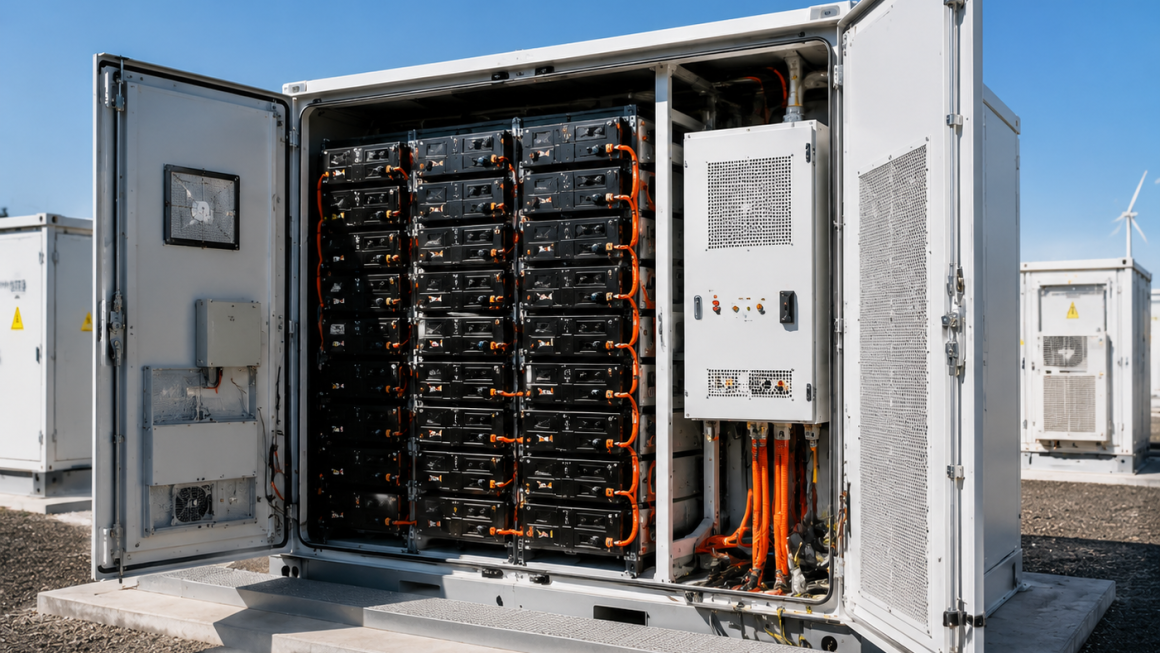
In Battery Energy Storage Systems (BESS), the terms heat, fire, and reliability are often used interchangeably. However, in engineering practice, they represent three fundamentally different challenges.
Confusing them can lead to incorrect system design priorities—for example, relying solely on fire suppression systems while neglecting long-term thermal management or mechanical degradation.
To build safer and more reliable energy storage systems, it is essential to clearly separate these three domains.
1. Heat: The Continuous Operating Challenge
Heat is a constant condition in all operating BESS systems.
It comes from two main sources:
Internal Heat Generation
- Battery charge and discharge cycles
- Power Conversion Systems (PCS)
- Busbars and connectors
- DC/AC conversion losses
External Heat Input
- Solar radiation
- High ambient temperature
- Poor ventilation conditions
Unlike fire, heat is always present during normal operation.
Why Heat Matters
Excessive heat does not immediately cause failure, but it gradually affects system performance:
- Accelerated insulation aging
- Increased electrical resistance
- Reduced battery lifespan
- Higher cooling energy consumption
Heat is a long-term degradation factor, not a sudden failure event.
2. Fire: The Rare but High-Impact Event
Fire in BESS systems is usually associated with thermal runaway, but it is a low-frequency, high-consequence event.
It may be triggered by:
- Internal cell failure
- External mechanical damage
- Electrical short circuits
- Manufacturing defects
Why Fire Protection Is Different
Fire is not a continuous condition like heat. It is an emergency event that requires:
- Detection systems
- Suppression systems
- Isolation strategies
- Venting design
Fire protection is therefore reactive and event-driven, not continuous.
3. Reliability: The System-Level Outcome
Reliability is not a single physical phenomenon—it is the result of all design decisions across the entire system lifecycle.
It includes:
- Thermal stability
- Electrical stability
- Mechanical durability
- Environmental resistance
- Maintenance accessibility
Reliability Depends on Heat + Fire Management
Reliability is influenced by both:
- Continuous thermal stress (heat)
- Rare failure events (fire)
But it also includes many non-fire, non-thermal factors such as:
- Connector wear
- Cable degradation
- Corrosion
- Vibration and mechanical fatigue
How These Three Layers Interact
A modern BESS protection strategy should clearly separate roles:
| Layer | Type | Nature | Engineering Focus |
|---|---|---|---|
| Heat | Operational | Continuous | Thermal management |
| Fire | Emergency | Event-based | Safety & suppression |
| Reliability | System outcome | Lifecycle | Materials + design integration |
Why Heat Control Comes First
Among the three, heat is the root condition.
If heat is not properly controlled:
- Component aging accelerates
- Failure probability increases
- Fire risk indirectly increases
- System reliability decreases
This is why modern BESS design increasingly emphasizes:
- Thermal insulation layers
- Reflective covers
- Cable thermal protection
- Liquid cooling systems
- Rack-level airflow design
Why Fire Protection Alone Is Not Enough
Fire suppression systems are essential, but they do not prevent:
- Cable insulation aging
- Connector degradation
- PCS overheating
- Long-term material failure
Fire protection is a last line of defense, not a design optimization tool.
Reliability Is Built, Not Installed
Reliability cannot be achieved through a single component.
It is built through:
- Material selection (conductive coatings, insulation materials)
- Structural design (racks, chassis, integration systems)
- Thermal design (heat management layers)
- Environmental protection (UV, corrosion, dust resistance)
Each layer contributes to the final system performance.
Industry Trend: From Fire-Centric to Heat-Centric Design
Traditional energy storage design focused heavily on fire protection.
However, the industry is shifting toward:
Preventing heat → reducing degradation → improving reliability → indirectly reducing fire risk
This shift leads to:
- More passive thermal materials
- More distributed protection systems
- More focus on cable and structural thermal shielding
- More system-level material engineering
Heat, fire, and reliability represent three distinct but interconnected challenges in Battery Energy Storage Systems.
- Heat is the continuous operating condition
- Fire is the rare failure event
- Reliability is the system-level result
Modern BESS design is increasingly moving toward a heat-first engineering philosophy, where controlling thermal stress at the material and system level improves both safety and long-term performance.
By clearly separating these three layers, engineers can design energy storage systems that are not only safer in emergencies, but also more stable, efficient, and durable over their entire lifecycle.