


As liquid cooling becomes the absolute standard for utility-scale Energy Storage Systems (BESS), engineers and procurement managers are paying closer attention to every component in the cooling loop. When dealing with multi-megawatt battery containers, keeping the cells at their optimal temperature is critical for safety and longevity.
However, there is a hidden profit killer inside many liquid cooling systems: Flow Resistance, commonly known as Pressure Drop.
For middleware integrators, project developers, and aftermarket maintenance teams, the pressure drop caused by quick disconnect couplings (QDs) isn’t just a technical detail—it directly impacts your bottom line. Choosing the wrong connector increases energy waste, stresses hardware, and inflates your long-term operational expenses (OPEX). This guide explains in plain terms why flow resistance matters and how choosing the right quick coupling can maximize your system’s overall efficiency.
1. What is “Pressure Drop” and Why Should a BESS Buyer Care?
Imagine trying to drink a thick milkshake through a tiny, crushed straw. You have to suck much harder to get any liquid out. That is exactly what happens inside a liquid cooling loop when a fluid connector has poor internal design.
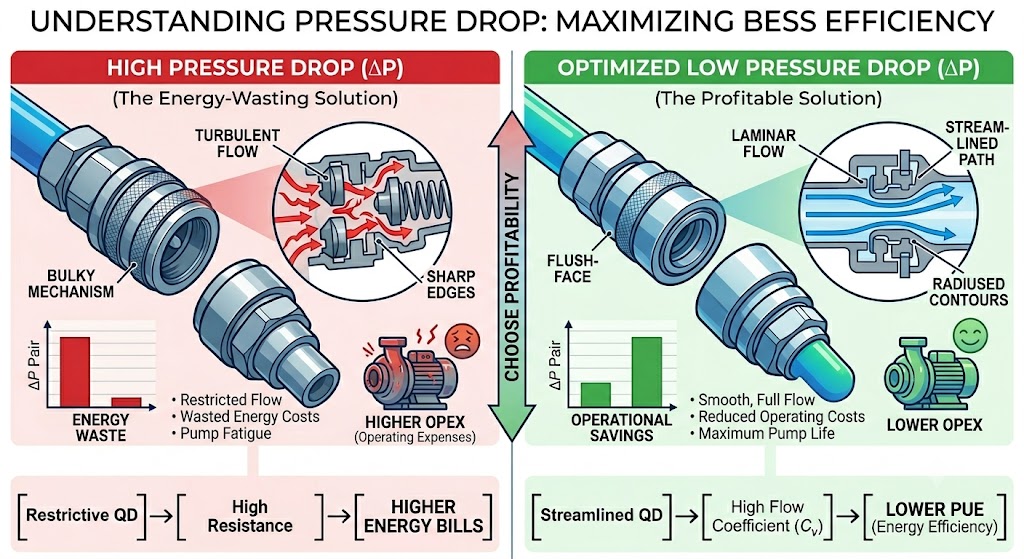
As the cooling liquid (whether it is water-glycol or a specialized dielectric fluid) travels from the central cooling unit through the pipes and into the battery packs, it passes through Quick Disconnect Couplings. If the inside of that coupling is restrictive, narrow, or full of sharp turns, the fluid slows down, and pressure is lost. This loss of pressure from one side of the connector to the other is called Pressure Drop.
In the energy storage market, every bit of resistance matters. If your quick couplings create a bottleneck, your system’s coolant pumps have to work twice as hard to push the liquid through.
2. The Financial Impact: Wasted Power and Lower PUE
For BESS owners and operators, the ultimate goal is to export as much stored electricity to the grid as possible. However, running auxiliary systems—like fans, HVAC, and liquid cooling pumps—consumes a portion of that stored energy. This is known as a parasitic load.
How Restrictive Connectors Drain Your Profits
When you install low-quality or poorly matched aftermarket quick couplings, the resulting high pressure drop forces the cooling pumps to draw more electricity continuously.
- The PUE Problem: This extra power consumption drives up the system’s PUE (Power Usage Effectiveness). A higher PUE means your system is less efficient.
- The Lifetime Cost: While a slight increase in pump power might seem minor on a single day, a typical energy storage asset operates for 10 to 15 years. Over a decade of continuous operation across a massive container site, that extra energy consumption adds up to thousands of dollars in unnecessary electricity bills.
By sourcing optimized, high-flow quick couplings, you minimize this parasitic drag, lowering your PUE and keeping more money in your pocket.
3. Hidden Risks of Poor Flow Design in the Aftermarket
Choosing a quick coupling solely based on the lowest purchase price often leads to much higher costs down the road. High fluid resistance causes several secondary problems that can disrupt an entire BESS operation:
3.1 Unbalanced Cooling Across the Container
In a standard storage container, multiple battery racks sit side-by-side, sharing a central cooling manifold. Fluid naturally follows the path of least resistance. If a maintenance technician replaces a broken coupling on one rack with a cheaper, more restrictive alternative, the fluid flow to that specific rack will drop.
As a result, that battery rack will run hotter than the others. This thermal imbalance triggers the Battery Management System (BMS) alarms and accelerates the aging of those expensive battery cells.
3.2 Pump Fatigue and Cavitation
When pumps are forced to fight against heavy flow resistance, they experience increased mechanical stress. This can lead to a damaging phenomenon called cavitation—where tiny vapor bubbles form and violently collapse inside the fluid loop. Cavitation can erode pump impellers, ruin internal seals, and cause unexpected system downtime, forcing costly aftermarket repairs.
4. What Makes a Quick Coupling “Low Resistance”?
When you are reviewing specifications from component manufacturers or looking for aftermarket replacements, you don’t need to be a fluid dynamics scientist. You just need to look for a few key design features that guarantee smooth flow:
4.1 Smooth “Flush-Face” Internal Geometry
Traditional industrial couplers often use bulky internal valves with heavy springs right in the middle of the fluid path. This forces the liquid to smash into obstacles, creating heavy turbulence.
Premium liquid cooling couplings utilize a flush-face (flat-face) design. When connected, the internal mechanism slides completely out of the way or aligns perfectly with the tube wall. This creates a straight, smooth channel that allows the coolant to glide through with almost zero resistance.
4.2 Matching the Flow Coefficient ($C_v$)
On technical datasheets, manufacturers will list a value called the Flow Coefficient (usually written as $C_v$ or $K_v$).
- The simple rule of thumb: The higher the $C_v$ number, the less resistance the connector has.
- Always look for couplings specifically rated for “high-flow liquid cooling” rather than standard industrial hydraulic couplers, which are built for high pressures but have terrible flow efficiency.
4.3 High-Performance Internal Finishes
The rougher the inside of a metal connector, the more friction it creates against the moving liquid. High-quality connectors feature polished internal walls and protective surface treatments that keep the fluid moving smoothly in a clean, laminar stream, preventing micro-friction from robbing the system of pressure.
5. Summary Checklist for Sourcing and Procurement Teams
When upgrading your BESS liquid cooling components or purchasing replacement stock for field maintenance, use this business-focused checklist to ensure you are getting the most efficient parts:
- [ ] Is it rated for Liquid Cooling? Ensure it isn’t a repurposed hydraulic part that will restrict flow.
- [ ] Does it have a High $C_v$ Rating? Compare options and select the connector that offers the highest flow capacity for its physical size.
- [ ] Is it a True Non-Spill Flush-Face Valve? This guarantees both low flow resistance and zero leakage during hot-swappable maintenance near live electronics.
- [ ] Is it Compatible with Your Fluids? Ensure the internal seals are rated for water-glycol or dielectric fluids so they won’t swell and block the flow path over time.
In the energy storage market, profitability depends on system uptime and energy efficiency. While quick disconnect couplings are a small part of a multi-million dollar BESS project, they have a massive impact on daily operating costs. By choosing premium, low-resistance fluid connectors, middleware integrators and aftermarket teams can protect vital system pumps, maintain perfect thermal balance across battery racks, and keep parasitic power drops to an absolute minimum. Investing in high-flow connection technology is a smart, simple strategy to lower your asset’s TCO and ensure long-term performance.