
As battery energy storage systems (BESS) scale up to meet utility and industrial demands, system voltages are rising rapidly. Shifting from traditional 1000V architectures to advanced 1500V high-voltage platforms has become the industry standard. High voltage allows for greater energy density, smaller cable cross-sections, and reduced transmission losses across the station.
However, managing 1500V DC power demands uncompromising hardware reliability. Within a BESS container, High-Voltage Connectors (HV Connectors) serve as the vital electrical nervous system, linking battery modules in series to create high-voltage strings.
For middleware integrators, EPC contractors, and aftermarket maintenance managers, selecting the right high-voltage connectors is a high-stakes commercial decision. It dictates whether a BESS plant operates with flawless uptime or faces devastating risks like electrical arcing, thermal runaway, and costly system downtime. This guide breaks down the essential selection criteria from a business and safety perspective.
1. The Commercial Reality: Why Connectors Dictate BESS Safety and ROI
In a typical utility-scale storage facility, thousands of high-voltage connections are made during initial assembly and routine aftermarket servicing. A single loose or poorly insulated connection can jeopardize the return on investment (ROI) of the entire project.
[Poor Connection Quality]  ──> High Contact Resistance ──> Micro-Arcing & Thermal Runaway ──> System Fire Risk
[Premium HVAC Connectors]   ──> Perfect Touch-Proof Fit  ──> Minimal Energy Loss  ──> 15+ Years Safe Operation
The Threat of Micro-Arcing and Contact Resistance
When high currents flow through a standard or degraded connector, any microscopic gap or misalignment creates contact resistance. At 1500V DC, even a tiny resistance can generate immense localized heat. Over time, this heat melts plastic housings, triggers false Battery Management System (BMS) alarms, and—in worst-case scenarios—causes dangerous electrical arcing that can ignite a catastrophic battery fire.
Sourcing premium, heavy-duty high-voltage connectors is the most cost-effective insurance policy against these multi-million-dollar operational failures.
2. Key Selection Pillars for Procurement and Operations Teams
When evaluating high-voltage connectors for BESS modules, multi-megawatt inverters, and high-voltage distribution boxes, look for these four non-negotiable performance categories:
2.1 Quick-Locking Mechanisms (Reducing On-Site Labor Costs)
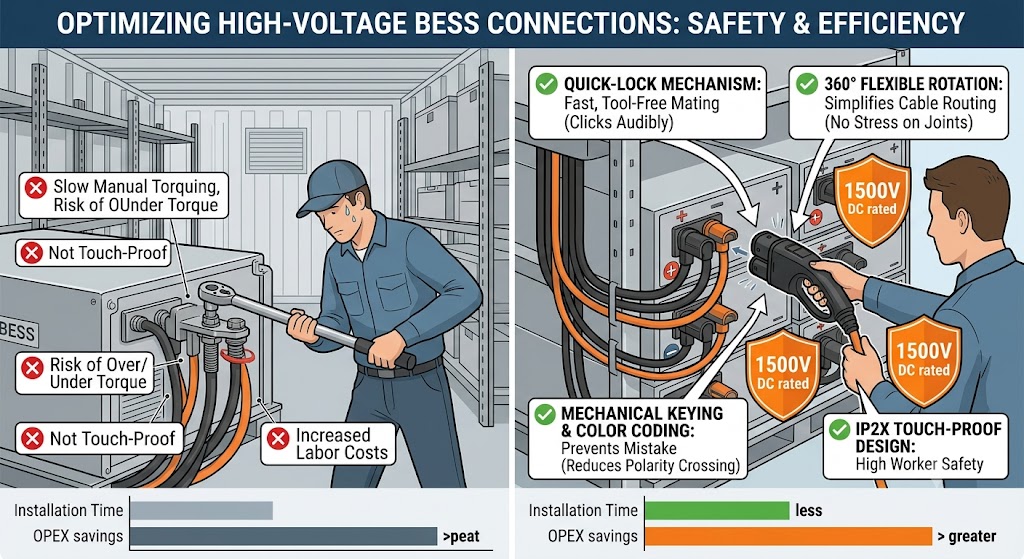
Traditional bolt-on lug terminals require technicians to manually torque each connection inside a tight battery cabinet. This process is incredibly slow and highly prone to human error (under-torquing leads to loose contacts; over-torquing strips threads).
- The Solution: Modern premium HV connectors utilize tool-free, quick-locking mechanisms (push-pull or twist-lock). They click audibly when securely mated. This single feature slashes field installation time by up to 70%, drastically reducing initial labor costs and making aftermarket module replacements incredibly fast.
2.2 360° Rotation and Flexible Cable Routing
Inside space-constrained BESS racks, heavy-gauge high-voltage cables are thick, stiff, and difficult to bend.
- The Design Advantage: Look for high-voltage plug connectors that feature a 360-degree free rotation mechanism after insertion. This allows technicians to route cables at any angle without putting mechanical stress on the connector head or the internal busbar, eliminating a major cause of micro-fractures in electrical joints.
2.3 Mistake-Proofing via Mechanical Keying and Color Coding
In a fast-paced installation or aftermarket repair environment, accidentally crossing positive and negative high-voltage cables results in instant short circuits and component destruction.
- The Visual Solution: Sourcing connectors with strict mechanical keying (different slot shapes for positive and negative that physically prevent mismatching) and distinct color-coding (typically Orange for Positive, Black for Negative) ensures absolute safety during high-stress field operations.
2.4 Touch-Proof (IP2X) Safety for Field Technicians
High-voltage DC is lethal. During maintenance, field technicians must be protected from accidental shock. Top-tier connectors feature a touch-proof design (IP2X standard), meaning the live internal metal pins are deeply recessed so that human fingers or metallic tools cannot make accidental contact, protecting your workforce and lowering liability insurance risks.
3. Surviving the Elements: Material Durability in Extreme Environments
Since large-scale energy storage systems are deployed globally—from desert solar farms to salty coastal wind ports—the high-voltage connectors must be able to withstand severe environmental weathering without degrading.
3.1 Advanced Flame-Retardant and UV-Stabilized Plastics
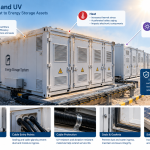
The outer housing of a premium connector is molded from engineered high-performance plastics (such as PA66 or specialized polymers) that hold a UL94 V-0 flame-retardant rating. This ensures that even if an internal malfunction occurs, the plastic will self-extinguish within seconds rather than spreading a fire. Additionally, high UV-resistance guarantees that connectors exposed to direct sunlight near inverter doors will not become brittle and crack over a 10-year period.
3.2 IP67 / IP68 Ingress Protection
BESS containers often face severe humidity fluctuations, internal condensation, and dust storms. Connectors must maintain an IP67 or IP68 waterproof rating when mated. If moisture or dust creeps into the contact interface, it rapidly accelerates corrosion, leading to insulation failure and ground faults that shut down the entire battery string.
4. Summary Checklist for Sourcing High-Voltage Connectors
Before approving a new supplier or purchasing aftermarket replacement stock, ensure your high-voltage connectors tick every box on this commercial validation checklist:
- [ ] Is it rated for 1500V DC? Ensure it meets the voltage threshold of modern high-density battery architectures.
- [ ] Does it feature an Audible Quick-Lock? Eliminates the risks of manual torquing errors and lowers on-site labor overhead.
- [ ] Is it Mechanically Keyed and Color-Coded? Prevents devastating polarity reversals during fast-paced field maintenance.
- [ ] Does it have a UL94 V-0 and IP67/68 Rating? Guarantees maximum safety in harsh outdoor climates (deserts, coasts, highlands).
- [ ] Does it offer 360° Freedom of Rotation? Simplifies cable routing and eliminates mechanical stress on internal contacts.
High-voltage connectors might represent a small percentage of a BESS project’s total hardware budget, but they carry 100% of the operational risk. By prioritizing tool-free quick-locking designs, strict environmental protection, and mistake-proof keying, middleware integrators and aftermarket engineering teams can systematically wipe out the leading causes of electrical failure. Investing in high-grade connection interfaces is a powerful, proactive strategy to safeguard expensive battery assets, minimize field maintenance costs, and ensure a highly reliable, low-OPEX energy storage lifecycle.