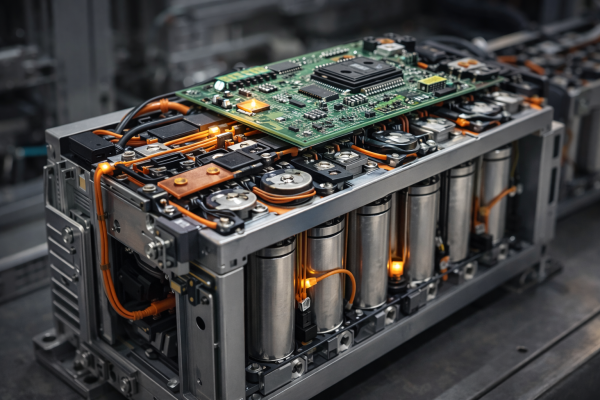




As lithium-ion batteries continue to achieve higher energy density and faster charging capabilities, thermal management has become one of the most important challenges facing the energy storage industry. Excessive heat can negatively impact battery performance, shorten service life, and increase safety risks.
To address these challenges, advanced thermal materials are increasingly being incorporated into battery pack designs. Among them, graphene has emerged as one of the most promising materials due to its exceptional thermal conductivity, lightweight structure, and multifunctional properties.
From electric vehicles (EVs) to utility-scale energy storage systems (ESS), graphene-based thermal solutions are attracting significant attention as manufacturers seek safer, more efficient, and longer-lasting battery systems.
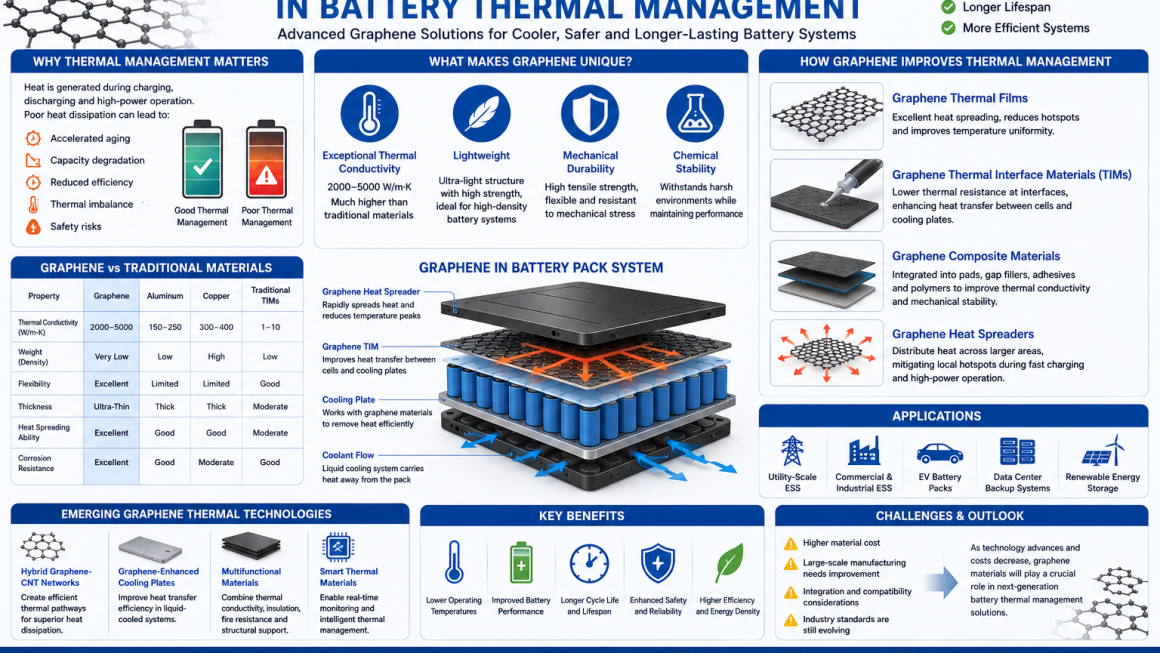
Why Battery Thermal Management Is Critical
Lithium-ion batteries generate heat during:
- Charging
- Discharging
- Fast charging cycles
- High-power operation
If heat is not properly managed, batteries may experience:
- Accelerated aging
- Capacity degradation
- Increased internal resistance
- Reduced charging efficiency
- Thermal imbalance
- Thermal runaway risks
Modern battery packs require effective thermal management systems that can maintain consistent temperatures across all cells.
What Makes Graphene Unique?
Graphene is a single layer of carbon atoms arranged in a two-dimensional honeycomb structure.
It possesses several remarkable properties:
Exceptional Thermal Conductivity
Graphene has thermal conductivity values exceeding:
2000–5000 W/m·K
This is significantly higher than many conventional thermal materials.
Lightweight Structure
Graphene is extremely lightweight while maintaining excellent mechanical strength.
This makes it attractive for:
- EV battery systems
- Portable energy storage
- High-density ESS applications
Mechanical Durability
Graphene exhibits:
- High tensile strength
- Excellent flexibility
- Resistance to mechanical degradation
These characteristics support long-term reliability.
Chemical Stability
Graphene can withstand demanding operating environments while maintaining thermal performance.
Challenges in Battery Thermal Management
Modern battery systems face several thermal challenges.
Increasing Energy Density
Higher energy density means:
- More stored energy
- More heat generation per unit volume
This makes thermal control increasingly difficult.
Fast Charging Requirements
Ultra-fast charging technologies generate significant heat.
Without effective heat dissipation:
- Charging performance suffers
- Cell degradation accelerates
Thermal Uniformity
Battery packs often contain hundreds or thousands of cells.
Maintaining consistent temperatures across all cells is critical for:
- Battery balancing
- Performance optimization
- Safety
Space Constraints
Energy storage systems increasingly require:
- Compact footprints
- Higher power density
This limits cooling system design flexibility.
How Graphene Supports Battery Thermal Management
Graphene Thermal Films
Graphene films are among the most common thermal management applications.
They function as:
- Heat spreaders
- Thermal diffusion layers
- Hotspot mitigation materials
Benefits include:
- Rapid heat distribution
- Reduced local temperature peaks
- Improved temperature uniformity
Graphene Thermal Interface Materials (TIMs)
Thermal Interface Materials are used between:
- Battery cells
- Cooling plates
- Heat sinks
- Structural components
Graphene-enhanced TIMs offer:
- Lower thermal resistance
- Improved heat transfer
- Enhanced cooling efficiency
These materials help maximize the effectiveness of both air-cooled and liquid-cooled systems.
Graphene Composite Cooling Materials
Graphene can be incorporated into:
- Polymer composites
- Thermal pads
- Gap fillers
- Adhesives
These composites provide:
- Improved thermal conductivity
- Electrical insulation options
- Enhanced mechanical stability
Graphene Heat Spreaders
Localized hotspots can develop during:
- Fast charging
- High-current discharge
- High-power operation
Graphene heat spreaders help distribute heat across a larger surface area, reducing peak temperatures.
Applications in Energy Storage Systems
Utility-Scale ESS
Large battery containers generate significant thermal loads.
Graphene materials can improve:
- Cooling efficiency
- Thermal uniformity
- System reliability
Commercial and Industrial ESS
Graphene-based thermal solutions support:
- Higher power density
- Compact system design
- Longer operational life
EV Battery Packs
Electric vehicles increasingly require:
- Fast charging capability
- High energy density
- Lightweight thermal solutions
Graphene materials address all three requirements.
Data Center Backup Systems
As AI and cloud computing infrastructure expands, backup battery systems require enhanced thermal performance.
Graphene helps improve:
- Heat dissipation
- Reliability
- Operational efficiency
Renewable Energy Storage
Solar and wind storage systems often operate under challenging environmental conditions.
Graphene thermal materials help maintain stable operating temperatures.
Graphene vs Traditional Thermal Materials
| Property | Graphene | Aluminum | Copper | Traditional TIMs |
|---|---|---|---|---|
| Thermal Conductivity | Extremely High | Moderate | High | Moderate |
| Weight | Very Low | Low | High | Low |
| Flexibility | Excellent | Limited | Limited | Good |
| Thickness | Ultra-Thin | Thick | Thick | Moderate |
| Heat Spreading Ability | Excellent | Good | Good | Moderate |
| Corrosion Resistance | Excellent | Good | Moderate | Good |
Graphene’s combination of high thermal conductivity and low weight makes it particularly attractive for next-generation battery systems.
Emerging Graphene Thermal Technologies
Hybrid Graphene-CNT Networks
Combining:
- Graphene
- Carbon nanotubes (CNTs)
creates highly efficient thermal pathways within composite materials.
Graphene-Enhanced Cooling Plates
Manufacturers are exploring graphene-integrated cold plates that improve heat transfer between cells and cooling systems.
Multifunctional Materials
Future materials may combine:
- Thermal conductivity
- Electrical insulation
- Fire resistance
- Structural support
within a single graphene-based solution.
Smart Thermal Materials
Advanced graphene composites may eventually support:
- Real-time thermal monitoring
- Self-regulating heat dissipation
- Predictive maintenance systems
Challenges for Large-Scale Adoption
Despite its potential, graphene still faces several challenges.
Cost Considerations
High-quality graphene materials remain more expensive than conventional thermal materials.
Manufacturing Scale
Consistent large-scale production remains a key industry focus.
Integration Complexity
System designers must carefully evaluate:
- Material compatibility
- Assembly processes
- Long-term reliability
before implementation.
Performance Standardization
Industry-wide standards for graphene thermal materials are still developing.
Best Practices for Graphene Integration
To maximize performance:
- Evaluate thermal requirements during early design stages
- Combine graphene materials with effective cooling architectures
- Use graphene-enhanced TIMs where interface resistance is critical
- Validate thermal performance through simulation and testing
- Consider lifecycle cost rather than material cost alone
Future Outlook
As battery systems become more powerful and compact, demand for advanced thermal management solutions will continue to increase.
Graphene is expected to play an increasingly important role in:
- Utility-scale energy storage systems
- Electric vehicle battery packs
- Fast-charging infrastructure
- AI data center backup systems
- Renewable energy storage applications
As manufacturing costs decrease and material technologies mature, graphene-based thermal solutions are likely to become a standard component in next-generation battery designs.
Graphene materials offer a powerful combination of high thermal conductivity, lightweight structure, mechanical durability, and design flexibility. These properties make graphene one of the most promising materials for addressing the growing thermal management challenges of modern battery systems.
From thermal interface materials and heat spreaders to advanced composite cooling solutions, graphene is helping improve battery safety, efficiency, and longevity. As the energy storage industry continues to evolve, graphene-based thermal management technologies are expected to play an increasingly important role in enabling higher-performance and more reliable battery systems.