

Why Coastal Environments Present Unique Challenges
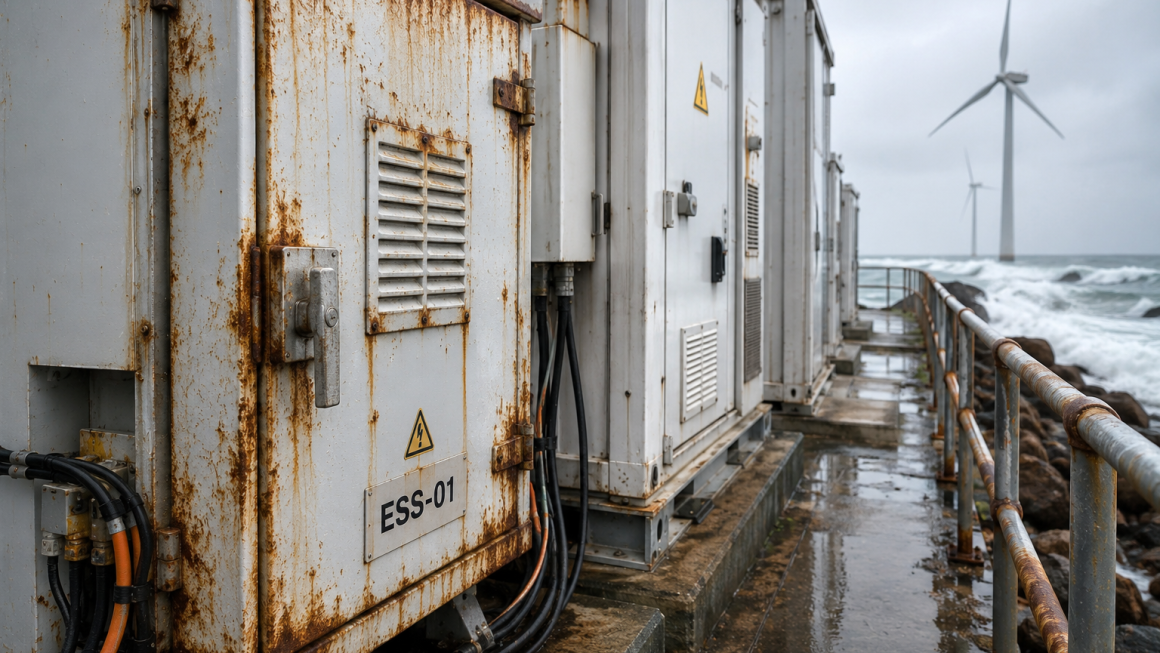
Battery Energy Storage Systems (BESS) are increasingly installed in coastal regions to support renewable energy integration, port electrification, island microgrids, and grid stabilization.
While these locations provide strategic advantages, they also expose equipment to one of the most aggressive environmental conditions—salt spray corrosion.
Unlike visible mechanical damage, corrosion develops gradually. Salt particles carried by sea air settle on equipment surfaces, attracting moisture and accelerating the deterioration of metals, electrical connections, and protective coatings.
Without proper corrosion protection, coastal environments can significantly reduce the service life of energy storage systems and increase maintenance costs.
What Is Salt Spray Corrosion?
Salt spray corrosion occurs when airborne salt particles combine with humidity to form a conductive electrolyte on metal surfaces.
This thin moisture layer accelerates electrochemical reactions that attack exposed materials.
The corrosion process becomes even more severe when combined with:
- High humidity
- Elevated temperatures
- Frequent wet-dry cycles
- Strong coastal winds
- Industrial pollutants
For outdoor BESS installations, these conditions create a continuous challenge throughout the system’s operating life.
Components Most Vulnerable to Corrosion
Salt spray affects more than the external enclosure.
Critical components include:
Battery Enclosures
Steel cabinets and containers may experience coating degradation, rust formation, and structural weakening if protective finishes are damaged.
Cable Assemblies
Salt contamination can accelerate aging of cable jackets and increase the risk of moisture intrusion at cable terminations.
Protective cable sleeves and sealed routing systems help reduce exposure.
Electrical Connectors
Connectors are particularly sensitive because corrosion increases contact resistance.
Possible consequences include:
- Voltage drops
- Heat generation
- Intermittent electrical faults
- Reduced connector lifespan
Corrosion-resistant connector materials and proper sealing are essential in coastal projects.
Battery Racks and Structural Frames
Rack structures support significant mechanical loads over many years.
Protective surface treatments help maintain structural integrity while reducing long-term corrosion.
Cooling System Components
Liquid cooling systems may include manifolds, quick disconnects, valves, and fittings.
These components require materials that resist corrosion while remaining compatible with the selected coolant.
Why Salt Spray Affects System Reliability
Corrosion rarely causes immediate failure.
Instead, it gradually reduces reliability through:
- Increased electrical resistance
- Mechanical weakening
- Seal degradation
- Higher maintenance frequency
- Reduced equipment lifespan
Because these changes develop slowly, corrosion often remains unnoticed until system performance begins to decline.
Engineering Strategies for Corrosion Protection
Successful coastal BESS projects combine multiple protection measures rather than relying on a single solution.
Corrosion-Resistant Materials
Material selection is the first line of defense.
Common choices include:
- Aluminum alloys with protective anodizing
- Stainless steel for critical hardware
- Corrosion-resistant composite materials
- Marine-grade fasteners
Selecting materials according to the operating environment improves long-term durability.
Protective Coating Systems
Industrial coatings help isolate metal surfaces from moisture and salt deposits.
Typical systems may include:
- Epoxy primers
- Polyurethane topcoats
- Zinc-rich protective layers
- High-performance anti-corrosion coatings
Proper coating selection extends service life and reduces maintenance requirements.
Cable and Connector Protection
Exposed cable assemblies benefit from additional environmental protection through:
- High-performance cable sleeves
- Sealed cable glands
- UV-resistant outer jackets
- Heat- and moisture-resistant protective wraps
These measures help preserve insulation integrity in coastal climates.
Enclosure Sealing
Well-designed enclosures reduce the entry of:
- Salt particles
- Moisture
- Wind-driven rain
- Dust
Effective sealing minimizes contamination of sensitive electrical equipment.
Combining Heat and Corrosion Protection
Many coastal regions also experience high temperatures and strong solar radiation.
As a result, protection strategies should address multiple environmental challenges simultaneously, including:
- Salt spray
- UV exposure
- High ambient temperature
- Humidity
- Wind-blown sand in coastal industrial areas
A comprehensive protection system often combines:
- Reflective thermal barriers
- Corrosion-resistant coatings
- Cable protection sleeves
- Durable sealing systems
- Weather-resistant structural materials
This integrated approach improves both reliability and service life.
Future Trends in Coastal BESS Protection
As energy storage deployments expand along coastlines worldwide, protection technologies continue to evolve.
Emerging developments include:
- Advanced nano-ceramic coatings
- Multi-layer corrosion protection systems
- Smart coating health monitoring
- Lightweight corrosion-resistant composites
- High-performance sealing technologies
- Integrated thermal and corrosion protection materials
These innovations help reduce lifecycle costs while improving long-term system reliability.
Salt spray corrosion is one of the most significant environmental risks for coastal Battery Energy Storage Systems.
Although corrosion develops gradually, it can affect battery enclosures, cable assemblies, connectors, cooling systems, and structural components throughout the system lifecycle.
By combining corrosion-resistant materials, industrial coating systems, effective cable protection, sealed enclosures, and durable structural designs, engineers can significantly improve the reliability and longevity of coastal energy storage projects.
As renewable energy installations continue to expand into marine and coastal environments, corrosion protection will remain a critical element of successful BESS engineering.