
As battery energy storage systems continue to scale in size and energy density, structural design has become a critical factor in determining long-term system reliability. While much attention is often given to battery chemistry, thermal management, and battery management systems (BMS), the physical structure of a battery pack plays an equally important role in ensuring safe, stable, and durable operation over many years.
A well-designed battery pack structure must withstand mechanical stress, thermal cycling, environmental exposure, transportation impacts, and long-term operational loads. For modern energy storage systems (ESS), structural engineering is no longer simply about housing batteries—it is a key contributor to safety, performance, maintainability, and lifecycle cost.
Why Structural Design Matters in Battery Packs
Battery packs are expected to operate reliably for:
- 10–20 years in ESS applications
- Thousands of charge-discharge cycles
- Various environmental conditions
- Continuous thermal and mechanical stress
Without proper structural design, systems may experience:
- Cell movement and deformation
- Loose electrical connections
- Increased vibration damage
- Water or dust ingress
- Thermal management inefficiencies
- Accelerated component aging
A robust structural architecture helps protect battery cells while maintaining consistent system performance throughout the product lifecycle.
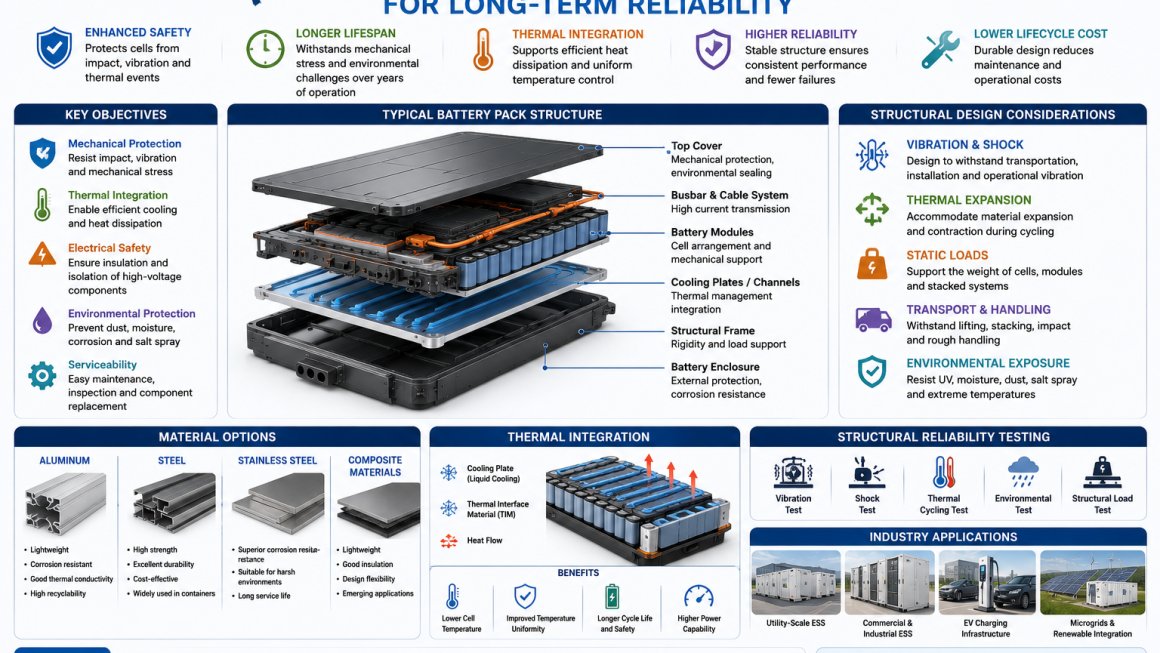
Key Objectives of Battery Pack Structural Design
The primary goals include:
Mechanical Protection
Protect battery cells and internal components from:
- Impact
- Shock
- Vibration
- Transportation loads
Thermal Integration
Support efficient heat transfer and cooling system integration.
Electrical Safety
Maintain proper insulation and isolation between high-voltage components.
Environmental Protection
Prevent contamination from:
- Dust
- Moisture
- Salt spray
- Corrosive environments
Serviceability
Allow efficient maintenance, replacement, and inspection.
Major Structural Components in Battery Packs
Battery Enclosure
The enclosure serves as the first line of protection.
Typical functions include:
- Mechanical protection
- Environmental sealing
- Fire containment support
- Structural rigidity
Common enclosure materials include:
- Aluminum
- Steel
- Stainless steel
- Composite materials
For ESS applications, aluminum is increasingly popular due to its combination of lightweight properties and corrosion resistance.
Module Frames
Battery modules require dedicated support structures that:
- Maintain cell positioning
- Reduce vibration effects
- Ensure dimensional stability
Proper module frame design improves manufacturing consistency and operational reliability.
Mounting Systems
Mounting structures must accommodate:
- Transportation loads
- Seismic conditions
- Thermal expansion
In large-scale ESS installations, mounting systems are often designed according to regional engineering standards and environmental requirements.
Internal Support Structures
Internal supports help:
- Prevent cell movement
- Manage mechanical stress
- Improve structural stiffness
These components become increasingly important as battery packs grow larger and heavier.
Mechanical Challenges in ESS Battery Packs
Vibration
Energy storage systems may experience vibration from:
- Transportation
- Industrial equipment
- Cooling systems
- Environmental factors
Repeated vibration can cause:
- Connection fatigue
- Fastener loosening
- Structural wear
Designers often perform vibration testing to validate structural durability.
Thermal Expansion and Contraction
Battery systems continuously experience temperature changes.
Different materials expand at different rates, potentially causing:
- Mechanical stress
- Seal degradation
- Component misalignment
Structural design must accommodate these movements without compromising safety.
Static Loads
Large battery racks and containers generate significant weight.
Structures must support:
- Long-term compression loads
- Rack stacking loads
- Installation loads
without deformation.
Transportation and Installation Stress
Battery systems often travel long distances before installation.
Structural designs must withstand:
- Shipping vibration
- Handling impacts
- Crane lifting operations
without damage.
Structural Design for Thermal Management
Structural engineering and thermal management are closely linked.
Modern battery pack structures often incorporate:
Cooling Plate Integration
Structural frames support:
- Liquid cooling plates
- Thermal interface materials
- Cooling channels
to ensure efficient heat transfer.
Heat Dissipation Paths
Metal structures can help distribute heat away from localized hotspots.
Materials with higher thermal conductivity improve overall thermal performance.
Airflow Optimization
In air-cooled systems, structural layouts influence:
- Air distribution
- Cooling efficiency
- Temperature uniformity
Poor structural design can restrict airflow and create thermal imbalances.
Material Selection Considerations
Aluminum
Advantages:
- Lightweight
- Corrosion resistant
- Good thermal conductivity
- High recyclability
Widely used in ESS battery enclosures and module structures.
Steel
Advantages:
- High strength
- Excellent durability
- Lower material cost
Often used in utility-scale battery containers and support frames.
Stainless Steel
Advantages:
- Superior corrosion resistance
- Suitable for harsh environments
Common in coastal or industrial installations.
Composite Materials
Emerging applications include:
- Lightweight structural panels
- Insulating components
- Advanced enclosure solutions
Environmental Protection Requirements
Battery packs are often deployed in demanding environments.
Structural design must address:
Dust Protection
Industrial and outdoor systems require high ingress protection ratings.
Moisture Resistance
Proper sealing prevents:
- Corrosion
- Electrical faults
- Insulation degradation
Salt Spray Resistance
Coastal installations require enhanced corrosion protection.
UV Resistance
Outdoor enclosures must withstand long-term sunlight exposure.
Structural Reliability Testing
Reliable battery packs undergo extensive validation testing.
Vibration Testing
Evaluates structural durability under dynamic loading.
Mechanical Shock Testing
Simulates transportation and operational impacts.
Thermal Cycling Testing
Validates performance under repeated temperature fluctuations.
Environmental Testing
Includes:
- Humidity exposure
- Salt spray testing
- Dust ingress testing
Structural Load Testing
Verifies strength under operational conditions.
Emerging Trends in Battery Pack Structures
Lightweight Design
Manufacturers are increasingly seeking:
- Reduced system weight
- Improved transport efficiency
- Lower installation costs
Modular Architectures
Modular structures simplify:
- Manufacturing
- Maintenance
- System expansion
Integrated Cooling Structures
Future designs increasingly combine:
- Structural support
- Thermal management
- Electrical integration
within a unified architecture.
Smart Structural Monitoring
Advanced sensors can monitor:
- Vibration
- Stress
- Temperature
- Structural health
in real time.
Applications Across the ESS Industry
Utility-Scale Energy Storage
Requires highly durable structural systems capable of decades of operation.
Commercial and Industrial ESS
Focuses on compactness, serviceability, and thermal integration.
EV Charging Infrastructure
Requires robust structures capable of handling frequent cycling and high power operation.
Microgrids
Often require transportable and modular structural designs.
Renewable Energy Integration Projects
Demand long-term environmental durability and minimal maintenance.
Best Practices for Long-Term Reliability
To maximize battery pack durability:
- Design for the full operational lifecycle
- Consider thermal and mechanical interactions early
- Select corrosion-resistant materials
- Validate structures through comprehensive testing
- Optimize for maintenance accessibility
- Incorporate modular design principles
- Account for transportation and installation loads
Battery pack structural design is a fundamental element of long-term energy storage system reliability. Beyond simply housing battery cells, modern structures must provide mechanical protection, thermal integration, environmental resistance, and operational durability throughout years of service.
As energy storage systems continue to increase in scale and complexity, advanced structural engineering will remain a key factor in achieving safer, more efficient, and longer-lasting battery solutions. For manufacturers, integrators, and project developers, investing in robust battery pack structural design is essential for maximizing performance and minimizing lifecycle risk.