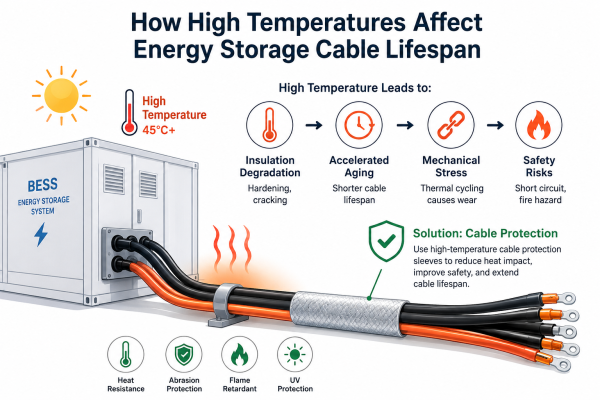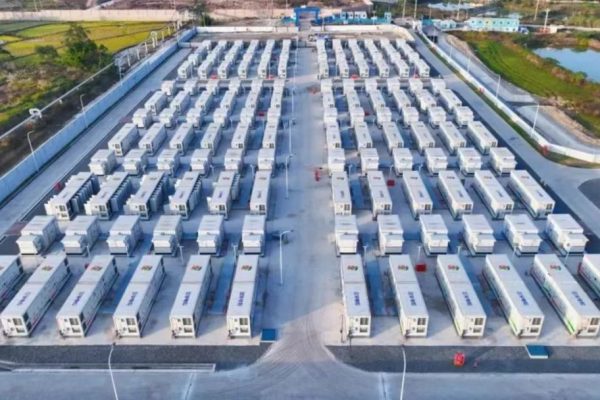
As battery energy storage systems (ESS) continue to grow in capacity and energy density, thermal management has become one of the most important factors affecting system performance, safety, and lifespan. Excessive heat can reduce battery efficiency, accelerate degradation, and increase the risk of thermal runaway.
To address these challenges, two primary cooling approaches dominate the energy storage industry: air cooling and liquid cooling. Each technology offers distinct advantages and limitations depending on project size, operating conditions, and performance requirements.
This article explores the differences between liquid cooling and air cooling in battery energy storage systems and helps identify the most suitable solution for various applications.
Why Thermal Management Matters in ESS
Lithium-ion batteries operate best within a controlled temperature range, typically between 15°C and 35°C.
Poor thermal management can lead to:
- Reduced battery lifespan
- Capacity degradation
- Lower charging efficiency
- Uneven cell temperatures
- Increased maintenance requirements
- Safety concerns
As energy density continues to increase, efficient cooling becomes increasingly critical.
Understanding Air Cooling Systems
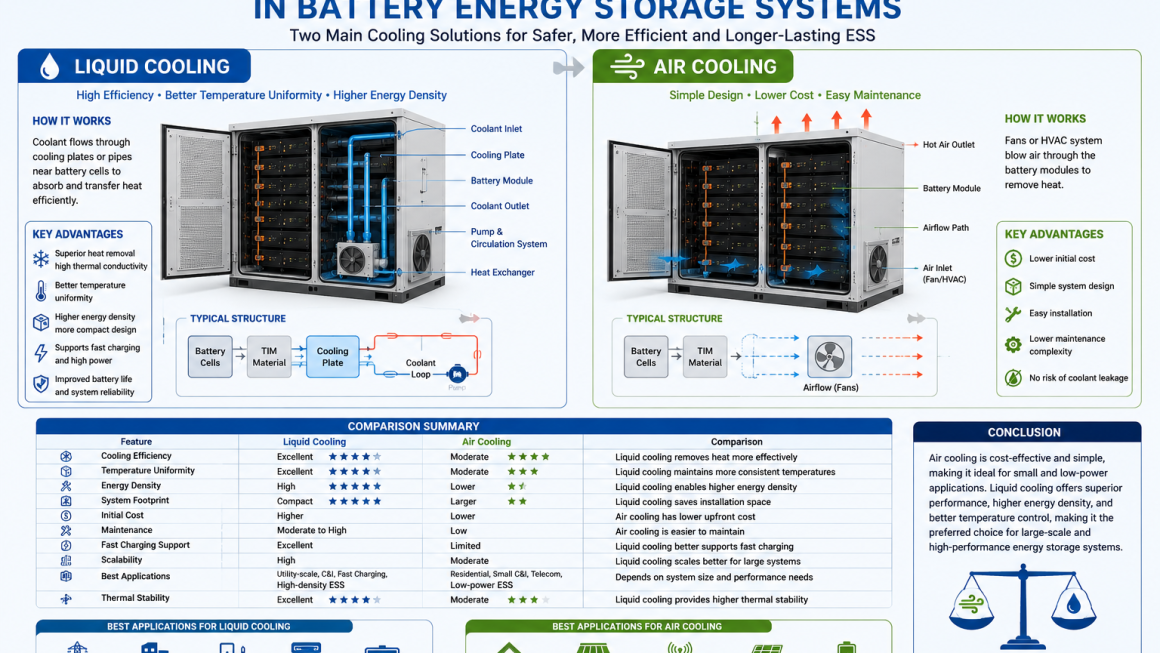
Air cooling removes heat using airflow generated by fans, blowers, or HVAC systems.
The cooling process typically involves:
- Heat generated by battery cells
- Heat transferred to surrounding air
- Forced airflow removing heat from the battery enclosure
Air cooling remains one of the most widely used thermal management solutions in small and medium-sized energy storage systems.
Advantages of Air Cooling
Lower Initial Cost
Air cooling systems generally require:
- Fewer components
- Simpler installation
- Lower engineering complexity
This reduces upfront project costs.
Easier Maintenance
Maintenance typically involves:
- Filter replacement
- Fan inspection
- HVAC servicing
Compared to liquid cooling systems, maintenance procedures are generally simpler.
Proven Technology
Air cooling has been widely used across:
- Commercial ESS
- Residential battery systems
- Telecommunications backup systems
The technology is well understood and widely available.
Lower Risk of Coolant Leakage
Since no liquid circulates through the battery system, there is no risk of coolant leakage damaging electrical components.
Limitations of Air Cooling
Lower Cooling Efficiency
Air has relatively low thermal conductivity.
As battery power density increases, air cooling may struggle to remove heat quickly enough.
Larger Installation Footprint
Air-cooled systems often require:
- Larger ventilation pathways
- Increased spacing between battery racks
- Additional HVAC capacity
This can reduce overall energy density.
Temperature Non-Uniformity
Airflow distribution may create:
- Hot spots
- Uneven cooling
- Cell temperature variation
These factors can affect battery performance and lifespan.
Understanding Liquid Cooling Systems
Liquid cooling uses a coolant circulating through cooling plates, pipes, or cold plate assemblies positioned near battery cells.
Heat transfer occurs through:
- Battery cells
- Thermal interface materials
- Cooling plates
- Coolant circulation system
- External heat exchangers
This approach provides significantly higher cooling efficiency than air cooling.
Advantages of Liquid Cooling
Superior Heat Removal
Liquids have much higher thermal conductivity and heat capacity than air.
Benefits include:
- Faster heat dissipation
- Better temperature control
- Improved thermal stability
Higher Energy Density
Because cooling is more efficient, battery modules can be packed closer together.
This enables:
- More compact ESS designs
- Higher energy density
- Smaller system footprint
Better Temperature Uniformity
Liquid cooling helps maintain:
- Consistent cell temperatures
- Reduced thermal gradients
- Improved battery balancing
This contributes to longer battery life.
Enhanced Fast Charging Support
High-power applications such as:
- Utility-scale ESS
- EV charging infrastructure
- Grid stabilization projects
often require liquid cooling to manage thermal loads effectively.
Limitations of Liquid Cooling
Higher Initial Cost
Liquid cooling systems require:
- Pumps
- Cooling plates
- Heat exchangers
- Fluid management systems
This increases capital costs.
More Complex System Design
Engineering considerations include:
- Coolant flow optimization
- Leak prevention
- Thermal interface design
System integration is more complex than air cooling.
Maintenance Requirements
Periodic inspection may include:
- Coolant quality monitoring
- Pump maintenance
- Leak detection
These requirements increase operational complexity.
Comparing Air Cooling and Liquid Cooling
| Feature | Air Cooling | Liquid Cooling |
|---|---|---|
| Initial Cost | Lower | Higher |
| Cooling Efficiency | Moderate | Excellent |
| Energy Density | Lower | Higher |
| Temperature Uniformity | Moderate | Excellent |
| Maintenance Complexity | Lower | Higher |
| System Footprint | Larger | Smaller |
| Fast Charging Support | Limited | Excellent |
| Scalability | Moderate | High |
| Thermal Stability | Moderate | Excellent |
| Utility-Scale Applications | Limited | Preferred |
Applications Best Suited for Air Cooling
Air cooling remains attractive for:
Residential Energy Storage
- Home battery systems
- Backup power applications
Small Commercial ESS
- Retail facilities
- Small office buildings
Telecommunications
- Backup power systems
- Remote communication infrastructure
Low-Power Applications
Systems with moderate cycling and lower thermal loads can perform well with air cooling.
Applications Best Suited for Liquid Cooling
Liquid cooling is increasingly preferred for:
Utility-Scale Energy Storage
Large battery installations require superior thermal control.
Commercial and Industrial ESS
High-cycle applications benefit from stable thermal management.
EV Charging Infrastructure
Fast charging generates substantial heat.
Liquid cooling improves charging performance and battery longevity.
Data Centers and AI Infrastructure
Growing power demands require highly efficient cooling systems.
High-Density Battery Systems
Liquid cooling enables compact designs while maintaining safe operating temperatures.
The Role of Thermal Interface Materials
Regardless of cooling method, thermal interface materials (TIMs) play a critical role.
TIMs improve heat transfer between:
- Battery cells
- Cooling plates
- Structural components
- Heat spreaders
Common TIM solutions include:
- Thermal pads
- Thermal gels
- Gap fillers
- Graphene-enhanced materials
Proper TIM selection can significantly improve cooling effectiveness.
Emerging Trends in ESS Cooling
Liquid Cooling Becomes Mainstream
Many modern utility-scale ESS platforms are transitioning toward liquid-cooled architectures.
Graphene and Advanced Thermal Materials
New materials are improving heat transfer efficiency while reducing weight.
AI-Based Thermal Management
Advanced EMS platforms can optimize cooling performance using:
- Real-time temperature monitoring
- Predictive analytics
- Dynamic cooling control
Immersion Cooling
Future high-density battery systems may adopt immersion cooling technologies for even greater thermal performance.
Best Practices for ESS Thermal Design
- Evaluate thermal requirements early in system design
- Match cooling technology to application requirements
- Prioritize temperature uniformity across battery modules
- Integrate thermal interface materials effectively
- Conduct thermal simulations and field testing
- Design for long-term maintenance and reliability
The choice between liquid cooling and air cooling depends on project requirements, battery density, operating conditions, and performance goals. Air cooling remains a cost-effective solution for smaller and lower-power systems, while liquid cooling is rapidly becoming the preferred choice for high-density, utility-scale, and fast-charging applications.
As energy storage systems continue to evolve, advanced thermal management technologies will play an increasingly important role in improving efficiency, extending battery lifespan, and ensuring safe operation. For modern ESS projects, selecting the right cooling strategy is a key factor in achieving reliable and long-lasting energy storage performance.