
As global demand for renewable energy and grid flexibility continues to rise, modern energy storage systems are evolving rapidly. While much attention is often focused on battery chemistry, cell energy density, or charging speed, one critical layer is frequently overlooked:
Battery module design.
In large-scale energy storage systems (ESS), battery modules act as the bridge between individual battery cells and the complete storage container or cabinet. Their design directly impacts system safety, thermal performance, maintenance efficiency, manufacturing scalability, transportation, and long-term operational reliability.
Today, as the energy storage industry moves toward larger capacities, higher energy densities, and faster deployment cycles, optimized ESS battery modules are becoming a key differentiator for system integrators and battery manufacturers alike.
What Is a Battery Module in an ESS?
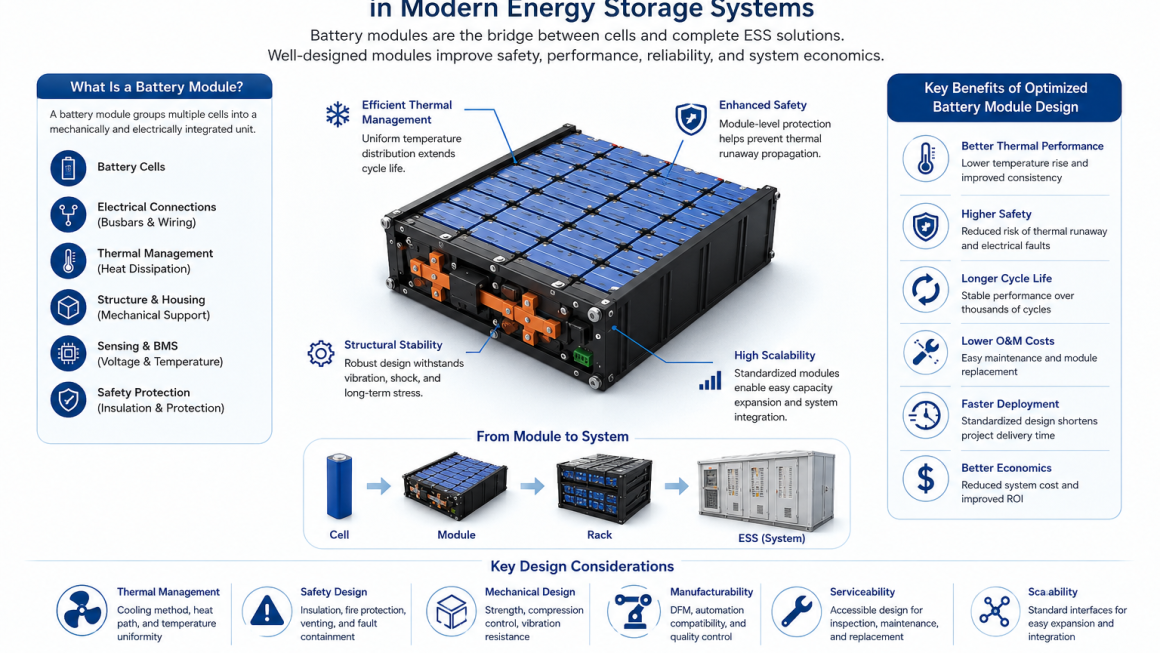
A battery module is an intermediate assembly that groups multiple battery cells into a mechanically and electrically integrated structure.
Typically, a battery module includes:
- Battery cells
- Busbars and electrical connections
- Thermal management interfaces
- Structural frames or housings
- Voltage and temperature sensing components
- Safety protection mechanisms
- Insulation materials
Multiple modules are then combined into battery packs, racks, and ultimately full energy storage systems.
This modular architecture is widely adopted across utility-scale ESS, commercial & industrial (C&I) storage, telecom backup systems, and renewable energy integration projects.
Without effective battery module design, even high-performance battery cells may fail to deliver reliable system-level performance.
Why Battery Module Design Is Becoming More Important
The modern energy storage industry is facing several simultaneous pressures:
- Higher energy density requirements
- Lower system costs
- Faster installation timelines
- Improved safety standards
- Easier maintenance
- Better thermal control
- Flexible scalability
As battery cells continue to become larger — especially with the rise of 280Ah, 314Ah, and even larger-format LFP cells — the challenges at the module level become significantly more complex.
In many cases, the module becomes the real engineering bottleneck.
A poorly designed module can lead to:
- Uneven temperature distribution
- Thermal runaway propagation
- Difficult field maintenance
- Excessive vibration stress
- Electrical inconsistency
- Increased assembly complexity
- Reduced cycle life
This is why advanced modular battery systems are now being designed with far greater attention to mechanical engineering, thermal architecture, manufacturability, and safety integration.
The Role of Battery Module Design in Thermal Management
Thermal management is one of the most critical factors in ESS reliability.
Battery cells generate heat during charging and discharging. If this heat is not distributed evenly, temperature gradients form inside the module.
Even small temperature differences can cause:
- Capacity imbalance
- Accelerated aging
- Reduced cycle life
- Safety risks
- Lower energy efficiency
Modern ESS battery modules are therefore increasingly designed around thermal pathways.
Depending on the application, modules may use:
- Air cooling
- Liquid cooling
- Cold plate integration
- Phase change materials
- Heat spreaders
- Thermal interface materials
The mechanical structure of the module determines how efficiently heat can move away from the cells.
For example, liquid-cooled energy storage systems require carefully engineered cooling channels, pressure control, sealing reliability, and thermal contact consistency.
As energy density increases, thermal design is no longer optional — it becomes foundational.
Safety Starts at the Module Level
In modern energy storage systems, safety is no longer viewed only at the container level.
The battery module itself has become a primary safety boundary.
A well-designed module can help prevent:
- Thermal runaway propagation
- Internal short circuits
- Electrical arc risks
- Mechanical deformation
- Overheating during high-rate operation
Many modern modular battery systems now include integrated fire-resistant barriers, thermal insulation layers, pressure relief pathways, and gas venting structures directly inside the module architecture.
This approach improves containment capability before failures spread to adjacent modules or racks.
The shift toward stricter global ESS safety regulations is also increasing focus on module-level protection strategies.
Standards such as:
- UL 9540A
- IEC 62619
- NFPA 855
are pushing manufacturers to rethink how battery modules are engineered for large-scale deployment.
Mechanical Design and Structural Stability
Battery modules in ESS applications often operate for 10–20 years under varying environmental conditions.
During this period, modules may experience:
- Thermal expansion
- Mechanical vibration
- Transportation shock
- Humidity exposure
- Repeated cycling stress
Mechanical instability can gradually damage electrical connections, weld points, or thermal interfaces.
As a result, battery module design now requires a strong focus on structural engineering.
Key considerations include:
Compression Control
Certain battery chemistries require stable compression forces to maintain long-term cell performance.
Uneven pressure distribution may lead to swelling, degradation, or capacity inconsistency.
Vibration Resistance
Large-scale ESS containers may be transported over long distances before installation.
Poor vibration resistance can damage busbars, connectors, or sensing systems.
Lightweight Structural Optimization
Reducing module weight can improve:
- Installation efficiency
- Transportation costs
- Energy density
- Rack loading capability
This is driving increased adoption of aluminum alloys, composite materials, and optimized frame geometries.
Modular Battery Systems Improve Scalability
One major advantage of modular battery systems is scalability.
Instead of redesigning entire storage architectures for each project, manufacturers can standardize around repeatable module platforms.
This modular approach allows:
- Faster system integration
- Simplified maintenance
- Easier capacity expansion
- Improved manufacturing consistency
- Reduced spare parts complexity
For utility-scale projects, scalability becomes extremely important.
Developers may deploy systems ranging from a few megawatt-hours (MWh) to several gigawatt-hours (GWh).
Using standardized ESS battery modules enables more efficient production and deployment across multiple project sizes.
This is also why many leading ESS companies invest heavily in platform-based module architectures.
Battery Module Design Affects Manufacturing Efficiency
Battery manufacturing is increasingly shifting toward automation.
However, automation efficiency depends heavily on module design compatibility.
Complex or inconsistent module structures can slow production and increase defect rates.
Modern battery module design therefore emphasizes:
- Automated assembly compatibility
- Reduced fastener counts
- Simplified busbar layouts
- Standardized interfaces
- Faster welding processes
- Improved inline inspection
Design for manufacturability (DFM) is becoming a critical requirement in large-scale ESS production.
A module that performs well in the laboratory may still fail commercially if it cannot be manufactured efficiently at scale.
Maintenance and Serviceability Matter
Energy storage systems are long-term infrastructure assets.
Over time, operators may need to:
- Replace failed modules
- Inspect thermal systems
- Upgrade system capacity
- Perform diagnostics
Poor module accessibility increases downtime and operational costs.
Modern ESS battery modules are therefore increasingly designed with serviceability in mind.
Features may include:
- Front-access maintenance
- Plug-and-play electrical interfaces
- Quick-disconnect cooling systems
- Simplified monitoring integration
- Modular replacement capability
This is especially important for commercial and industrial ESS installations where maintenance windows may be limited.
The Shift Toward Cell-to-Pack and Cell-to-System Architectures
The industry is also seeing growing interest in:
- Cell-to-Pack (CTP)
- Cell-to-System (CTS)
These approaches aim to reduce intermediate structural layers and improve energy density.
However, even in these architectures, the principles of battery module design remain highly relevant.
Thermal management, structural integrity, electrical isolation, and safety engineering still need to be addressed — simply at a different architectural level.
In many cases, the “module” becomes more functional than physical.
This means future ESS engineering will likely focus less on traditional module shapes and more on integrated system-level design strategies.
How Battery Module Design Impacts ESS Economics
Battery module engineering does not only affect technical performance.
It also directly impacts project economics.
Optimized ESS battery modules can help reduce:
- Manufacturing costs
- Installation labor
- Cooling energy consumption
- Maintenance expenses
- Transportation costs
- System downtime
At utility scale, even small efficiency improvements can create significant financial advantages over the lifetime of a project.
As energy storage markets become increasingly competitive, module optimization is becoming a strategic advantage rather than just a technical detail.
Future Trends in ESS Battery Modules
Several trends are shaping the future of battery module design in modern energy storage systems:
Larger Cell Formats
As larger LFP cells become mainstream, module structures must adapt to increased thermal and mechanical challenges.
Higher Integration
Future systems will likely integrate cooling, sensing, and structural functions more tightly together.
Smarter Monitoring
Embedded sensors and AI-assisted diagnostics may become standard at the module level.
Advanced Thermal Materials
Graphene-enhanced materials, phase change materials, and advanced thermal interfaces may improve heat management efficiency.
Faster Manufacturing
Highly automated module assembly lines will become increasingly important for GWh-scale production.
Modern energy storage systems are no longer defined solely by battery chemistry.
The real-world performance of an ESS increasingly depends on how effectively the system is engineered at the module level.
Battery module design influences:
- Safety
- Thermal management
- Structural reliability
- Manufacturing scalability
- Maintenance efficiency
- Long-term project economics
As the global ESS industry continues scaling rapidly, companies that optimize their modular battery systems will be better positioned to deliver reliable, cost-effective, and commercially successful energy storage solutions.
In the coming years, battery module engineering will likely become one of the most important competitive layers in the entire energy storage value chain.