
As global energy infrastructure shifts toward electrification, renewable integration, and decentralized power management, energy storage system (ESS) architecture is evolving rapidly. Traditional large-scale battery installations are gradually giving way to modular energy storage architectures that offer greater flexibility, scalability, safety, and deployment efficiency.
Today, modular ESS design has become one of the most important trends in modern energy storage development, enabling applications ranging from residential backup systems to utility-scale renewable integration and AI-driven smart grids.
What Is a Modular Energy Storage Architecture?
A modular energy storage architecture is a system design approach where the ESS is built using standardized and scalable building blocks.
These modules may include:
- Battery modules
- Battery racks
- Power conversion systems (PCS)
- Battery management systems (BMS)
- Thermal management systems
- EMS control units
Instead of relying on a single monolithic structure, modular ESS platforms allow flexible system expansion and simplified deployment.
Why Modular ESS Architecture Became Important
Traditional energy storage systems often faced challenges such as:
- Difficult scalability
- Complex maintenance
- Long deployment cycles
- High integration costs
- Limited flexibility for different applications
Modular architectures solve these issues by enabling:
- Faster deployment
- Easier maintenance
- Flexible system sizing
- Improved redundancy and reliability
- Lower lifecycle operational complexity
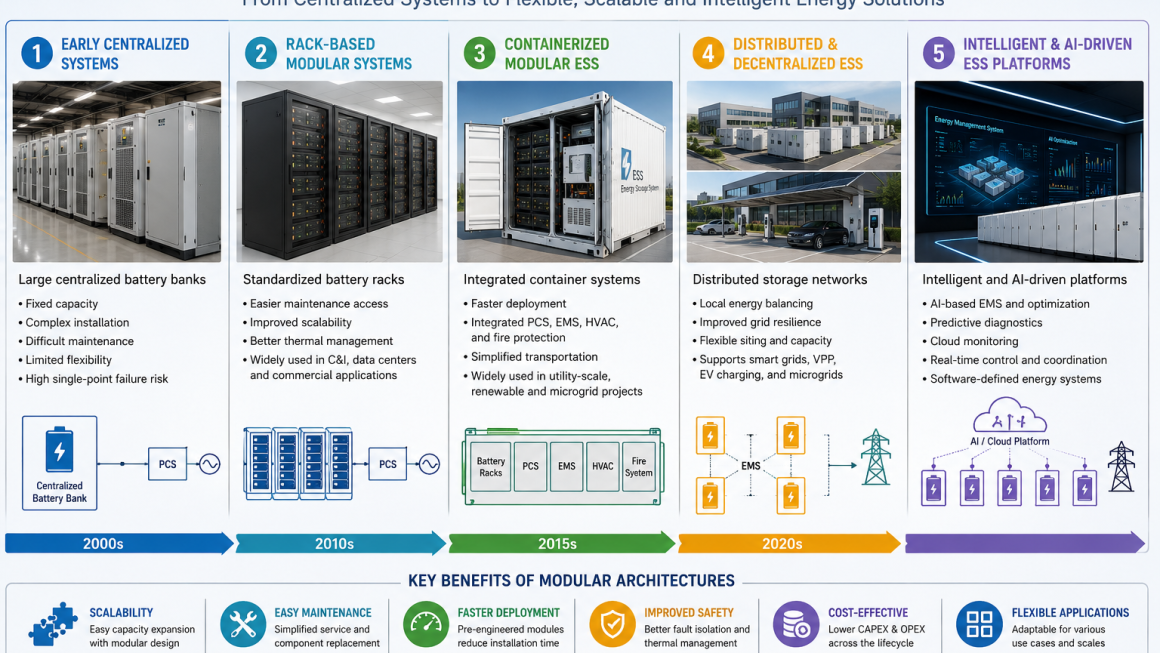
The Evolution of ESS Architecture
1. Early Centralized Energy Storage Systems
Initial ESS designs were:
- Large centralized battery banks
- Fixed-capacity systems
- Highly customized installations
Challenges included:
- Difficult expansion
- Complex maintenance
- Single-point failure risks
These systems were primarily designed for utility-scale applications.
2. Rack-Based Modular Architectures
As ESS demand expanded, rack-based designs emerged.
Features included:
- Standardized battery racks
- Easier maintenance access
- Improved scalability
- Better thermal management organization
Rack-based systems became widely adopted in:
- Commercial & industrial ESS
- Data centers
- Renewable integration projects
3. Containerized Modular ESS
The next major evolution was the rise of containerized ESS platforms.
Integrated container systems combined:
- Battery racks
- PCS
- EMS
- HVAC systems
- Fire suppression systems
Advantages:
- Faster deployment
- Reduced on-site engineering
- Simplified transportation
- Improved environmental protection
Containerized ESS is now widely used in:
- Utility-scale storage
- Renewable power plants
- Microgrids
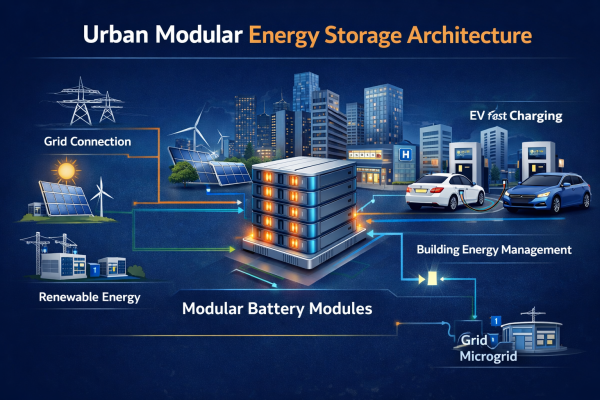
4. Distributed and Decentralized ESS Architectures
Modern energy systems increasingly require distributed storage networks.
This evolution supports:
- Urban energy systems
- Smart grids
- EV charging infrastructure
- Virtual power plants (VPP)
Distributed ESS enables:
- Localized energy balancing
- Improved grid resilience
- Flexible energy dispatch
5. Intelligent and AI-Driven ESS Platforms
Future ESS architectures are becoming increasingly software-defined.
Modern systems integrate:
- AI-based EMS platforms
- Predictive diagnostics
- Cloud monitoring
- Smart grid communication
- Real-time optimization algorithms
This enables:
- Autonomous system management
- Predictive maintenance
- Dynamic energy optimization
Key Advantages of Modular ESS Design
Scalability
Modular systems support:
- Flexible capacity expansion
- Incremental deployment
- Easier future upgrades
Additional modules can be added as demand increases.
Faster Deployment
Pre-engineered modular systems reduce:
- Installation time
- Site complexity
- Engineering workload
This accelerates project implementation.
Simplified Maintenance
Modular architecture allows:
- Easier component replacement
- Reduced downtime
- Better fault isolation
Maintenance becomes more efficient and cost-effective.
Improved Safety
Modular segmentation helps:
- Contain thermal events
- Improve fault isolation
- Enhance fire protection strategies
Safety architecture becomes more manageable at the module level.
Greater Application Flexibility
Modular ESS can support:
- Residential systems
- Commercial buildings
- Industrial facilities
- Utility-scale renewable integration
- EV charging infrastructure
- Microgrids
Core Components of Modern Modular ESS
1. Battery Modules
Standardized battery units designed for:
- Flexible integration
- High energy density
- Simplified replacement
Common chemistries:
- LFP (Lithium Iron Phosphate)
- NMC (Nickel Manganese Cobalt)
- Emerging sodium-ion systems
2. Modular PCS (Power Conversion System)
Modern PCS architecture supports:
- Bidirectional energy flow
- Parallel operation
- Independent module control
3. Distributed BMS Architecture
Advanced BMS systems provide:
- Cell-level monitoring
- Rack-level protection
- Centralized system coordination
4. Intelligent EMS Platforms
EMS systems optimize:
- Energy dispatch
- Renewable coordination
- Load balancing
- Predictive maintenance
AI-driven control is becoming increasingly important.
5. Integrated Thermal Management
Modular thermal design supports:
- Independent cooling zones
- Improved heat dissipation
- Better operational consistency
Cooling methods may include:
- Air cooling
- Liquid cooling
- Immersion cooling
Applications Driving Modular ESS Growth
Renewable Energy Integration
Modular ESS supports:
- Solar farms
- Wind power systems
- Hybrid renewable projects
Commercial & Industrial ESS
Flexible architecture enables:
- Peak shaving
- Backup power
- Energy optimization
EV Charging Infrastructure
Modular storage supports:
- Fast charging systems
- Urban charging hubs
- Fleet charging networks
Data Centers and AI Infrastructure
ESS improves:
- Power stability
- UPS functionality
- AI workload resilience
Smart Cities and Urban Energy Systems
Distributed modular ESS supports:
- Local energy balancing
- Smart grid coordination
- Renewable integration
Emerging Trends in Modular ESS Architecture
All-in-One ESS Cabinets
Compact integrated systems for urban deployment.
Plug-and-Play Energy Modules
Simplified installation and rapid scalability.
AI-Optimized Distributed ESS
Intelligent coordination across multiple storage assets.
Hybrid Energy Storage Platforms
Combining:
- Batteries
- Supercapacitors
- Hydrogen systems
- Long-duration storage technologies
High-Voltage Modular Platforms
Improved efficiency and reduced system losses.
Challenges in Modular ESS Development
Thermal Complexity
Higher power density increases cooling demands.
System Standardization
Industry-wide interoperability standards are still evolving.
Communication and Control
Distributed systems require robust software coordination.
Safety Management
Large-scale modular systems require advanced protection architecture.
Best Practices
- Prioritize modular scalability from the early design stage
- Integrate thermal and safety systems at the module level
- Design for easy maintenance and replacement
- Use intelligent EMS for distributed coordination
- Validate systems through pilot and real-world deployment
The evolution of modular energy storage architectures is reshaping the future of modern energy infrastructure. By enabling scalable deployment, flexible integration, improved safety, and intelligent energy management, modular ESS platforms are becoming the foundation of next-generation renewable and decentralized energy systems.
As energy networks continue transitioning toward smarter and more distributed architectures, modular ESS design will play a critical role in building resilient, efficient, and future-ready power ecosystems.