As industries move toward electrification, renewable integration, and smarter energy management, industrial energy storage systems (ESS) are becoming a critical part of modern infrastructure. From manufacturing plants and logistics centers to data centers and heavy industrial operations, energy storage enables greater energy stability, operational flexibility, and long-term cost optimization.
However, industrial applications require more than simply adding batteries. Successful deployment depends on careful system design, integration, thermal management, safety planning, and long-term operational strategy.
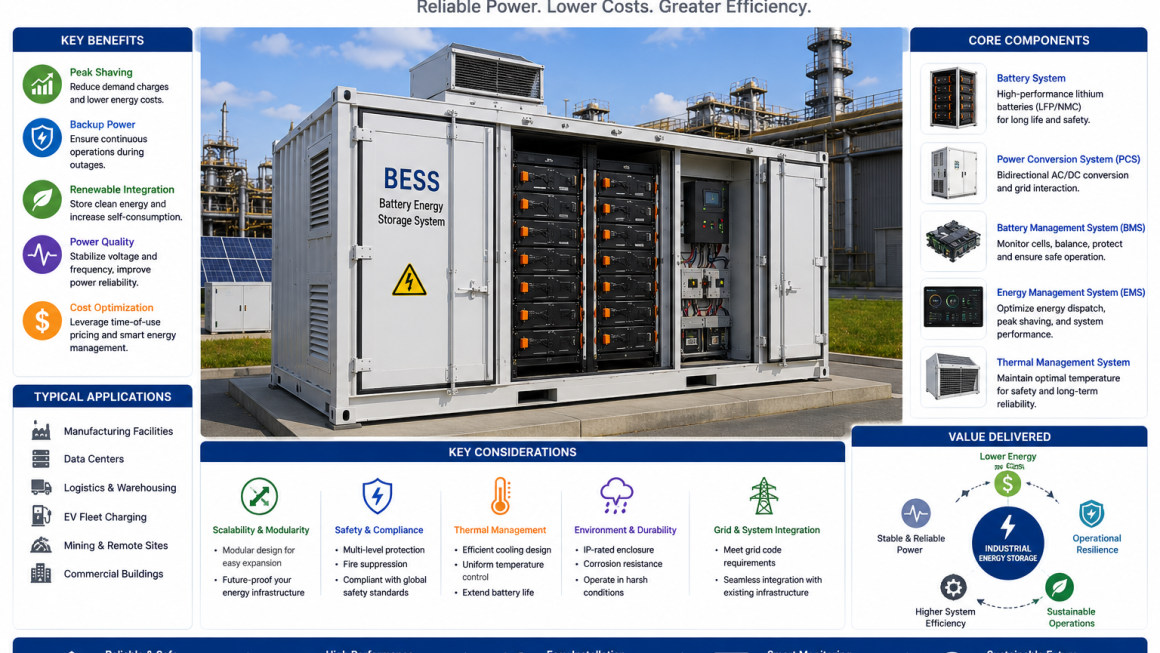
Why Industrial Energy Storage Matters
Industrial facilities often face:
- High peak electricity demand
- Rising energy costs
- Power quality issues
- Renewable integration challenges
- Backup power requirements
Energy storage systems help solve these challenges by:
- Stabilizing energy supply
- Reducing peak demand charges
- Supporting renewable energy usage
- Improving operational resilience
Main Functions of Industrial Energy Storage Systems
1. Peak Shaving
Industrial ESS can:
- Store electricity during off-peak periods
- Supply power during high-demand periods
This reduces:
- Demand charges
- Grid stress
- Operational electricity costs
2. Backup Power and Energy Resilience
Energy storage provides:
- Emergency backup power
- Protection against grid outages
- Improved operational continuity
Critical industries increasingly rely on ESS for energy security.
3. Renewable Energy Integration
Industrial ESS supports:
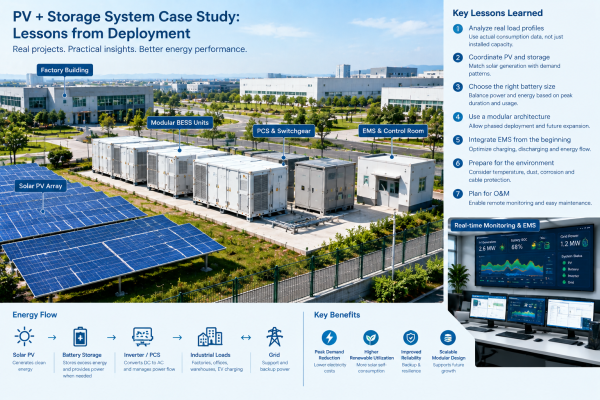
- Solar + storage systems
- Wind + storage integration
- Hybrid renewable power architectures
This improves renewable utilization and energy independence.
4. Power Quality and Stability
Energy storage helps stabilize:
- Voltage fluctuations
- Frequency variations
- Sudden load changes
Especially important for:
- Precision manufacturing
- Semiconductor production
- Data centers
5. Energy Cost Optimization
ESS enables:
- Time-of-use energy management
- Smart load shifting
- Reduced infrastructure upgrade costs
Key Components of Industrial ESS
1. Battery Storage System
The battery system stores and delivers electrical energy.
Common battery chemistries:
- LFP (Lithium Iron Phosphate)
- NMC (Nickel Manganese Cobalt)
- Emerging sodium-ion technologies
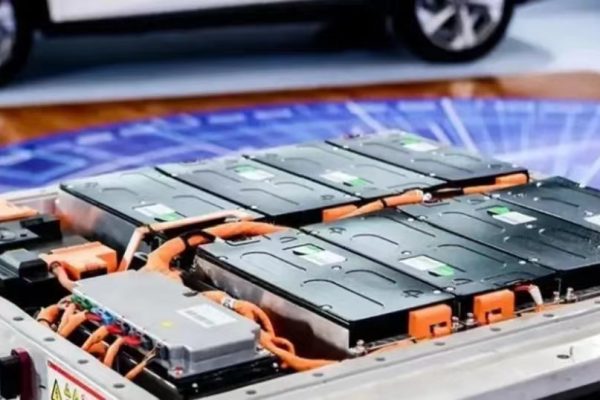
Battery systems include:
- Cells
- Modules
- Packs and racks
- High-voltage DC architectures
2. Power Conversion System (PCS)
The PCS manages:
- AC/DC conversion
- Bidirectional power flow
- Grid synchronization
- Charging and discharging operations
3. Battery Management System (BMS)
The BMS ensures:
- Cell balancing
- Thermal monitoring
- Safety protection
- Fault diagnostics
4. Energy Management System (EMS)
The EMS optimizes:
- Energy dispatch
- Peak shaving strategies
- Renewable coordination
- Real-time energy analytics
Modern EMS platforms increasingly use AI-based optimization.
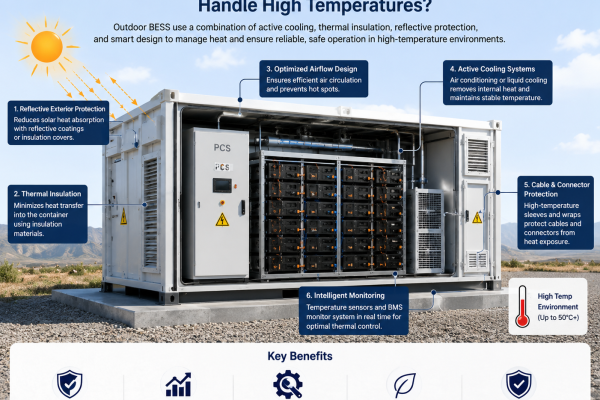
5. Thermal Management System
Industrial ESS generates significant heat under high-load operation.
Thermal systems maintain:
- Temperature stability
- Battery safety
- Long-term reliability
Cooling approaches include:
- Air cooling
- Liquid cooling
- Hybrid thermal systems
Key Design Considerations
1. System Scalability
Industrial energy demand may grow over time.
ESS architecture should support:
- Modular expansion
- Flexible deployment
- Future capacity upgrades
2. Safety and Fire Protection
Industrial ESS requires advanced safety architecture:
- Thermal runaway prevention
- Fire suppression systems
- Gas detection and ventilation
- Electrical isolation and grounding
Safety design is especially critical for large-scale systems.
3. Thermal Management
High-power industrial operation requires:
- Uniform temperature control
- Efficient heat dissipation
- Long-duration operational stability
Thermal performance directly impacts battery lifespan and safety.
4. Mechanical and Environmental Protection
Industrial systems may operate in:
- Dusty environments
- High-temperature conditions
- Outdoor installations
- Corrosive industrial settings
Enclosures must provide:
- Structural durability
- Environmental sealing
- Corrosion resistance
5. Grid and Infrastructure Compatibility
Industrial ESS must integrate with:
- Existing electrical infrastructure
- Renewable generation systems
- Facility energy management systems
- Utility interconnection standards
Typical Industrial ESS Configurations
Manufacturing Facilities
Used for:
- Peak demand reduction
- Backup power
- Process stability
Logistics and Warehousing
Supports:
- EV fleet charging
- Renewable integration
- Load balancing
Data Centers
Energy storage improves:
- Backup power capability
- Power quality stability
- AI infrastructure reliability
Heavy Industry
Applications include:
- Mining operations
- Chemical plants
- Steel manufacturing
- Remote industrial sites
Key Challenges
High Power Density
Industrial systems often operate under continuous heavy load.
Thermal Complexity
Large systems generate substantial heat.
Safety Management
Industrial ESS requires multi-layer protection architecture.
System Integration
Coordinating batteries, PCS, EMS, HVAC, and facility infrastructure is complex.
Emerging Trends
1. Containerized Industrial ESS
Pre-integrated modular systems for rapid deployment.
2. AI-Based Energy Optimization
Predictive energy management and operational analytics.
3. Renewable + Industrial Storage Ecosystems
Integrated clean energy infrastructure for industrial operations.
4. High-Voltage ESS Platforms
Improved efficiency for large-scale industrial applications.
5. Hybrid Energy Storage Systems
Combining batteries with:
- Supercapacitors
- Hydrogen systems
- Renewable generation
Best Practices
- Design for scalability from the beginning
- Prioritize safety and thermal management early
- Integrate EMS and facility energy systems jointly
- Validate systems through pilot and field testing
- Ensure compliance with industrial and utility standards
Industrial energy storage solutions are becoming a key component of modern industrial infrastructure. By improving energy stability, reducing costs, supporting renewable integration, and enhancing operational resilience, ESS enables industries to transition toward smarter and more sustainable energy systems.
As industrial electrification accelerates globally, advanced energy storage will play a critical role in shaping the future of reliable and efficient industrial power management.