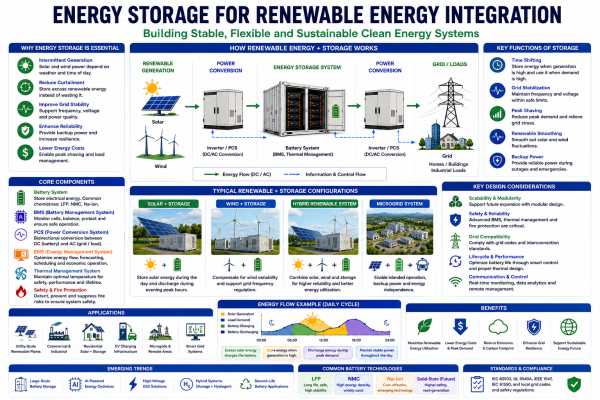
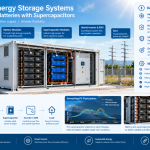
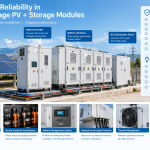
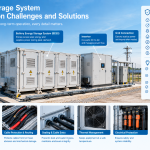
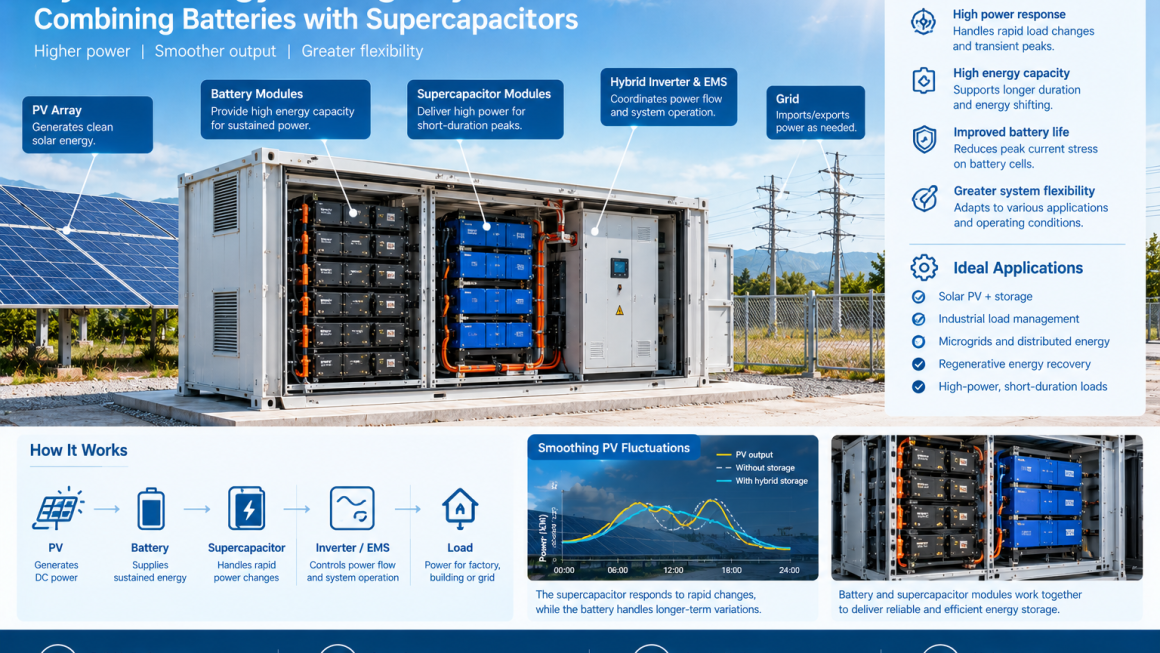
As renewable energy, electrification, and industrial power demands continue to grow, energy storage systems must do more than store electricity. They increasingly need to respond to rapid power fluctuations, manage sudden load changes, support stable operation, and maintain reliable performance over repeated charge and discharge cycles.
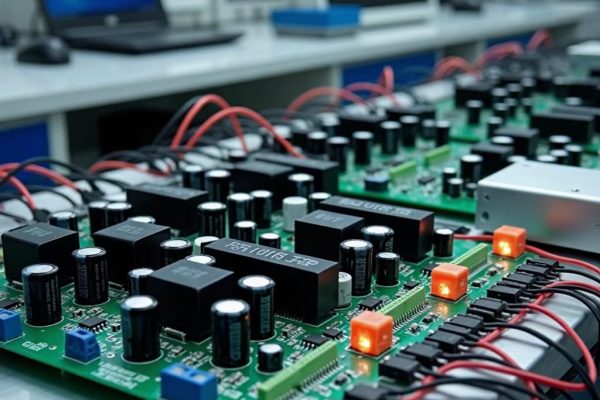
Battery energy storage systems (BESS) are widely used because they can store substantial amounts of energy and deliver it over extended periods. However, frequent high-power transients and rapid changes in demand can place additional stress on battery cells, depending on the battery chemistry, system design, and operating conditions.
Supercapacitors offer a complementary capability. They can absorb and release electrical energy very quickly, provide high power over short periods, and tolerate many charge and discharge cycles. Their principal limitation is that they generally store much less energy per unit of mass or volume than batteries.
By combining batteries with supercapacitors, engineers can create a hybrid energy storage system (HESS) that balances energy capacity, power response, and operating flexibility.
This article explains how battery-supercapacitor hybrid storage works, where it can be useful, what engineering challenges must be addressed, and how project developers can evaluate whether the additional complexity is justified.
1. What Is a Hybrid Battery-Supercapacitor Energy Storage System?
A hybrid energy storage system combines two or more energy storage technologies to take advantage of their different characteristics.
In a battery-supercapacitor configuration, the battery typically supplies sustained energy demand, while the supercapacitor handles rapid changes in power demand or absorbs short-duration energy surges.
The system may include:
- Battery modules for medium- and long-duration energy storage
- Supercapacitor modules for rapid charge and discharge
- DC/DC converters for voltage regulation and power control
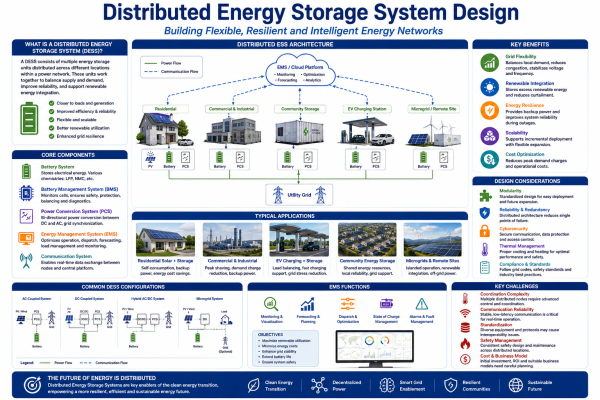
- An inverter or power conversion system (PCS), depending on the application
- A battery management system (BMS)
- A supervisory energy management system (EMS)
- Sensors, protection devices, and communication interfaces
The exact architecture depends on whether the system connects to a DC bus, an AC network, a renewable energy installation, or an industrial load.
The main design objective is to allocate power intelligently between the battery and supercapacitor rather than expecting one technology to perform every function.
Battery vs. supercapacitor: What is the difference?
| Characteristic | Battery energy storage | Supercapacitor energy storage |
|---|---|---|
| Primary strength | Higher energy storage capacity | High power and rapid response |
| Typical operating role | Sustained energy delivery | Short-duration power support |
| Response to rapid power changes | Depends on chemistry, cell design, and power electronics | Well suited to rapid charge and discharge |
| Cycle life | Depends on chemistry, temperature, depth of discharge, and operating profile | Often supports very high cycle counts |
| Energy density | Generally higher | Generally much lower |
| Self-discharge | Chemistry-dependent | Often relatively high |
| Common applications | Solar storage, backup power, energy shifting | Power smoothing, transient support, regenerative energy capture |
These are general comparisons. Actual performance depends on the specific battery and supercapacitor technologies, their operating conditions, and the power electronics used to connect them.
A supercapacitor is not simply a smaller battery. It serves a different function in the overall energy system.
2. Why Combine Batteries with Supercapacitors?
The main reason to combine these technologies is that energy demand does not always change smoothly.
A solar installation may experience rapid output fluctuations when clouds pass overhead. An industrial machine may draw a large current during startup. A motor drive may generate brief power surges during acceleration, while a braking system may return energy to the electrical bus during deceleration.
If a battery is required to respond to every rapid fluctuation, its current profile may become more demanding than necessary.
A supercapacitor can provide a fast-response power buffer, potentially reducing the magnitude or frequency of some battery power fluctuations.
The benefits depend on the system design and operating profile.
2.1 Handling short-duration power peaks
Supercapacitors can supply high power for short periods when an electrical load suddenly increases.
For example, if an industrial load briefly requires more power than its normal operating level, the supercapacitor may provide part of the additional demand while the battery continues supplying the sustained load.
This arrangement can reduce the need to size the battery solely around brief power peaks, provided the supercapacitor has sufficient power capability and usable energy.
2.2 Smoothing renewable energy fluctuations
PV output can change quickly due to passing clouds, shading, or other environmental conditions.
A hybrid controller can direct rapid fluctuations to the supercapacitor while allowing the battery to respond to slower changes in the energy balance.
This can help smooth power delivered to a load or electrical bus. Whether it reduces battery stress depends on the control strategy, the duration of the fluctuations, and the relative sizes of the two storage devices.
2.3 Capturing regenerative energy
Certain industrial and transportation applications release electrical energy during braking or deceleration.
A supercapacitor can absorb this energy quickly, subject to its available capacity and charge-power limits. The stored energy can then be reused during acceleration or another high-power event.
This can improve energy recovery where the system architecture supports regenerative operation.
2.4 Supporting transient stability
Rapid load changes can cause voltage fluctuations or challenge power conversion equipment.
A suitably controlled supercapacitor can provide fast power support to a DC bus or other electrical interface. However, it does not automatically provide grid-forming capability, backup power, or voltage regulation at the system level. Those functions depend on the converter and control architecture.
3. How Does a Battery-Supercapacitor Hybrid System Work?
A hybrid storage system relies on coordinated power management.
The controller monitors the load, available renewable generation, battery state of charge, supercapacitor voltage, and other relevant operating variables. It then determines how much power each storage device should deliver or absorb.
A simplified operating strategy is:
- Battery: Supplies the sustained or low-frequency component of the power demand.
- Supercapacitor: Handles selected rapid fluctuations and short-duration peaks.
- Controller: Coordinates power sharing and maintains operating limits.
- Power electronics: Regulate voltage and current while connecting the storage devices to the electrical system.
For example, when a machine starts and its power demand increases rapidly, the supercapacitor may discharge to support the initial transient. If the elevated load continues, the battery supplies the sustained portion.
When the load decreases suddenly, the controller may reduce battery output and direct available regenerative or surplus energy toward the supercapacitor, provided charging limits and system conditions permit.
The controller must also restore the supercapacitor’s available energy after each event. If it is depleted before the next power surge, its ability to provide support will be reduced.
A simplified power-sharing concept
Let the total storage power required by the application be (P_{\text{req}}). Under a simplified sign convention:
[
P_{\text{req}} = P_{\text{battery}} + P_{\text{SC}}
]
Here, (P_{\text{SC}}) represents supercapacitor power, and positive values represent discharge toward the load.
The controller allocates power according to the required response, device limits, and system objectives.
This equation is a conceptual power balance. A real system must also account for conversion losses, auxiliary consumption, renewable generation, grid power, and other energy flows.
4. Selecting the Right Hybrid System Architecture
The electrical architecture determines how independently the battery and supercapacitor can be controlled.
Three common approaches are passive, semi-active, and fully active configurations.
4.1 Passive hybrid configuration
In a passive configuration, the battery and supercapacitor are connected through a relatively simple electrical arrangement without fully independent converter control.
The distribution of current depends heavily on device voltage characteristics and the electrical network.
Advantages
- Potentially simpler power electronics
- Lower control complexity
- Possible reduction in component count
Limitations
- Less independent control over power sharing
- Operating performance depends strongly on the electrical characteristics of both devices
- Voltage matching and safe operating limits require careful design
Passive configurations may suit particular applications, but they are not automatically the most efficient or economical choice.
4.2 Semi-active configuration
A semi-active system uses a converter to control one storage device while the other connects more directly to the electrical bus.
For example, the supercapacitor may connect through a bidirectional DC/DC converter while the battery remains connected to a regulated DC bus.
This allows more controlled use of the supercapacitor without requiring separate converters for both storage devices.
The trade-off is that the directly connected device has less independent voltage and power control.
4.3 Fully active configuration
In a fully active system, both the battery and supercapacitor connect through independently controlled power converters.
This provides greater flexibility in managing power sharing, voltage, and operating limits.
Potential benefits include:
- Independent power control
- More flexible voltage matching
- Better control of rapid load changes
- Greater freedom to optimize operating strategies
However, additional converters and control functions increase system complexity, cost, and conversion losses. The actual efficiency depends on the converter design and operating point.
For applications requiring precise power management, a fully active configuration may be worth evaluating. For simpler applications, its additional cost may not produce sufficient benefit.
5. Key Engineering Considerations for Battery-Supercapacitor Integration
A successful hybrid storage system requires more than connecting a supercapacitor module to an existing battery installation.
The two technologies have different electrical characteristics, voltage behavior, operating constraints, and energy management requirements.
5.1 Voltage matching and DC/DC conversion
Battery voltage changes with state of charge, current, temperature, and chemistry. Supercapacitor voltage also changes substantially as it charges and discharges.
A supercapacitor’s stored energy is approximately:
[
E = \frac{1}{2}CV^2
]
where:
- (E) is stored energy in joules
- (C) is capacitance in farads
- (V) is the supercapacitor voltage
Because energy depends on the square of voltage, only part of the nominal energy may be available within the system’s permitted voltage window.
A bidirectional DC/DC converter can regulate power flow and allow the supercapacitor to operate across a suitable voltage range.
Engineers must evaluate converter power rating, current limits, voltage range, efficiency, transient response, and thermal performance.
5.2 Battery chemistry and operating limits
Lithium-ion batteries, lead-acid batteries, and other battery technologies have different charging requirements, power capabilities, and degradation mechanisms.
The hybrid controller must respect the battery manufacturer’s limits for charging current, discharge current, voltage, temperature, and state of charge.
The presence of a supercapacitor does not remove these constraints. Instead, the controller should use the supercapacitor to manage suitable transient events while keeping the battery within its permitted operating envelope.
5.3 Supercapacitor sizing
Supercapacitor sizing should be based on the power and energy required for the target transient.
For a simplified constant-power discharge lasting (t) seconds, the required delivered energy is:
[
E_{\text{delivered}} = P \times t
]
For example, supplying 20 kW for 5 seconds requires:
20 kW × 5 s = 100 kJ
This equals approximately 0.028 kWh of delivered energy.
Although the energy requirement appears small, the supercapacitor and converter must still support the required power, current, voltage range, and response time.
The nominal capacitance should be calculated from the permitted voltage window and the required delivered energy, with allowances for conversion losses, operating reserve, and manufacturer limits.
A short-duration high-power requirement may therefore need substantial capacitance and current capability even when the total energy requirement is modest.
5.4 Thermal management
High current and frequent power cycling can generate heat in supercapacitor cells, busbars, connectors, and power converters.
The battery also requires suitable thermal management according to its chemistry and operating conditions.
The thermal design should address:
- Ambient temperature and installation environment
- Converter and conductor losses
- Battery operating temperature
- Supercapacitor temperature rise during repeated pulses
- Ventilation or cooling requirements
- Temperature monitoring and protective responses
Thermal performance should be evaluated under realistic operating cycles, not only under a single isolated power event.
5.5 Protection and system safety
The hybrid system requires coordinated protection for both storage technologies and their power electronics.
Depending on the design, this may include overcurrent protection, voltage monitoring, isolation, grounding, temperature monitoring, fault detection, and emergency shutdown functions.
Supercapacitors can deliver very high currents under fault conditions. Their terminals and stored energy must be treated as electrical hazards even when the nominal system voltage is relatively low.
The final protection design must follow equipment specifications and applicable electrical and safety standards.
6. Applications of Battery-Supercapacitor Hybrid Energy Storage
Hybrid storage is most attractive when an application combines a need for substantial energy storage with frequent or demanding short-duration power events.
6.1 Solar PV and battery storage
PV systems often need to balance energy production over minutes or hours, while certain loads or grid-support requirements involve much faster power changes.
A battery can provide sustained energy shifting, while a supercapacitor can help manage selected rapid fluctuations.
Potential applications include:
- Smoothing rapid PV output changes
- Supporting short-duration load transients
- Reducing selected battery power peaks
- Improving DC-bus response in suitable architectures
The value depends on the PV output profile, battery characteristics, grid requirements, and cost of the additional equipment.
For many ordinary rooftop solar-plus-storage installations, a battery and well-designed inverter may already be sufficient. A supercapacitor should be added only when the specific power-quality or transient requirement justifies it.
6.2 Industrial equipment and manufacturing
Industrial loads such as presses, cranes, lifting systems, motor drives, and certain production machines can experience sharp changes in electrical power demand.
A hybrid system may provide fast power support during these events while the battery supplies the longer-duration energy requirement.
Potential benefits include reducing selected demand spikes, supporting the DC bus, and recovering regenerative energy where available.
The system should be evaluated against the machine’s actual load profile. A short peak that occurs only occasionally may not justify a dedicated hybrid storage installation.
6.3 Electric transportation and regenerative braking
Electric buses, rail systems, industrial vehicles, and other transportation applications may generate high-power regenerative energy during braking.
Supercapacitors can absorb short bursts of regenerated energy and release it during subsequent acceleration. A battery can provide the broader energy supply.
The achievable benefit depends on braking frequency, duty cycle, vehicle or system architecture, converter efficiency, and available opportunities to reuse the recovered energy.
6.4 Microgrids and distributed energy systems
Microgrids may experience changes in renewable generation, load demand, and power flow.
A hybrid storage system can provide rapid power support alongside battery-based energy management, provided the converters and controls are designed for the required functions.
For example, a supercapacitor may support short transients while the battery responds to longer variations in net demand.
However, grid-forming operation, black start, islanding, and frequency regulation require specific converter capabilities and control strategies. These functions should not be assumed merely because the system includes a supercapacitor.
6.5 Data centers and other sensitive electrical loads
Data centers and certain industrial facilities have strict requirements for power continuity and electrical stability.
A supercapacitor may be useful for short-duration transient support in a properly designed electrical architecture. Nevertheless, it should not automatically be considered a replacement for a UPS, generator, or other required backup system.
The appropriate role depends on the duration of the power interruption, the response time of the wider power system, and the facility’s availability requirements.
7. Can Supercapacitors Extend Battery Life?
One of the most frequently discussed benefits of hybrid storage is the potential to reduce battery degradation.
Batteries experience different forms of stress depending on their chemistry and operating conditions. High current, elevated temperature, frequent cycling, and certain operating states can contribute to aging.
A supercapacitor may reduce some of this stress by supplying rapid current peaks or absorbing short-duration energy surges that would otherwise be handled by the battery.
For example, a controller may assign fast power fluctuations to the supercapacitor while limiting the rate at which battery power changes.
This can reduce selected battery current transients when the system is properly sized and controlled.
However, a hybrid storage system does not automatically extend battery life.
The outcome depends on several factors:
- The frequency, magnitude, and duration of power transients
- Battery chemistry and baseline degradation mechanisms
- The effectiveness of the power-sharing algorithm
- Supercapacitor sizing and available energy
- Converter losses and thermal conditions
- The additional cycling imposed on the supercapacitor
- The overall operating strategy
If battery degradation is primarily driven by calendar aging or temperature rather than power transients, adding a supercapacitor may provide limited improvement.
Project developers should compare measured or modeled battery stress and lifecycle costs before making a battery-life extension claim.
8. Challenges and Limitations of Hybrid Storage
Although battery-supercapacitor systems offer useful capabilities, they also introduce technical and commercial trade-offs.
Higher initial cost
A hybrid system may require supercapacitor modules, additional converters, sensors, controls, protection devices, and installation work.
These costs must be justified by measurable improvements in performance or lifecycle economics.
More complex controls
The EMS must determine how to divide power between the battery and supercapacitor, maintain adequate reserve, and respect all device limits.
Poor control logic can cause unnecessary energy circulation, inefficient operation, or insufficient supercapacitor energy during a peak event.
Additional conversion losses
Power passing through DC/DC converters incurs losses. A hybrid architecture may therefore consume more energy than a simpler system under some operating conditions.
Limited supercapacitor energy capacity
Supercapacitors are well suited to brief high-power events, but their relatively low energy density makes them less suitable for long-duration energy supply.
If the application requires sustained output for minutes or hours, the battery or another energy storage technology must provide the required energy.
Space and integration requirements
Adding another storage technology increases the number of components, electrical interfaces, and maintenance considerations. The project must account for physical space, thermal management, service access, and system protection.
Lifecycle evaluation
The economic model should include the cost of the supercapacitor, converters, controls, maintenance, replacement assumptions, and any reduction in battery degradation or demand charges.
The strongest case for hybrid storage usually occurs when the value of rapid power response is both technically important and economically measurable.
9. How to Evaluate Whether a Hybrid Storage System Is Worthwhile
Before choosing a battery-supercapacitor system, project developers should establish the specific problem they want to solve.
A practical evaluation process includes six steps.
Step 1: Measure the load profile
Collect power data at a sampling rate suitable for capturing the relevant transients. Standard utility billing data may be too slow to reveal millisecond- or second-scale events.
Step 2: Identify the target function
Determine whether the objective is renewable power smoothing, transient support, peak demand reduction, regenerative energy recovery, or another defined function.
Step 3: Separate energy and power requirements
Calculate the sustained energy requirement in kWh and the transient power requirement in kW. Identify how long the high-power event lasts and how frequently it occurs.
Step 4: Compare system architectures
Evaluate battery-only, passive hybrid, semi-active, and fully active configurations where appropriate. Compare power capability, control flexibility, efficiency, complexity, and cost.
Step 5: Model the control strategy
Simulate or test power sharing using representative load profiles, battery limits, supercapacitor voltage limits, and converter efficiency.
Step 6: Evaluate lifecycle economics
Compare the additional cost of the hybrid system with the expected value of reduced demand peaks, improved operating performance, energy recovery, or potentially lower battery stress.
The evaluation should use realistic operating data and conservative assumptions. A technically impressive system is not necessarily the most cost-effective solution for a particular facility.
10. Battery-Only vs. Hybrid Storage: A Practical Comparison
| Evaluation factor | Battery-only system | Battery-supercapacitor hybrid |
|---|---|---|
| Sustained energy storage | Often well suited | Primarily provided by the battery |
| Short-duration high-power events | Depends on battery and converter ratings | Supercapacitor can provide additional transient power |
| Control complexity | Generally lower | Generally higher |
| Initial equipment cost | Generally lower for comparable baseline functions | Often higher due to additional components |
| Battery power fluctuation management | Managed through battery and inverter controls | Can allocate selected fluctuations to the supercapacitor |
| Regenerative energy capture | Depends on battery charge acceptance and converter design | May improve short-duration capture where properly designed |
| Maintenance requirements | Fewer component types | Additional storage and power electronics require maintenance |
| Best-fit application | Energy shifting and sustained power delivery | Applications needing both sustained energy and rapid power response |
The comparison is qualitative. Actual system performance, cost, and efficiency depend on the selected equipment and operating conditions.
11. A Practical Checklist for Hybrid Storage Project Planning
Before specifying a battery-supercapacitor system, project teams should confirm the following:
- The application has a clearly identified transient power or response requirement.
- The load profile captures the relevant event duration and frequency.
- Battery energy capacity and power rating have been evaluated separately.
- Supercapacitor power and usable energy requirements have been calculated.
- DC/DC converter voltage, current, and power limits have been verified.
- Battery operating limits and BMS communication are supported.
- Power-sharing and reserve management strategies have been defined.
- Thermal management and electrical protection requirements have been addressed.
- The architecture can be maintained safely and efficiently.
- Lifecycle costs have been compared with a battery-only alternative.
- Performance targets can be verified during commissioning.
This checklist helps prevent overengineering and keeps the project focused on the actual application requirements.
Combine Technologies Only When Their Differences Create Value
Hybrid energy storage systems that combine batteries with supercapacitors offer a way to balance sustained energy delivery with rapid power response.
Batteries remain the primary choice for many applications requiring substantial stored energy over longer periods. Supercapacitors can complement them by handling selected short-duration power peaks, absorbing rapid energy fluctuations, or capturing regenerative energy.
However, hybrid storage also introduces additional equipment, control requirements, conversion losses, and cost. Its value depends on the application’s load profile and the specific problem the additional technology is intended to solve.
For PV + storage installations, industrial equipment, microgrids, and other power-sensitive applications, the best starting point is a detailed analysis of power demand, transient duration, operating conditions, and lifecycle economics.
The goal is not to add more storage technologies simply to make a system more advanced. It is to assign each technology the task it performs best and demonstrate that the combined system delivers measurable value.
Q1: What is a hybrid battery-supercapacitor energy storage system?
It is an energy storage architecture that combines batteries, which generally provide higher energy capacity, with supercapacitors, which can deliver or absorb high power over short periods. A controller coordinates their operation according to the application requirements.
Q2: Why combine batteries with supercapacitors?
The combination can provide sustained energy storage and rapid transient power support in one system. It may help smooth renewable power fluctuations, manage short-duration load peaks, or recover regenerative energy.
Q3: Can supercapacitors extend battery life?
They may reduce certain battery current peaks and power fluctuations, potentially lowering some forms of operating stress. However, battery-life improvement is application-dependent and should be validated using system modeling or measured operating data.
Q4: Are hybrid energy storage systems suitable for solar PV installations?
They can be useful when a PV installation has rapid power fluctuations or specific transient support requirements. For many conventional solar-plus-storage applications, a battery-only system may be simpler and more economical.
Q5: What are the main disadvantages of battery-supercapacitor hybrid systems?
The main disadvantages include additional equipment costs, more complex controls, converter losses, extra installation and maintenance requirements, and the relatively low energy density of supercapacitors.
Q6: How do you size a supercapacitor for an energy storage application?
Sizing requires the target power, event duration, permitted voltage range, usable energy, converter efficiency, current limits, and expected event frequency. Both power capability and usable energy must be checked.