Why Material Selection Matters in Liquid Cooling Systems
As AI servers, high-performance computing (HPC), and Battery Energy Storage Systems (BESS) continue to increase in power density, liquid cooling systems have become a critical part of thermal management infrastructure.
At the core of these systems are quick disconnect (QD) fluid connectors, which enable fast, reliable, and leak-free connection and disconnection of coolant lines.
While design and sealing performance are important, material selection plays an equally critical role in determining system cost, durability, and long-term reliability.
The most commonly used materials for liquid cooling QDs include:
- Aluminum
- Brass
- Stainless steel
Each material offers a different balance between weight, cost, and corrosion resistance.
Key Requirements for Liquid Cooling QDs
Liquid cooling connectors must operate under demanding conditions, including:
- Continuous fluid circulation
- High or fluctuating pressures
- Thermal cycling
- Potential exposure to glycol-based coolants or deionized water
- Long service life requirements in data center environments
Therefore, material selection directly affects:
- System reliability
- Maintenance frequency
- Total cost of ownership (TCO)
- Installation efficiency
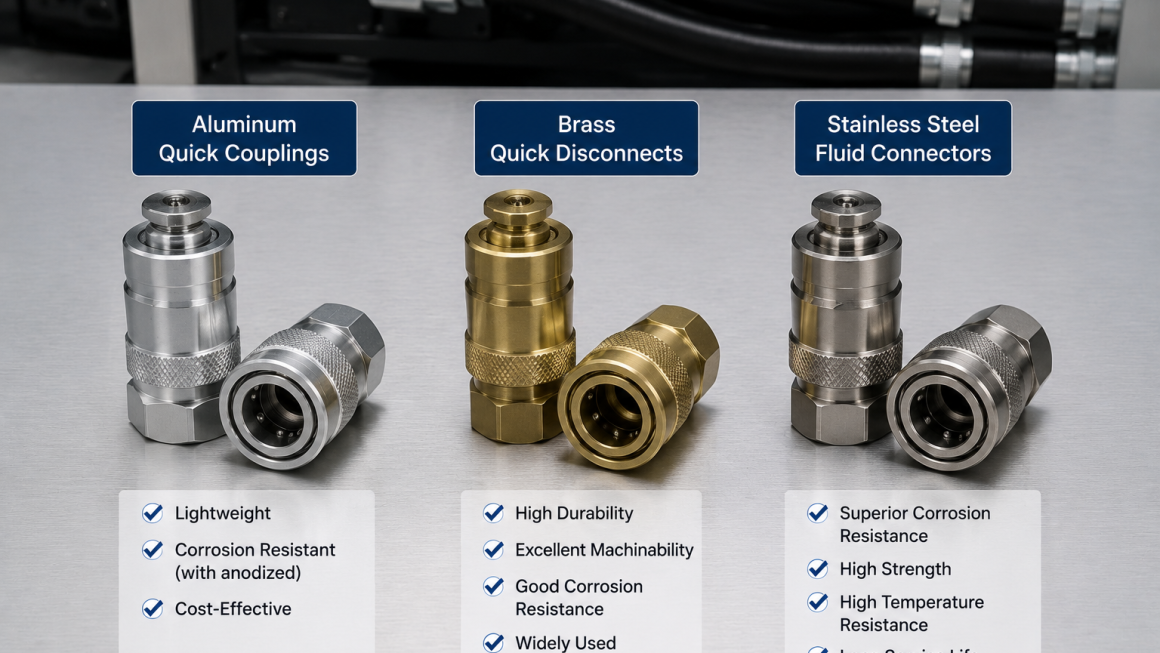
Aluminum Quick Couplings
Aluminum is widely used in modern liquid cooling systems where weight reduction and cost efficiency are important.
Advantages:
- Lightweight structure
- Lower material cost
- Good thermal conductivity
- Suitable for large-scale modular systems
Limitations:
- Lower corrosion resistance compared to other metals
- Requires surface treatment (anodizing or coating)
- Not ideal for aggressive coolant chemistries
- Lower mechanical strength under repeated cycling
Typical Applications:
- AI server racks
- Edge computing systems
- Lightweight modular cooling systems
Aluminum QDs are often preferred in high-density, cost-sensitive deployments where scalability is a priority.
Brass Quick Disconnects (Brass QDs)
Brass has been a traditional material choice in industrial fluid systems for decades.
Advantages:
- Excellent machinability
- Good sealing performance
- Strong mechanical durability
- Proven long-term industrial reliability
Limitations:
- Heavier than aluminum
- Higher cost than aluminum
- Potential dezincification in certain environments
- Less suitable for ultra-lightweight designs
Typical Applications:
- Industrial cooling systems
- Legacy data center infrastructure
- Standard HVAC and fluid systems
- Moderate-performance liquid cooling loops
Brass QDs are often chosen when reliability and sealing stability are more important than weight reduction.
Stainless Steel Fluid Connectors
Stainless steel represents the highest level of performance in harsh environments.
Advantages:
- Excellent corrosion resistance
- High mechanical strength
- Stable performance under extreme conditions
- Long service life
- Compatible with aggressive coolant chemistries
Limitations:
- Highest material cost
- Heavier than aluminum and brass
- More difficult machining and manufacturing
- Higher system cost impact at scale
Typical Applications:
- High-end HPC liquid cooling systems
- Corrosive or marine environments
- Long-life infrastructure projects
- Critical industrial cooling systems
Stainless steel QDs are often used when maximum durability and chemical resistance are required.
Material Comparison Overview
| Material | Weight | Cost | Corrosion Resistance | Mechanical Strength | Best Use Case |
|---|---|---|---|---|---|
| Aluminum | Low | Low | Medium | Medium | AI servers, lightweight systems |
| Brass | Medium | Medium | Medium-High | High | General industrial cooling |
| Stainless Steel | High | High | Very High | Very High | Critical, harsh environments |
How to Choose the Right Material
Material selection is not only a cost decision—it is a system-level engineering trade-off.
Choose Aluminum When:
- Weight reduction is critical
- Large-scale deployment is required
- Cost optimization is important
- Coolant chemistry is well-controlled
Choose Brass When:
- Balanced performance is needed
- System operates in standard industrial conditions
- Long-term sealing reliability is a priority
- Cost and performance must be balanced
Choose Stainless Steel When:
- System operates in corrosive environments
- Maximum reliability is required
- Long service life is critical
- High-pressure or high-risk applications are involved
System-Level Perspective: Beyond Material Alone
In modern liquid cooling architectures, QDs are not isolated components—they are part of a complete thermal system that includes:
- Cold plates
- Manifolds
- Pumps
- Heat exchangers
- Rack-level distribution networks
Therefore, material selection should always align with:
- System pressure design
- Coolant type
- Maintenance strategy
- Deployment environment
- Lifecycle cost expectations
A well-optimized system often uses different materials in different parts of the same cooling architecture.
- Aluminum offers lightweight scalability
- Brass provides balanced industrial reliability
- Stainless steel delivers maximum durability and corrosion resistance
As liquid cooling becomes standard in AI and high-density energy systems, selecting the right material for QDs will play a key role in system efficiency, reliability, and total cost of ownership.
Understanding these trade-offs allows engineers to design cooling systems that are not only efficient, but also optimized for real-world operating conditions.