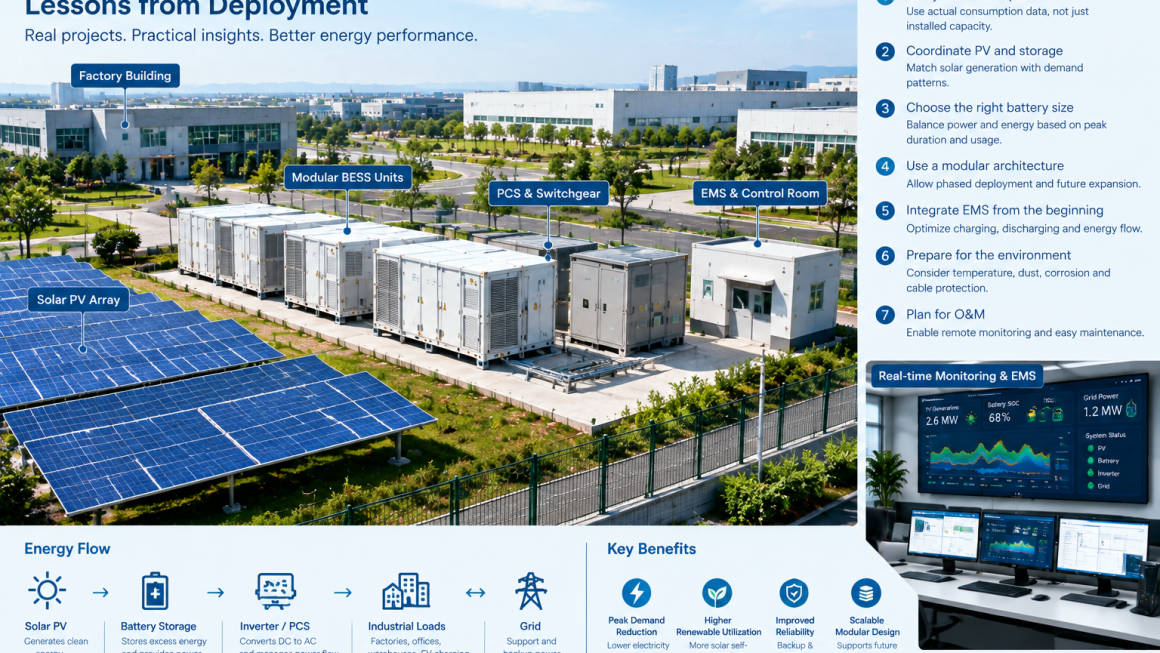
The combination of photovoltaic (PV) generation and battery energy storage systems (BESS) has become an increasingly important solution for industrial facilities, commercial campuses, and distributed energy projects.
While the concept appears straightforward:
Solar generation → Battery storage → Energy consumption
the actual deployment process involves many technical, operational, and integration challenges.
Real-world PV + Storage projects require careful consideration of:
- Load characteristics
- Solar generation patterns
- Battery sizing
- Energy management strategies
- Electrical infrastructure
- Environmental conditions
- Operation and maintenance requirements
A successful project is not simply about installing more solar panels or a larger battery.
It is about designing an energy system that matches the site’s actual operational needs.
This case study summarizes common lessons learned from PV + Storage deployment projects and highlights practical considerations for future installations.
1. Project Background: Why PV + Storage Was Needed
Many industrial and commercial facilities initially install PV systems to reduce electricity costs and increase renewable-energy utilization.
However, PV generation alone has limitations.
Solar power generation typically follows:
Morning → Increasing output
↓
Midday → Maximum generation
↓
Afternoon → Declining output
↓
Night → No generation
The problem is that electricity demand does not always follow the same pattern.
For example:
- Solar generation peak: 12:00–13:00
- Industrial production peak: 15:00–18:00
This creates a mismatch between renewable generation and energy consumption.
Battery storage helps solve this timing problem.
The system can:
Store excess solar energy during high-generation periods
and
Release stored energy when demand increases
This creates a more flexible energy system.
2. Project Overview: Typical PV + Storage Architecture
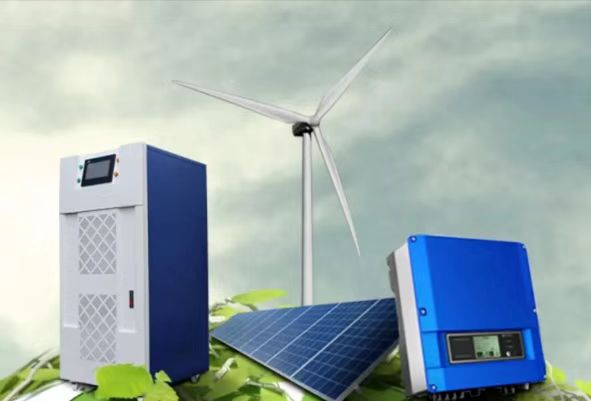
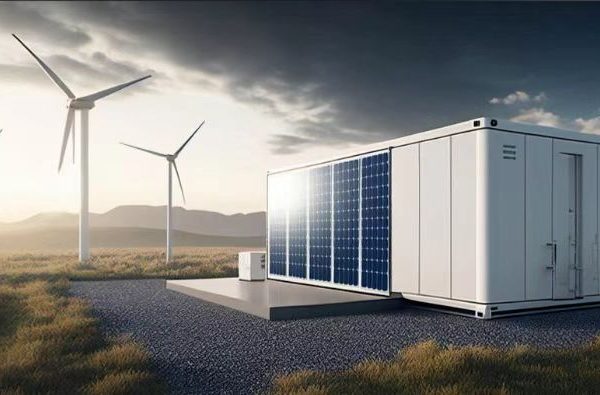
A typical commercial or industrial PV + Storage system includes:
Solar Generation Side
- PV modules
- DC combiner boxes
- Inverters
- Monitoring equipment
Storage Side
- Battery modules
- Battery racks
- Battery management system (BMS)
- Power conversion system (PCS)
- Thermal management system
- Fire protection system
Energy Management Side
- Energy management system (EMS)
- Metering devices
- Communication network
- Grid monitoring
A simplified energy flow is:
PV Array
↓
Inverter
↓
AC Distribution
↓
↙ ↘
Building Load BESS
↓
EMS Optimization
The EMS determines whether electricity should be:
- Used immediately
- Stored
- Exported
- Released from storage
3. Lesson One: Understand the Load Profile Before Designing the System
One of the most important lessons from PV + Storage deployment is:
The battery should be designed around the energy profile, not around the PV size alone.
A common mistake is:
Install the largest possible PV system and add battery capacity later.
However, the optimal storage size depends on:
- When electricity is consumed
- When demand peaks occur
- How long peaks last
- Electricity tariff structure
- Required backup capability
Before system design, collect:
- Hourly load data
- Daily consumption patterns
- Seasonal changes
- Production schedules
- Peak demand records
A typical industrial profile may show:
Morning:
Production starts → Load increases
Midday:
PV generation high → Battery charging opportunity
Afternoon:
Production peak → Battery discharge
Night:
Low load → Grid supply
The battery should be sized according to these real operating conditions.
4. Lesson Two: PV Generation and Load Timing Must Be Coordinated
Installing PV does not automatically maximize renewable-energy utilization.
The key question is:
Does solar generation happen when electricity is needed?
For example:
Without Storage
12:00
PV output increases
↓
Excess electricity generated
↓
Possible export or curtailment
18:00
PV output decreases
↓
Industrial demand remains high
↓
Grid electricity required
With Storage
12:00
PV surplus
↓
Battery charging
18:00
Demand increases
↓
Battery discharge
This simple shift can significantly improve solar utilization.
The project design should therefore evaluate:
- PV generation curve
- Load curve
- Battery charging window
- Battery discharge window
5. Lesson Three: Battery Capacity Is Not the Only Important Parameter
Many people focus mainly on:
How many MWh of batteries are installed?
However, another important parameter is:
How many MW of power can the system deliver?
For example:
A facility may experience a short 1 MW demand peak lasting 30 minutes.
A large energy capacity battery with insufficient power output may not solve the problem.
Conversely:
A high-power battery with insufficient energy capacity may not support longer load shifting.
Battery selection should consider:
Power Requirement
How much electricity must be delivered immediately?
Energy Requirement
How long must the battery support the load?
Cycling Requirement
How frequently will the battery charge and discharge?
6. Lesson Four: Modular Architecture Improves Project Flexibility
Many successful PV + Storage projects adopt modular designs.
Instead of installing one oversized system:
Initial phase:
500 kW / 1 MWh
↓
Expansion:
1 MW / 2 MWh
↓
Future:
2 MW / 4 MWh
This approach provides several benefits:
Lower Initial Investment
The project starts with the capacity required today.
Easier Expansion
Additional storage modules can be added as energy demand grows.
Reduced Deployment Risk
Operators can validate actual performance before expanding.
Easier Maintenance
Individual units can be isolated without stopping the entire system.
7. Lesson Five: EMS Strategy Determines Real Performance
A battery system without intelligent control may not achieve expected benefits.
The EMS determines:
- When to charge
- When to discharge
- How much power to provide
- Which loads receive priority
- How to maintain battery health
A simple control strategy:
Daytime
PV generation high
↓
Charge battery if excess electricity exists
Peak period
Grid demand increases
↓
Discharge battery
Night
Low PV
↓
Maintain reserve SOC
A more advanced EMS can include:
- Weather forecasting
- Electricity-price forecasting
- Load prediction
- Production scheduling
- Battery degradation optimization
8. Lesson Six: Environmental Conditions Affect System Design
Many PV + Storage systems are installed outdoors.
Environmental conditions can strongly affect performance.
Important factors include:
Temperature
High temperatures can accelerate battery degradation.
Consider:
- Cooling system
- Ventilation
- Thermal monitoring
Dust and Sand
Outdoor installations may experience:
- Filter blockage
- Reduced cooling efficiency
- Component contamination
Protection measures include:
- Sealed enclosures
- Dust-resistant designs
- Proper ventilation strategies
Humidity and Corrosion
Coastal or industrial environments may require:
- Corrosion-resistant materials
- Protective coatings
- Proper cable sealing
9. Lesson Seven: Cable Protection Is Critical in Outdoor PV + Storage
A PV + Storage system contains many electrical connections:
- PV cables
- Battery cables
- Communication cables
- Sensor cables
- Control wiring
Outdoor cable systems may face:
- UV exposure
- Mechanical damage
- Dust
- Water ingress
- Temperature cycling
- Chemical exposure
Common protection solutions include:
- Cable glands
- Flexible conduits
- Braided protection sleeves
- Self-wrapping sleeves
- Heat-resistant protection
- Sealing accessories
Cable protection is often overlooked during initial installation but becomes important during long-term operation.
10. Lesson Eight: Fire Protection and Safety Must Be Integrated Early
Battery storage projects require safety considerations from the beginning.
Important design areas include:
- Battery enclosure design
- Thermal monitoring
- Fire detection
- Ventilation
- Emergency shutdown
- Maintenance procedures
Safety should not be treated as an additional feature after installation.
It should be integrated into:
- System architecture
- Equipment selection
- Installation planning
- Operation procedures
11. Lesson Nine: Electrical Integration Requires Careful Planning
A PV + Storage system interacts with the existing electrical infrastructure.
Important considerations include:
Transformer Capacity
Can the transformer support:
- PV generation
- Battery charging
- Battery discharge
- Existing loads?
Protection Coordination
Electrical protection settings must consider:
- Bidirectional power flow
- Fault conditions
- Grid connection requirements
Power Quality
Evaluate:
- Voltage fluctuations
- Harmonics
- Power factor
- Frequency response
The BESS should operate as part of the electrical network rather than as an isolated device.
12. Lesson Ten: Operation and Maintenance Should Be Planned Before Installation
A PV + Storage project is a long-term asset.
Successful projects consider:
- Remote monitoring
- Maintenance access
- Spare parts
- Inspection procedures
- Software updates
- Performance tracking
Important monitoring parameters include:
PV Side
- Solar production
- Inverter status
- Module performance
Battery Side
- SOC
- Temperature
- Voltage
- Current
- Alarm status
System Side
- Grid power
- Energy flow
- Efficiency
- Availability
13. Common Deployment Challenges
Real projects often encounter several challenges.
Challenge 1: Oversized System Design
Cause:
Design based on future assumptions without sufficient current data.
Solution:
Use measured load profiles and phased expansion.
Challenge 2: Poor PV-Battery Coordination
Cause:
PV and storage designed separately.
Solution:
Design them as one integrated energy system.
Challenge 3: Insufficient Environmental Protection
Cause:
Outdoor conditions underestimated.
Solution:
Consider dust, heat, humidity, corrosion, and cable protection.
Challenge 4: Lack of Operational Strategy
Cause:
Battery installed without clear EMS objectives.
Solution:
Define priorities:
- Peak shaving
- Self-consumption
- Backup
- Energy arbitrage
- Grid support
14. Future Expansion Considerations
A PV + Storage system should not only solve today’s problem.
Future changes may include:
- Additional production lines
- More EV chargers
- Increased electricity demand
- Additional PV capacity
- New buildings
- Microgrid development
A scalable system should reserve:
- Electrical capacity
- Physical installation space
- Communication capability
- EMS scalability
The best design principle is:
Build today’s system while preparing tomorrow’s expansion.
15. Key Deployment Checklist
Before starting a PV + Storage project:
Energy Analysis
✓ Historical electricity data
✓ Load profile analysis
✓ Peak demand identification
✓ PV generation assessment
System Design
✓ Battery power rating
✓ Battery energy capacity
✓ EMS strategy
✓ Electrical integration
Environmental Protection
✓ Temperature management
✓ Dust protection
✓ Corrosion resistance
✓ Cable protection
Safety
✓ Fire protection
✓ Monitoring
✓ Emergency procedures
Operation
✓ Remote monitoring
✓ Maintenance plan
✓ Performance evaluation
Expansion
✓ Modular architecture
✓ Future capacity planning
A successful PV + Storage project is not defined by the size of the solar array or battery capacity alone.
The most important lessons from deployment experience are:
- Analyze real energy demand before sizing the system
- Coordinate PV generation with actual consumption patterns
- Select battery power and capacity according to operational needs
- Use modular architectures for future expansion
- Integrate EMS strategies from the beginning
- Protect equipment against environmental conditions
- Design cable systems for long-term reliability
- Plan operation and maintenance before commissioning
The future of PV + Storage is moving beyond simple renewable-energy generation.
It is becoming a complete energy-management platform combining:
Solar generation + Modular BESS + Intelligent EMS + Flexible Loads + Microgrid Capability
Through practical deployment experience and continuous optimization, PV + Storage systems can provide more reliable, flexible, and scalable energy solutions for industrial parks, campuses, and distributed energy applications.
Frequently Asked Questions
What is a PV + Storage system?
A PV + Storage system combines solar photovoltaic generation with battery energy storage to improve renewable-energy utilization, reduce peak demand, and provide energy flexibility.
Why add batteries to a solar system?
Batteries allow excess solar energy generated during the day to be stored and used later when electricity demand increases or solar generation decreases.
How should a PV + Storage system be sized?
Sizing should consider actual load profiles, PV generation patterns, peak demand periods, required backup duration, and future expansion plans.
What is the role of EMS in PV + Storage?
The EMS coordinates PV generation, battery charging/discharging, electricity demand, and operational priorities to optimize system performance.
Why is modular design important?
Modular systems allow phased deployment, easier maintenance, and future expansion as energy requirements increase.
What are common PV + Storage deployment mistakes?
Common issues include incorrect sizing, poor PV-battery coordination, insufficient environmental protection, and lack of long-term operation planning.