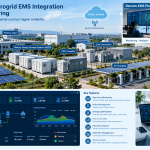
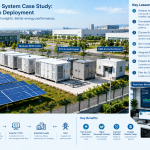
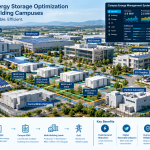
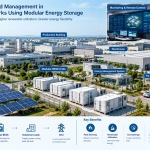
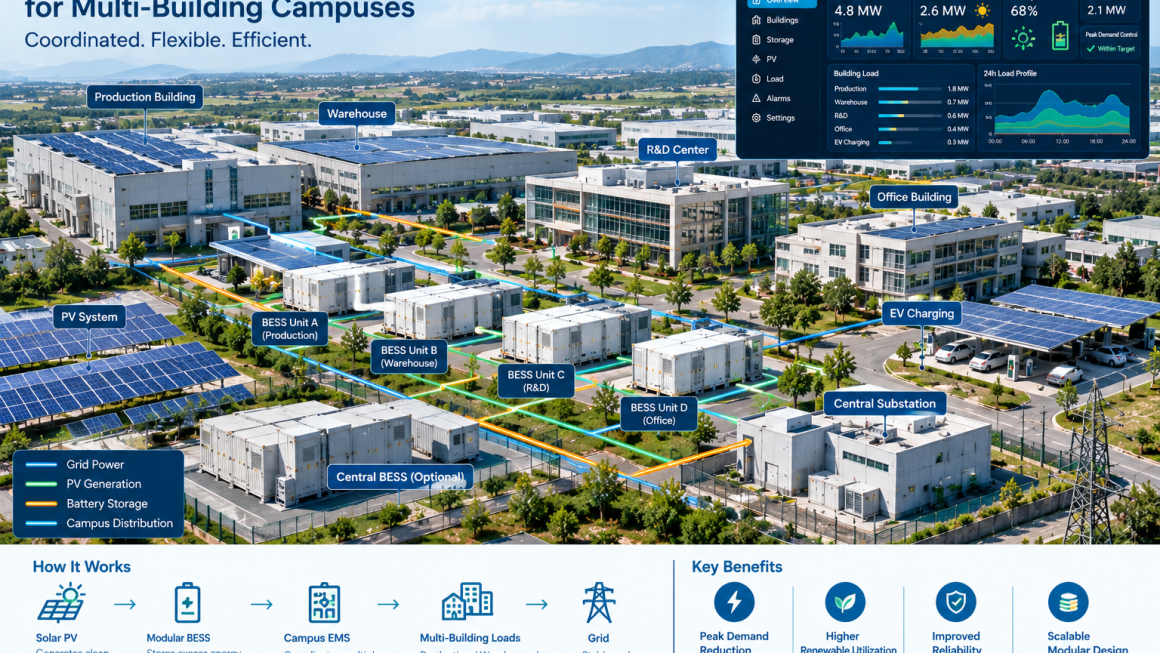
Large campuses rarely have a single, uniform electricity load.
An industrial campus may contain production buildings, warehouses, offices, laboratories, utility plants, EV charging stations, and renewable energy installations. Each building can have a different operating schedule, load profile, and energy demand.
This creates a more complex energy-management challenge than simply installing one large battery system.
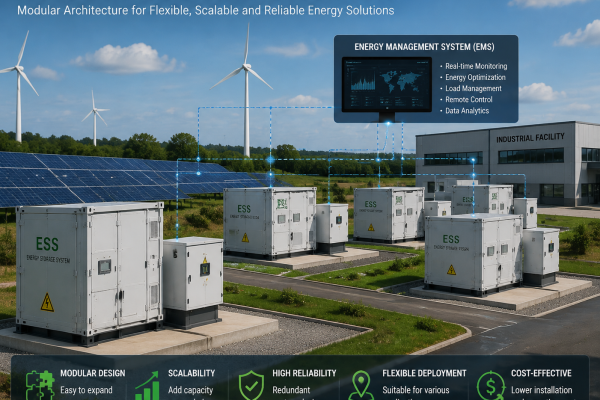
Modular energy storage can provide a flexible architecture for coordinating energy across multiple buildings.
Instead of treating every building as an isolated electricity consumer, a campus-level energy management strategy can coordinate distributed or centralized battery systems according to real-time demand, renewable generation, electricity tariffs, and operational priorities.
The basic concept is:
Multiple buildings → Different load profiles → Modular energy storage → Campus-level EMS → Coordinated energy optimization
This approach can support peak demand reduction, renewable-energy utilization, load shifting, backup power, and future campus expansion.
Why Multi-Building Campuses Require a Different Energy Strategy
A single building may have a relatively predictable load profile.
A multi-building campus is different.
For example:
- Building A may operate manufacturing equipment during the day.
- Building B may contain offices with high HVAC demand in the afternoon.
- Building C may operate laboratories continuously.
- Building D may be a warehouse with relatively low demand.
- EV charging stations may create short-duration power peaks.
- Solar PV may generate the most electricity around midday.
Consequently, the campus load is the combination of many different profiles.
A simplified representation is:
Campus load = Building A + Building B + Building C + Building D + shared infrastructure
The important point is that individual building peaks do not necessarily occur at exactly the same time.
This creates opportunities for load diversity and energy-storage optimization.
Centralized and Distributed Storage Architectures
There are two fundamental approaches to modular energy storage across a multi-building campus.
Centralized Modular BESS
A large modular BESS can be installed near the campus main substation.
The architecture may look like:
Utility Grid
↓
Main Substation
↓
Central Modular BESS
↓
Campus Distribution Network
↓
Multiple Buildings
This approach provides centralized control and maintenance.
It can be suitable when the campus has:
- A strong central electrical network
- Limited space at individual buildings
- A common electrical distribution system
- A centralized energy-management strategy
- A large shared PV installation
The main advantage is that the storage capacity can be managed as one coordinated resource.
Distributed Modular BESS
Alternatively, smaller BESS units can be installed closer to individual buildings.
For example:
Building A → BESS A
Building B → BESS B
Building C → BESS C
Building D → BESS D
A campus-level EMS coordinates all units.
This architecture can reduce dependence on a single storage location and allow storage capacity to be matched to individual load characteristics.
Distributed storage can be particularly useful when buildings are geographically separated or have different electrical distribution systems.
Hybrid Architecture: Central + Distributed Storage
For larger campuses, a hybrid approach may be more effective.
A possible architecture is:
Campus-level central BESS
Building-level modular BESS
PV systems
Flexible loads
Campus EMS
The central system can handle major campus-level demand events, while smaller distributed systems respond to local requirements.
For example:
Building A BESS → Local peak shaving
Building B BESS → PV self-consumption
Building C BESS → Critical-load backup
Central BESS → Campus-level demand management
This creates multiple layers of energy flexibility.
Start With Building-Level Load Analysis
Energy-storage optimization should begin with data rather than battery selection.
For every major building, analyze:
- Maximum demand
- Average demand
- Minimum demand
- Peak duration
- Daily load profile
- Weekly operating pattern
- Seasonal variations
- Critical loads
- HVAC demand
- Production schedules
- EV charging demand
- PV generation
The objective is to understand not only how much energy each building consumes, but when and why it consumes it.
A useful process is:
Collect data → Identify load patterns → Identify peak events → Classify loads → Determine flexibility → Optimize storage
Load Diversity Can Reduce Required Storage Capacity
Suppose three buildings have the following maximum demand:
- Building A: 2 MW
- Building B: 2 MW
- Building C: 1.5 MW
The theoretical combined maximum would be 5.5 MW.
However, this does not necessarily mean the campus needs a 5.5 MW battery.
If the three buildings reach their maximum demand at different times, the actual simultaneous campus peak may be significantly lower.
For example:
Building A peak → 09:00
Building B peak → 13:00
Building C peak → 17:00
Campus-level optimization can therefore take advantage of the diversity between buildings.
This is one reason why campus-wide energy management can sometimes be more efficient than sizing independent storage systems for every building.
Optimizing Battery Power and Energy Capacity
Two parameters are particularly important:
Power capacity (MW)
and
Energy capacity (MWh).
Power capacity determines how much instantaneous demand the system can support.
Energy capacity determines how long the system can maintain that output.
The basic relationship is:
Energy capacity ≈ Power × Operating duration
For example:
A 2 MW / 4 MWh BESS has a theoretical two-hour duration at a constant 2 MW discharge rate.
However, actual operating conditions may use a narrower SOC window and reserve energy for other functions.
Therefore, battery sizing should consider the intended application.
Short Peak Shaving
If demand peaks last only 15–30 minutes, high power with relatively limited energy capacity may be sufficient.
Load Shifting
If the objective is to move several hours of energy consumption from one period to another, greater energy capacity becomes important.
Backup Power
Critical-load backup requires additional consideration of:
- Required backup power
- Backup duration
- Load prioritization
- Islanding capability
- Black-start requirements
Prioritize Buildings and Loads
Not every building needs the same level of energy-storage support.
A practical campus strategy is to classify buildings into categories.
Tier 1 — Critical Buildings
Examples may include:
- Data centers
- Laboratories
- Critical production facilities
- Emergency systems
These loads may require high reliability and dedicated backup capacity.
Tier 2 — Important Operational Loads
Examples include:
- Production equipment
- HVAC systems
- Refrigeration
- Utility systems
These loads may benefit primarily from peak shaving and energy optimization.
Tier 3 — Flexible Loads
Examples include:
- EV charging
- Non-critical HVAC
- Water pumping
- Certain warehouse operations
- Deferrable processes
These loads can potentially be shifted instead of being supported entirely by batteries.
This classification can reduce unnecessary battery capacity.
Coordinate PV and Modular Storage
Multi-building campuses often have multiple PV systems.
For example:
Building A rooftop PV
Building B rooftop PV
Parking canopy PV
Ground-mounted PV
The challenge is that PV generation and electricity demand may not occur at the same time.
During midday:
PV generation ↑
Building demand may be moderate
↓
PV surplus
↓
Battery charging
Later:
PV generation ↓
Building demand ↑
↓
Battery discharge
This improves the utilization of locally generated renewable energy.
Campus-Level Energy Management System
The EMS is the coordination layer between buildings, storage systems, PV, and the utility grid.
A campus EMS may monitor:
- Building-level power
- Grid power
- BESS SOC
- BESS charging/discharging power
- PV output
- Electricity prices
- Transformer loading
- Weather conditions
- EV charging
- Critical-load status
The control sequence can be summarized as:
Measure → Forecast → Prioritize → Optimize → Dispatch → Verify
Instead of asking:
Which battery should discharge?
the system should ask:
What is the most efficient way to meet the campus energy objective?
That may involve a combination of:
- Battery discharge
- PV utilization
- Load shifting
- EV charging control
- HVAC optimization
- Thermal storage
Avoid Independent Battery Control
One of the most important optimization principles is to avoid operating every BESS independently.
Consider a campus with four storage systems.
If each system independently reacts to local load changes, several problems can occur:
- Simultaneous unnecessary discharge
- Excessive battery cycling
- Poor SOC balance
- Insufficient energy during a later peak
- Higher operating costs
A hierarchical control structure is more effective.
Level 1: Building Control
Each building monitors local loads.
Level 2: BESS Control
Each storage unit manages battery safety, SOC, temperature, and power limits.
Level 3: Campus EMS
The campus EMS determines how different storage units should cooperate.
This can be expressed as:
Local monitoring → Local protection → Campus optimization → Coordinated dispatch
State-of-Charge Coordination
SOC management becomes especially important when several BESS units operate together.
Suppose:
BESS A = 85% SOC
BESS B = 45% SOC
BESS C = 30% SOC
If a major campus demand peak is expected later, the EMS should not necessarily discharge all three systems equally.
Instead, it may:
- Use the higher-SOC unit first
- Preserve lower-SOC units
- Charge selected units using PV
- Maintain a reserve for critical buildings
SOC therefore becomes a campus-level optimization variable rather than simply a battery-level parameter.
Peak Demand Management Across Buildings
The campus EMS can establish a grid-demand threshold.
For example:
Campus demand threshold = 8 MW
When campus demand approaches the threshold, the EMS can coordinate multiple resources.
A possible sequence is:
Campus load rises
↓
Flexible HVAC adjusted
↓
EV charging reduced or delayed
↓
Local BESS units discharge
↓
Central BESS provides additional power
↓
Grid demand remains below target
This layered strategy can reduce the amount of battery power required.
Time-of-Use Energy Arbitrage
Where electricity tariffs vary by time, modular storage can also shift energy consumption.
A simplified strategy is:
Low-price period → Charge
High-price period → Discharge
However, pure price arbitrage should not conflict with peak-demand management.
For example, fully discharging the battery during a high-price period may leave insufficient SOC for an unexpected demand peak later in the day.
A better EMS strategy maintains an SOC reserve.
For example:
SOC reserve → Peak demand protection
Available SOC → Energy arbitrage
This balances cost savings and operational reliability.
Thermal Loads Can Also Be Optimized
Battery storage should not be considered separately from thermal energy.
Large campuses may have significant:
- Chilled-water loads
- Heating systems
- Cooling towers
- Heat pumps
- Refrigeration
- HVAC systems
Some of these loads have thermal inertia.
For example, a cooling system can potentially pre-cool a building during a lower-cost period.
The strategy becomes:
Low-demand period → Produce/store cooling
↓
Peak electricity period → Reduce chiller operation
↓
Thermal storage + BESS → Reduce electrical peak
This can reduce the required battery capacity.
EV Charging as a Flexible Campus Load
EV charging can create significant short-duration peaks.
If multiple vehicles begin charging simultaneously:
EV charging demand ↑ → Campus demand ↑
Instead of installing additional battery capacity solely for EV charging, the EMS can coordinate charging schedules.
For example:
Vehicle connected → Charging request
↓
Check campus load
↓
Check PV output
↓
Check electricity price
↓
Check BESS SOC
↓
Determine charging power
This creates a flexible relationship between EV charging and energy storage.
Reliability and Backup Power
Energy-storage optimization is not only about electricity costs.
For critical campus facilities, modular BESS can also support resilience.
A campus may establish different backup priorities.
For example:
Critical laboratory systems → Highest priority
Emergency lighting → Highest priority
IT infrastructure → High priority
HVAC → Selective priority
Non-critical production → Lower priority
During a grid outage, the EMS can prioritize available stored energy according to these requirements.
A modular architecture can also provide multiple energy-storage locations, potentially reducing dependence on a single storage point.
Cable Management and Environmental Protection
As storage becomes distributed across a campus, the physical electrical infrastructure becomes more complex.
Cables may run between:
- BESS units
- PV systems
- Building distribution boards
- Main substations
- EV chargers
- Monitoring equipment
Outdoor cable routes may face:
- UV exposure
- Rain and humidity
- Dust
- Mechanical abrasion
- Temperature cycling
- Chemical exposure
- Corrosion
Appropriate cable protection, glands, sealing, routing systems, and maintenance access should therefore be incorporated into the design.
The objective is not only electrical performance but also long-term serviceability.
Modular Expansion for Campus Growth
One major advantage of modular storage is that the system can evolve with the campus.
For example:
Initial campus
→ 1 MW / 2 MWh
New production building
→ Add 1 MW / 2 MWh
Additional PV
→ Add storage capacity
New EV charging infrastructure
→ Add localized storage
Campus expansion
→ Increase central BESS capacity
This avoids designing the entire energy-storage system around uncertain future demand.
The preferred principle is:
Install according to current demand, but design the infrastructure for future expansion.
Optimization Should Include Battery Lifecycle
A battery should not be dispatched purely according to electricity prices.
Each charging and discharging event contributes to battery utilization and degradation.
The optimization model should therefore consider:
- SOC
- Temperature
- Cycle depth
- Number of cycles
- Power level
- Battery age
- Expected degradation
- Remaining useful capacity
For example, if two BESS units can provide the same amount of power, the EMS may choose the unit that offers the better operating condition rather than simply using both equally.
This can improve long-term asset utilization.
A Practical Multi-Building Optimization Model
A practical campus strategy can combine several objectives.
Objective 1: Reduce Peak Demand
Keep campus grid demand below the target threshold.
Objective 2: Increase PV Self-Consumption
Use excess solar generation to charge storage.
Objective 3: Reduce Energy Cost
Shift consumption away from expensive tariff periods.
Objective 4: Protect Critical Loads
Maintain sufficient SOC for emergency or backup requirements.
Objective 5: Reduce Battery Stress
Avoid unnecessary cycling and excessive depth of discharge.
Objective 6: Support Future Expansion
Maintain a modular architecture that can accommodate additional buildings and loads.
The EMS therefore optimizes not just one variable but the overall energy system.
Recommended Architecture
A scalable multi-building campus can be organized into five layers:
Utility Grid
↓
Campus Electrical Distribution
↓
Central + Distributed Modular BESS
↓
Building Loads + PV + EV Charging + Thermal Systems
↓
Campus Energy Management System
At the physical level, the architecture provides flexibility.
At the digital level, the EMS provides coordination.
At the operational level, the modular BESS provides fast-response energy flexibility.
Best Practices Checklist
Before deploying modular energy storage across a multi-building campus, evaluate:
Load Analysis
- Building-level demand profiles
- Campus-level peak demand
- Peak duration
- Load diversity
- Seasonal variations
Storage Architecture
- Centralized BESS
- Distributed BESS
- Hybrid architecture
- Required MW
- Required MWh
EMS
- Building-level monitoring
- Campus-level optimization
- SOC coordination
- PV forecasting
- Demand forecasting
- Tariff optimization
Flexible Loads
- HVAC
- Thermal storage
- EV charging
- Water pumping
- Non-critical production
Reliability
- Critical-load classification
- Backup duration
- Islanding requirements
- Emergency operating strategy
Physical Infrastructure
- Cable routing
- Cable protection
- Sealing
- Environmental protection
- Maintenance access
Future Expansion
- Spare electrical capacity
- Additional BESS locations
- Communication interfaces
- EMS scalability
- Additional PV and EV infrastructure
Modular energy storage optimization for multi-building campuses is fundamentally a coordination problem rather than simply a battery-sizing problem.
Different buildings have different load profiles, operating schedules, renewable resources, and reliability requirements.
A well-designed modular architecture can use these differences to improve overall system efficiency.
The optimization process can be summarized as:
Building-level data → Load diversity analysis → Modular BESS allocation → PV coordination → Flexible-load management → Campus EMS optimization → Peak shaving → Reliability → Scalable expansion
For smaller campuses, a centralized modular BESS may provide the simplest solution.
For geographically distributed or rapidly expanding campuses, distributed or hybrid storage architectures may provide greater flexibility.
The most advanced approach combines modular BESS, PV, flexible industrial loads, EV charging, thermal systems, and intelligent EMS control into one coordinated energy platform.
The result is not simply a larger battery system.
It is a scalable campus energy infrastructure capable of responding dynamically to changing loads, renewable generation, electricity prices, and future expansion requirements.
Frequently Asked Questions
What is modular energy storage optimization for multi-building campuses?
It is the coordinated management of multiple energy-storage units across several buildings to reduce peak demand, improve renewable-energy utilization, control energy costs, and maintain operational resilience.
Is centralized or distributed BESS better for a multi-building campus?
Neither is universally better. Centralized storage simplifies management, while distributed storage can provide localized support. A hybrid architecture can combine both advantages.
Can multiple buildings share one energy-storage system?
Yes. When buildings are connected through a common electrical distribution system, a centralized BESS can serve multiple buildings under a campus-level EMS.
Why is building-level load analysis important?
Different buildings have different peak times and load characteristics. Understanding these differences helps avoid unnecessary battery capacity and improves overall storage utilization.
Can PV and BESS be optimized together?
Yes. Excess PV generation can charge modular storage, while stored energy can support buildings during later demand peaks or periods of low solar generation.
How does an EMS coordinate multiple BESS units?
The EMS monitors building loads, PV generation, SOC, electricity prices, and grid demand, then determines how different storage units and flexible loads should operate together.
Can modular BESS support campus backup power?
Yes, depending on the system architecture and electrical design. Critical loads can be prioritized, with stored energy reserved for emergency operation.
Why is modularity important for growing campuses?
It allows energy-storage capacity to be added as new buildings, production lines, PV systems, or EV charging infrastructure are introduced, reducing the need for a large initial investment.