

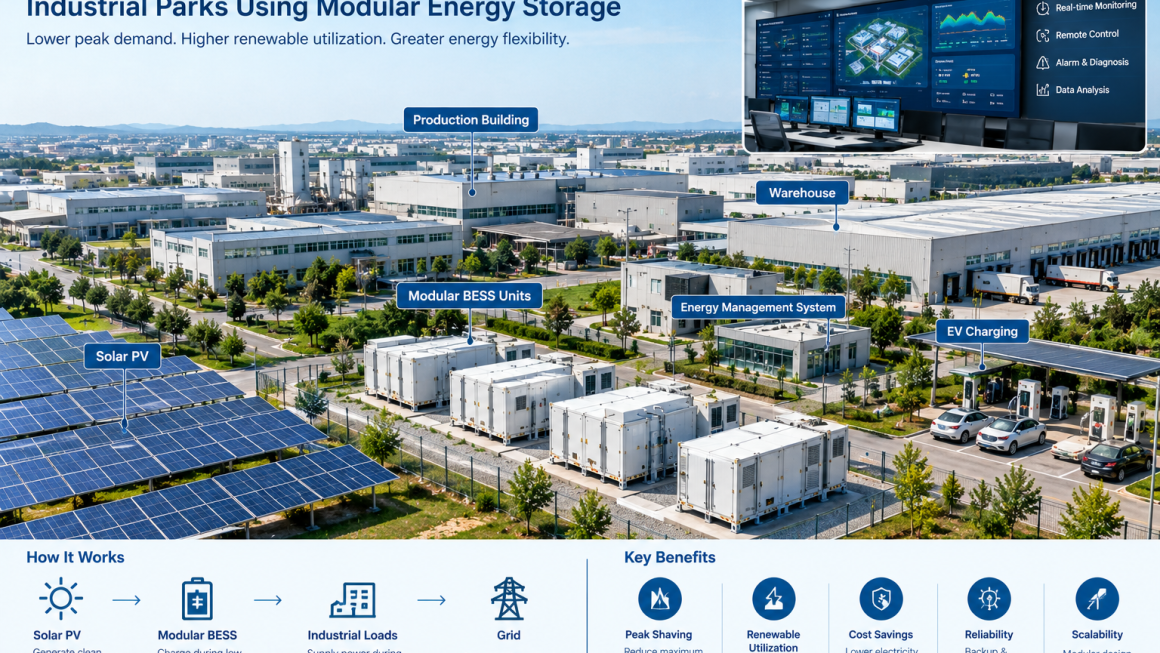
Industrial parks often face a recurring energy challenge: electricity demand is not constant throughout the day.
Manufacturing equipment, HVAC systems, compressors, pumps, process heating, EV charging, and other large electrical loads can create short periods of very high demand. Even when total monthly energy consumption is manageable, these demand peaks can significantly increase electricity costs, stress local electrical infrastructure, and complicate the integration of renewable energy.
Modular energy storage systems can provide a flexible way to manage these peak loads.
Instead of designing one oversized centralized battery system, industrial parks can deploy modular battery energy storage in stages and operate the system according to actual load conditions.
This approach combines peak demand management, load shifting, renewable energy integration, and future capacity expansion within a scalable energy architecture.
What Is Peak Demand Management?
Peak demand management is the process of reducing or shifting the highest levels of electricity consumption during a defined period.
For an industrial park, the daily load profile may look approximately like:
Low-load period → production ramp-up → peak production → demand peak → production reduction → low-load period
The objective is not necessarily to reduce total electricity consumption.
Instead, the goal is to reduce the maximum grid power demand.
For example, an industrial facility may normally operate at:
- Base load: 2 MW
- Normal production load: 4 MW
- Short-duration peak: 6 MW
If the facility can use energy storage to provide 1–2 MW during the peak period, the grid may only need to supply approximately 4–5 MW instead of 6 MW.
The battery effectively becomes a flexible electrical buffer between the grid and industrial loads.
Why Industrial Parks Are Suitable for Modular Energy Storage
Industrial parks are particularly attractive for energy storage because they typically contain multiple facilities with different operating schedules.
A typical park may include:
- Manufacturing buildings
- Warehouses
- Office buildings
- HVAC systems
- Air compressors
- Water pumps
- Chillers
- Process equipment
- EV charging stations
- Solar PV systems
- Backup power systems
The resulting load profile is usually more complex than that of a single commercial building.
However, this diversity can also create opportunities for energy optimization.
For example:
Factory A production peak + Factory B low load + Factory C solar generation
may create a situation where energy storage can redistribute electrical power across the park.
This makes a modular architecture particularly useful.
How Modular Energy Storage Supports Peak Shaving
The basic operating principle is straightforward.
During periods of relatively low demand, the energy storage system charges.
During periods of high demand, the battery discharges.
The simplified operating sequence is:
Low grid demand → battery charging → production increases → demand approaches threshold → battery discharge → grid demand stabilized
The energy management system continuously monitors:
- Grid power
- Battery state of charge
- Production load
- PV generation
- Transformer capacity
- Electricity tariffs
- Forecast demand
The storage system can then determine when to charge and discharge.
Peak Shaving Example
Consider an industrial park with a contracted grid capacity of 5 MW.
During normal operation:
| Period | Load |
|---|---|
| 00:00–06:00 | 2.0 MW |
| 06:00–09:00 | 3.5 MW |
| 09:00–12:00 | 5.5 MW |
| 12:00–14:00 | 3.0 MW |
| 14:00–18:00 | 5.8 MW |
| 18:00–24:00 | 2.5 MW |
Without energy storage, the facility could reach nearly 6 MW.
Suppose a modular BESS can provide approximately 1 MW of discharge power during the highest-demand periods.
The operating strategy could become:
5.8 MW industrial load − 1 MW BESS discharge = approximately 4.8 MW grid demand
The objective is therefore to keep grid demand below a predefined threshold.
This is commonly referred to as peak shaving.
Modular vs. Centralized Energy Storage
A large industrial park does not necessarily need to install its final energy-storage capacity on day one.
A modular approach allows capacity to grow with demand.
For example:
Phase 1 → 1 MW / 2 MWh
Phase 2 → 2 MW / 4 MWh
Phase 3 → 4 MW / 8 MWh
The exact configuration depends on the park’s load profile, tariff structure, operating hours, and expansion plan.
This provides several advantages.
1. Lower Initial Investment
The industrial park can begin with the capacity required for current demand rather than immediately investing in a much larger system.
2. Easier Capacity Expansion
Additional battery modules or storage units can be integrated as new factories and production lines are added.
3. Reduced Project Risk
The operator can validate actual savings before committing to a larger deployment.
4. Easier Maintenance
A modular architecture can allow individual units to be isolated for maintenance while other storage units remain operational.
5. Flexible Site Deployment
Storage can potentially be distributed across different electrical zones instead of being concentrated in one location.
Centralized vs. Distributed Modular Storage
There are two common approaches.
Centralized Storage
A large BESS is installed near the main substation.
The architecture can be simplified as:
Grid → Main Substation → Central BESS → Industrial Park Loads
Advantages include:
- Centralized maintenance
- Simplified energy management
- Large-scale power conversion
- Easier centralized monitoring
- Efficient use of site infrastructure
However, long cable runs and the concentration of storage in one location may create limitations.
Distributed Modular Storage
Multiple smaller storage units are installed closer to different load centers.
For example:
Grid
↓
Main Distribution Network
↙ ↓ ↘
Factory A BESS — Factory B BESS — Factory C BESS
This architecture can reduce the distance between storage and major loads.
It can also provide more localized control.
Distributed storage may be particularly useful when an industrial park contains geographically separated production buildings.
Matching Storage Power to the Demand Peak
One of the most important design decisions is the relationship between battery power rating and energy capacity.
A battery specified as:
2 MW / 4 MWh
has:
- Maximum power: 2 MW
- Stored energy: 4 MWh
If it continuously discharges at 2 MW, its theoretical discharge duration is approximately:
4 MWh ÷ 2 MW = 2 hours
However, real operating strategies may use only part of the available capacity to maintain reserve margins and battery health.
For peak demand management, the system does not necessarily need to operate for many hours.
If the industrial peak lasts only 30–60 minutes, a high-power system with moderate energy capacity may be more appropriate.
This is why load-profile analysis should come before battery sizing.
Use Actual Load Profiles Before Sizing the BESS
A common mistake is to size an energy storage system simply according to the total installed electrical capacity of an industrial park.
Installed capacity is not the same as actual demand.
A better approach is to collect historical power data.
Important information includes:
- 15-minute or 30-minute demand data
- Daily load profiles
- Weekly production schedules
- Seasonal variations
- Maximum demand events
- Transformer loading
- PV generation
- HVAC operation
- Compressor operation
- EV charging schedules
- Planned production expansion
The objective is to identify:
When does the peak occur?
How long does it last?
How frequently does it occur?
Which loads cause it?
Can the peak be shifted?
Only after answering these questions should the BESS power and energy capacity be determined.
Coordinating Energy Storage With PV
Industrial parks increasingly combine PV and battery storage.
Without storage, PV generation typically follows:
Solar radiation → PV generation → Instantaneous consumption → Excess electricity
The problem is that PV generation may not match the industrial load profile.
For example:
PV peak at 12:00
while
Industrial demand peak at 15:00–18:00
Energy storage can bridge this mismatch.
The operating strategy becomes:
Midday PV surplus → Battery charging → Afternoon production peak → Battery discharge
This can improve solar self-consumption while simultaneously supporting peak demand management.
EMS Is the Control Layer
A modular BESS should not operate independently from the industrial park’s energy system.
An Energy Management System (EMS) provides the coordination layer.
The EMS can monitor:
- Grid power
- PV power
- BESS charging/discharging power
- State of charge
- Transformer loading
- Production schedules
- Electricity tariffs
- Demand thresholds
- Alarm conditions
A simplified control loop is:
Measure → Forecast → Compare → Optimize → Dispatch → Monitor
For example:
If grid demand approaches the predefined peak threshold:
Grid demand ↑ → EMS detects threshold → BESS discharge → Grid demand ↓
If demand falls below the charging threshold:
Grid demand ↓ → EMS allows charging → BESS SOC ↑
Demand Forecasting Improves Peak Management
Simple threshold control can work for basic applications.
However, industrial parks with variable production benefit from forecasting.
The EMS can combine:
- Historical demand
- Production schedules
- Weather conditions
- PV forecasts
- HVAC demand
- Electricity prices
- Battery SOC
to predict upcoming demand peaks.
For example:
Production schedule indicates high load at 14:00
↓
PV generation expected to decline
↓
Battery SOC checked
↓
EMS reserves sufficient energy
↓
BESS discharges during the expected peak
This is more efficient than waiting until the peak has already occurred.
Avoiding Excessive Battery Cycling
Peak shaving should not mean discharging the battery every time load increases slightly.
Frequent unnecessary cycling can increase battery degradation.
A better strategy is to establish a meaningful demand threshold.
For example:
Grid demand < 4.5 MW → normal operation
Grid demand 4.5–5.0 MW → monitor
Grid demand > 5.0 MW → BESS discharge
This prevents the system from responding to every small load fluctuation.
The EMS can also incorporate:
- Minimum SOC
- Maximum SOC
- Maximum discharge power
- Battery temperature
- Reserve capacity
- Cycle limits
- Forecast demand
Electrical Infrastructure Must Be Considered
Battery storage is not simply a container of batteries.
Industrial peak management projects require coordination with the site’s electrical infrastructure.
Important considerations include:
Transformer Capacity
The BESS charging power should not create an additional transformer peak.
Switchgear
Protection settings must account for bidirectional power flow.
Cable Sizing
Charging and discharging currents must be considered in cable selection and thermal calculations.
Protection Coordination
Circuit breakers, relays, and protection systems must operate correctly under different operating conditions.
Power Quality
The system should be evaluated for:
- Harmonics
- Voltage fluctuations
- Reactive power
- Power factor
- Rapid load changes
The BESS should be integrated into the existing electrical architecture rather than treated as an isolated device.
Modular Architecture and O&M
One of the major advantages of modular storage is serviceability.
Instead of shutting down an entire storage installation for every maintenance operation, individual modules or units can potentially be isolated.
A practical architecture may include:
Battery module → Rack → BESS unit → AC/DC distribution → Park-level EMS
Each layer can have its own monitoring and protection.
O&M teams can therefore identify whether an issue originates from:
- Battery module
- Rack
- PCS
- Cooling system
- Cable connection
- Protection device
- Communication system
- EMS
This hierarchical approach can shorten troubleshooting time.
Cable Protection Is Part of Peak-Demand Infrastructure
As industrial parks deploy more BESS units, PV systems, charging infrastructure, and electrical equipment, cable routing becomes increasingly important.
Cables may be exposed to:
- Heat
- UV radiation
- Dust
- Mechanical abrasion
- Vibration
- Moisture
- Oil or chemicals
- Outdoor environmental conditions
Protection systems may include:
- Braided cable sleeves
- Self-wrapping sleeves
- High-temperature protection
- Aluminum-foil fiberglass sleeves
- Cable glands
- Sealing systems
- Cable routing accessories
Good cable management supports both reliability and maintenance accessibility.
Designing for Future Expansion
A modular energy-storage system should be designed with future expansion in mind.
Important considerations include:
- Spare electrical capacity
- Space for additional BESS units
- Cable routing reserves
- Communication interfaces
- EMS scalability
- Transformer capacity
- Cooling capacity
- Fire-safety planning
- Maintenance access
A useful principle is:
Design the infrastructure for the final architecture, but install storage according to current demand.
This avoids both overinvestment and expensive redesign later.
Peak Demand Management Beyond Batteries
Battery storage is not the only flexible resource in an industrial park.
A more advanced strategy combines several forms of flexibility:
Battery storage + PV + HVAC optimization + thermal storage + flexible production + EV charging management
For example:
- Delay EV charging during the grid peak
- Pre-cool buildings before peak hours
- Charge batteries during PV surplus
- Shift non-critical production
- Reduce compressor operation temporarily
- Discharge BESS during critical demand periods
This creates a broader industrial energy flexibility system.
The battery becomes one component within the overall energy-management architecture.
Practical Design Checklist
Before deploying modular energy storage for peak demand management, evaluate:
Load Analysis
- Historical demand data
- Maximum demand
- Peak duration
- Peak frequency
- Seasonal changes
BESS Sizing
- Required discharge power
- Required energy capacity
- SOC operating window
- Reserve capacity
- Expected cycling frequency
Electrical Integration
- Transformer capacity
- Switchgear
- Protection coordination
- Cable sizing
- Power quality
EMS Strategy
- Demand threshold
- Forecasting
- PV coordination
- Tariff optimization
- SOC management
Physical Installation
- Outdoor/indoor environment
- Temperature
- Dust and sand
- Humidity
- Corrosion
- Cable routing
- Maintenance access
Future Expansion
- Additional BESS space
- Electrical reserve
- Communication architecture
- EMS scalability
- Production expansion
Peak demand management in industrial parks is not simply a matter of installing a large battery.
The most effective approach combines accurate load analysis, appropriately sized modular energy storage, intelligent EMS control, renewable-energy coordination, and scalable electrical infrastructure.
A modular architecture allows industrial parks to start with a practical storage capacity and expand as production demand increases.
The overall strategy can be summarized as:
Industrial load analysis → Peak identification → Modular BESS sizing → EMS control → Peak shaving → PV coordination → O&M optimization → Future expansion
For industrial parks with rapidly changing production loads, modular energy storage provides an adaptable way to manage peak demand without committing to an oversized energy-storage system from the beginning.
The long-term opportunity is even broader: once battery storage, PV, flexible industrial loads, thermal systems, EV charging, and digital energy management are coordinated through a common control architecture, the industrial park can evolve from a passive electricity consumer into a flexible energy system.
Frequently Asked Questions
What is peak demand management in an industrial park?
It is the process of reducing or shifting the highest electricity demand periods to lower the maximum grid demand and improve energy-cost efficiency.
How does modular energy storage reduce peak demand?
The BESS charges during lower-demand periods and discharges when industrial electricity demand approaches a predefined peak threshold.
Does a larger battery always provide better peak shaving?
No. Battery power, energy capacity, peak duration, cycling frequency, and load characteristics all need to be considered. An oversized system may increase investment without providing proportional benefits.
Can PV and BESS work together for peak demand management?
Yes. Excess PV generation can charge the BESS during the day, while stored energy can be discharged later when industrial demand increases.
Why is modular BESS useful for industrial parks?
It allows storage capacity to be deployed in stages, expanded with production growth, and potentially distributed across different load centers.
What role does the EMS play?
The EMS monitors grid demand, PV generation, battery SOC, production loads, and other parameters, then coordinates charging and discharging according to the operating strategy.
Should peak shaving be combined with load management?
Yes. Combining BESS with flexible HVAC, thermal storage, EV charging, and non-critical production loads can reduce the required battery capacity and improve overall energy flexibility.