As battery energy density continues to increase, thermal management has become one of the most critical aspects of battery pack design. Whether in electric vehicles (EVs), commercial energy storage systems (ESS), utility-scale battery installations, or data center backup systems, effective thermal control directly impacts battery safety, performance, lifespan, and overall system reliability.
Modern high-density battery packs generate significant heat during charging, discharging, and high-power operation. Without proper thermal management materials, excessive temperatures can accelerate battery degradation, reduce efficiency, and increase the risk of thermal runaway.
This article explores the key thermal management materials used in today’s battery systems and how they contribute to safer and more efficient energy storage solutions.
Why Thermal Management Matters in High-Density Battery Packs
Lithium-ion batteries operate most efficiently within a relatively narrow temperature range.
Excessive heat can lead to:
- Accelerated battery aging
- Capacity loss
- Increased internal resistance
- Reduced charging performance
- Cell imbalance
- Safety risks
Meanwhile, uneven temperature distribution across a battery pack can create localized hotspots that further affect system performance.
As battery energy density increases, managing heat effectively becomes increasingly important.
Sources of Heat in Battery Systems
Battery packs generate heat from several mechanisms:
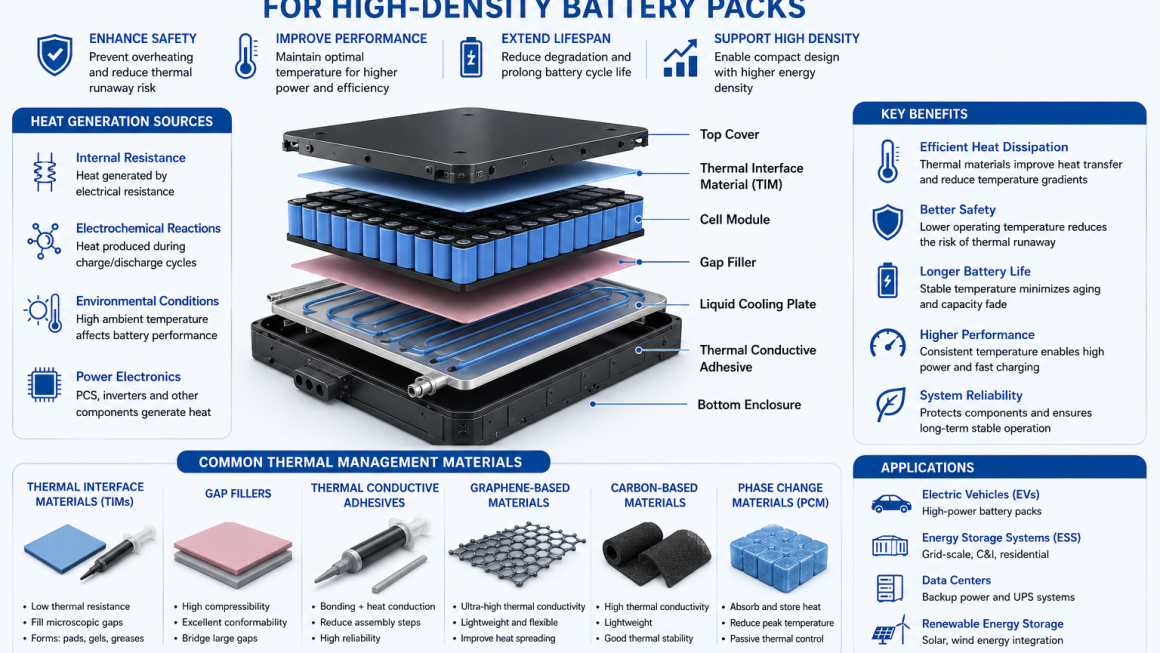
Internal Resistance
As current flows through battery cells, electrical resistance generates heat.
This effect becomes more pronounced during:
- Fast charging
- High-rate discharging
- Peak power operation
Electrochemical Reactions
Battery charging and discharging processes naturally produce heat through electrochemical reactions.
Environmental Conditions
External temperatures can significantly affect battery performance, especially in:
- Outdoor ESS installations
- Desert climates
- Industrial environments
- Containerized energy storage systems
Power Electronics
Components such as:
- Inverters
- PCS units
- DC/DC converters
- Busbars
also contribute to overall thermal load within energy storage systems.
Key Thermal Management Materials
Thermal Interface Materials (TIMs)
Thermal Interface Materials are among the most important battery thermal materials.
TIMs are designed to improve heat transfer between:
- Battery cells
- Cooling plates
- Heat sinks
- Structural components
Without TIMs, microscopic air gaps significantly reduce thermal conductivity.
Common TIM formats include:
- Thermal pads
- Thermal gels
- Thermal greases
- Phase change materials
Benefits:
- Lower thermal resistance
- Improved temperature uniformity
- Enhanced cooling efficiency
Gap Fillers
Gap fillers are soft thermal materials used to bridge larger spaces between components.
Applications include:
- Cell-to-cooling plate interfaces
- Module-to-cold plate connections
- Battery pack assemblies
Advantages:
- Excellent conformability
- Vibration absorption
- Improved heat dissipation
Gap fillers are widely used in EV battery packs and liquid-cooled ESS systems.
Thermal Conductive Adhesives
These materials combine:
- Mechanical bonding
- Thermal conductivity
They are commonly used for:
- Module assembly
- Cooling plate attachment
- Electronic component mounting
Benefits include:
- Reduced part count
- Simplified assembly
- Reliable thermal pathways
Graphene-Based Thermal Materials
Graphene is attracting increasing attention in battery thermal management.
Key properties include:
- Extremely high thermal conductivity
- Lightweight structure
- Excellent mechanical strength
Applications include:
- Thermal films
- Heat spreaders
- Composite thermal interface materials
Graphene-enhanced materials can help distribute heat more evenly throughout battery systems.
Carbon-Based Thermal Solutions
Advanced carbon materials such as:
- Graphene
- Carbon nanotubes (CNTs)
- Expanded graphite
are increasingly used to improve thermal conductivity in battery systems.
Benefits include:
- Enhanced heat spreading
- Lower material weight
- Improved thermal stability
These materials are especially attractive for next-generation high-density battery packs.
Phase Change Materials (PCM)
PCMs absorb thermal energy during phase transitions.
Benefits include:
- Peak temperature reduction
- Passive thermal regulation
- Improved thermal stability
PCM solutions are often combined with active cooling systems.
ESS Cooling Materials and System Integration
Thermal materials are most effective when integrated into a complete cooling architecture.
Air-Cooled Systems
Air cooling remains common in:
- Small commercial ESS
- Residential storage systems
Thermal materials help improve:
- Heat transfer efficiency
- Temperature uniformity
Liquid-Cooled Systems
Liquid cooling is increasingly becoming the preferred solution for high-density ESS applications.
Advantages:
- Higher cooling efficiency
- Better thermal control
- Improved energy density
Thermal interface materials play a critical role in maximizing heat transfer between cells and cooling plates.
Cold Plate Integration
Cold plates are widely used in:
- Utility-scale ESS
- EV battery packs
- High-performance energy storage systems
Thermal materials ensure:
- Efficient heat conduction
- Reduced interface resistance
- Uniform temperature distribution
Material Selection Considerations
Choosing the right battery thermal materials requires balancing multiple factors.
Thermal Conductivity
Higher thermal conductivity generally improves heat transfer performance.
Electrical Insulation
Many battery applications require materials that provide:
- Thermal conductivity
- Electrical isolation
simultaneously.
Mechanical Reliability
Materials must withstand:
- Vibration
- Thermal cycling
- Long-term operation
without degradation.
Environmental Resistance
ESS cooling materials should resist:
- Moisture
- Dust
- Corrosion
- UV exposure
particularly in outdoor installations.
Manufacturing Compatibility
Materials should support:
- Automated assembly
- Consistent quality
- Scalable production
Emerging Trends in Battery Thermal Materials
Graphene-Enhanced TIMs
Graphene composites are increasingly used to improve thermal conductivity while maintaining lightweight designs.
Liquid Cooling Optimization
Advanced thermal materials are being developed specifically for next-generation liquid-cooled battery systems.
Multifunctional Materials
Future thermal materials may combine:
- Heat dissipation
- Structural support
- Electrical insulation
- Fire resistance
within a single solution.
AI-Driven Thermal Design
Simulation and artificial intelligence are helping engineers optimize thermal pathways before physical prototyping.
Applications Across Energy Storage Industries
Thermal management materials are essential for:
Utility-Scale ESS
- Containerized storage systems
- Grid-scale battery installations
Commercial & Industrial ESS
- Peak shaving systems
- Renewable integration projects
EV Battery Packs
- Fast charging applications
- High-performance vehicle platforms
Data Centers
- Backup battery systems
- AI infrastructure power solutions
Renewable Energy Storage
- Solar-plus-storage systems
- Wind energy integration projects
Best Practices for Thermal Management Design
To maximize battery safety and performance:
- Evaluate thermal performance early in system design
- Combine thermal materials with active cooling strategies
- Prioritize temperature uniformity across battery modules
- Validate thermal performance under real operating conditions
- Select materials compatible with long-term system reliability requirements
Conclusion
As battery systems continue to achieve higher energy density and power capability, thermal management materials are becoming increasingly important. Thermal interface materials, gap fillers, graphene-based solutions, conductive adhesives, and advanced cooling materials all play critical roles in maintaining safe and efficient battery operation.
For modern ESS and battery pack designers, selecting the right combination of battery thermal materials and cooling technologies is no longer simply an engineering consideration—it is a key factor that determines system performance, safety, lifecycle, and long-term commercial success.