
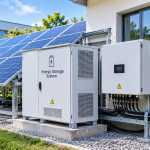

How to Upgrade Cable Protection in Existing Energy Storage Systems Without Rewiring
In an operating energy storage system, cable protection requirements can change over time.
Cables that were adequately protected during initial installation may become exposed to abrasion, vibration, UV radiation, dust, moisture, elevated temperatures, or mechanical interference as the installation environment changes. Maintenance inspections may also reveal damaged protective sleeves, poorly secured cable sections, or insufficient protection around bends and connection points.
However, upgrading cable protection in an existing energy storage installation is not always straightforward.
Removing and reinstalling cables can require equipment shutdowns, additional labor, electrical isolation procedures, and coordination with multiple contractors. In some installations, cables are routed through restricted spaces or integrated into cable trays and equipment structures, making removal particularly inconvenient.
This is where retrofit cable protection solutions become valuable.
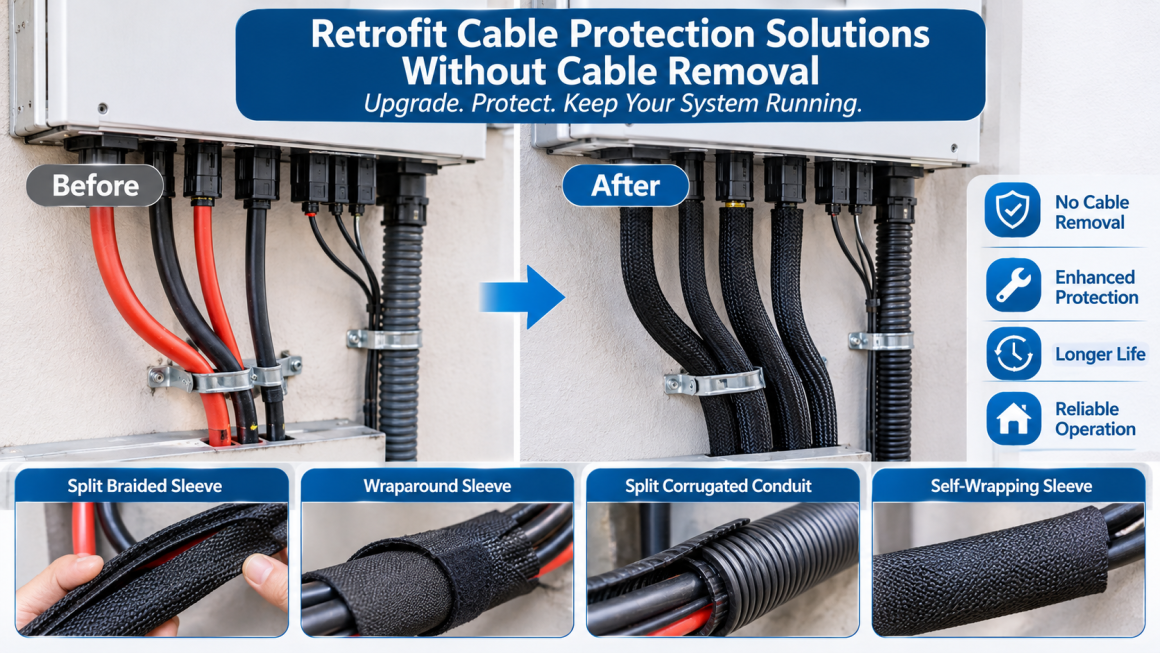
By using suitable split, wraparound, expandable, or flexible protective products, some cable protection improvements can be completed without removing the existing cables.
This article explains the main retrofit approaches, their applications, selection considerations, and practical limitations in energy storage installations.
1. Why Existing Energy Storage Systems Need Cable Protection Retrofits
Cable protection is not necessarily a one-time installation requirement. It should be reviewed throughout the operating life of an energy storage system.
Several conditions can create a need for retrofitting.
1.1 Mechanical abrasion and contact damage
Cables may gradually rub against:
- Metal brackets and support structures
- Cable tray edges
- Equipment enclosure openings
- Adjacent cables or conduits
- Moving or vibrating components
Even relatively minor repeated contact can damage an outer cable jacket over time.
A retrofit sleeve or protective wrap can provide an additional mechanical barrier at accessible contact points, provided the cable itself has not already suffered unacceptable damage.
1.2 Environmental exposure
Outdoor and semi-outdoor energy storage installations may expose cables to:
- Direct sunlight and UV radiation
- Rainwater and moisture
- Dust and airborne particles
- Sand and wind-driven debris
- Temperature fluctuations
- Condensation and corrosive atmospheres
Existing cable protection may become unsuitable when operating conditions change or when the original protection was not designed for the actual environment.
1.3 Changes during system operation
After commissioning, additional cables may be installed for monitoring, communication, auxiliary equipment, or system expansion.
These changes can create new cable routing conditions and expose previously protected sections.
Retrofit protection can help address localized requirements without redesigning the entire cable installation.
1.4 Aging or damaged protective accessories
Existing protective products may become cracked, loose, displaced, or mechanically damaged.
In some cases, the cable remains in acceptable condition while its external protective accessory needs replacement.
This distinction is important: replacing a sleeve is not equivalent to repairing damaged cable insulation.
2. Why Cable Removal Is Not Always the Best Retrofit Approach
Traditional cable protection products are often installed before cable termination or final routing.
For example, a conventional closed tubular sleeve generally needs to be threaded over the cable from an accessible end.
In an existing installation, this can create several difficulties.
| Retrofit challenge | Practical consequence |
|---|---|
| Cable ends are already terminated | Connectors or terminals may need to be disconnected |
| Cable routing is tightly integrated | Removal may require substantial dismantling |
| Restricted installation space | Threading a closed sleeve may be impractical |
| System shutdown requirements | Additional operational coordination is needed |
| Multiple cables are bundled together | Separating cables can disturb the existing arrangement |
| Limited maintenance access | Installation time and labor can increase |
For these reasons, retrofit-friendly cable protection products should be considered during the design of maintenance and upgrade work.
The objective is not to avoid all cable removal under every circumstance. It is to identify situations where an external protective accessory can be installed safely and effectively without disturbing an otherwise acceptable cable installation.
3. Main Retrofit Cable Protection Solutions
Different cable protection products provide different installation methods and protection characteristics.
The most suitable solution depends on cable diameter, accessibility, operating temperature, environmental exposure, mechanical requirements, and the condition of the existing cable.
3.1 Split braided sleeves
Split braided sleeves are designed with an opening that allows them to be fitted around an existing cable bundle.
<Placeholder: Split braided sleeve installed around an existing cable bundle>
Main advantages:
- Can be installed around cables without threading from the cable end
- Flexible and suitable for irregular cable routing
- Can accommodate multiple cables
- Allows localized protection upgrades
- Can be useful where cable branches or connectors prevent the use of closed sleeves
Typical applications include cable bundles inside energy storage cabinets, auxiliary wiring, accessible cable sections, and areas where mechanical abrasion is a concern.
The opening and closure design should be checked to ensure that the sleeve remains securely positioned during operation.
3.2 Wraparound cable protection sleeves
Wraparound sleeves are particularly useful when cables are already installed and cannot easily be disconnected.
Depending on the construction, the sleeve can be wrapped around the cable and secured using an integrated closure, fastening strip, or other suitable mechanism.
<Placeholder: Wraparound cable sleeve protecting an installed power cable>
Main advantages:
- Installation without removing the cable
- Convenient for localized maintenance
- Suitable for selected cable diameters and bundle configurations
- Can simplify protection upgrades in restricted spaces
Wraparound sleeves are especially relevant when only a limited section of an existing cable requires additional protection.
The closure mechanism should be suitable for the expected vibration, temperature, and maintenance conditions.
3.3 Self-wrapping braided sleeves
Self-wrapping braided sleeves are designed to wrap around cable bundles while retaining flexibility.
Their overlapping construction can make them useful for cable sections where access is limited or where several cables need to be protected together.
Potential applications:
- Auxiliary cable bundles
- Communication and monitoring cables
- Cable sections near equipment interfaces
- Areas requiring additional abrasion protection
- Existing installations with irregular cable arrangements
The overlap should be maintained during installation, and the sleeve should not create excessive compression or interfere with cable movement.
3.4 Split corrugated conduits
Split corrugated conduits provide a more structured protective enclosure around existing cables.
They can be useful where cables require additional protection against mechanical contact or where the routing arrangement benefits from a defined protective channel.
<Placeholder: Split corrugated conduit fitted around an existing cable>
Potential applications include:
- Cable routing along equipment frames
- Exposed cable sections near metal structures
- Auxiliary wiring in accessible installation areas
- Selected outdoor cable routing sections
The conduit and its fittings should be compatible with the cable diameter, bending requirements, and environmental conditions.
3.5 Aluminum foil and fiberglass protection sleeves
In locations where cables are exposed to elevated temperatures or radiant heat, specialized high-temperature protection products may be required.
Aluminum foil and fiberglass-based protective sleeves are examples of materials used in selected thermal protection applications.
They may be considered around:
- Cable sections near heat-generating equipment
- Areas exposed to radiant heat
- Selected industrial auxiliary wiring
- Locations where conventional textile sleeves may not provide sufficient temperature resistance
However, the temperature rating of the protective product must be evaluated against the actual operating conditions.
A reflective outer layer should not automatically be interpreted as complete thermal insulation or fire protection. Product construction, installation method, exposure duration, and the underlying cable’s own temperature limits all matter.
4. Comparison of Retrofit Cable Protection Options
The following table provides a general selection reference.
| Product type | Installation around existing cables | Main application | Key consideration |
|---|---|---|---|
| Split braided sleeve | Yes | Cable bundles and abrasion protection | Opening retention and coverage |
| Wraparound sleeve | Yes | Localized cable protection | Closure security |
| Self-wrapping braided sleeve | Yes | Flexible cable bundle protection | Overlap and positioning |
| Split corrugated conduit | Yes | More structured mechanical protection | Fittings and bending radius |
| Aluminum foil/fiberglass sleeve | Depends on product construction | Selected thermal exposure areas | Temperature rating and exposure conditions |
| Conventional closed sleeve | Usually requires an accessible cable end | New installations or accessible cable runs | Cable removal may be necessary |
No single product is suitable for every retrofit situation.
A flexible sleeve may be preferable for irregular cable bundles, while a split conduit may be more appropriate where a defined mechanical barrier is needed.
5. How to Retrofit Cable Protection Without Removing Existing Cables
A successful retrofit begins with understanding the existing installation rather than selecting a sleeve immediately.
The following workflow provides a practical framework.
Step 1: Inspect the existing cable condition
Before adding any protective accessory, inspect the cable and identify whether the problem is limited to the external protection or involves the cable itself.
Check for:
- Visible cuts or abrasion
- Cracked or degraded cable jackets
- Signs of overheating or discoloration
- Exposed conductors or shielding
- Damaged connectors or terminations
- Evidence of moisture ingress
If the cable itself is damaged, installing an external sleeve should not be treated as a substitute for the appropriate electrical assessment and repair or replacement.
Step 2: Identify the actual protection requirement
Determine why the retrofit is needed.
Is the primary concern:
- Mechanical abrasion?
- Contact with sharp edges?
- UV exposure?
- Dust and debris?
- Moisture exposure?
- Elevated temperature?
- Cable bundling and routing stability?
A retrofit product should be selected according to the actual exposure rather than a general assumption that thicker protection is always better.
Step 3: Measure cable dimensions
Collect basic installation information:
- Individual cable outside diameter
- Total bundle diameter
- Number of cables in the bundle
- Available installation clearance
- Cable bend radius
- Required protection length
For irregular bundles, the maximum outside dimension should be considered when selecting a sleeve.
The product should fit securely without excessive compression.
Step 4: Evaluate installation accessibility
Check whether the cable can be accessed along the section requiring protection.
Consider:
- Available working space
- Nearby terminals and connectors
- Existing cable ties and clamps
- Adjacent equipment
- Cable movement during operation
- Whether the product can be opened and closed in the available space
This step helps determine whether a split sleeve, wraparound sleeve, or split conduit is more practical.
Step 5: Select the appropriate protection material
Material selection should reflect the installation environment.
| Operating condition | Material or product direction |
|---|---|
| General abrasion protection | Polyester or suitable braided textile sleeves |
| Flexible cable bundling | Self-wrapping braided sleeves |
| More structured mechanical protection | Split corrugated conduit |
| Outdoor UV exposure | UV-resistant protective materials |
| Elevated-temperature exposure | Rated fiberglass or other high-temperature constructions |
| Selected radiant heat exposure | Appropriate reflective and thermal protection constructions |
Material descriptions alone are not sufficient. Request technical data covering temperature range, UV resistance, abrasion performance, chemical compatibility, and other relevant properties.
Step 6: Install and secure the protection
The installation should follow the manufacturer’s instructions.
Important considerations include:
- Maintaining the cable manufacturer’s minimum bending radius
- Avoiding excessive compression
- Preventing sharp edges from contacting the cable
- Securing the sleeve without damaging the cable jacket
- Maintaining access to connectors and service points
- Avoiding interference with ventilation or equipment access
- Keeping drainage and water-management provisions functional
Where electrical work or equipment isolation is required, qualified personnel should follow the applicable procedures and local regulations.
Step 7: Inspect the completed retrofit
After installation, verify that:
- The sleeve covers the intended section
- Openings and closures remain secure
- No cable is excessively compressed
- Cable bends remain within permitted limits
- Existing labels and identification remain visible or are appropriately restored
- Maintenance access is preserved
- No new interference has been introduced
Document the modified sections so that future maintenance personnel can identify the retrofit work.
6. Special Considerations for Energy Storage Systems
Energy storage installations introduce several requirements that should be considered when upgrading cable protection.
6.1 Battery cabinet cable routing
Inside battery cabinets, cables may be routed through compact spaces with limited clearance.
Retrofit protection should not obstruct:
- Ventilation paths
- Access to serviceable components
- Battery module removal
- Inspection points
- Existing cable identification
A protective sleeve should not be used to conceal damaged wiring or create an arrangement that makes future inspection more difficult.
6.2 Power cables and auxiliary cables
Power cables, communication cables, and auxiliary wiring may have different protection requirements.
They should not automatically be treated as one group.
In particular, cable bundling and routing modifications must respect the original electrical design, separation requirements, thermal conditions, and manufacturer instructions.
6.3 Outdoor energy storage installations
Outdoor systems may require additional protection against UV radiation, moisture, dust, and mechanical damage.
A retrofit sleeve can improve localized protection, but it does not automatically make an existing cable connection waterproof.
Cable glands, enclosure interfaces, connectors, and sealing arrangements should be evaluated separately.
6.4 Thermal and fire-related considerations
Cable protection accessories should not be assumed to provide fire containment, flame propagation control, or certified fire resistance unless the complete product and installation configuration have been appropriately tested and documented.
Where fire performance is a requirement, the relevant system specifications and applicable standards should guide product selection.
7. Common Mistakes During Cable Protection Retrofits
Even when the objective is relatively simple, retrofit work can introduce new problems if the installation is not properly assessed.
| Common mistake | Why it matters | Better approach |
|---|---|---|
| Selecting a sleeve based only on cable diameter | Bundle dimensions may be larger | Measure the complete bundle |
| Using a closed sleeve where cable ends are inaccessible | Installation may require unnecessary disconnection | Consider split or wraparound products |
| Choosing a product without checking temperature ratings | Material may not suit actual exposure | Review technical specifications |
| Over-tightening fastening points | May compress or damage cable jackets | Use suitable fastening methods |
| Covering damaged cables without assessment | Can conceal an underlying electrical problem | Inspect and address cable condition first |
| Blocking ventilation or service access | May affect equipment operation and maintenance | Preserve original clearances |
| Assuming a sleeve provides waterproofing | The complete cable entry may remain exposed | Evaluate sealing and glands separately |
| Ignoring future maintenance | Protection may become difficult to inspect | Use accessible, maintainable designs |
8. What Information Is Needed to Select a Retrofit Solution?
For an existing energy storage installation, a small amount of technical information can significantly improve product selection.
A practical inquiry should include:
- Cable type: Power cable, communication cable, auxiliary cable, or mixed bundle.
- Cable dimensions: Individual outside diameter and total bundle diameter.
- Installation location: Battery cabinet, inverter area, outdoor cable tray, equipment interface, or other location.
- Main protection concern: Abrasion, UV, dust, moisture, heat, or mechanical contact.
- Installation constraints: Whether cable removal is possible and how much working space is available.
- Required protection length: Full cable run or localized sections.
- Environmental conditions: Indoor/outdoor exposure, operating temperature, and relevant chemical or weather exposure.
Photographs of the existing cable routing can also help identify suitable retrofit product structures.
Where necessary, additional information such as vibration conditions, chemical exposure, and applicable certification requirements should be collected before final selection.
9. The Role of Retrofit Cable Protection in Long-Term O&M
Cable protection upgrades are not only about replacing damaged accessories.
They can also be part of a broader maintenance strategy.
During scheduled inspections, operators and maintenance contractors can review:
- Cable sections contacting structural edges
- Exposed cables near equipment interfaces
- Areas where existing sleeves have become displaced
- Outdoor cable sections with insufficient environmental protection
- Cable bundles modified during previous maintenance work
- Sections where additional monitoring or auxiliary wiring has been installed
A documented retrofit approach can help maintenance teams address localized issues without automatically treating every protection upgrade as a complete cable replacement project.
The most effective approach is to combine condition inspection, correct product selection, qualified installation, and periodic verification.
10. How GR-NEWenergy Supports Retrofit Cable Protection Projects
GR-NEWenergy focuses on cable protection products and accessories for energy storage installation and O&M applications.
For retrofit projects, the product selection process can consider:
- Split and wraparound braided sleeves
- Self-wrapping cable protection sleeves
- Split corrugated conduits
- Flexible cable protection solutions
- Fiberglass and aluminum foil-based thermal protection products
- Cable routing, fastening, and protection accessories
The objective is to identify a suitable protection structure based on the existing cable arrangement, operating environment, and installation constraints.
For customers who cannot easily remove existing cables, retrofit-friendly product designs may provide a practical way to upgrade selected cable sections while minimizing unnecessary dismantling.
Product suitability should always be confirmed against the actual application, technical specifications, and relevant installation requirements.
Frequently Asked Questions
Can cable protection sleeves be installed without disconnecting existing cables?
Yes. Split sleeves, wraparound sleeves, and certain self-wrapping products are designed to be installed around existing cables without threading them from an open cable end. Suitability depends on the product design and available installation access.
Can retrofit cable sleeves be used on existing power cables?
They may be suitable for selected applications, provided the sleeve is compatible with the cable dimensions, temperature conditions, and installation environment. The cable’s electrical condition must be assessed separately.
Can a split braided sleeve replace a damaged cable jacket?
No. A protective sleeve is an external accessory and should not be considered a substitute for repairing or replacing damaged cable insulation or jackets.
Are wraparound sleeves suitable for outdoor energy storage systems?
Some products may be suitable, but UV resistance, moisture exposure, temperature range, closure design, and environmental compatibility should be verified using the manufacturer’s technical data.
Can retrofit cable protection improve thermal protection?
Certain specialized products can provide additional protection in selected thermal exposure conditions. However, their performance depends on construction, rating, installation, and exposure. They do not automatically replace cable thermal ratings or certified fire protection systems.
Is it necessary to shut down an energy storage system before installing retrofit cable protection?
That depends on the work location, electrical hazards, equipment design, and applicable safety procedures. A retrofit sleeve does not make work on energized equipment safe. Required isolation and work procedures must be determined and carried out by qualified personnel.
What is the most important information when selecting a retrofit sleeve?
The most important starting points are cable or bundle diameter, installation accessibility, the actual protection requirement, and the operating environment.
Retrofitting cable protection without cable removal can be a practical option for existing energy storage systems, particularly where cables are already terminated, integrated into equipment structures, or routed through restricted spaces.
Split braided sleeves, wraparound sleeves, self-wrapping products, and split conduits offer different installation possibilities for localized protection upgrades.
However, successful retrofit work requires more than choosing an easy-to-install sleeve. Cable condition, dimensions, environmental exposure, temperature limits, bending radius, and maintenance access must all be considered.
For energy storage operators and O&M contractors, retrofit-friendly cable protection products provide another way to improve the maintainability of existing installations without automatically undertaking extensive cable replacement work.
Q1: How can cable protection be upgraded without removing existing cables?
Cable protection can sometimes be upgraded using split braided sleeves, wraparound sleeves, self-wrapping sleeves, or split corrugated conduits. These products can be fitted around accessible cable sections without threading them from an open cable end.
Q2: What is the best cable sleeve for retrofit applications?
There is no universal best option. Split braided sleeves are useful for flexible cable bundles, wraparound sleeves are suitable for localized protection, and split conduits provide a more structured mechanical enclosure.
Q3: Can existing energy storage cables be protected against abrasion without rewiring?
In selected cases, yes. A suitable external sleeve can provide additional abrasion protection around accessible cable sections, provided the existing cable remains in acceptable condition.
Q4: What should be checked before installing retrofit cable protection?
Inspect the cable condition, measure the cable or bundle diameter, identify the actual environmental exposure, check installation accessibility, and verify product compatibility and temperature ratings.
Q5: Does retrofit cable protection eliminate the need for cable maintenance?
No. Protective accessories can reduce certain exposure risks, but regular inspection remains necessary to identify cable damage, displaced sleeves, loose fittings, and changing operating conditions.