10 Practical Issues That Can Affect Home Energy Storage System Reliability
Residential Energy Storage Systems (ESS) are becoming an increasingly important part of modern home energy management.
By combining solar PV generation, battery storage, inverters, and intelligent energy management, homeowners can increase solar self-consumption, reduce electricity costs, and maintain power availability during grid interruptions when the system is properly designed for backup operation.
However, selecting suitable batteries and inverters is only part of a successful installation.
The quality of the installation itself has a significant influence on system reliability, operational efficiency, maintenance requirements, and long-term performance.
In residential ESS projects, some problems do not originate from the main equipment. Instead, they arise from inadequate site assessment, poor equipment positioning, unsuitable cable routing, insufficient environmental protection, or a lack of maintenance planning.
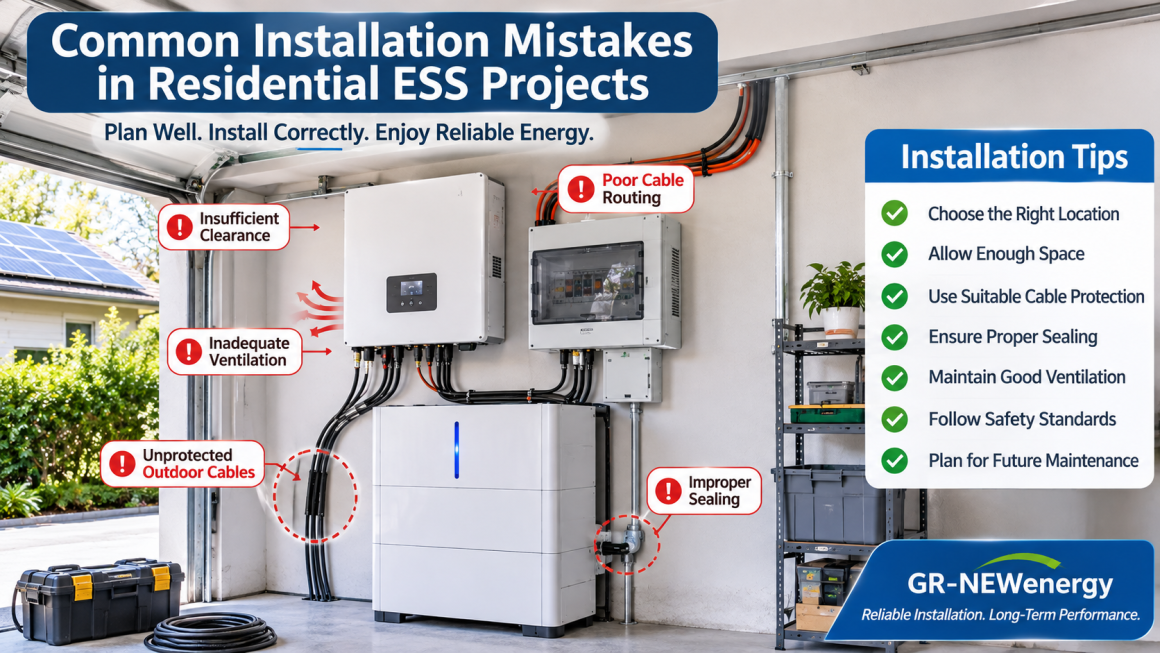
This article examines ten common installation mistakes in residential energy storage projects and explains how homeowners, installers, and system integrators can avoid unnecessary problems.
1. Inadequate Site Assessment Before Installation
One of the most common mistakes is selecting an installation location before fully evaluating the site conditions.
A residential ESS may be installed in a garage, utility room, basement, outdoor enclosure, or dedicated equipment area.
Each location has different environmental and installation requirements.
Important factors include:
- Ambient temperature and temperature fluctuations.
- Humidity and potential water exposure.
- Ventilation and heat dissipation.
- Available installation space.
- Equipment weight and structural support.
- Access for inspection and maintenance.
- Distance between batteries, inverters, and distribution equipment.
- Applicable fire safety and electrical installation requirements.
For example, a garage may appear to provide convenient installation space, but its temperature conditions, ventilation, vehicle access, and exposure to dust or moisture should be evaluated.
How to avoid this mistake:
Conduct a site assessment before equipment selection and installation planning. Confirm that the proposed location meets the battery and inverter manufacturers’ requirements and applicable local regulations.
2. Incorrect Equipment Layout and Insufficient Clearance
Residential ESS installations often involve multiple components, including battery modules, inverters, distribution equipment, isolation devices, and monitoring systems.
Poor equipment positioning can make installation more difficult and affect future maintenance.
Common layout problems include:
- Insufficient working clearance.
- Restricted access to service panels.
- Poor arrangement of battery modules.
- Equipment positioned too close to heat sources.
- Obstructed ventilation openings.
- Difficult access to cable connections.
- Inadequate space for future maintenance or replacement.
A compact installation may save space initially, but it can create unnecessary difficulties when technicians need to inspect or replace equipment.
How to avoid this mistake:
Plan the complete equipment arrangement before installation. Follow the manufacturer’s specified clearances, ventilation requirements, structural limitations, and maintenance access recommendations.
3. Poor Cable Routing and Management
Cable routing is an important but sometimes underestimated aspect of residential ESS installation.
An energy storage system may contain several cable categories:
- PV DC cables.
- Battery DC cables.
- AC power cables.
- Communication cables.
- Monitoring and sensor cables.
- Grounding and bonding conductors.
When cables are not properly organized, the installation may become difficult to inspect, maintain, and modify.
Common problems include:
- Unorganized cable bundles.
- Excessive cable bending.
- Insufficient mechanical support.
- Cables exposed to abrasion.
- Poor separation where required by equipment specifications.
- Difficult identification of individual connections.
- Cable routes that interfere with maintenance access.
How to avoid this mistake:
Develop a cable routing plan before installation. Use suitable cable supports, conduits, protective sleeves, and identification accessories according to the cable type and installation environment.
Power and communication cable arrangements should follow the equipment manufacturer’s instructions and applicable electrical standards.
4. Using Unsuitable Cable Protection Products
Not all cable protection products are designed for the same operating conditions.
A sleeve that works well inside an electrical cabinet may not be suitable for an outdoor cable route exposed to direct sunlight, moisture, temperature changes, or mechanical abrasion.
Similarly, a product with a high temperature rating may not necessarily provide the required flexibility, UV resistance, or environmental durability.
Typical selection mistakes include:
- Choosing the wrong sleeve diameter.
- Ignoring operating temperature.
- Using unsuitable materials for outdoor exposure.
- Overlooking abrasion resistance.
- Selecting products that are difficult to remove during maintenance.
- Failing to consider installation space and cable bending requirements.
Common Cable Protection Options
| Product type | Typical application |
|---|---|
| Braided cable sleeves | Cable bundling and mechanical protection |
| Self-wrapping sleeves | Cable bundles requiring easier access |
| High-temperature sleeves | Cable sections exposed to elevated temperatures |
| Protective conduits | Cable routing and mechanical protection |
| UV-resistant sleeves | Suitable exposed outdoor cable sections |
| Cable glands and grommets | Cable entry and enclosure interfaces |
The correct product should be selected according to the actual installation conditions rather than its product category alone.
How to avoid this mistake:
Confirm cable dimensions, material compatibility, temperature range, environmental exposure, and maintenance requirements before purchasing protective accessories.
5. Ignoring Heat Dissipation and Ventilation Requirements
Battery systems and power conversion equipment generate heat during operation.
Insufficient ventilation or unsuitable equipment placement may result in operating conditions outside the manufacturer’s specified limits.
Potential causes include:
- Equipment installed in restricted spaces.
- Ventilation openings obstructed by nearby objects.
- Inadequate spacing between equipment.
- Exposure to excessive ambient temperatures.
- Poor coordination between equipment placement and room ventilation.
Battery thermal management requirements vary according to battery chemistry, enclosure design, and equipment architecture.
A cooling arrangement suitable for one system should not automatically be assumed suitable for another.
How to avoid this mistake:
Follow the battery and inverter manufacturer’s thermal management instructions. Confirm the required clearances, ambient temperature range, ventilation conditions, and installation restrictions.
6. Inadequate Protection Against Dust, Moisture, and Outdoor Exposure
Residential ESS equipment may be installed in locations exposed to environmental conditions that change throughout the year.
Outdoor installations can encounter:
- Rain and splashing water.
- UV radiation.
- Dust and sand.
- Humidity and condensation.
- Temperature fluctuations.
- Corrosive environmental exposure in certain locations.
Even indoor installations may experience dust accumulation, moisture, or occasional water exposure.
Problems can occur when equipment enclosure ratings, cable entry arrangements, and external protective accessories are not properly matched to the installation environment.
Important Protection Considerations
Enclosure protection
Check the equipment’s specified ingress protection rating and installation limitations.
Cable entry sealing
Cable glands and grommets must be suitable for the cable dimensions, enclosure design, and required protection level.
External cable protection
Exposed cable sections may require additional mechanical or environmental protection.
Material suitability
Protective sleeves and accessories should be compatible with expected temperature, UV exposure, moisture, and other relevant conditions.
How to avoid this mistake:
Evaluate the complete installation environment, not just the equipment enclosure. Cable entries, external connections, routing accessories, and mounting arrangements should all be considered.
7. Incorrect Electrical Connections and Incomplete Verification
Electrical connections are critical to the reliable operation of any residential ESS.
Problems may arise when connection requirements are not properly followed or when installation verification is incomplete.
Examples of issues that require attention include:
- Incorrect cable specifications.
- Incompatible terminals and connection interfaces.
- Improperly completed electrical connections.
- Inadequate identification and labeling.
- Incomplete grounding and bonding arrangements.
- Missing or incorrectly selected protective devices.
- Incomplete commissioning records.
These issues should not be treated as minor installation details.
How to avoid this mistake:
Electrical installation and commissioning should be performed by appropriately qualified personnel.
All connection work, protection arrangements, inspection, and testing must follow the equipment manufacturer’s documentation and applicable local electrical regulations.
8. Overlooking Battery and Inverter Compatibility
A battery and inverter may appear suitable based on their rated capacity and voltage specifications, but compatibility involves more than matching headline figures.
Important considerations include:
- Supported battery chemistry.
- Operating voltage range.
- Charging and discharging limits.
- Continuous and peak power ratings.
- Communication protocols.
- BMS compatibility.
- Firmware and configuration requirements.
- Manufacturer-approved operating combinations.
An incompatible configuration can lead to communication problems, operating limitations, or commissioning difficulties.
How to avoid this mistake:
Confirm the complete battery and inverter compatibility information before purchasing equipment. Obtain written confirmation from the relevant manufacturers where necessary.
9. Neglecting Maintenance Accessibility
Some installations are designed primarily around the initial installation process, without sufficient consideration of future maintenance.
This can create unnecessary difficulties when technicians need to:
- Inspect cable connections.
- Check equipment status.
- Replace protective sleeves.
- Access communication interfaces.
- Replace components.
- Update system configurations.
- Perform routine inspections.
Cable bundles that are tightly packed or routed through inaccessible spaces can increase maintenance time.
Protective accessories that cannot be removed or repositioned conveniently may also complicate servicing.
How to avoid this mistake:
Consider maintenance access during the original layout design.
Where appropriate, use organized cable routing, clear identification, removable protective sleeves, and accessible connection arrangements.
A maintainable installation is often easier to inspect and service over its operating life.
10. Failing to Plan for Future Expansion
Residential energy requirements can change over time.
A homeowner may initially install a relatively small battery system and later decide to increase storage capacity, add solar panels, or modify the electrical installation.
If the original installation does not consider future requirements, expansion may involve unnecessary modifications.
Potential limitations include:
- Insufficient equipment space.
- Inverter capacity constraints.
- Battery compatibility restrictions.
- Limited cable routing space.
- Inadequate distribution equipment capacity.
- Insufficient provision for additional monitoring or communication connections.
Not every residential system needs to be designed for expansion, but future requirements should be discussed before installation.
How to avoid this mistake:
Clarify whether future expansion is expected. Confirm the manufacturer’s expansion limitations and consider reasonable provision for additional cable routes, equipment access, and installation space.
11. Residential ESS Installation Checklist
A structured checklist can help installers review important project details before, during, and after installation.
| Installation stage | Key considerations |
|---|---|
| Site assessment | Temperature, humidity, ventilation, space, structural suitability |
| Equipment selection | Battery and inverter compatibility |
| Layout planning | Clearance, access, mounting, equipment arrangement |
| Cable planning | Cable sizing, routing, identification, support |
| Protection selection | Sleeves, conduits, glands, grommets, sealing |
| Environmental protection | Dust, moisture, UV, temperature exposure |
| Electrical installation | Qualified installation and applicable protection requirements |
| Commissioning | Manufacturer procedures, inspection, functional verification |
| Documentation | Equipment records, installation drawings, warranty information |
| O&M planning | Inspection access, replacement parts, maintenance requirements |
This checklist provides a general planning framework. The actual inspection and commissioning requirements must be established according to the specific equipment, project design, and local regulations.
12. Why Installation Accessories Matter in Long-Term ESS Reliability
Residential energy storage systems are often evaluated according to battery capacity, inverter efficiency, and system price.
However, smaller installation components also contribute to the quality of the complete system.
Cable protection sleeves, conduits, cable glands, grommets, and sealing accessories help address practical installation requirements.
For example:
- Protective sleeves can reduce mechanical abrasion on suitable cable sections.
- Self-wrapping sleeves can make certain cable bundles easier to inspect and maintain.
- UV-resistant materials can provide additional protection for exposed outdoor cable routes.
- Cable glands and grommets can support properly designed cable entry interfaces.
- Cable supports can help maintain organized routing and reduce unnecessary mechanical stress.
These products do not replace electrical protection devices, correct system design, or qualified installation.
Their purpose is to support the mechanical and environmental protection of cables and connections under the conditions for which they are specified.
At GR-NEWenergy, we focus on energy storage installation and O&M protection solutions, including cable protection sleeves, routing accessories, sealing components, and related products.
By selecting suitable accessories at the planning stage, installers can create more organized and maintainable residential ESS installations.
13. Good Installation Practices Start Before Equipment Delivery
Residential ESS reliability depends on more than selecting a suitable battery and inverter.
Site assessment, equipment layout, cable routing, environmental protection, connection quality, compatibility verification, and maintenance accessibility all contribute to the overall installation quality.
Many common installation problems can be reduced through better planning and clearer coordination between homeowners, equipment suppliers, and qualified installers.
For residential energy storage projects, attention to seemingly small details can make a meaningful difference in installation quality and long-term serviceability.
At GR-NEWenergy, our focus is on supporting these practical requirements through cable protection products, routing accessories, sealing components, and related installation and O&M solutions.
Whether a residential ESS uses a DIY kit or a supplier-assembled system, a well-planned installation is essential for dependable operation.
Frequently Asked Questions
1. What are the most common installation mistakes in residential ESS projects?
Common mistakes include inadequate site assessment, insufficient equipment clearance, poor cable routing, unsuitable cable protection, inadequate environmental protection, compatibility issues, and insufficient maintenance access.
2. Where should a residential battery energy storage system be installed?
The installation location must comply with the battery manufacturer’s requirements and applicable local regulations. Temperature, ventilation, moisture exposure, structural support, accessibility, and relevant fire safety requirements should all be considered.
3. Why is cable management important in residential ESS installations?
Proper cable management helps organize electrical connections, reduce mechanical abrasion, maintain suitable routing, and support inspection and maintenance.
4. What cable protection products are commonly used in home energy storage systems?
Common options include braided cable sleeves, self-wrapping sleeves, protective conduits, high-temperature sleeves, cable glands, grommets, and sealing accessories.
5. Can outdoor ESS installations use the same cable protection products as indoor systems?
Not necessarily. Outdoor installations may require additional resistance to UV radiation, moisture, temperature fluctuations, and environmental exposure. Product selection should be based on actual operating conditions.
6. Does a supplier-assembled ESS eliminate installation problems?
No. Supplier assembly can reduce certain equipment integration tasks, but site preparation, external cable routing, electrical connections, sealing, installation, and commissioning still require appropriate planning and qualified personnel.
7. How can homeowners improve long-term ESS maintenance?
They should ensure that equipment remains accessible, cable routes are organized, documentation is retained, and maintenance follows manufacturer recommendations and applicable regulations.
Q1: What should be checked before installing a residential energy storage system?
Before installation, check the site environment, equipment compatibility, available space, ventilation, structural suitability, cable routing, electrical requirements, and maintenance access.
Q2: Why is cable protection important in residential ESS projects?
Cable protection helps reduce mechanical abrasion and provides application-specific protection against environmental exposure. Suitable sleeves, conduits, glands, and sealing accessories should be selected according to cable dimensions and installation conditions.
Q3: What are common outdoor home battery installation problems?
Common concerns include unsuitable equipment placement, excessive heat exposure, moisture, UV radiation, dust, inadequate cable entry sealing, and insufficient maintenance access.
Q4: Does a preassembled home energy storage system require additional installation accessories?
Yes. Even when the main equipment is preassembled, site-level cable routing, external connections, cable protection, sealing, and mounting arrangements may still require additional accessories.
Q5: How can installers improve the maintainability of residential ESS systems?
Installers can improve maintainability through organized cable routing, accessible equipment layouts, clear cable identification, removable protective accessories where appropriate, and complete installation documentation.