
Why Coastal Energy Storage Systems Need Protective Covers
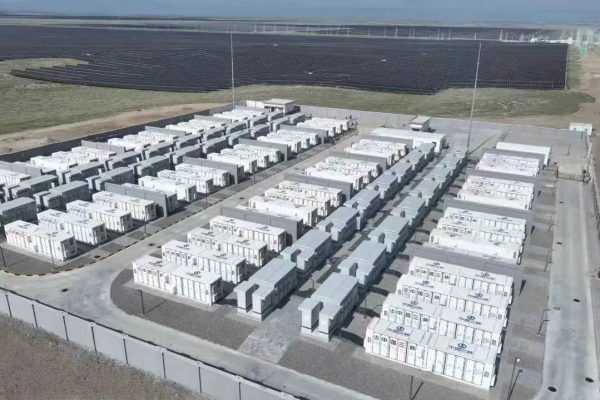
Energy Storage Systems (ESS) are increasingly deployed in coastal areas to support renewable energy integration, industrial power management, and grid flexibility.
However, coastal environments create some of the most challenging operating conditions for outdoor battery systems.
Typical environmental factors include:
- Salt spray exposure
- High humidity
- Strong UV radiation
- Temperature fluctuations
- Wind-driven rain
- Airborne contaminants
These conditions can accelerate corrosion, damage sensitive components, and reduce the service life of energy storage equipment.
Protective covers provide an additional physical barrier to help ESS components maintain reliable operation in harsh coastal environments.
What Are Protective Covers in ESS Applications?
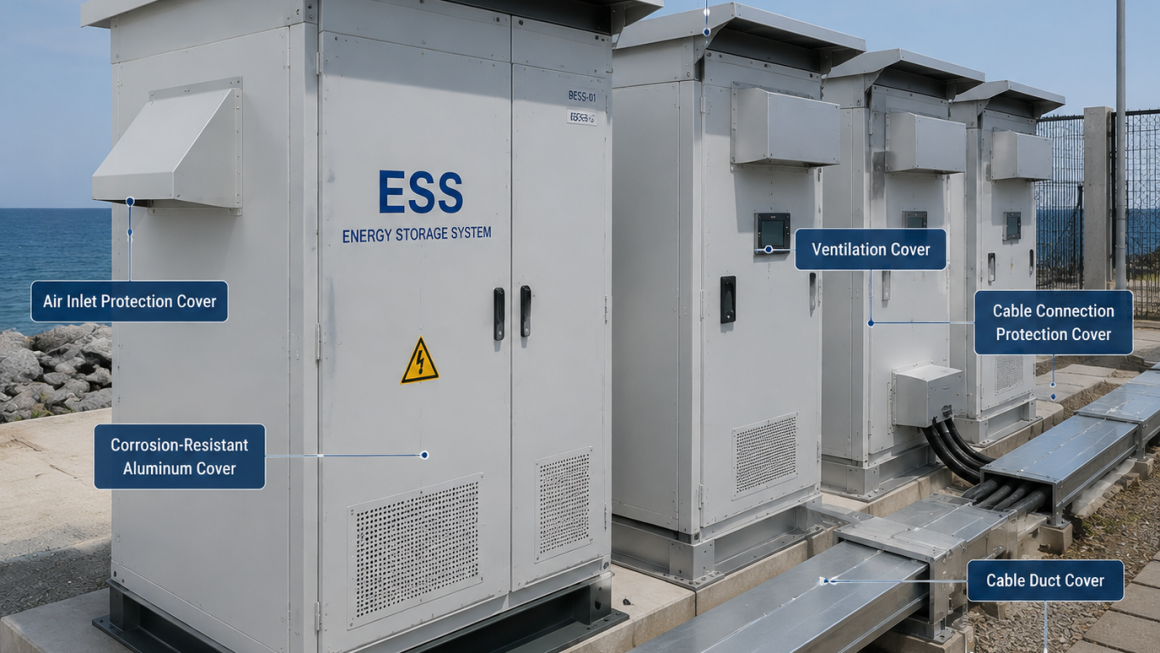
Protective covers are external protection components designed to shield critical ESS equipment from environmental exposure.
They may be installed on:
- Battery cabinets
- Cable assemblies
- Electrical connectors
- Cooling components
- PCS units
- Outdoor control equipment
Unlike a complete enclosure, protective covers are often designed as targeted protection solutions for specific vulnerable areas.
Main Challenges in Coastal ESS Environments
Salt Spray Corrosion
Salt particles carried by marine air can accelerate corrosion of:
- Metal panels
- Fasteners
- Cable glands
- Electrical terminals
- Structural components
Chloride ions can damage protective coatings and create long-term reliability issues.
High Humidity and Condensation
Coastal locations often experience high moisture levels.
Repeated temperature changes can create condensation inside equipment.
Potential risks include:
- Electrical insulation degradation
- Connector corrosion
- Reduced component lifetime
Solar Heat Exposure
Outdoor ESS equipment may receive direct sunlight for many hours.
Solar radiation can increase surface temperatures and create additional thermal stress.
Protection systems must balance:
- Environmental shielding
- Heat dissipation
Functions of Protective Covers
1. Corrosion Protection
The primary function of protective covers is reducing direct exposure to corrosive environments.
They help protect:
- Metal surfaces
- Electrical connections
- Cooling components
Common solutions include:
- Anti-corrosion coatings
- Aluminum alloy covers
- Stainless steel hardware
- Sealed joints
2. Weather Protection
Protective covers help reduce exposure to:
- Rainwater
- Dust
- Wind-driven particles
- Industrial pollutants
Proper design prevents water accumulation while maintaining ventilation.
3. Mechanical Protection
Outdoor ESS equipment may experience:
- Impact
- Vibration
- External contact
Protective covers provide an additional mechanical barrier for sensitive components.
4. Thermal Shielding
A key challenge in ESS design is preventing overheating while maintaining protection.
A poorly designed cover may trap heat.
Effective solutions include:
- Ventilation channels
- Heat-reflective surfaces
- Thermal insulation layers
- High thermal conductivity materials
Material Selection for Coastal ESS Protective Covers
Aluminum Covers
Aluminum is widely used for outdoor protection components.
Advantages:
- Lightweight
- Natural oxide corrosion protection
- Good thermal conductivity
- Easy fabrication
Applications include:
- Battery cabinet covers
- Cooling system shields
- Cable protection covers
Additional surface treatments can improve corrosion resistance.
Stainless Steel Covers
Advantages:
- Excellent marine corrosion resistance
- High mechanical strength
- Long service life
Suitable for:
- Coastal infrastructure
- Highly exposed locations
- Critical protection components
Composite Materials
Composite covers provide:
- Lightweight construction
- Chemical resistance
- Electrical insulation
They are useful where weight reduction and corrosion resistance are priorities.
Design Considerations for Protective Covers
Ventilation and Heat Dissipation
One of the biggest engineering challenges is balancing protection and cooling.
A fully sealed cover may improve moisture protection but increase heat accumulation.
Good designs include:
- Air channels
- Vent openings
- Heat dissipation paths
- Thermal management integration
Water Management
Protective covers should include:
- Sloped surfaces
- Drainage paths
- Sealed connection points
These features prevent water pooling.
Maintenance Accessibility
ESS equipment requires regular inspection.
A good protective cover design should allow:
- Easy removal
- Quick inspection
- Simple replacement
Protective Covers for Different ESS Components
Battery Enclosures
Covers protect:
- External panels
- Doors
- Cooling interfaces
- Electrical access points
Cable Systems
Cable protection covers help prevent:
- UV degradation
- Salt exposure
- Mechanical damage
They are especially important for outdoor cable routing.
PCS Protection
Power conversion systems contain sensitive electronics.
Protective solutions help reduce exposure to:
- Rain
- Dust
- Corrosive air
Liquid Cooling Components
Cooling systems include:
- Pipes
- Quick disconnect couplings
- Manifolds
Protective covers reduce environmental exposure and improve long-term reliability.
Protective Covers and C5 Corrosion Protection
For coastal ESS projects requiring C5-level protection, protective covers are part of a complete corrosion management strategy.
A reliable system combines:
- Proper material selection
- Surface coatings
- Sealing design
- Protective covers
- Regular inspection
No single protection method can completely prevent corrosion.
System-level design is essential.
Applications
Coastal Renewable Energy Storage
Supporting:
- Solar farms
- Wind power projects
- Offshore renewable systems
Port and Marine Facilities
Protecting ESS equipment in high-salt environments.
Industrial Coastal Parks
Supporting:
- Peak shaving
- Backup power
- Energy management
Remote Coastal Microgrids
Providing reliable energy storage in challenging locations.
Future Trends in ESS Protective Cover Design
Future protective solutions will focus on:
- Lightweight aluminum structures
- Integrated thermal management
- Smart corrosion monitoring
- Advanced surface coatings
- Modular protection components
Protective covers will become more than passive shields; they will become integrated components of intelligent ESS protection systems.
Protective covers play an important role in improving the reliability of coastal Energy Storage Systems.
By reducing exposure to salt spray, humidity, UV radiation, and mechanical damage, they help extend the service life of critical ESS components.
Successful coastal ESS protection requires a balance between:
- Corrosion resistance
- Thermal performance
- Mechanical strength
- Maintenance accessibility
Through optimized materials and engineering design, protective covers can significantly improve the durability and reliability of outdoor energy storage installations.