


Why AI Racks Need Advanced Liquid Cooling Connections
The rapid growth of Artificial Intelligence (AI) computing and High-Performance Computing (HPC) is driving server power density to unprecedented levels.
Modern AI servers equipped with advanced GPUs and accelerators can generate significantly more heat than traditional data center equipment.
Traditional air cooling systems face increasing limitations due to:
- Higher rack power density
- Reduced cooling efficiency
- Increased fan power consumption
- Limited heat removal capability
As a result, liquid cooling has become an important solution for next-generation AI data centers.
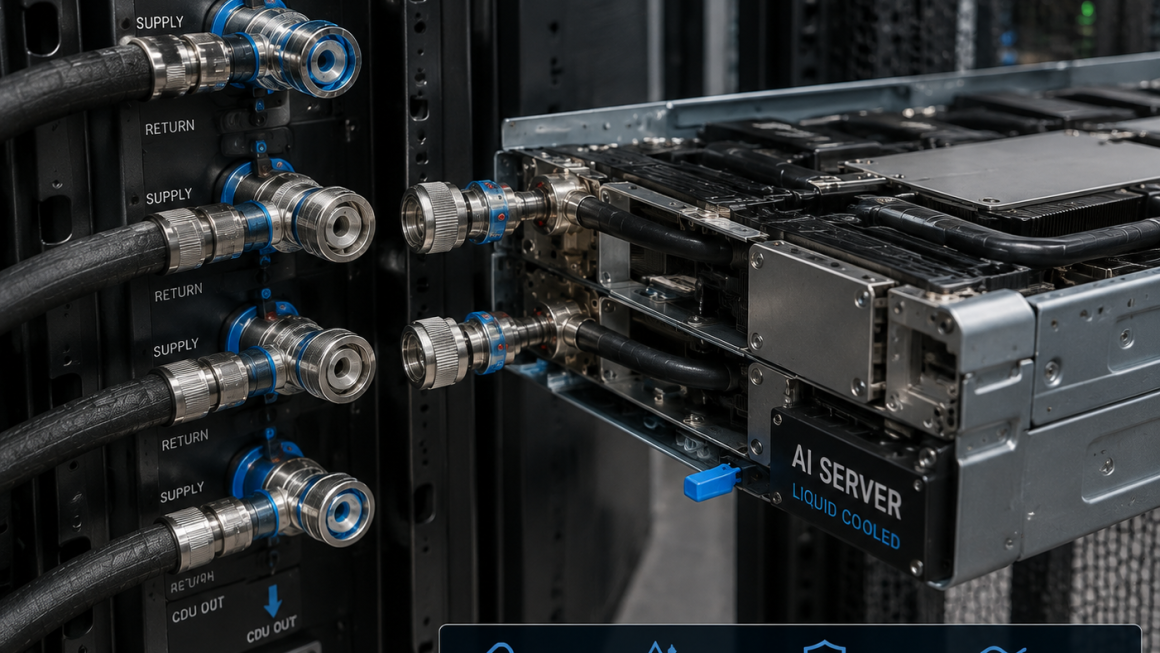
Within liquid cooling systems, quick disconnect couplings (QDs) play a critical role by enabling reliable, maintenance-friendly fluid connections between cooling components.
What Are Liquid Cooling Quick Couplings?
Liquid Cooling Quick Couplings are precision-engineered connectors designed to connect and disconnect cooling fluid lines while minimizing:
- Fluid leakage
- Air contamination
- Maintenance downtime
In AI and HPC systems, QDs are commonly used between:
- Server cooling loops
- Cold plates
- Rack manifolds
- Coolant distribution units (CDUs)
- Facility cooling infrastructure
They provide a flexible connection point that allows servers and cooling components to be installed, replaced, or serviced efficiently.
Why AI & HPC Racks Require Specialized QDs
AI server environments have much higher requirements than conventional industrial cooling systems.
Liquid cooling quick couplings must support:
High Thermal Loads
AI accelerators generate significant heat.
Cooling systems require:
- High flow rates
- Low pressure drop
- Stable fluid circulation
Poorly designed connectors can reduce cooling efficiency.
Reliability for Continuous Operation
Data centers operate 24/7.
Cooling failures can lead to:
- Server shutdown
- Performance degradation
- Equipment damage
Reliable QDs must provide long-term leak-free operation.
Frequent Maintenance Requirements
AI infrastructure evolves rapidly.
Servers and accelerator modules may require:
- Upgrades
- Replacement
- Reconfiguration
Quick couplings simplify maintenance by allowing rapid connection and disconnection.
How Liquid Cooling QDs Work
A typical liquid cooling quick coupling consists of:
- Male coupling half
- Female coupling half
- Valve mechanism
- Sealing system
- Locking structure
When connected:
→ Fluid pathways open
→ Coolant flows through the system
When disconnected:
→ Internal valves close
→ Fluid loss is minimized
This design allows maintenance without draining the entire cooling loop.
Types of Liquid Cooling Quick Couplings
Blind-Mate Quick Couplings
Blind-mate QDs are designed for automatic alignment during installation.
They are widely used in:
- Rack-level liquid cooling
- Blade servers
- Modular HPC systems
Advantages:
- Fast installation
- Reduced alignment requirements
- Improved service efficiency
Non-Spill Quick Disconnect Couplings
Non-spill designs minimize coolant leakage during connection and separation.
Benefits include:
- Cleaner maintenance
- Reduced contamination risk
- Improved operator safety
Panel-Mount and Rack-Level QDs
These are integrated directly into:
- Server chassis
- Rack manifolds
- Cooling distribution systems
They support modular data center architectures.
Key Design Requirements for AI Liquid Cooling QDs
Low Pressure Drop
Cooling efficiency depends on maintaining sufficient coolant flow.
QDs should provide:
- Smooth internal passages
- Optimized fluid channels
- Minimal resistance
Leak Prevention
Leak protection is one of the most important requirements.
Design considerations include:
- High-quality sealing materials
- Precision machining
- Reliable valve structures
- Pressure testing
Material Compatibility
Cooling fluids may include:
- Water
- Water-glycol mixtures
- Dielectric fluids
Materials must resist:
- Corrosion
- Chemical degradation
- Long-term exposure
Common materials include:
- Aluminum alloys
- Stainless steel
- Brass
- Engineering polymers
Aluminum vs Stainless Steel QDs
Aluminum Quick Couplings
Advantages:
- Lightweight
- Good thermal conductivity
- Lower material cost
Suitable for:
- Weight-sensitive systems
- Rack-level cooling applications
Considerations:
- Requires proper surface treatment
- Must address corrosion compatibility
Stainless Steel Quick Couplings
Advantages:
- Excellent corrosion resistance
- High mechanical strength
- Long service life
Suitable for:
- High-reliability data center environments
- Harsh operating conditions
Role of QDs in Rack-Level Liquid Cooling
Modern AI racks often use architectures including:
- Direct-to-chip cooling
- Cold plates
- Rear-door heat exchangers
- Liquid cooling manifolds
Quick couplings connect these components into a reliable cooling network.
Typical cooling path:
CDU
↓
Rack Manifold
↓
Quick Coupling
↓
Cold Plate
↓
GPU / CPU
↓
Return Cooling Loop
Integration With AI Data Center Infrastructure
Liquid cooling QDs are becoming an important component in:
AI Training Clusters
Large-scale GPU clusters require:
- High cooling capacity
- Reliable fluid connections
- Easy maintenance
HPC Research Facilities
Scientific computing environments require:
- Stable operation
- High availability
- Efficient thermal management
Enterprise AI Data Centers
Private AI infrastructure requires:
- Flexible deployment
- Modular expansion
- Simplified maintenance
Future Trends in Liquid Cooling Connections
As AI computing continues to scale, QD technology will evolve toward:
Higher Flow Capability
Supporting higher-density AI racks.
More Compact Designs
Reducing space requirements inside server systems.
Smarter Cooling Systems
Integration with:
- Sensors
- Monitoring systems
- Intelligent thermal control
Modular Rack Architecture
Quick couplings will enable faster deployment and maintenance of modular AI infrastructure.
Liquid Cooling Quick Couplings are a critical enabling component for next-generation AI and HPC data centers.
As server power density continues to increase, reliable fluid connection technology becomes essential for maintaining cooling efficiency, system uptime, and operational flexibility.
By combining precision engineering, corrosion-resistant materials, reliable sealing technology, and modular integration, liquid cooling QDs help build the foundation for future high-performance computing infrastructure.