

Why Coastal BESS Requires More Than One Protection Layer
Battery Energy Storage Systems (BESS) installed in coastal environments face a combination of environmental challenges that can accelerate equipment degradation.
Unlike indoor installations, coastal battery systems may be continuously exposed to:
- Salt spray
- High humidity
- Condensation
- UV radiation
- Wind-driven rain
- Dust and airborne contaminants
- High ambient temperatures
These factors can affect battery enclosures, structural components, cables, connectors, cooling systems, and electrical equipment.
For this reason, reliable coastal BESS protection should not depend on a single coating, enclosure, or protective cover.
A multi-layer protection system combines several protection strategies to address different environmental risks.
The Coastal BESS Protection Challenge
A typical coastal ESS can experience several risks at the same time.
Salt + Humidity
Salt particles combined with moisture can accelerate metal corrosion and electrical contact degradation.
Heat + Solar Radiation
Direct sunlight can increase enclosure surface temperatures and create additional thermal stress.
Rain + Wind
Wind-driven rain can reach cable entries, connectors, ventilation openings, and enclosure joints.
Dust + Moisture
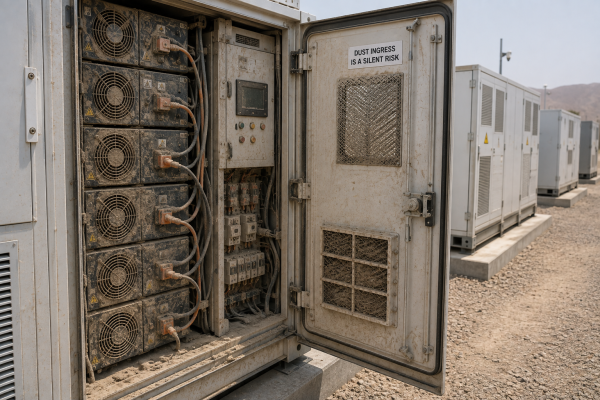
Dust accumulation combined with humidity can create contamination pathways around electrical components.
This means that coastal protection must be designed at the system level, rather than treating each risk independently.
What Is a Multi-Layer Protection System?
A multi-layer protection system uses different engineering measures to create several barriers between sensitive ESS components and the external environment.
A practical protection architecture can be viewed as:
Coastal Environment
↓
Protective Cover / External Shield
↓
Corrosion-Resistant Enclosure
↓
Sealing & Cable Protection
↓
Protected Electrical Components
↓
Thermal Management System
↓
Battery and Power Electronics
Each layer performs a different function.
Layer 1: Material Selection
The first layer starts with choosing materials that can withstand the expected environment.
Common materials for outdoor BESS components include:
Aluminum
Aluminum is attractive for ESS structures because of its:
- Low weight
- Natural oxide protection
- Good thermal conductivity
- Fabrication flexibility
It can be used for:
- Structural components
- Protective covers
- Heat dissipation components
- Enclosure parts
Surface treatment may be added when higher corrosion resistance is required.
Stainless Steel
Stainless steel provides high corrosion resistance and mechanical strength.
It is particularly useful for:
- Fasteners
- Brackets
- Critical structural components
- Highly exposed areas
Coated Carbon Steel
Carbon steel remains attractive for large ESS structures because of its strength and cost efficiency.
However, it requires an appropriate corrosion protection system.
Layer 2: Protective Coatings
A suitable coating system provides a physical barrier between the metal substrate and the marine environment.
Depending on the application, protection may include:
- Powder coating
- Epoxy primer systems
- Polyurethane topcoats
- Specialized marine coatings
- Conversion coatings
The coating system should be selected according to:
- Salt exposure
- UV exposure
- Temperature
- Mechanical requirements
- Expected service life
For demanding coastal projects, corrosion protection should be evaluated as a complete coating system rather than simply specifying a coating thickness.
Layer 3: C5-Level Corrosion Protection
Coastal BESS projects may require very high corrosion resistance depending on the site conditions.
C5-oriented protection strategies can combine:
- Corrosion-resistant materials
- Surface preparation
- Protective coatings
- Sealed joints
- Appropriate fasteners
- Regular inspection
The objective is not simply to make the outside of the enclosure resistant to corrosion.
The entire system must minimize corrosion pathways.
Layer 4: Protective Covers and Weather Shields
Protective covers provide an additional physical barrier against environmental exposure.
They can be used to protect:
- Cable connections
- Cooling components
- Electrical interfaces
- Ventilation areas
- External control equipment
A well-designed cover can reduce direct exposure to rain and salt spray while allowing necessary heat dissipation.
This is particularly important because maximum environmental sealing is not always the same as maximum thermal performance.
Layer 5: Cable and Connector Protection
Cable systems are often among the most exposed components in outdoor ESS installations.
Potential failure points include:
- Cable glands
- Connectors
- Junction boxes
- Cable bends
- Metal conduit interfaces
Protection strategies may include:
- Weather-resistant cable glands
- Protective conduits
- Cable sleeves
- Sealed connection points
- Corrosion-resistant fittings
Cable protection should be designed as part of the enclosure system rather than treated as an independent accessory.
Layer 6: Sealing and Water Management
Even a corrosion-resistant enclosure can experience problems if water enters the system.
Good enclosure design should manage:
- Rainwater
- Condensation
- Drainage
- Air exchange
Important design features include:
- Sealed access points
- Proper door gaskets
- Sloped surfaces
- Drainage channels
- Protected cable entries
The goal is not necessarily to create a completely sealed box.
Instead, the system should control where water and moisture can enter, accumulate, and exit.
Layer 7: Thermal Protection and Heat Dissipation
Coastal BESS systems face an important engineering contradiction:
The better the enclosure is protected, the more difficult heat removal can become.
High ambient temperatures and direct solar exposure can increase battery and electronics temperatures.
Therefore, thermal protection must work together with environmental protection.
Possible solutions include:
- Liquid cooling
- Cooling plates
- Heat exchangers
- Thermal insulation
- Heat-reflective surfaces
- Ventilation pathways
The objective is to protect the equipment without trapping excessive heat inside the enclosure.
Layer 8: Mechanical Protection
Coastal projects can also experience strong winds, vibration, and external impact.
Structural protection should consider:
- Wind loading
- Equipment weight
- Transportation vibration
- Maintenance operations
- Long-term structural stability
Protective covers, brackets, racks, and mounting systems should maintain mechanical integrity throughout the system lifecycle.
Layer 9: Inspection and Maintenance
Even the best protection system requires inspection.
A coastal BESS maintenance program should monitor:
- Coating condition
- Corrosion around fasteners
- Cable gland integrity
- Enclosure seals
- Drainage paths
- Cooling system performance
Early detection can prevent small environmental issues from becoming major equipment failures.
How the Protection Layers Work Together
A coastal BESS protection system can be summarized as:
Material Selection
↓
Surface Treatment
↓
C5 Corrosion Protection
↓
Protective Covers
↓
Sealing & Water Management
↓
Cable & Connector Protection
↓
Thermal Management
↓
Inspection & Maintenance
Each layer addresses a different failure mechanism.
The objective is to prevent one weak point from compromising the entire system.
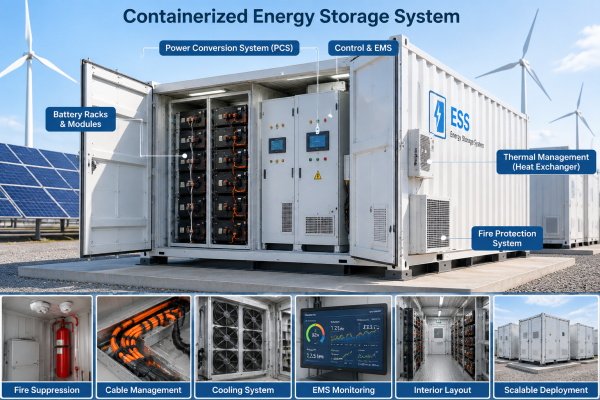
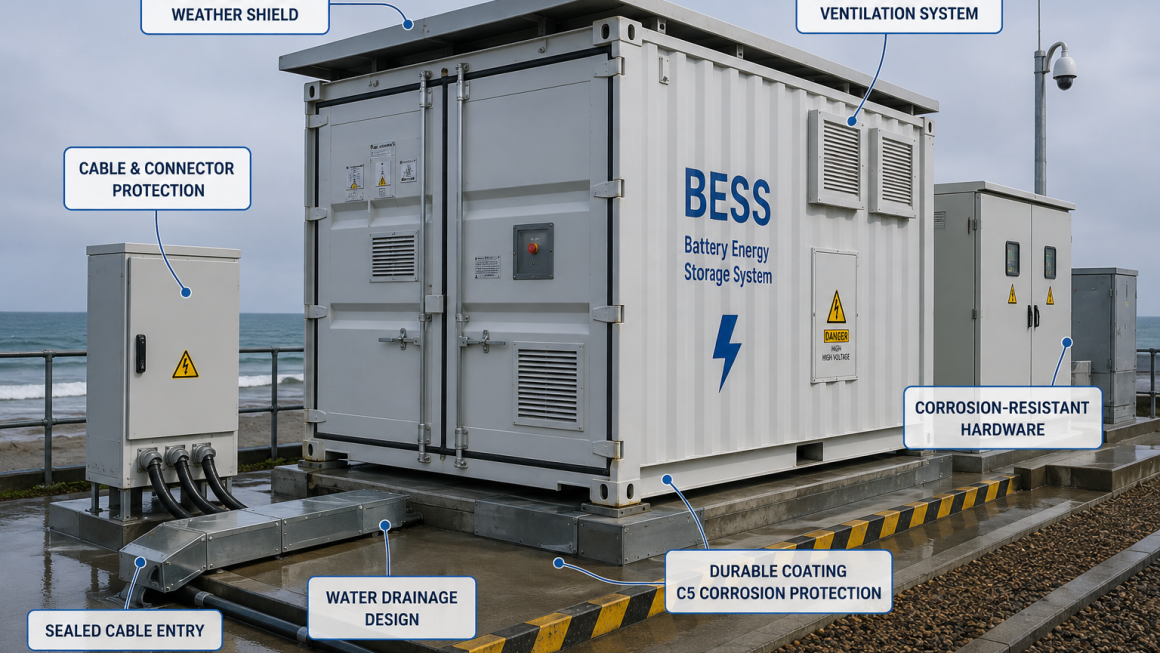
Example: Coastal Battery Container
Consider a battery container installed near the coast.
The system may use:
Aluminum or coated steel structure
→ Provides the basic structural and corrosion-resistant foundation.
Protective coating
→ Reduces direct metal exposure.
Weather-resistant cover
→ Reduces salt spray and rain exposure.
Sealed cable entries
→ Protect electrical connections.
Corrosion-resistant hardware
→ Protects mechanical joints.
Liquid cooling system
→ Controls battery temperature.
Drainage design
→ Prevents water accumulation.
Inspection program
→ Detects early corrosion or seal degradation.
This layered approach provides more reliable protection than relying on a single high-performance material.
Why System-Level Protection Matters
Coastal BESS reliability is determined by the weakest protection point.
For example, a highly corrosion-resistant enclosure may still experience problems if:
- Cable glands are poorly sealed
- Fasteners are incompatible
- Water accumulates around joints
- Protective covers trap heat
- Cooling components are exposed to salt spray
Therefore, engineers should evaluate the complete environmental protection system.
Designing Protection Around the Actual Site
Not every coastal BESS project requires exactly the same protection strategy.
Site assessment should consider:
- Distance from the coastline
- Salt spray intensity
- Ambient temperature
- Humidity
- Wind conditions
- Industrial pollution
- Solar exposure
A site-specific protection strategy can prevent both under-protection and unnecessary cost.
Future Trends in Coastal BESS Protection
Future outdoor energy storage systems will increasingly combine:
- Lightweight corrosion-resistant materials
- Advanced protective coatings
- Modular protective covers
- Improved cable protection
- Integrated thermal management
- Smart environmental monitoring
The trend is moving from individual protective components toward integrated environmental protection systems.
Coastal BESS installations face multiple environmental risks at the same time. Salt spray, humidity, heat, UV exposure, rain, and mechanical stress can all affect long-term system reliability.
A reliable solution is therefore not based on one material or one coating.
Instead, coastal BESS should use a multi-layer protection system combining:
- Appropriate materials
- Corrosion-resistant coatings
- C5-level protection strategies
- Protective covers
- Cable and connector protection
- Sealing and drainage
- Thermal management
- Mechanical protection
- Regular inspection
By designing these layers together, energy storage manufacturers and system integrators can improve equipment durability, reduce maintenance requirements, and build more reliable BESS installations for demanding coastal environments.