
Industrial facilities often have some of the largest and most predictable energy loads in their buildings and production environments.
Cooling systems, chillers, heat pumps, boilers, electric heaters, refrigeration systems, and thermal processing equipment can consume substantial amounts of electricity, particularly during periods of high production or peak grid demand.
Traditionally, these systems have been operated according to production schedules, temperature requirements, and equipment availability.
However, the growing deployment of battery energy storage systems, thermal energy storage, microgrids, and intelligent energy management systems creates a new opportunity:
Industrial cooling and heating loads can become flexible energy resources.
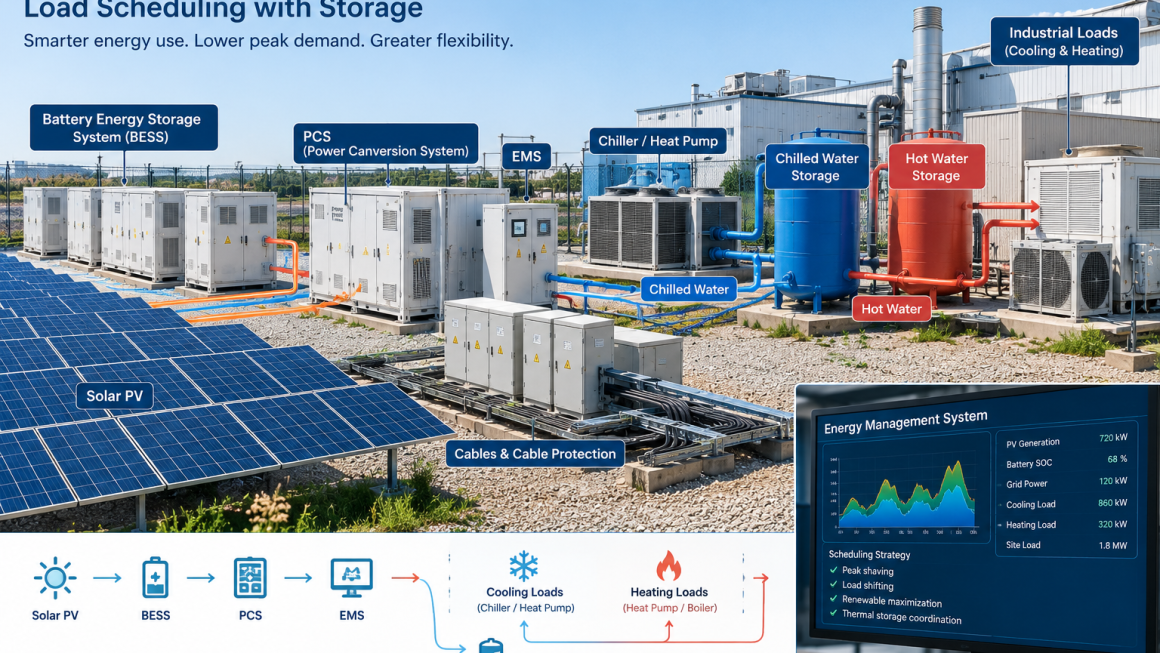
Instead of simply responding to electricity demand, industrial thermal systems can be scheduled together with energy storage to reduce peak demand, increase renewable-energy utilization, and improve overall energy efficiency.
The basic concept is:
Industrial thermal load + energy storage + EMS → flexible energy management
This approach is particularly valuable for factories, cold-storage facilities, food processing plants, chemical facilities, warehouses, data-intensive industrial sites, and other facilities with significant heating or cooling requirements.
1. Why Cooling and Heating Loads Are Good Candidates for Scheduling
Not all industrial loads can be shifted.
Some machines must operate continuously because stopping them would interrupt production.
Thermal systems are different.
Many cooling and heating processes have a certain degree of thermal inertia.
For example, a chilled-water system may cool water to a lower temperature than immediately required and allow the stored cooling capacity to be used later.
Similarly, a building or industrial process may be heated slightly ahead of time and then temporarily reduce heater operation while the temperature remains within an acceptable range.
This creates an important principle:
Electrical energy can be shifted in time by storing thermal energy.
Instead of storing all energy in batteries, a facility can use a combination of:
- Battery energy storage
- Chilled water
- Ice storage
- Hot water
- Heated process media
- Building thermal mass
- Refrigerated inventory
This can significantly increase the flexibility of industrial energy management.
2. The Difference Between Battery Storage and Thermal Storage
Battery storage and thermal storage solve related but different problems.
Battery energy storage
Battery systems store electrical energy.
Grid/PV → Battery → Electrical load
They can provide:
- Peak shaving
- Backup power
- Energy arbitrage
- Power smoothing
- Renewable integration
Thermal energy storage
Thermal storage shifts cooling or heating energy.
Electricity → Chiller/Heater → Thermal storage → Cooling/Heating load
Examples include:
- Chilled-water tanks
- Ice storage
- Hot-water tanks
- Molten-salt systems
- Phase-change materials
- Thermal mass
The most effective industrial strategy may therefore combine both.
Battery storage manages electrical power.
Thermal storage manages thermal demand.
Together, they provide a broader energy-management capability.
3. Industrial Cooling Loads Can Be Scheduled Around Electricity Prices
Cooling demand frequently changes throughout the day.
Consider an industrial facility with the following pattern:
Morning
Production starts → cooling demand increases
Midday
Solar generation increases → electricity becomes relatively available
Afternoon
Production remains high → cooling demand remains high
Evening
Solar generation falls → grid electricity becomes more expensive or constrained
A smart EMS can use this pattern to schedule cooling production.
For example:
Midday
PV generation → Chiller operates at higher output → chilled-water storage charges
↓
Afternoon
Chiller output reduced → stored cooling supports the process
↓
Peak period
Battery discharge + thermal storage → reduced grid demand
This creates a form of thermal load shifting.
The facility does not necessarily reduce the amount of cooling it provides.
It changes when the electricity is consumed.
4. Peak Shaving with Industrial Thermal Loads
Demand charges can represent a significant portion of electricity costs for industrial facilities.
A short period of high power demand can increase the monthly peak demand.
For example:
Normal facility demand:
2.0 MW
Peak cooling operation:
+0.8 MW
Total:
2.8 MW
If the cooling system can temporarily reduce electrical consumption while thermal storage supplies part of the cooling requirement, the peak may be reduced.
For example:
2.0 MW industrial load + 0.3 MW cooling
instead of:
2.0 MW industrial load + 0.8 MW cooling
The resulting peak becomes approximately:
2.3 MW
Battery storage can provide additional support if required.
This creates a coordinated strategy:
Thermal load shifting + battery discharge → lower grid peak
5. Heating Loads Can Be Managed in the Same Way
The same principle applies to industrial heating.
Potentially flexible heating loads include:
- Heat pumps
- Electric boilers
- Hot-water systems
- Drying systems
- Building heating
- Low-temperature process heating
- Thermal storage systems
For example, a heat pump could operate at higher output during periods of abundant solar generation.
The thermal energy can then be stored in hot water or another thermal medium.
Later:
Stored heat → Industrial process
while:
Grid electricity consumption → reduced
This can increase renewable-energy utilization while reducing peak-period electricity consumption.
6. Thermal Inertia Creates a Virtual Energy-Storage Resource
One of the most interesting aspects of industrial load scheduling is that some facilities already contain a form of energy storage.
A chilled-water tank stores cooling capacity.
A refrigerated warehouse stores thermal capacity.
A hot-water tank stores heat.
Even a building structure can absorb and release thermal energy.
Therefore:
Thermal inertia ≈ flexible energy resource
This does not mean thermal inertia is equivalent to a battery.
Its response speed, storage duration, efficiency, and operating limits are different.
However, from an EMS perspective, both can provide a way to move energy consumption from one time period to another.
7. The EMS Needs to Understand Thermal Constraints
Industrial load scheduling cannot be based only on electricity prices.
The EMS must understand the actual thermal requirements of the facility.
Relevant parameters may include:
- Supply temperature
- Return temperature
- Temperature limits
- Cooling capacity
- Heating capacity
- Thermal storage SOC
- Production schedule
- Equipment efficiency
- Ambient temperature
- Process constraints
For a chilled-water system, for example, the EMS may monitor:
Chilled-water temperature + tank state + cooling demand + chiller capacity
The scheduling algorithm can then determine when the chiller should operate and at what output level.
8. Cooling Efficiency Changes with Ambient Conditions
Industrial cooling systems do not consume the same amount of electricity throughout the day.
Outdoor temperature has a significant influence on cooling efficiency.
For refrigeration and air-conditioning systems, higher ambient temperatures can increase compressor power requirements.
This creates an additional scheduling opportunity.
For example:
Cooler period → higher cooling efficiency
Hotter period → lower cooling efficiency
If thermal storage is available, the facility may produce additional cooling during more favorable operating conditions and use the stored cooling during hotter periods.
This can improve overall system efficiency.
However, the strategy must account for thermal losses and storage efficiency.
9. Battery Storage and Cooling Systems Can Work Together
Battery storage can complement thermal load scheduling.
Consider a facility with:
- 1 MW PV
- 500 kWh battery
- Industrial chiller
- Chilled-water storage
- Variable production load
During high solar production:
PV → Industrial load
PV → Chiller
PV → Battery
PV → Thermal storage
The EMS determines how available renewable electricity should be allocated.
During peak grid periods:
Battery → Electrical loads
Thermal storage → Cooling demand
The result is a multi-layer energy-management strategy.
Instead of using the battery to handle every demand fluctuation, thermal storage handles the portion that can be shifted thermally.
This can reduce the required battery capacity.
10. Coordinated Scheduling Is Better Than Independent Control
Traditional industrial facilities may have independent control systems.
For example:
- Chiller controller controls cooling
- Boiler controller controls heating
- BESS controller controls battery
- PV inverter controls solar
- Building management system controls HVAC
Each system may operate correctly on its own.
But independent optimization can create conflicts.
For example:
Chiller starts at 5:00 PM
Battery begins charging at 5:00 PM
Grid demand reaches its daily peak
The individual systems may be functioning normally, but the combined energy strategy is poor.
An integrated EMS can coordinate them.
A simplified scheduling hierarchy could be:
Renewable generation forecast
↓
Production forecast
↓
Thermal demand forecast
↓
Battery SOC
↓
Thermal storage SOC
↓
Electricity tariff / demand target
↓
Optimal equipment schedule
11. Forecasting Is Essential
Effective scheduling requires forecasting.
The EMS may need to predict:
- Solar generation
- Electricity demand
- Production activity
- Outdoor temperature
- Cooling demand
- Heating demand
- Electricity prices
- Battery availability
For example:
Tomorrow afternoon
High temperature + high production + low solar generation
↓
Expected cooling demand increases
↓
EMS charges battery and thermal storage earlier
↓
Peak-period demand is reduced
This is significantly more effective than reacting after the peak has already occurred.
12. Avoid Excessive Cycling of Thermal Equipment
Load scheduling should not simply turn equipment on and off repeatedly.
Frequent cycling can increase:
- Compressor wear
- Motor stress
- Valve wear
- Maintenance requirements
- Energy losses
Therefore, the EMS should consider equipment operating constraints such as:
- Minimum run time
- Minimum shutdown time
- Ramp rate
- Minimum loading
- Maximum loading
- Start-up energy
- Equipment efficiency curve
For large chillers and heat pumps, operating continuously at an efficient partial load may sometimes be better than frequent start-stop operation.
13. Variable-Speed Equipment Expands Scheduling Flexibility
Variable-frequency drives and variable-speed compressors can significantly improve load flexibility.
Instead of:
ON / OFF
the system can operate at:
30% → 50% → 70% → 90%
This gives the EMS much finer control.
For example, if the facility needs 600 kW of cooling capacity but the grid demand is approaching its limit, the EMS may temporarily reduce chiller electrical demand.
Thermal storage can compensate for the difference.
This creates:
Variable-speed control + thermal storage + battery storage
as a powerful combination for industrial energy management.
14. A Practical Scheduling Example
Consider a simplified industrial facility.
The site contains:
- 2 MW industrial electrical load
- 1 MW peak cooling load
- 500 kW heating load
- 1 MW solar PV
- 1 MWh battery
- Chilled-water storage
- Hot-water storage
A simplified daily strategy could look like this.
08:00–11:00
Production increases.
PV generation begins increasing.
Cooling equipment operates according to production demand.
11:00–14:00
PV output reaches a high level.
The EMS increases cooling and heating production where thermal storage capacity is available.
Battery charging also takes place if economically justified.
14:00–17:00
Production remains high.
Thermal storage begins supporting part of the cooling and heating requirements.
Battery SOC is maintained for the expected peak period.
17:00–20:00
PV output decreases.
Electricity demand remains high.
The EMS uses:
Battery discharge + thermal storage
to reduce grid demand.
Night
Production decreases.
Thermal systems return to normal operating schedules.
Battery charging may occur during lower-cost periods if required.
This is only a simplified example, but it demonstrates the central concept:
Move flexible energy consumption away from expensive or constrained periods.
15. Thermal Storage Can Reduce Battery Size
One of the strongest arguments for combining thermal storage with batteries is that not every peak needs to be handled electrically.
Suppose a facility experiences a 1 MW cooling load for two hours during the grid peak.
The theoretical electrical energy associated with that load is approximately:
1 MW × 2 h = 2 MWh
A battery could potentially be used to offset part of that demand.
But if the cooling requirement can instead be shifted through thermal storage, the battery may only need to manage the remaining electrical loads.
This can reduce:
- Battery capacity requirements
- Battery capital cost
- Battery cycling
- Cooling requirements for the BESS
- Battery degradation
The optimal balance depends on the specific facility.
16. Energy Scheduling Must Respect Production Requirements
Energy savings should never compromise product quality or production stability.
Industrial thermal processes can have strict temperature requirements.
Examples include:
- Food processing
- Chemical production
- Pharmaceutical manufacturing
- Plastics processing
- Cold-chain storage
- Electronics manufacturing
The EMS should therefore define operating boundaries.
For example:
Target temperature: 20°C
Acceptable range: 19–21°C
Within this range, the EMS may have flexibility.
Outside the range, production requirements take priority.
This leads to an important principle:
Energy optimization must operate inside the process constraints.
17. Storage Scheduling Can Support Renewable Energy Integration
Industrial cooling and heating can also help absorb renewable generation.
When solar production exceeds immediate demand:
PV surplus → Chiller / heat pump → thermal storage
Instead of curtailing solar power, the facility converts some of the surplus electricity into useful thermal energy.
This can increase renewable utilization.
The same strategy can work with battery storage.
A coordinated system can therefore prioritize:
Direct renewable consumption
↓
Thermal storage
↓
Battery storage
↓
Grid export or curtailment
The exact priority depends on electricity tariffs, system efficiency, battery operating limits, and grid conditions.
18. Communication and Measurement Are Critical
Load scheduling requires accurate data.
The EMS needs information from:
- Power meters
- Temperature sensors
- Chillers
- Heat pumps
- Thermal storage
- BESS
- PV systems
- Production systems
- Weather sensors
Poor measurements can result in poor scheduling.
For example, if the EMS underestimates cooling demand, thermal storage may not be sufficiently charged before a peak period.
If it overestimates demand, unnecessary energy may be consumed.
Therefore, accurate metering and reliable communication infrastructure are fundamental to industrial energy optimization.
19. O&M Must Be Included in the Scheduling Strategy
Energy scheduling should not ignore equipment condition.
A chiller operating with a dirty heat exchanger may consume significantly more energy than expected.
A clogged cooling filter, degraded pump, or inefficient compressor can also change the real operating profile.
Therefore, energy-management systems can potentially combine scheduling data with maintenance information.
For example:
Cooling efficiency decreases
↓
Energy consumption per unit of cooling increases
↓
EMS identifies abnormal performance
↓
Maintenance inspection triggered
This moves the system toward predictive energy and maintenance management rather than simply energy scheduling.
20. A Multi-Layer Storage Strategy
Industrial facilities do not necessarily need to rely on one type of storage.
A more advanced architecture can combine:
Electrical storage
Battery energy storage system
Fast response + peak shaving + power management
Thermal storage
Chilled water / ice / hot water
Longer-duration thermal shifting
Flexible loads
HVAC, pumps, compressors, and other controllable equipment
Demand-side flexibility
Together:
BESS + thermal storage + flexible loads + renewable generation + EMS
creates a highly flexible industrial energy platform.
21. Key Design Considerations
Before implementing industrial cooling/heating load scheduling, project teams should evaluate:
Load profile
- Peak demand
- Daily demand
- Seasonal demand
- Production schedule
Thermal system
- Cooling capacity
- Heating capacity
- COP
- Part-load efficiency
- Ramp rate
Thermal storage
- Capacity
- Charge/discharge rate
- Thermal losses
- Operating temperature range
Battery storage
- Energy capacity
- Power capacity
- SOC limits
- Cycling requirements
Renewable generation
- PV capacity
- Generation profile
- Forecast accuracy
EMS
- Communication
- Control hierarchy
- Scheduling algorithm
- Fail-safe operation
Economics
- Energy tariff
- Demand charges
- Renewable curtailment
- Battery degradation
- Maintenance costs
22. The Business Case Is About More Than Electricity Savings
The value of coordinated industrial load scheduling can come from several sources.
Peak-demand reduction
Lower maximum grid demand can reduce demand-related charges.
Energy arbitrage
Electricity consumption can be shifted toward lower-cost periods.
Renewable utilization
More solar energy can be consumed locally instead of curtailed.
Battery optimization
Thermal storage can reduce unnecessary battery cycling.
Equipment efficiency
Cooling and heating equipment can be scheduled around more efficient operating conditions.
Resilience
BESS can provide additional support during grid disturbances.
The result is not simply:
“Use less electricity.”
It is:
“Use electricity at the right time, in the right form, and with the right storage technology.”
Industrial cooling and heating loads represent a significant opportunity for flexible energy management.
Instead of treating chillers, heat pumps, boilers, refrigeration systems, and thermal processes as fixed electricity consumers, industrial facilities can use their thermal flexibility as part of a broader storage strategy.
The most effective approach combines:
Renewable generation + battery storage + thermal storage + flexible loads + EMS
Battery systems provide fast electrical response.
Thermal storage provides longer-duration load shifting.
Flexible industrial equipment provides additional control capacity.
The EMS coordinates these resources according to production requirements, electricity prices, renewable generation, thermal conditions, and battery state of charge.
The ultimate objective is not simply to reduce energy consumption.
It is to create a more flexible industrial energy system that can reduce peak demand, increase renewable utilization, optimize storage assets, and maintain stable production.
As industrial facilities continue to electrify and integrate renewable energy, intelligent cooling and heating load scheduling will become an increasingly important component of modern energy management.
Frequently Asked Questions
What is industrial cooling and heating load scheduling?
It is the coordinated control of industrial cooling and heating equipment so that electricity consumption occurs at the most beneficial times while maintaining required process temperatures and production conditions.
Why are cooling loads suitable for energy scheduling?
Many cooling systems have thermal inertia. Chilled water, ice, refrigerated spaces, and other thermal storage methods can temporarily maintain cooling requirements while reducing the instantaneous electrical load.
Can batteries and thermal storage be used together?
Yes. Batteries can manage fast electrical demand while thermal storage handles flexible cooling or heating demand. Combining them can reduce battery cycling and potentially reduce the required battery capacity.
How does thermal storage reduce peak demand?
Cooling or heating can be produced before a high-demand period and stored. During the peak period, the stored thermal energy supports the process, allowing chillers, heaters, or heat pumps to consume less electricity.
Can solar energy be used for thermal storage?
Yes. During periods of high solar generation, excess PV electricity can power chillers or heat pumps and charge thermal storage, increasing on-site renewable utilization.
Does load scheduling affect industrial production?
It should not if properly designed. The EMS must operate within defined process temperature and equipment constraints, with production requirements taking priority over energy optimization.
What role does the EMS play?
The EMS coordinates PV, BESS, thermal storage, cooling and heating equipment, electricity demand, tariffs, and production requirements to determine the optimal operating schedule.
Can load scheduling reduce BESS costs?
Potentially. If thermal storage and flexible loads can handle part of the peak demand, the battery may not need to provide the entire peak-shaving function. This can reduce required battery capacity and cycling.
What is the difference between thermal storage and battery storage?
Battery storage stores electrical energy, while thermal storage stores cooling or heating capacity. They have different response characteristics and efficiencies but can complement each other within an integrated energy-management system.
What is the long-term trend for industrial energy management?
The trend is toward integrated systems in which BESS, renewable generation, thermal storage, flexible industrial loads, and EMS platforms operate as one coordinated energy system rather than as independent assets.