


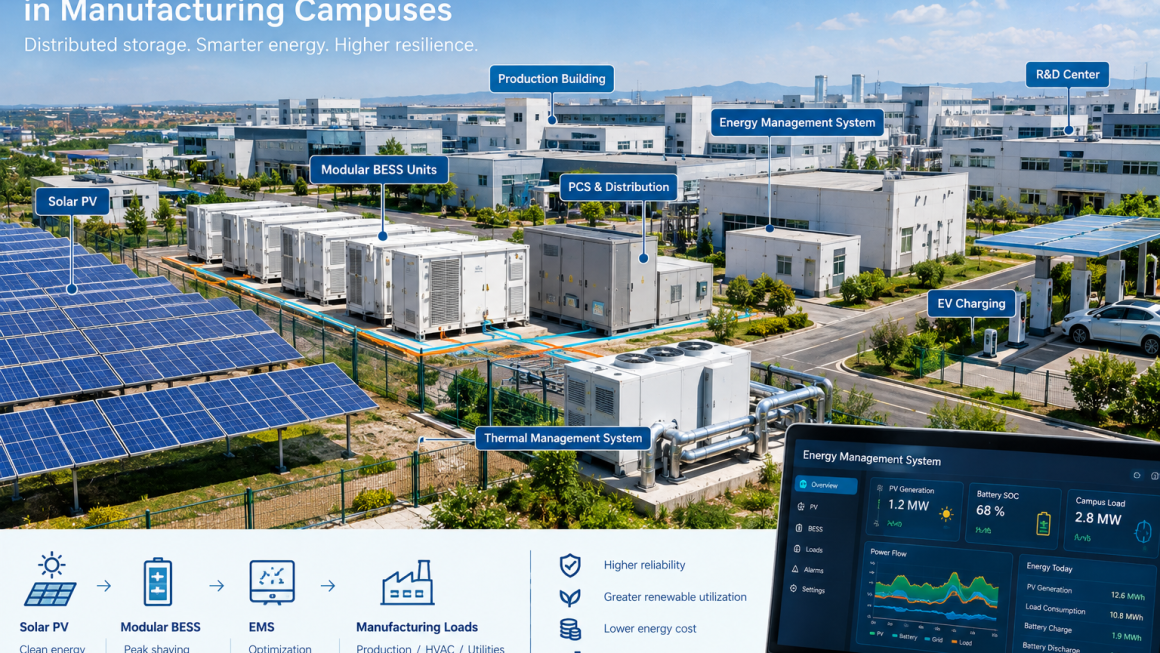
Manufacturing campuses are becoming increasingly complex energy environments.
A modern industrial campus may contain multiple production buildings, warehouses, laboratories, offices, utility systems, HVAC equipment, compressed-air systems, electric vehicles, charging infrastructure, and distributed renewable-energy resources.
As electricity demand increases and manufacturers seek greater energy flexibility, modular energy storage systems are becoming an increasingly practical solution.
Unlike a single large centralized battery system, a modular energy storage architecture can distribute storage capacity across different buildings, production zones, or electrical nodes.
This approach can provide several advantages:
- Flexible capacity expansion
- Distributed peak shaving
- Improved renewable-energy utilization
- Local backup capability
- Easier maintenance
- Reduced dependence on a single storage asset
- Better adaptation to changing production requirements
This case study examines how a modular energy storage system can be applied across a manufacturing campus and what practical lessons can be learned from such a deployment.
1. The Energy Challenge of a Manufacturing Campus
Consider a manufacturing campus containing several independent but interconnected facilities.
The site includes:
- Production Building A
- Production Building B
- Warehouse
- R&D Center
- Administrative Building
- Utility Building
- Central electrical distribution system
- Rooftop solar PV
- Electric vehicle charging stations
The campus has different load profiles throughout the day.
For example:
Production buildings
High daytime electricity demand
Warehouse
Moderate and relatively stable demand
R&D center
Variable demand with sensitive equipment
Administrative building
Lower daytime demand with HVAC-related peaks
EV charging
Potentially large but flexible demand
The result is a highly dynamic site-level load profile.
A centralized battery could provide support to the entire campus, but it may not always be the most flexible architecture.
2. Why Modular Energy Storage Was Selected
The manufacturing campus in this example had three major objectives:
1. Reduce peak electricity demand
The facility wanted to reduce short-duration demand peaks created by production equipment and HVAC systems.
2. Increase solar self-consumption
The campus had significant daytime PV generation but experienced periods when solar output exceeded immediate demand.
3. Improve energy resilience
Certain production and control systems required continued power availability during grid disturbances.
A modular BESS architecture provided a way to address all three objectives.
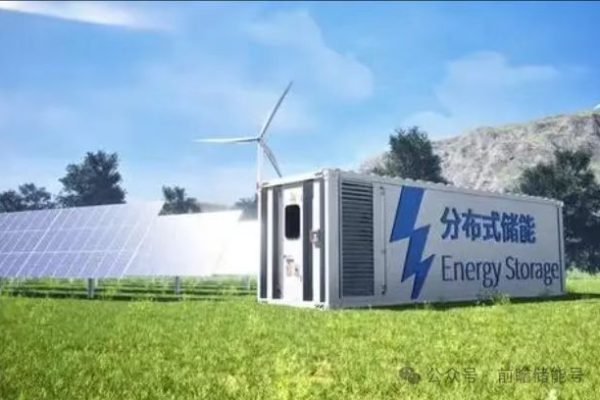
Instead of installing one very large battery at a single electrical point, storage capacity was distributed across several campus locations.
3. A Typical Modular Architecture
A simplified architecture could look like this:
Solar PV
↓
Campus Medium/Low-Voltage Distribution
↓
Multiple Modular BESS Units
↓
Production + Warehouse + R&D + Building Loads
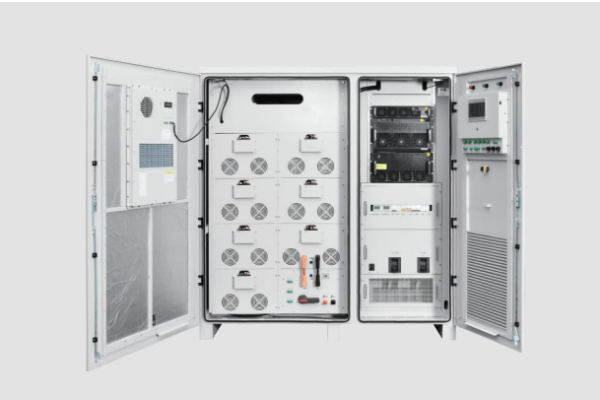
Each modular BESS may include:
- Battery racks
- BMS
- PCS
- Local controller
- HVAC or thermal management
- Fire protection
- Protection equipment
- Communication interface
The site-level EMS coordinates the individual storage units.
This creates two levels of control:
Local BESS control
and
Campus-level energy management
The local controller maintains safe battery operation.
The campus EMS determines how the distributed storage assets should be used.
4. Example Modular Deployment
A hypothetical manufacturing campus could deploy:
BESS Unit A
Near Production Building A
BESS Unit B
Near Production Building B
BESS Unit C
Near the warehouse and EV charging area
BESS Unit D
Near the central electrical distribution area
The exact capacity of each unit would depend on the electrical topology and load profile.
For example:
Production A → BESS A
Production B → BESS B
Warehouse + EV charging → BESS C
Campus balancing → BESS D
This creates a distributed energy-storage network rather than a single storage point.
5. Local Peak Shaving
One of the most practical advantages of modular storage is local peak shaving.
Suppose Production Building A normally operates at:
1.5 MW
During a production peak:
Load increases to 2.0 MW
A local BESS can discharge:
0.5 MW
The grid therefore sees approximately:
2.0 MW − 0.5 MW = 1.5 MW
This reduces the local demand peak.
If the same event occurred simultaneously in several buildings, the campus EMS could coordinate multiple BESS units.
For example:
BESS A → 0.4 MW
BESS B → 0.3 MW
BESS C → 0.2 MW
Total support:
0.9 MW
The distributed system can therefore respond to the campus-wide demand profile.
6. Solar Energy Can Be Distributed More Efficiently
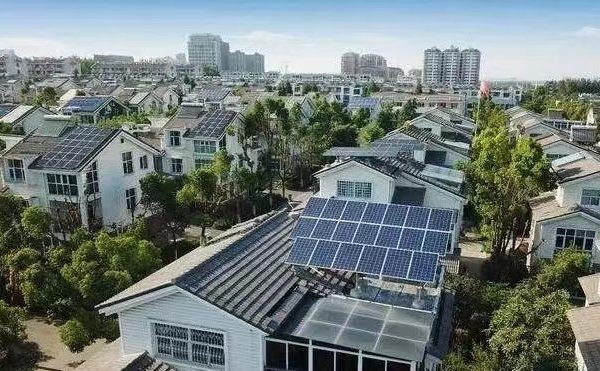
Manufacturing campuses often have large rooftop PV systems.
However, PV generation and electricity consumption do not always occur at the same location or at the same time.
For example:
12:00
PV generation = 5 MW
Campus load = 4 MW
Potential surplus = 1 MW
Instead of exporting or curtailing the surplus, the EMS can direct some of the energy toward battery charging.
PV → Local loads
PV → BESS
This allows the campus to shift renewable electricity toward later periods.
At 18:00:
PV generation → near zero
Production load → still significant
The BESS can discharge.
This creates:
Solar generation → storage → evening industrial load
7. Modular Storage Supports Different Load Profiles
Another important advantage is that different BESS units can be assigned different operating strategies.
For example:
Production BESS
Prioritize:
- Peak shaving
- Power support
- Production resilience
Warehouse BESS
Prioritize:
- PV absorption
- EV charging support
- Load shifting
R&D BESS
Prioritize:
- Power quality
- Backup support
- Sensitive equipment protection
Central BESS
Prioritize:
- Campus balancing
- Renewable integration
- Grid demand management
This allows the storage system to reflect the actual requirements of each part of the campus.
8. Manufacturing Loads Are Not All Equal
A key lesson from campus-scale deployment is that energy consumption should not be treated as one homogeneous load.
Manufacturing sites often contain:
Continuous loads
Equipment that operates continuously or for long periods.
Batch-process loads
Equipment that operates according to production batches.
Intermittent loads
Equipment that operates periodically.
Flexible loads
Loads that can be shifted without affecting production.
Critical loads
Loads that must remain operational during power disturbances.
Understanding these categories helps determine where modular storage provides the greatest value.
9. Battery Storage Can Support Critical Production
A manufacturing campus may contain equipment that should not experience uncontrolled power interruption.
Examples include:
- Industrial control systems
- PLCs
- Data servers
- Process monitoring
- Laboratory equipment
- Security systems
- Communication equipment
A modular BESS can provide local backup support.
During a grid disturbance:
Grid failure
↓
Local BESS response
↓
Critical loads maintained
This does not necessarily mean the entire production line must be backed up.
Instead, the system can prioritize critical loads.
This approach can reduce the amount of storage required while improving operational resilience.
10. Modular Architecture Reduces Single Points of Failure
A centralized storage system concentrates a large amount of capacity in one location.
If that system becomes unavailable, a significant portion of the site’s storage capability may be lost.
With distributed modular storage:
BESS A + BESS B + BESS C + BESS D
the failure of one unit does not necessarily eliminate the functionality of the others.
For example:
BESS B unavailable
↓
BESS A + C + D remain operational
↓
Campus energy strategy continues with reduced capacity
This creates a degree of operational redundancy.
However, modular architecture does not automatically eliminate all single points of failure.
The electrical distribution system, communication network, EMS, and protection architecture must also be considered.
11. Communication Architecture Is Critical
Distributed BESS requires reliable communication between:
- Individual BESS units
- PCS controllers
- BMS
- Energy meters
- PV inverters
- Campus EMS
- Building management systems
A typical hierarchy can be:
Battery cell
↓
Module / rack BMS
↓
BESS controller
↓
Site EMS
↓
Campus energy-management platform
This allows local protection to remain independent from higher-level optimization.
If communication with the campus EMS is temporarily lost, the local BESS should still be able to maintain safe operation.
This principle is particularly important for industrial facilities.
12. Cable Routing Becomes More Important
Distributed energy storage means more electrical connections across the campus.
This increases the importance of:
- Cable trays
- Cable glands
- Protective conduits
- Flexible cable protection
- Junction boxes
- Sealing systems
- Mechanical protection
Outdoor cable routes may be exposed to:
- UV radiation
- Dust
- Rain
- Temperature cycling
- Mechanical impact
- Forklift traffic
- Chemical contamination
Cable protection should therefore be considered as part of the modular energy-storage architecture.
A reliable BESS is not only about the battery cabinet.
It also depends on the integrity of the infrastructure connecting the equipment.
13. Maintenance Becomes More Distributed
Modular architecture changes the maintenance model.
A centralized BESS may require maintenance at one major location.
A modular system requires inspection across multiple locations.
This can increase the number of maintenance points.
However, modularity can also simplify replacement.
For example:
Fault detected in BESS C
↓
Isolate BESS C
↓
Service or replace BESS C
↓
Other BESS units remain operational
This can reduce the impact of individual equipment maintenance.
The key is to standardize components and maintenance procedures wherever possible.
14. Modular Systems Make Future Expansion Easier
Manufacturing campuses rarely remain static.
Production capacity may expand.
New buildings may be constructed.
EV charging demand may increase.
Additional PV capacity may be installed.
New production equipment may be electrified.
A modular BESS can expand alongside the campus.
For example:
Phase 1
2 BESS units
↓
Phase 2
Add 2 additional units
↓
Phase 3
Expand selected high-demand areas
This avoids committing to the final storage capacity on day one.
It also allows investment to follow actual energy demand.
15. Thermal Management Remains Important
Distributed BESS units still require appropriate thermal management.
Battery temperature affects:
- Performance
- Efficiency
- Aging
- Safety
- Available power
Outdoor units may experience:
- High ambient temperatures
- Solar radiation
- Dust
- Humidity
- Seasonal temperature variation
Indoor units may face different challenges such as:
- HVAC interaction
- Limited ventilation
- Building heat loads
The BESS thermal-management system must therefore be designed around the specific installation environment.
16. Environmental Protection Must Match Each Location
Different campus areas may have different environmental conditions.
A warehouse BESS may be relatively protected.
An outdoor production-area BESS may experience:
- Dust
- Rain
- UV
- Mechanical exposure
A coastal manufacturing site may also face salt-related corrosion.
Therefore, modular BESS units do not necessarily require identical environmental protection strategies.
The enclosure, cable protection, sealing, ventilation, and maintenance approach should reflect the installation environment.
17. EMS Optimization Across Multiple BESS Units
The real value of a modular architecture comes from coordinated operation.
Suppose the campus has four BESS units.
The EMS receives:
- Real-time load data
- PV generation
- Battery SOC
- Electricity tariff
- Production schedule
- Grid demand
- Equipment availability
It can then determine which BESS should charge or discharge.
For example:
BESS A SOC = 80%
BESS B SOC = 55%
BESS C SOC = 30%
BESS D SOC = 70%
During a peak period, the EMS may prioritize BESS A and D while preserving BESS C for a later requirement.
This is more sophisticated than simply telling every battery to discharge at the same power level.
18. The Importance of a Standardized Interface
One practical lesson from modular deployments is the importance of standardization.
Each BESS unit should ideally use standardized:
- Communication protocols
- Electrical interfaces
- Monitoring parameters
- Alarm definitions
- Maintenance procedures
- Spare parts
- Documentation
Standardization simplifies:
- Expansion
- Training
- Troubleshooting
- Maintenance
- Replacement
It also reduces the complexity of integrating equipment from different deployment phases.
19. Modular BESS and EV Charging
Manufacturing campuses are increasingly adding EV charging infrastructure.
This creates another significant load.
If multiple vehicles charge simultaneously:
EV charging demand ↑
↓
Campus peak demand ↑
A modular BESS can support charging loads without requiring the full charging power to come directly from the grid.
For example:
Grid → 500 kW
BESS → 300 kW
EV chargers → 800 kW
This can reduce the grid-side demand while maintaining charging capacity.
The same BESS can later support other campus loads when EV charging demand decreases.
20. Economic Evaluation Should Consider Multiple Value Streams
A modular BESS should not be evaluated solely by battery price per kWh.
Potential value streams include:
- Peak-demand reduction
- Solar self-consumption
- Energy arbitrage
- Backup capability
- EV charging support
- Renewable-energy integration
- Power management
- Reduced production interruption risk
A simplified lifecycle evaluation can consider:
Total value = Energy savings + demand savings + resilience value + renewable utilization value
against:
Total cost = Equipment + installation + maintenance + replacement + financing
This provides a more realistic assessment.
21. Lessons Learned from Modular Manufacturing-Campus Deployment
Several important lessons emerge from this type of project.
Lesson 1: Start with the campus load map
Understand where electricity is consumed before deciding where storage should be installed.
Lesson 2: Local storage can be more flexible
Placing storage closer to high-demand loads can reduce local peaks and electrical infrastructure stress.
Lesson 3: Do not oversize every BESS
Different campus areas have different requirements.
Lesson 4: Standardization is essential
Common interfaces make future expansion and maintenance easier.
Lesson 5: Local control should remain independent
Higher-level EMS optimization should not become a single point of failure.
Lesson 6: Environmental protection matters
Outdoor BESS installations require appropriate protection against dust, heat, UV, moisture, and mechanical exposure.
Lesson 7: Cable infrastructure is part of system reliability
The connection between BESS units and industrial loads deserves the same engineering attention as the storage equipment itself.
Lesson 8: Design for expansion
Manufacturing campuses change over time. Modular infrastructure should be able to grow with them.
22. A Practical Modular Energy Architecture
A mature manufacturing-campus energy platform may eventually combine:
Solar PV
↓
Campus Electrical Network
↓
Modular BESS
↓
Industrial Loads
alongside:
EV Charging
Thermal Systems
Flexible Production Loads
Energy Management System
This creates a distributed energy ecosystem.
The BESS is no longer simply a backup battery.
It becomes an active energy-management resource.
Modular energy storage systems can provide a practical way for manufacturing campuses to manage increasingly complex electricity demand.
By distributing storage capacity across production buildings, warehouses, R&D facilities, EV charging areas, and central electrical infrastructure, a campus can create a more flexible and resilient energy system.
The strongest benefits come from combining:
Modular BESS + Solar PV + Campus EMS + Flexible Loads + Local Control + Reliable Infrastructure
The key lesson is that modularity is not simply about installing several smaller batteries instead of one large battery.
It is about creating an energy architecture that can be expanded, maintained, controlled, and adapted as the manufacturing campus changes.
For industrial operators, this can provide a more practical pathway toward peak-demand management, renewable-energy integration, production resilience, and long-term energy optimization.
Frequently Asked Questions
What is a modular energy storage system?
A modular energy storage system consists of multiple standardized storage units that can operate independently or together under coordinated control.
Why use modular BESS on a manufacturing campus?
Modular BESS can place storage closer to major loads, support local peak shaving, improve renewable-energy utilization, provide backup capability, and allow capacity to expand over time.
Can multiple BESS units be controlled by one EMS?
Yes. A campus-level EMS can coordinate multiple BESS units according to load demand, PV generation, battery SOC, electricity prices, and operating priorities.
Does modular BESS improve reliability?
It can reduce dependence on a single storage asset. If one unit is unavailable, other units may remain operational, provided the overall electrical and control architecture is appropriately designed.
Can modular BESS support EV charging?
Yes. BESS can provide additional power during periods of high EV charging demand, helping reduce the amount of instantaneous power required from the grid.
What should be considered when installing BESS outdoors?
Key factors include temperature, dust, UV radiation, rain, humidity, corrosion, ventilation, cable protection, physical security, and maintenance access.
Is modular BESS easier to expand?
Generally, yes. Additional standardized storage units can potentially be added as electricity demand, PV capacity, or campus operations grow.
What is the most important design principle?
The most important principle is to design the BESS as part of the complete campus energy system, rather than treating battery storage as an isolated piece of equipment.