
As battery technologies mature, the focus is shifting from individual components to fully integrated energy storage systems (ESS). While battery modules are the core building blocks, transforming them into complete, reliable systems requires advanced integration across electrical, thermal, mechanical, and control layers.
This transition—from modules to systems—is where real-world performance, safety, and scalability are defined.
Why System Integration Matters
A battery module alone cannot function as a deployable solution. To operate effectively in real applications, it must be integrated into a complete system that manages:
- Power conversion and distribution
- Thermal regulation
- Safety and protection
- Monitoring and control
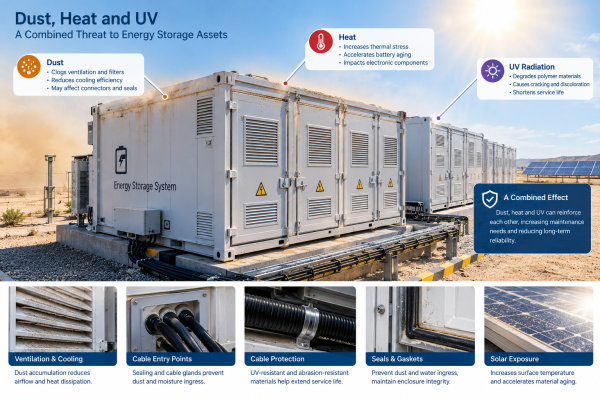
- Environmental protection
Without proper system integration, even high-performance modules may fail to meet application requirements.
The Architecture of a Complete Energy Storage System
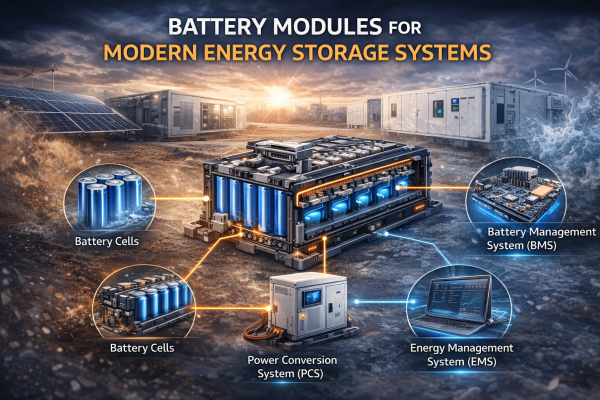
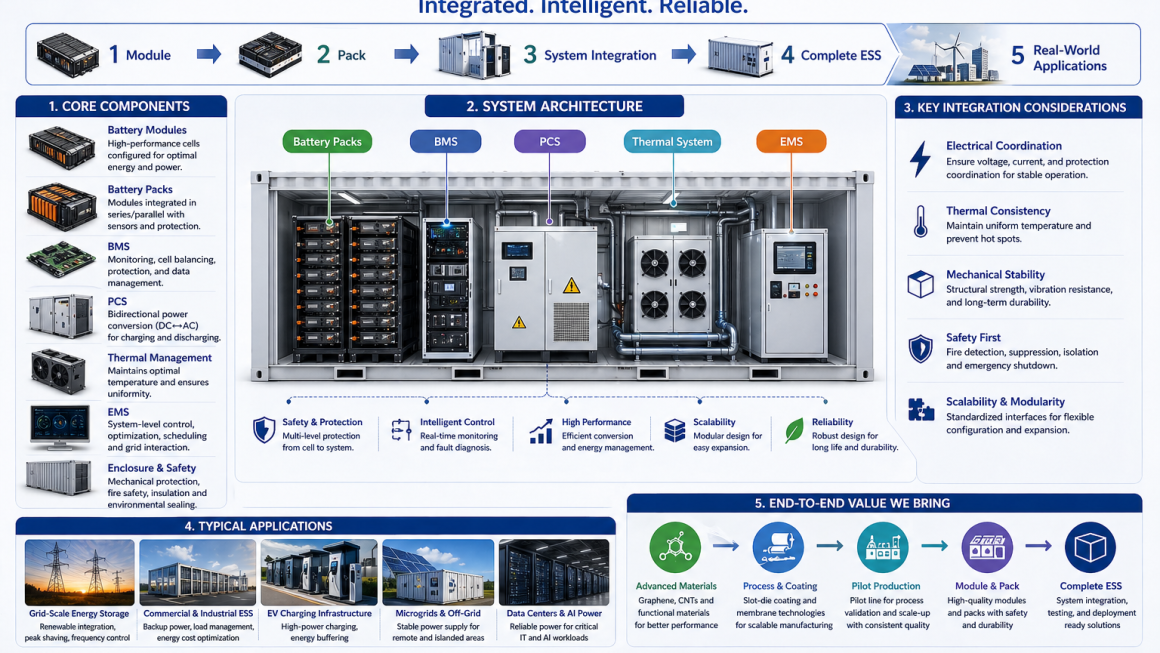
A typical ESS consists of multiple interconnected layers:
1. Battery Modules
- Core energy storage units
- Configured in series/parallel to achieve target voltage and capacity
- Designed for thermal, mechanical, and electrical stability
2. Battery Packs
- Aggregation of modules into larger assemblies
- Includes busbars, wiring, and structural frames
- Integrated with sensors and protection components
3. Battery Management System (BMS)
- Monitors voltage, current, and temperature
- Performs cell balancing
- Detects faults and controls safety mechanisms
- Communicates with higher-level system controllers
4. Power Conversion System (PCS)
- Converts DC (battery) to AC (grid/load) and vice versa
- Enables charging and discharging control
- Includes inverters, converters, and transformers
5. Thermal Management System
- Maintains optimal operating temperature
- Includes air or liquid cooling systems
- Ensures uniform temperature across modules
6. Enclosure and Structural System
- Protects against environmental conditions (dust, water, corrosion)
- Provides mechanical stability
- Supports modular installation and scalability
7. Energy Management System (EMS)
- Optimizes system-level performance
- Controls energy flow based on demand and supply
- Integrates with grid, renewable sources, and loads
Key Integration Challenges
1. Electrical Coordination
- Matching voltage and current across modules and systems
- Managing high-voltage safety and insulation
- Ensuring stable power conversion
2. Thermal Consistency
- Preventing temperature gradients across large systems
- Coordinating cooling across modules and packs
- Avoiding hotspots in dense configurations
3. Mechanical and Structural Alignment
- Ensuring stability under vibration and load
- Integrating modules into racks or containers
- Managing expansion and long-term fatigue
4. Safety and Protection
- Multi-layer protection from cell to system level
- Fire detection and suppression
- Fault isolation and emergency shutdown
5. Scalability and Modularity
- Designing systems that can expand easily
- Standardizing module interfaces
- Supporting flexible deployment configurations
Integration Pathway: From Module to System
Step 1: Module Standardization
Define electrical, mechanical, and thermal interfaces.
Step 2: Pack Assembly
Combine modules into scalable units with integrated protection.
Step 3: System Integration
Connect packs with PCS, BMS, and thermal systems.
Step 4: Testing and Validation
Validate performance under real operating conditions.
Step 5: Deployment
Install in target applications with monitoring and control systems.
Typical Applications
- Grid-scale energy storage (renewable integration, peak shaving)
- Commercial & industrial ESS (backup power, load management)
- Electric vehicle charging infrastructure
- Microgrids and off-grid systems
- Data centers and AI power systems
Emerging Trends
1. Containerized Energy Storage Systems
Pre-integrated ESS units for rapid deployment.
2. High-Voltage System Architectures
Improved efficiency and reduced losses.
3. Integrated Cooling and Structural Design
Combining thermal and mechanical functions.
4. Smart and Connected Systems
AI-driven EMS for predictive optimization and maintenance.
Best Practices
- Design with system integration in mind from the module stage
- Standardize interfaces for scalability
- Align thermal, electrical, and mechanical design early
- Validate through pilot and system-level testing
- Ensure compliance with safety and regulatory standards
Transitioning from battery modules to complete energy storage systems is a complex but essential step in delivering real-world energy solutions. Success depends on seamless integration across all system layers—ensuring safety, efficiency, and long-term reliability.
As energy systems become more distributed and intelligent, system-level design will define the true value of battery technologies.