
Why Dust Ingress Matters in Energy Storage Systems
Outdoor Energy Storage Systems (ESS) are often designed to withstand rain, humidity, UV exposure, and temperature variations.
However, another environmental factor is sometimes overlooked:
Dust ingress.
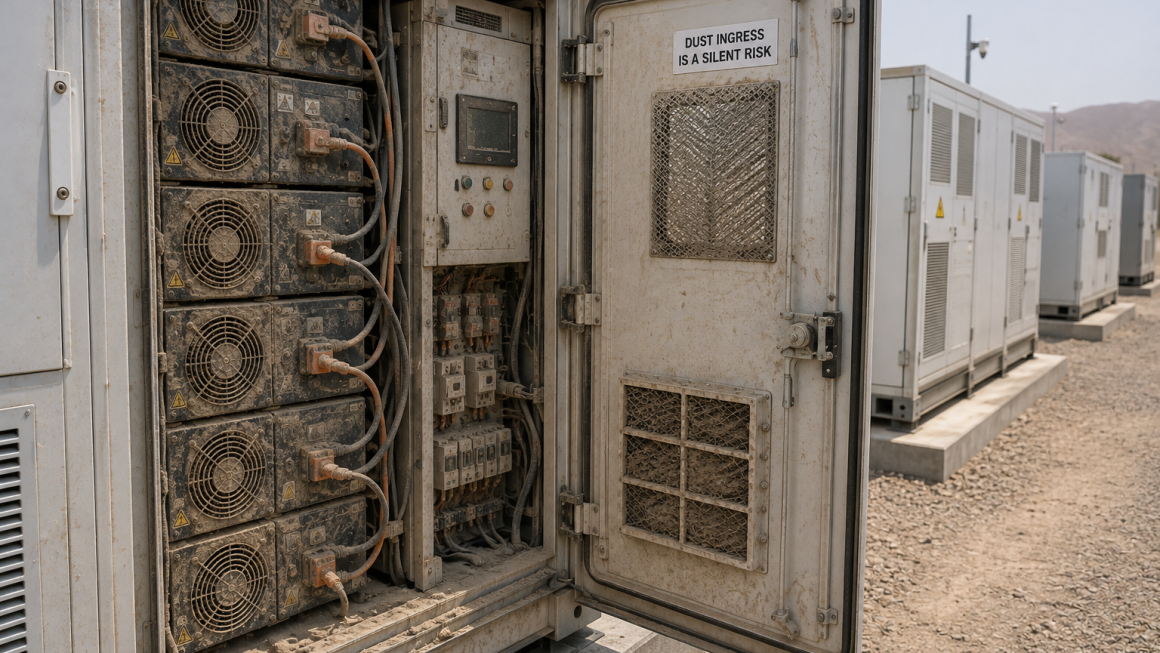
Dust can enter battery enclosures, electrical cabinets, cooling systems, cable interfaces, and ventilation pathways.
Over time, accumulated dust can affect:
- Electrical insulation
- Cooling efficiency
- Component reliability
- Connector performance
- Enclosure cleanliness
- Maintenance requirements
For ESS installed in industrial, desert, agricultural, construction, or roadside environments, dust protection should be considered during the initial system design.
Where Does Dust Enter an ESS?
Dust does not necessarily enter through a major opening.
It can enter through small pathways such as:
- Ventilation openings
- Cable glands
- Door gaps
- Panel joints
- Connector interfaces
- Cooling air channels
- Maintenance access points
Even when an enclosure appears visually sealed, repeated temperature changes can create pressure differences that draw contaminated air into the system.
Why Outdoor ESS Is Particularly Vulnerable
Outdoor energy storage systems experience continuously changing environmental conditions.
For example:
High daytime temperature
↓
Enclosure air expands
↓
Air moves outward
↓
Nighttime cooling
↓
Internal pressure decreases
↓
External air is drawn inward
If the surrounding environment contains dust, repeated pressure cycling can gradually introduce particles into the enclosure.
Therefore, dust ingress can occur even without obvious physical damage.
Dust and Electrical Components
One of the most important concerns is the accumulation of dust around electrical equipment.
Dust can accumulate on:
- Busbars
- Terminals
- Circuit breakers
- Power electronics
- Control boards
- Connectors
- Insulators
Depending on the type of dust and environmental humidity, contamination can potentially reduce insulation performance and increase the risk of electrical problems.
Conductive or chemically active particles can be particularly problematic.
Dust and Thermal Management
Dust can also reduce the effectiveness of thermal management systems.
In air-cooled ESS:
Dust accumulation
↓
Airflow resistance increases
↓
Heat transfer decreases
↓
Component temperature increases
This can reduce cooling efficiency and increase the workload of fans and HVAC equipment.
For high-density battery systems, maintaining clean airflow pathways is particularly important.
Dust and Cooling Filters
Air-cooled ESS systems commonly use filters to prevent particles from entering the enclosure.
However, filters introduce another maintenance requirement.
As dust accumulates:
Clean Filter
→ High airflow
→ Efficient cooling
↓
Dust-Loaded Filter
→ Higher airflow resistance
→ Lower cooling capacity
Therefore, filter condition should be included in the maintenance strategy.
A highly efficient filter that is never maintained may ultimately reduce system performance.
Liquid Cooling Does Not Eliminate Dust Risk
Liquid cooling can reduce dependence on external airflow for battery thermal management, but it does not completely eliminate environmental contamination risks.
Other components may still require environmental protection, including:
- PCS
- Control cabinets
- Communication equipment
- Electrical connectors
- Pumps
- Cooling control systems
Therefore, liquid-cooled ESS still requires appropriate enclosure and sealing strategies.
Cable Entries as Dust Ingress Points
Cable interfaces are another potential weak point.
An ESS may contain numerous:
- Power cables
- Communication cables
- Grounding cables
- Sensor cables
Poorly designed cable entries can create gaps through which dust can enter.
Appropriate solutions may include:
- Sealed cable glands
- Compression fittings
- Protective conduits
- Cable entry plates
- Weather-resistant connectors
Cable protection should therefore be considered part of the overall enclosure protection system.
Enclosure Design for Dust Protection
A good ESS enclosure should minimize unnecessary openings while still allowing appropriate thermal management and maintenance access.
Important design considerations include:
Door Sealing
High-quality gaskets can reduce the gap between enclosure doors and frames.
Panel Joints
Poorly designed panel interfaces can become long-term contamination pathways.
Cable Entries
Cable glands should maintain sealing performance throughout the expected service life.
Ventilation
Airflow openings should be designed together with filtration and pressure management.
Dust Protection and IP Ratings
Ingress protection ratings are commonly used to describe enclosure resistance to solids and liquids.
For ESS applications, designers should evaluate the required protection level based on the actual installation environment.
However, an IP rating should not be treated as the only design consideration.
Real-world reliability also depends on:
- Gasket aging
- Cable gland installation
- Door alignment
- Filter maintenance
- Enclosure pressure changes
- Manufacturing quality
A high nominal protection rating does not automatically guarantee long-term field performance if the system is poorly maintained.
Different Dust Environments Require Different Strategies
Not all dust is the same.
Desert and Arid Environments
Typical challenges include:
- Fine dust
- Sand particles
- High solar radiation
- Large temperature changes
These environments require strong enclosure sealing and appropriate filtration.
Industrial Environments
Industrial sites may contain:
- Metal particles
- Cement dust
- Chemical particles
- Process-related contaminants
Material compatibility and electrical protection become particularly important.
Construction Areas
Construction sites can generate large quantities of:
- Concrete dust
- Sand
- Fine particulate matter
Temporary environmental protection may be necessary during installation and commissioning.
Coastal Industrial Areas
Coastal environments can combine:
Dust + Salt + Humidity
This combination can be more challenging than any individual factor.
Particles can accumulate on surfaces and interact with moisture and salt deposits, increasing corrosion and contamination risks.
Dust + Humidity: A More Serious Combination
Dry dust alone may not create the most serious problem.
The risk can increase significantly when dust combines with moisture.
For example:
Dust Accumulation
High Humidity
↓
Contaminated Surface
↓
Reduced Insulation Performance / Corrosion Risk
This is why dust protection should be considered together with humidity and corrosion protection.
Dust Protection for Battery Enclosures
A comprehensive battery enclosure strategy may combine:
- Sealed construction
- Appropriate IP protection
- High-quality gaskets
- Protected cable entries
- Controlled ventilation
- Replaceable filters
- Corrosion-resistant materials
- Drainage design
The goal is to create a controlled internal environment around sensitive equipment.
Protective Covers and External Shields
External covers can provide another layer of protection.
They can help reduce direct exposure to:
- Wind-driven dust
- Sand
- Rain
- Solar radiation
Protective covers are particularly useful around:
- External connectors
- Cable interfaces
- Cooling components
- Control equipment
However, covers should not block required ventilation or create excessive heat accumulation.
Maintenance Strategies
Dust protection is not only a design issue.
Maintenance is equally important.
A practical maintenance program may include:
Visual Inspection
Check for:
- Dust accumulation
- Damaged gaskets
- Open cable entries
- Enclosure deformation
Filter Inspection
Check:
- Filter cleanliness
- Airflow resistance
- Filter condition
Cable Entry Inspection
Check whether:
- Glands remain tight
- Seals are damaged
- Unused openings are properly closed
Internal Cleaning
Where appropriate, remove accumulated dust using cleaning procedures compatible with the electrical equipment.
Designing for Dust From the Beginning
The most effective approach is to consider dust protection during system design.
Instead of asking:
“How do we clean the ESS after dust enters?”
the better question is:
“How can we prevent unnecessary dust from entering in the first place?”
This changes the design priorities toward:
Enclosure
→ Sealing
→ Cable Protection
→ Filtration
→ Thermal Management
→ Maintenance
Dust Protection and Thermal Management Must Be Balanced
There is an important engineering trade-off.
Better sealing can reduce dust ingress.
However:
More sealing
→ Less uncontrolled airflow
→ More difficult heat removal
Therefore, ESS designers must balance:
Environmental Protection
with
Thermal Performance
Possible solutions include:
- Filtered ventilation
- Dedicated cooling systems
- Heat exchangers
- Liquid cooling
- Thermal insulation
- Controlled airflow paths
The correct solution depends on the battery chemistry, power density, enclosure architecture, and climate.
Future ESS Dust Protection Trends
Future outdoor ESS designs are likely to use more integrated environmental protection.
Potential developments include:
- Improved enclosure sealing
- Advanced filtration
- Smarter pressure management
- Automated filter monitoring
- Liquid cooling
- Environmental sensors
- Predictive maintenance
Sensors could monitor environmental conditions such as:
- Temperature
- Humidity
- Differential pressure
- Filter condition
This can help operators identify environmental risks before they become equipment problems.
Dust ingress is an often-overlooked environmental risk for outdoor Energy Storage Systems.
Although dust may initially appear to be a simple cleanliness issue, long-term accumulation can affect:
- Electrical components
- Cooling performance
- Connectors
- Cable systems
- Corrosion resistance
- Maintenance requirements
The risk becomes more significant when dust combines with humidity, salt, heat, or industrial contaminants.
A reliable ESS protection strategy should therefore combine:
- Proper enclosure design
- Sealing and gaskets
- Protected cable entries
- Appropriate filtration
- Thermal management
- Corrosion-resistant materials
- Protective covers
- Regular inspection
The objective is not simply to build a sealed battery enclosure.
It is to create a controlled and maintainable environment that protects the ESS throughout its operating life.