Communication towers and telecom base stations depend on continuous electrical power.
A short power interruption may not simply mean that a piece of equipment stops operating. It can affect mobile communication, wireless connectivity, data transmission, emergency communications, and other connected services.
For this reason, energy storage at communication towers has a different priority from many commercial energy-storage applications.
The primary objective is often not energy arbitrage.
It is power availability and backup reliability.
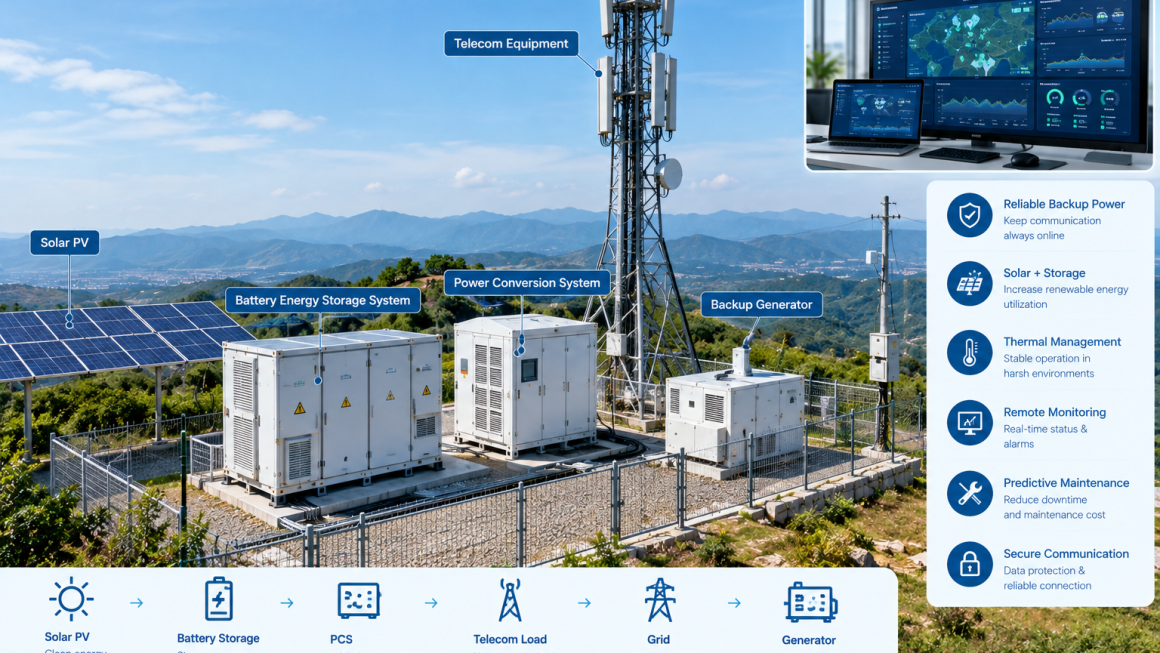
A typical communication tower energy system may include:
- Utility grid connection
- Rectifiers or power conversion equipment
- Lithium-ion battery storage
- Backup power systems
- Telecom loads
- Solar PV
- Energy management or monitoring systems
- Remote communication equipment
The basic architecture can be represented as:
Grid / PV → Power Conversion → Battery Storage → Telecom Loads
When grid power is available, the system supplies the communication equipment and maintains battery charge.
When the grid fails:
Grid outage → Battery discharge → Critical telecom loads remain powered
For remote and outdoor communication sites, however, battery reliability depends on much more than battery chemistry.
Environmental conditions, thermal management, cable protection, SOC management, remote monitoring, and maintenance strategy all have a direct impact on system availability.
1. Why Communication Tower Energy Storage Is Different
A communication tower typically has a relatively continuous electrical demand.
Unlike a factory that may intentionally shut down non-critical equipment during a power interruption, a telecom site generally needs to maintain its communication functions.
Important loads may include:
- Radio equipment
- Baseband units
- Network equipment
- Transmission equipment
- Control systems
- Site monitoring
- Security equipment
- Cooling or ventilation equipment
The energy-storage system therefore needs to prioritize:
Availability
The battery must be ready when grid power fails.
Predictable Backup Duration
Operators need to understand how long the available battery capacity can support critical loads.
Environmental Resilience
Outdoor telecom sites may experience heat, cold, humidity, dust, rain, and corrosion.
Remote Monitoring
Many communication towers are unattended or only visited periodically.
This makes remote monitoring particularly important.
2. Design Around Critical Load Requirements
Battery sizing should begin with the actual telecom load.
A simplified calculation is:
Required Energy ≈ Load Power × Backup Duration
For example, if the critical telecom load is approximately:
20 kW
and the required backup duration is:
4 hours
the theoretical energy requirement is:
20 kW × 4 h = 80 kWh
However, the installed battery capacity should not simply equal the theoretical number.
The design may need to account for:
- Usable SOC range
- Battery efficiency
- Power-conversion efficiency
- Temperature effects
- Aging
- Reserve capacity
- Future load growth
Therefore:
Installed capacity > theoretical energy requirement
is often necessary.
3. Separate Critical and Non-Critical Loads
Not every electrical load at a communication site has the same priority.
A useful architecture separates:
Critical Loads
Examples include:
- Communication equipment
- Network equipment
- Control systems
- Essential monitoring
Secondary Loads
Potential examples include:
- Non-essential lighting
- Auxiliary equipment
- Certain cooling loads
- Maintenance equipment
During a grid outage, the battery should prioritize critical loads.
This can significantly improve effective backup duration.
For example:
Battery available energy = 100 kWh
If total site consumption is:
30 kW
backup duration is theoretically:
100 ÷ 30 ≈ 3.3 hours
But if non-critical loads can be reduced and critical consumption is only:
20 kW
the theoretical duration becomes:
100 ÷ 20 = 5 hours
Load prioritization can therefore be as important as increasing battery capacity.
4. Maintain an Appropriate SOC Reserve
A communication-site battery should not normally operate as though every available kilowatt-hour can be consumed.
A reserve should be maintained for unexpected grid outages.
For example:
Normal operation
→ Battery SOC maintained within a defined operating window
Grid outage detected
→ Battery immediately available
Extended outage
→ EMS monitors remaining energy
SOC approaches reserve threshold
→ Non-critical loads reduced where possible
This is different from an energy-arbitrage application where the battery may be intentionally discharged according to electricity prices.
For telecom applications, availability of stored energy is itself a reliability objective.
5. Consider Battery Aging
A new battery and an aging battery do not provide exactly the same usable capacity.
Over time, battery capacity can decline due to:
- Charge/discharge cycling
- Temperature exposure
- High SOC operation
- Deep discharge
- Calendar aging
Therefore, system design should consider the expected battery lifecycle.
A useful strategy is to monitor:
- SOC
- SOH
- Cell voltage
- Battery temperature
- Charge/discharge current
- Cycle count
The objective is to identify capacity degradation before it becomes a serious backup problem.
6. Temperature Management Is Critical
Outdoor communication sites can experience significant temperature variations.
A battery enclosure may be exposed to:
- Direct solar radiation
- High ambient temperatures
- Cold winter conditions
- Rapid temperature changes
Battery performance and lifetime can be affected by temperature.
High temperatures may accelerate degradation.
Low temperatures may reduce available battery performance and affect charging behavior.
Therefore, the battery enclosure should consider:
- Thermal insulation where appropriate
- Ventilation
- Air conditioning
- Heat dissipation
- Temperature monitoring
- Thermal alarms
The correct approach depends on battery chemistry, enclosure design, climate, and operating requirements.
7. Protect the Battery From Dust and Sand
Communication towers may be installed in remote areas where dust and sand are significant environmental factors.
Dust can accumulate on:
- Cooling filters
- Fans
- Electrical components
- Ventilation paths
- Connectors
This can reduce cooling performance and increase maintenance requirements.
A suitable enclosure strategy may include:
- Controlled airflow
- Appropriate filtration
- Sealed cable entry
- Dust-resistant enclosure design
- Filter maintenance
- Environmental monitoring
For desert or semi-desert sites, dust protection should be treated as part of the energy-storage design rather than an afterthought.
8. Humidity and Corrosion Protection
Coastal and humid environments create another challenge.
Battery enclosures and electrical connections may be exposed to:
- High humidity
- Condensation
- Salt-laden air
- Corrosive industrial environments
Corrosion can affect:
- Electrical terminals
- Busbars
- Cable glands
- Enclosure components
- Fasteners
- Communication connections
Potential countermeasures include:
- Corrosion-resistant materials
- Protective coatings
- Appropriate enclosure protection
- Sealed cable entries
- Condensation management
- Regular inspection
For coastal telecom sites, the environmental protection strategy should be considered during equipment selection.
9. Cable Protection Should Not Be Overlooked
Battery reliability is closely connected to electrical connections.
Communication tower energy systems may include:
- Battery cables
- DC power cables
- PV cables
- Communication cables
- Sensor cables
- Grounding conductors
These cables may be exposed to:
- UV radiation
- Heat
- Rain
- Dust
- Mechanical abrasion
- Vibration
- Moisture
- Corrosive environments
Protection solutions can include:
- UV-resistant cable protection
- Braided sleeves
- Self-wrapping sleeves
- Flexible conduits
- High-temperature sleeves
- Cable glands
- Sealing accessories
The objective is to protect the electrical connection throughout the system lifecycle.
10. Cable Glands and Sealing Are Part of Reliability
A cable may be perfectly selected but still experience environmental problems if the cable entry is poorly sealed.
Cable glands should be selected according to:
- Cable diameter
- Enclosure requirements
- Environmental conditions
- Water-ingress requirements
- Temperature
- Mechanical stress
The cable-entry system should prevent unnecessary pathways for:
- Water
- Dust
- Humidity
- Insects
- Corrosive contaminants
This is particularly important for outdoor battery cabinets.
11. Remote Monitoring Is Essential for Unattended Sites
Many communication towers are geographically distributed.
An operator may be responsible for hundreds or thousands of sites.
Physically inspecting every site every day is impractical.
Remote monitoring therefore becomes a critical part of the reliability strategy.
Important parameters include:
Battery
- SOC
- SOH
- Voltage
- Current
- Temperature
Site Power
- Grid availability
- Load power
- Battery power
- PV generation
Equipment
- Rectifier status
- Converter status
- Cooling status
- Door status
- Communication status
Environment
- Cabinet temperature
- Humidity
- Smoke/fire alarms
- Water ingress where monitored
The objective is to identify abnormal conditions before they cause service interruption.
12. Alarm Prioritization
A remote monitoring system should not treat every alarm equally.
A practical hierarchy may include:
Critical
Requires immediate attention.
Examples:
- Battery protection event
- Severe temperature alarm
- Fire detection
- Major power-conversion failure
- Loss of critical backup capability
Warning
Requires investigation but may not immediately affect service.
Examples:
- Increasing battery temperature
- Cooling-system degradation
- Communication instability
- Abnormal SOC behavior
Information
Indicates normal operating events.
Examples:
- Grid restored
- Battery charging started
- Scheduled maintenance mode
- Normal operating transition
Prioritized alarms allow operators to focus on the events that have the greatest impact on communication availability.
13. Remote Fault Diagnosis
Remote monitoring becomes significantly more useful when historical data is available.
Consider a battery system showing:
Battery temperature increasing
↓
Cooling performance decreasing
↓
Fan operating time increasing
↓
Cabinet temperature approaching warning threshold
Rather than waiting for a critical temperature alarm, the operator can schedule an inspection.
Similarly:
Communication errors increasing
may indicate a developing network or gateway issue.
This changes maintenance from:
Reactive maintenance
to:
Condition-based maintenance
14. Communication Reliability Is Part of Energy Reliability
A remote monitoring system itself needs reliable communication.
Potential communication methods include:
- Cellular networks
- Ethernet
- Fiber
- Wireless communication
- Secure IP networks
But every communication path can experience interruption.
Therefore, the local battery system should not depend entirely on the remote EMS.
A useful hierarchy is:
Local protection → Local controller → Remote monitoring
If communication fails:
Communication lost → Local control continues → Safety functions remain active → Remote connection restored later
The battery must remain safe and functional even when the monitoring platform is temporarily unavailable.
15. Backup Duration Should Be Verified, Not Assumed
A battery rated at a certain number of kWh does not automatically guarantee the same backup time in every operating condition.
Actual backup duration can be affected by:
- Battery temperature
- Battery aging
- Load level
- Converter efficiency
- SOC limits
- Power fluctuations
- Auxiliary loads
Therefore, operators should monitor actual historical backup performance.
For example:
Expected backup duration
vs.
Measured backup duration
A growing difference may indicate:
- Capacity degradation
- Increasing site load
- Environmental effects
- Conversion losses
- Incorrect battery settings
This can provide an early indication that the system requires review.
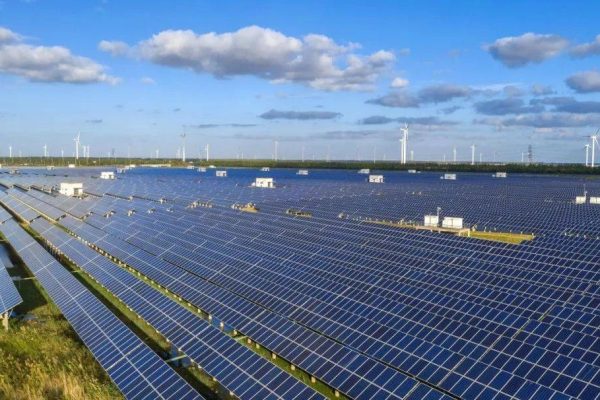
16. Solar PV Can Extend Telecom Site Autonomy
Remote communication sites may benefit from combining battery storage with PV.
A simplified architecture is:
Solar PV → Power Conversion → Telecom Load + Battery
During daylight:
PV generation → Site load
and:
PV surplus → Battery charging
At night:
PV unavailable → Battery + grid/backup source
This can reduce grid dependence and potentially extend operating autonomy in remote locations.
However, PV capacity should be designed around:
- Site load
- Solar resource
- Battery capacity
- Seasonal conditions
- Available installation area
- Maintenance requirements
17. Hybrid Power Architecture for Remote Sites
Some communication towers use multiple energy sources.
A possible system can include:
Grid + PV + BESS + Generator
Each source serves a different purpose.
Grid
Primary energy source where available.
PV
Renewable energy generation and daytime support.
BESS
Fast-response backup and energy storage.
Generator
Long-duration backup during extended outages.
The control strategy can be:
Grid available → Grid supplies load
Grid unavailable + PV available → PV + BESS
PV insufficient → BESS continues supplying critical loads
Extended outage → Generator starts
This creates multiple layers of resilience.
18. Generator and BESS Coordination
Where generators are used, the battery can reduce unnecessary generator operation.
For example:
Grid outage
↓
BESS immediately supports load
↓
Generator remains off initially
↓
SOC decreases
↓
Generator starts at predefined threshold
↓
Generator supplies load + recharges battery
This can allow the generator to operate at a more appropriate load level rather than running continuously at very low power.
The exact control strategy depends on the site architecture and generator characteristics.
19. Prevent Deep Discharge During Extended Outages
During a long grid outage, battery energy must be carefully managed.
Suppose:
Initial SOC = 90%
The system should not simply continue discharging until the battery reaches zero.
Instead, the EMS can establish:
- Normal operating SOC
- Warning SOC
- Reserve SOC
- Emergency shutdown threshold
For example:
SOC high → Normal backup
↓
SOC declining → Monitor
↓
SOC low → Reduce non-critical loads
↓
SOC reserve → Protect critical loads
This increases the probability that sufficient energy remains for essential communication functions.
20. Maintenance Strategy for Distributed Towers
A communication operator may manage a large number of geographically distributed sites.
Maintenance should therefore be prioritized according to actual condition.
A practical workflow is:
Remote monitoring
↓
Alarm detection
↓
Severity classification
↓
Remote diagnosis
↓
Maintenance priority
↓
Technician dispatch
↓
On-site inspection
↓
Remote verification
This approach can reduce unnecessary site visits.
It also allows technicians to prepare the correct replacement parts before traveling to a remote location.
21. Standardize Modular Components
Large telecom networks benefit from standardized equipment and maintenance procedures.
Where practical, operators can standardize:
- Battery modules
- Storage cabinets
- Cable protection
- Cable glands
- Communication interfaces
- Monitoring systems
- Spare parts
Standardization can simplify:
- Training
- Maintenance
- Inventory
- Troubleshooting
- Replacement
It can also reduce the complexity of managing large numbers of distributed sites.
22. Design for Easy Maintenance
A reliable battery system should also be easy to inspect.
Important physical design considerations include:
- Front access to components
- Clear cable routing
- Accessible terminals
- Replaceable filters
- Visible indicators
- Modular components
- Adequate working space
Maintenance personnel should be able to identify:
What failed → Where it failed → What needs to be replaced
without unnecessary disassembly.
Serviceability is therefore part of reliability.
23. Reliability Is a System-Level Property
A common mistake is to define battery reliability simply as:
How long will the battery last?
For communication towers, reliability is broader.
It includes:
Battery health
Thermal management
Power conversion
Electrical connections
Environmental protection
Remote monitoring
Communication
Maintenance
Backup strategy
A high-quality battery cannot compensate for a poorly protected cable connection or an ineffective thermal-management system.
Reliability must therefore be designed across the entire energy system.
24. Practical Reliability Checklist
Before deploying energy storage at a communication tower, evaluate:
Battery
- Required backup duration
- Required power
- SOC operating window
- SOH monitoring
- Battery aging
- Reserve capacity
Environment
- Ambient temperature
- Solar exposure
- Dust and sand
- Humidity
- Rain
- Salt spray
- Corrosion
Thermal Management
- Cooling capacity
- Ventilation
- Temperature monitoring
- Filter maintenance
Electrical Infrastructure
- Cable sizing
- Cable routing
- Cable protection
- Cable glands
- Sealing
- Grounding
Monitoring
- Remote SOC monitoring
- Battery temperature
- Alarm management
- Grid status
- Communication status
- Historical data
Backup
- Grid outage strategy
- PV integration
- Generator integration
- Critical-load prioritization
- Emergency SOC reserve
O&M
- Remote diagnosis
- Maintenance scheduling
- Spare parts
- Standardized components
- Site-access planning
25. The Future of Telecom Energy Storage
Communication networks are becoming increasingly distributed while energy systems are becoming more intelligent.
Future communication-site energy systems may combine:
PV + Modular BESS + Smart Power Conversion + Remote EMS + Predictive O&M
The system can continuously evaluate:
- Weather
- Grid status
- Battery condition
- Site load
- PV generation
- Backup requirements
and dynamically adjust the operating strategy.
For example:
Weather forecast → PV generation forecast → Battery SOC planning → Grid-outage reserve → Optimized charging
This moves telecom energy management from simple backup power toward intelligent site energy management.
Communication tower energy storage has one fundamental requirement:
The stored energy must be available when communication infrastructure needs it.
Achieving this requires more than selecting a suitable battery.
A reliable telecom energy-storage system should combine:
- Correct battery sizing
- Critical-load prioritization
- Appropriate SOC reserves
- Thermal management
- Dust and corrosion protection
- Reliable cable and sealing systems
- Remote monitoring
- Alarm prioritization
- Local control
- Backup-source coordination
- Condition-based maintenance
The overall reliability architecture can be summarized as:
Grid / PV → Power Conversion → Modular BESS → Critical Telecom Loads
with:
Environmental Protection + Thermal Management + Remote Monitoring + O&M
operating around the physical system.
For distributed communication networks, the combination of modular energy storage and remote monitoring is particularly valuable because it allows operators to manage large numbers of sites without treating every location as an isolated maintenance project.
The long-term objective is not simply longer battery runtime.
It is predictable, remotely managed, and maintainable power availability for communication infrastructure.
Frequently Asked Questions
Why is energy storage important for communication towers?
Communication equipment generally needs continuous power. Battery storage provides backup energy when the primary power source is interrupted.
How should a telecom battery system be sized?
Sizing should consider critical load power, required backup duration, battery efficiency, operating SOC range, aging, environmental conditions, and future load growth.
Can solar PV be combined with telecom battery storage?
Yes. PV can supply daytime loads and charge the battery, while stored energy can support the site when solar generation is unavailable.
Why is remote monitoring important?
Many communication towers are unattended or geographically distributed. Remote monitoring allows operators to track battery condition, power availability, alarms, and environmental conditions without immediately visiting the site.
What environmental conditions can affect telecom BESS reliability?
High temperature, low temperature, dust, sand, humidity, rain, condensation, and salt-laden air can all affect energy-storage equipment and electrical connections.
How can battery backup duration be improved?
Operators can optimize battery capacity, reduce non-critical loads, maintain appropriate SOC reserves, improve thermal conditions, and coordinate BESS operation with PV or backup generators.
Should communication tower batteries operate at 100% SOC?
Not necessarily. The appropriate SOC range depends on battery chemistry, system design, manufacturer requirements, expected backup needs, and lifecycle objectives.
What role does cable protection play?
Cable protection helps reduce damage from UV exposure, heat, abrasion, moisture, dust, vibration, and other environmental conditions that can affect long-term electrical reliability.
Can BESS and generators work together?
Yes. The BESS can provide immediate backup while the generator is started for longer-duration outages. The BESS can also help coordinate generator operation and battery charging.
What is the most important principle for telecom energy-storage reliability?
Reliability should be treated as a system-level property. Battery health, thermal management, environmental protection, electrical connections, monitoring, backup strategy, and maintenance all need to work together.