

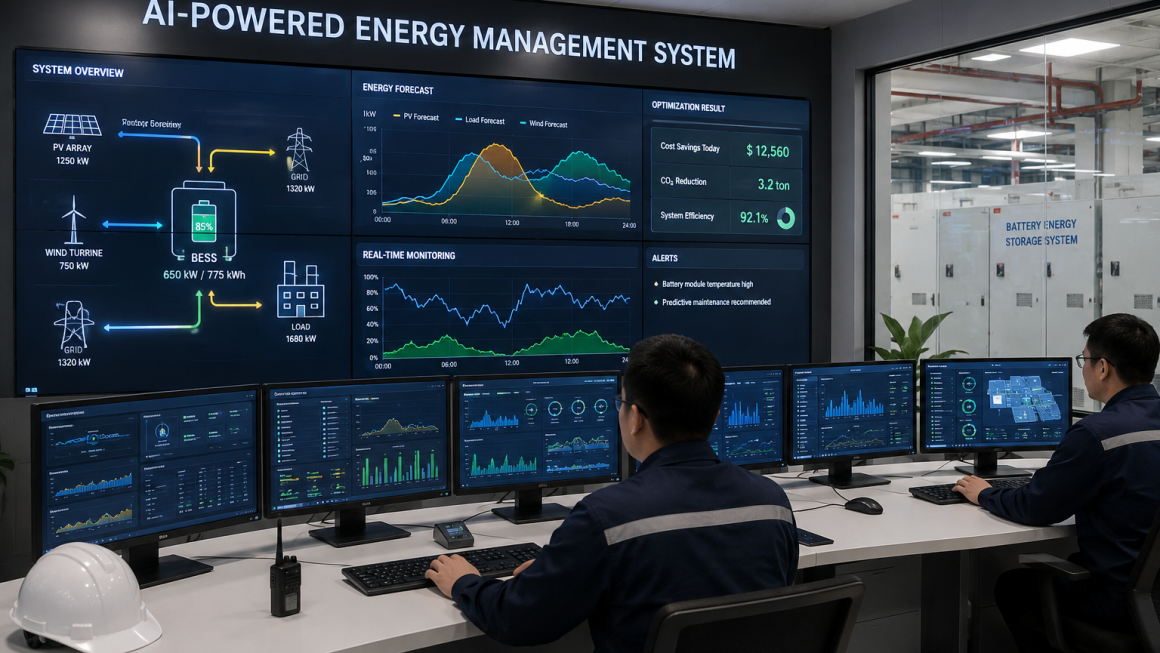
Energy Management Systems (EMS) are becoming increasingly important as power systems become more distributed, dynamic, and data-driven. The rapid growth of renewable energy, battery energy storage systems (BESS), electric vehicles, microgrids, and AI-driven data centers is creating a more complex energy environment in which traditional rule-based energy management is often no longer sufficient.
Artificial intelligence (AI) is transforming Energy Management Systems by enabling more accurate forecasting, predictive optimization, automated decision-making, and real-time energy control.
Instead of simply monitoring electricity consumption and executing predefined control strategies, an AI-powered EMS can analyze large amounts of historical and real-time data, identify patterns, predict future operating conditions, and continuously optimize energy resources.
For commercial buildings, industrial facilities, microgrids, and energy storage projects, this shift can improve energy efficiency, reduce operating costs, increase renewable energy utilization, and extend the useful life of energy assets.
What Is an Energy Management System?
An Energy Management System is a software and control platform designed to monitor, analyze, and optimize energy generation, storage, and consumption.
A conventional EMS typically collects information from:
- Grid connections
- Solar photovoltaic systems
- Battery energy storage systems
- Building loads
- Industrial equipment
- Electric vehicle charging systems
- Power meters
- HVAC and cooling systems
- Backup generators
- Environmental sensors
The EMS then uses predefined rules to determine how energy should be distributed or consumed.
For example, a traditional EMS may be programmed to charge a battery when electricity prices are low and discharge it during peak-price periods.
This approach works well when operating conditions are relatively predictable. However, modern energy systems are increasingly affected by variable renewable generation, dynamic electricity tariffs, unpredictable loads, extreme weather, and rapidly changing power demand.
This is where AI can provide a significant advantage.
How AI Changes Traditional EMS Architecture
Traditional EMS platforms primarily operate according to predefined rules.
AI-powered EMS platforms introduce an additional intelligence layer between data acquisition and energy control.
A simplified architecture can be represented as:
Sensors → Data Acquisition → AI Analytics → Prediction → Optimization → EMS Control → Energy Assets
The AI layer can process information from multiple sources simultaneously.
These may include electricity prices, historical energy consumption, weather forecasts, solar generation, battery state of charge (SOC), battery temperature, production schedules, occupancy patterns, and equipment operating conditions.
Instead of asking only:
“What is happening now?”
an AI-enabled EMS can also ask:
“What is likely to happen next?”
and:
“What is the best action under the expected conditions?”
This predictive capability is one of the most important differences between conventional and AI-enabled energy management.
AI-Based Load Forecasting
Accurate energy demand forecasting is fundamental to intelligent energy management.
Traditional EMS platforms may estimate future demand using historical averages or predefined schedules. AI models can identify more complex relationships between energy consumption and external variables.
Machine learning algorithms can analyze:
- Historical electricity consumption
- Time of day
- Day of week
- Seasonal patterns
- Weather conditions
- Production schedules
- Occupancy
- Equipment operation
- Electricity prices
- Previous system behavior
The system can then forecast energy demand over different time horizons.
For example, an industrial facility may use AI to predict its electricity demand for the next 15 minutes, several hours, or the following day.
This information allows the EMS to prepare the energy system before demand changes occur.
If the AI model predicts a significant load increase, the EMS can prepare battery storage in advance, adjust flexible loads, or increase local renewable energy utilization.
AI and Renewable Energy Forecasting
Renewable energy generation is inherently variable.
Solar power depends on sunlight, cloud cover, temperature, and weather conditions. Wind generation is influenced by wind speed and atmospheric conditions.
This variability creates challenges for energy management.
AI can combine historical generation data with weather forecasts and real-time sensor information to predict renewable energy output.
For example, an AI-enabled EMS can estimate whether a solar installation is likely to produce excess electricity during the afternoon.
If excess solar generation is expected, the system can schedule battery charging before the surplus occurs.
If cloud coverage is expected to reduce solar generation, the EMS can prepare alternative energy resources.
This creates a more proactive energy management strategy.
AI-Driven Battery Energy Storage Management
Battery energy storage is becoming one of the most important components of modern EMS architectures.
However, battery systems must balance multiple objectives simultaneously.
An EMS may need to consider:
- State of charge (SOC)
- State of health (SOH)
- Battery temperature
- Charge and discharge power
- Electricity prices
- Renewable generation
- Grid demand
- Peak demand
- Battery degradation
- Safety constraints
A simple rule-based system may struggle to optimize all these variables simultaneously.
AI can help identify operating strategies that balance economic performance and battery health.
For example, an AI-powered EMS may determine that aggressive battery cycling could generate short-term economic benefits but accelerate degradation.
Instead, the system can optimize the battery dispatch strategy according to expected electricity prices, load demand, renewable generation, and estimated degradation cost.
This can transform battery management from simple energy arbitrage into intelligent asset optimization.
Predictive Battery Management
AI can also support predictive battery management.
By analyzing historical battery data, the system may identify changes in voltage, temperature, internal resistance, charge behavior, or other operating characteristics.
These patterns can be used to estimate battery State of Health and identify potential abnormal conditions.
An AI-enabled EMS can therefore move from reactive management toward predictive operation.
Instead of waiting for a battery module to exhibit a serious problem, the system can identify early indicators and recommend inspection, maintenance, load reduction, or operating changes.
This capability can be particularly valuable for large-scale BESS installations where thousands of battery cells and multiple thermal zones may operate simultaneously.
AI for Peak Demand Management
For commercial and industrial electricity consumers, reducing peak demand can be as important as reducing total energy consumption.
Electricity tariffs in many markets include demand charges based on the maximum power drawn from the grid during a billing period.
An AI-powered EMS can forecast upcoming demand peaks and determine when energy storage or flexible loads should be activated.
For example, if the system predicts that a factory will reach a new monthly peak because of simultaneous operation of several production lines, the EMS can temporarily discharge the battery or adjust non-critical loads.
The objective is not necessarily to minimize electricity consumption.
Instead, the objective is to optimize the overall cost of electricity.
This distinction is important for modern energy management.
AI-Based Energy Price Optimization
As electricity markets become more dynamic, energy prices can change significantly throughout the day.
An intelligent EMS can combine electricity price forecasts with load forecasts and renewable generation predictions.
The system may then determine:
- When to charge the battery
- When to discharge the battery
- When to consume renewable electricity
- When to reduce flexible loads
- When to purchase electricity from the grid
- When to export electricity
This creates an intelligent energy trading and dispatch strategy.
For commercial and industrial users, AI-based price optimization can potentially reduce electricity costs while improving utilization of onsite energy resources.
AI and Microgrid Energy Management
Microgrids contain multiple distributed energy resources and therefore provide an ideal application environment for AI-powered EMS.
A typical microgrid may include:
Solar PV + Battery Storage + Grid Connection + Backup Generator + Flexible Loads + EV Charging
The EMS must coordinate these resources while maintaining reliability and economic performance.
AI can help determine how the microgrid should operate under different scenarios.
During normal grid-connected operation, the system may prioritize cost optimization.
During grid instability, it may prioritize reliability.
During a grid outage, it may prioritize critical loads and battery availability.
The AI system can therefore support different optimization objectives depending on operating conditions.
AI for Data Center Energy Management
The rapid expansion of AI computing is creating another important application for intelligent EMS.
AI data centers can consume enormous amounts of electricity, while their power demand can change rapidly depending on computing workloads.
At the same time, data centers require sophisticated cooling systems to remove heat generated by high-density computing equipment.
An AI-enabled EMS can coordinate:
- IT power consumption
- Cooling systems
- Liquid cooling infrastructure
- Battery energy storage
- Renewable energy
- Grid power
- Backup power systems
This creates an opportunity to optimize the entire energy and thermal infrastructure rather than treating electrical consumption and cooling as separate systems.
For example, if AI models predict a significant computing workload increase, the EMS can anticipate higher electrical and cooling demand and prepare energy resources accordingly.
AI and Thermal Energy Management
Energy management is not limited to electricity.
Industrial facilities and data centers increasingly require integrated thermal management.
AI can analyze temperature data, cooling demand, equipment performance, and environmental conditions to optimize cooling systems.
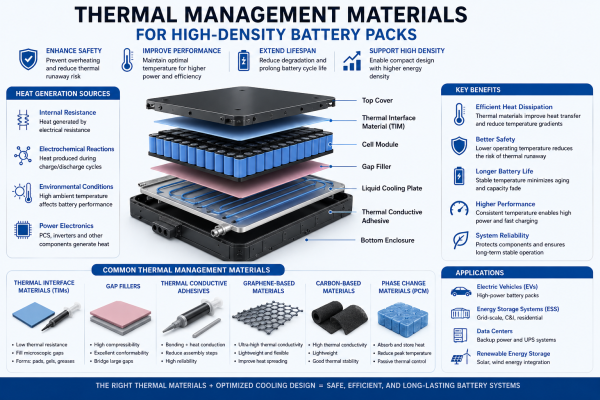
In a battery energy storage system, thermal management is particularly important because battery temperature affects efficiency, performance, degradation, and safety.
An intelligent EMS can therefore integrate electrical and thermal data.
For example:
Power Demand → Battery Dispatch → Heat Generation → Cooling Demand → Energy Consumption
Understanding this interaction can help prevent the EMS from optimizing electrical consumption while unintentionally increasing thermal management costs.
Digital Twins and AI-Powered EMS
Digital twin technology is another important development in intelligent energy management.
A digital twin creates a virtual representation of a physical energy system.
The model can represent:
- Battery systems
- Electrical distribution
- Solar generation
- Cooling systems
- Industrial loads
- Energy storage equipment
- Building energy systems
AI can use the digital twin to simulate different operating scenarios before applying decisions to the physical system.
For example, the EMS can compare several strategies:
Strategy A: Maximize battery arbitrage
Strategy B: Minimize demand charges
Strategy C: Maximize renewable energy utilization
Strategy D: Balance cost reduction and battery degradation
The AI system can evaluate these scenarios and select the strategy that best matches the defined objectives.
AI and Predictive Maintenance
Energy assets generate enormous amounts of operational data.
Traditional maintenance strategies often rely on fixed schedules.
AI enables a transition toward predictive maintenance.
Machine learning models can identify abnormal patterns in:
- Temperature
- Voltage
- Current
- Power
- Vibration
- Efficiency
- Cooling performance
- Communication signals
If the system identifies behavior outside normal operating conditions, the EMS can generate an early warning.
This can help reduce unexpected downtime and improve asset availability.
For large energy storage projects, predictive maintenance can also reduce unnecessary inspection and maintenance activities by focusing resources on equipment with higher risk.
AI Does Not Replace EMS Control
It is important to understand that AI should not necessarily replace the core EMS control system.
Instead, AI is best viewed as an intelligence and optimization layer.
A robust architecture can combine:
Traditional Control + AI Prediction + Optimization Algorithms + Safety Constraints + Human Oversight
The EMS remains responsible for deterministic control, communication, and operational constraints.
AI provides predictions, recommendations, optimization, and anomaly detection.
Safety-critical functions should continue to operate within clearly defined protection limits.
This hybrid architecture is particularly important for BESS, industrial power systems, and critical infrastructure.
Key Benefits of AI-Powered Energy Management Systems
The transformation from traditional EMS to AI-enabled EMS can provide several potential advantages.
1. Better Energy Forecasting
AI can improve prediction of energy demand and renewable generation.
2. Lower Energy Costs
Predictive optimization can help reduce peak demand and improve energy purchasing decisions.
3. Higher Renewable Energy Utilization
AI can coordinate renewable generation with flexible loads and battery storage.
4. Improved Battery Utilization
AI can optimize charging and discharging while considering battery degradation.
5. Predictive Maintenance
Abnormal operating conditions can be identified before they develop into major failures.
6. Improved System Efficiency
AI can optimize multiple energy assets simultaneously rather than optimizing individual devices independently.
7. Greater Operational Flexibility
AI-powered EMS platforms can adapt to changing electricity prices, workloads, weather conditions, and grid conditions.
Challenges of Implementing AI in EMS
Despite its advantages, AI-powered energy management is not without challenges.
Data Quality
AI models require reliable and sufficiently large datasets.
Poor sensor quality, missing data, inconsistent timestamps, and communication problems can reduce model accuracy.
Cybersecurity
As EMS platforms become increasingly connected, cybersecurity becomes critical.
An intelligent EMS must protect operational data, communication networks, and control interfaces from unauthorized access.
Model Reliability
AI predictions are probabilistic.
Energy management systems therefore require appropriate fallback strategies when predictions are inaccurate.
Integration Complexity
Existing industrial facilities may contain equipment from multiple vendors using different communication protocols.
Integrating AI into legacy EMS infrastructure can therefore require significant engineering effort.
Safety and Compliance
For critical energy infrastructure, AI decisions must operate within clearly defined technical and safety boundaries.
AI should enhance control intelligence without bypassing established protection systems.
The Future of AI-Powered EMS
The future of Energy Management Systems is likely to move from monitoring and rule-based control toward predictive, adaptive, and increasingly autonomous operation.
Several technologies will contribute to this evolution:
- Machine learning
- Reinforcement learning
- Digital twins
- Edge AI
- Cloud analytics
- Advanced forecasting
- Predictive maintenance
- Real-time optimization
- Demand response
- Grid-interactive energy storage
Edge AI will become particularly important for applications that require rapid decision-making.
Instead of sending every piece of operational data to the cloud, local AI computing can analyze critical information close to the energy equipment.
This can reduce latency and improve resilience.
At the same time, cloud platforms can provide fleet-level analytics across multiple BESS sites, factories, buildings, or data centers.
AI is fundamentally changing the role of Energy Management Systems.
Traditional EMS platforms primarily monitor energy assets and execute predefined control strategies. AI-powered EMS platforms can analyze large datasets, forecast future conditions, optimize energy resources, and support predictive decision-making.
For battery energy storage systems, AI can improve dispatch strategies, battery utilization, predictive maintenance, and lifecycle management. For renewable energy systems, AI can improve generation forecasting and renewable integration. For industrial facilities, it can reduce peak demand and optimize electricity costs. For AI data centers, it can coordinate computing power, cooling, energy storage, and grid interaction.
The most effective future architecture will not simply be “AI replacing EMS.”
Instead, it will be an integrated system in which AI prediction, optimization algorithms, deterministic EMS control, safety systems, and human oversight work together.
As energy systems become more distributed, electrified, and data-intensive, AI-powered EMS will increasingly become a core technology for managing the complex relationship between energy generation, energy storage, energy consumption, thermal management, and grid interaction.
For companies developing BESS, microgrids, industrial energy solutions, and AI data center infrastructure, integrating intelligent energy management into the system architecture is likely to become an increasingly important competitive advantage.
Frequently Asked Questions
What is an AI-powered Energy Management System?
An AI-powered Energy Management System uses artificial intelligence and machine learning to forecast energy demand, predict renewable generation, optimize energy storage, manage loads, detect abnormal conditions, and improve overall energy efficiency.
How does AI improve EMS?
AI improves EMS by adding predictive and optimization capabilities. Instead of relying only on predefined rules, an AI-enabled EMS can analyze historical and real-time data to predict future operating conditions and select optimized energy strategies.
Can AI optimize battery energy storage systems?
Yes. AI can optimize battery charging and discharging by considering electricity prices, load demand, renewable generation, battery SOC, SOH, temperature, and estimated degradation.
Can AI reduce energy costs?
AI can potentially reduce energy costs by optimizing battery dispatch, reducing peak demand, improving renewable energy utilization, and adjusting energy consumption according to electricity prices.
What is the difference between EMS and AI-powered EMS?
A conventional EMS primarily relies on monitoring and predefined control logic. An AI-powered EMS adds forecasting, machine learning, predictive analytics, anomaly detection, and advanced optimization capabilities.
Will AI replace traditional EMS?
AI is more likely to enhance rather than completely replace traditional EMS. A robust architecture combines AI intelligence with deterministic control, safety systems, operational constraints, and human oversight.
Why is AI important for BESS?
AI can help BESS operators optimize energy dispatch, reduce battery degradation, improve predictive maintenance, increase revenue opportunities, and coordinate batteries with renewable generation and grid demand.