



Busbars are a critical component in energy storage systems (ESS), providing the electrical backbone that connects battery cells, modules, and power electronics. Their design, material selection, and manufacturing quality directly affect conductivity, system efficiency, thermal management, and long-term reliability. As battery energy density and power demands increase, busbar performance becomes increasingly important.
This article explores the role of busbars in energy storage systems, the materials used, conductivity considerations, and strategies for reliable operation.
What Is a Busbar?
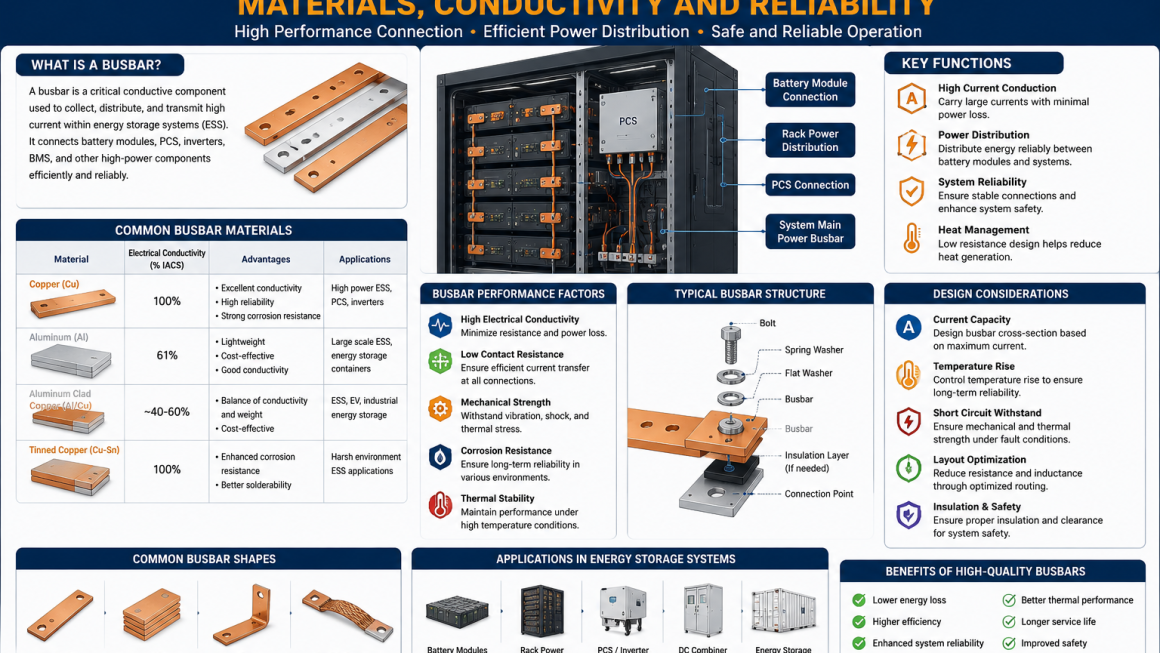
A busbar is a metallic strip or bar that conducts electricity within a battery pack, module, or ESS cabinet. Busbars provide:
- High-current paths with minimal voltage drop
- Connection between multiple battery cells in series or parallel
- Integration with PCS (Power Conversion Systems), BMS (Battery Management Systems), and other ESS components
They are essential for:
- Ensuring uniform current distribution
- Minimizing resistive losses
- Maintaining system safety and reliability
Key Functions of Busbars in ESS
1. Electrical Conductivity
Busbars must carry high currents efficiently. Poor conductivity leads to:
- Voltage drops
- Excessive heat generation
- Reduced system efficiency
2. Thermal Management
Busbars can act as passive heat conductors, spreading localized heat from high-current regions and preventing hotspots in battery modules.
3. Structural Support
In addition to electrical functionality, busbars may provide mechanical integrity and secure cell interconnections, particularly in high-vibration environments.
4. Safety and Reliability
High-quality busbars reduce:
- Risk of short circuits
- Arcing
- Thermal runaway
- Mechanical failure
Common Materials for ESS Busbars
1. Copper (Cu)
Advantages:
- Excellent electrical conductivity (~5.96 × 10^7 S/m)
- High thermal conductivity
- Durable and corrosion-resistant with proper plating
Considerations:
- Heavier than aluminum
- Higher material cost
- Requires surface treatment (tin or nickel plating) to prevent oxidation
Applications:
- High-current connections
- Utility-scale ESS modules
- Industrial battery racks
2. Aluminum (Al)
Advantages:
- Lightweight (~1/3 the density of copper)
- Good conductivity (~3.5 × 10^7 S/m)
- Cost-effective for large-scale systems
Considerations:
- Lower conductivity than copper, requiring larger cross-section
- Susceptible to oxidation, which can increase contact resistance
- Requires precise clamping or plating for reliable connections
Applications:
- Medium-current battery packs
- EV battery modules
- Urban ESS systems
3. Hybrid and Coated Busbars
Emerging solutions use:
- Copper-clad aluminum
- Coated or plated copper/aluminum
- Graphene or carbon-based conductive layers for improved thermal distribution
These designs balance weight, conductivity, and thermal performance.
Key Design Considerations
1. Cross-Sectional Area
Busbar thickness and width must match expected current to minimize resistive heating and voltage drop.
2. Electrical Resistance
Low-resistance busbars improve efficiency and reduce heating. Surface treatments and plating help maintain low contact resistance over time.
3. Thermal Management
Busbar design should:
- Spread heat evenly
- Interface effectively with battery cooling plates
- Avoid hotspots that degrade battery cells
4. Mechanical Reliability
- Vibration resistance is critical in EVs and industrial ESS
- Busbars must maintain integrity during thermal cycling and mechanical stress
5. Corrosion and Environmental Resistance
- Protective coatings prevent oxidation
- Material choice should suit indoor or outdoor installation environments
Busbar Manufacturing Methods
1. Stamped Busbars
- Cost-effective for high-volume production
- Precise shapes for series and parallel connections
2. Bent or Machined Busbars
- Used for complex layouts
- More labor-intensive but allows flexibility in design
3. Laminated Busbars
- Multi-layered copper or aluminum with insulation
- High-current, compact designs
- Improved thermal distribution
Integration with ESS Systems
Busbars are part of a larger energy storage ecosystem:
- Battery Modules: Series/parallel connections, uniform current flow
- BMS: Voltage and current monitoring at module level
- PCS: High-current distribution to inverters and converters
- Thermal Management: Busbars interface with cooling plates and TIMs
Proper busbar design enhances system efficiency, reliability, and safety.
Reliability Strategies
- Use plated surfaces to maintain low contact resistance
- Optimize cross-sectional area for current density
- Ensure mechanical support against vibration and thermal expansion
- Conduct electrical and thermal testing during assembly
- Integrate with thermal management solutions to avoid hotspots
Applications Across Energy Storage Systems
- Utility-Scale ESS: Copper busbars for high-current power distribution
- EV Battery Packs: Aluminum or hybrid busbars to reduce weight
- Commercial & Industrial ESS: Laminated busbars for compact modular systems
- Containerized ESS: Combination of copper and aluminum for optimized performance
- Microgrids: Lightweight and modular busbars for flexible deployment
Emerging Trends in Busbar Design
- Copper-aluminum hybrid materials for weight and cost optimization
- Coatings and surface treatments for low resistance and corrosion protection
- Integration with AI-driven thermal monitoring
- Multi-layer laminated designs for high-density modules
- Graphene-enhanced busbars for improved heat spreading
Best Practices for ESS Busbar Design
- Select material based on current rating, weight, and cost.
- Ensure low resistance and high thermal conductivity.
- Use protective coatings to prevent corrosion.
- Optimize mechanical design for vibration and thermal expansion.
- Integrate busbars with cooling systems and BMS for enhanced reliability.
Busbars are the electrical backbone of energy storage systems. Proper material selection, conductivity optimization, mechanical reliability, and thermal management are crucial for ESS performance and longevity. Whether copper, aluminum, or hybrid solutions, busbars play a central role in enabling safe, efficient, and scalable energy storage systems, from EV battery packs to utility-scale installations.
High-performance busbar design is no longer a secondary consideration—it is central to achieving reliable, high-density, and modular energy storage systems.