
Practical Entry Points — Not Laboratory Dreams
1. Offshore Wind Does Not Adopt Materials the Way Labs Do
In offshore wind engineering, materials are not chosen for novelty.
They are adopted only when they satisfy three unspoken rules:
- They do not change system architecture
- They reduce a clearly defined risk
- They can be justified without rewriting standards
This is why many “advanced materials” remain stuck in presentations, while only a few quietly enter real projects.
The question is not “What can this material do?”
The real question is:
Where can it enter without creating engineering resistance?
2. The Offshore Wind System Can Be Read as Layers
Instead of looking at offshore wind as turbines and megawatts, engineers see it as layers of risk control:
- Structural layer
- Electrical layer
- Thermal layer
- Environmental protection layer
Advanced materials do not enter at the structural core first.
They enter at the interfaces between these layers.
This is where performance improvements are welcome — and disruption is not.
3. Entry Point #1: Corrosion Control and Conductive Interfaces
Why this layer matters
Saltwater corrosion is not a surprise — it is assumed.
What matters is how fast corrosion propagates and how it interacts with electrical grounding.
Common problem zones include:
- Flanges and bolted joints
- Grounding paths on platforms and nacelles
- Interfaces between steel, aluminum, and copper components
Why advanced materials are considered here
At these interfaces, engineers care about:
- Stable conductivity over time
- Reduced micro-galvanic corrosion
- Coatings that remain functional even after partial damage
This is where conductive and corrosion-mitigating coatings can be evaluated as risk reducers, not structural elements.
The value proposition is not “better conductivity”
but more predictable grounding performance over years.
4. Entry Point #2: Thermal Paths in Power Electronics and Storage Modules
Why thermal issues are growing
As offshore wind scales, systems increasingly integrate:
- Power converters
- Transformers
- Energy storage buffers
- Grid-balancing electronics
These components are:
- Enclosed
- Maintenance-averse
- Sensitive to temperature cycling
Traditional thermal solutions often face trade-offs:
- Good conductivity vs. poor corrosion resistance
- Adequate heat spreading vs. weight and volume penalties
Where advanced materials fit
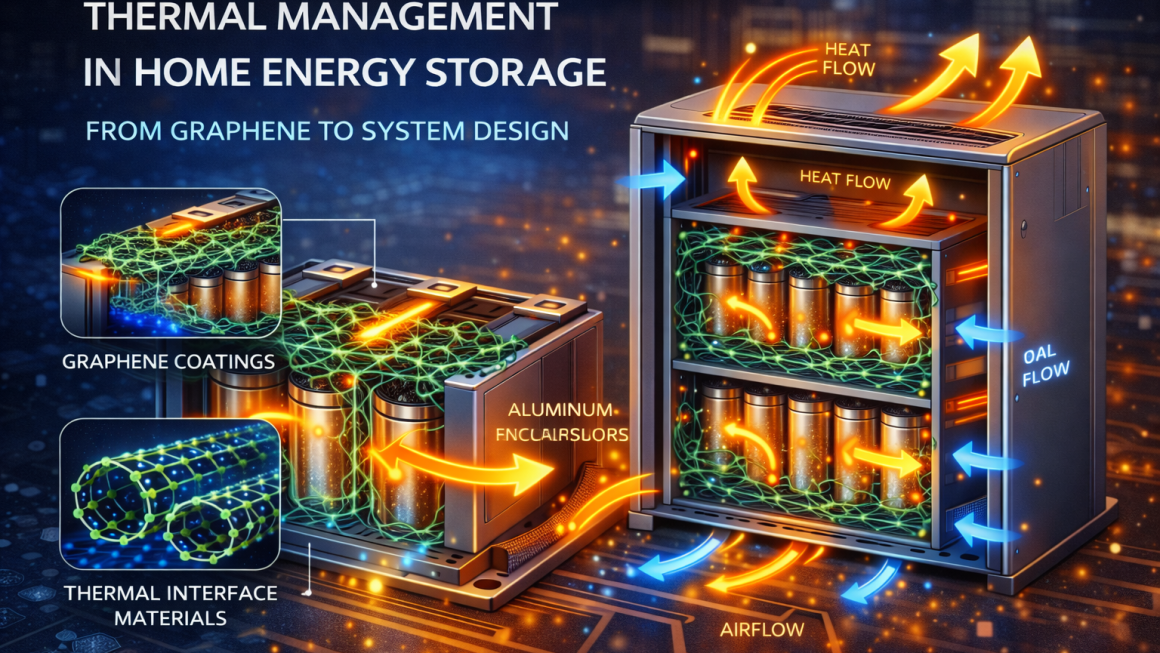
Materials that improve in-plane heat spreading, interface stability, or long-term thermal consistency can enter as:
- Additives in thermal interface materials (TIMs)
- Coatings or layers for enclosure heat management
- Enhancements to existing aluminum-based thermal structures
The key is this:
The system does not want a new thermal concept —
it wants less temperature stress with the same design.
5. Entry Point #3: Fatigue Mitigation at Non-Load-Bearing Interfaces
Offshore wind structures are designed to survive loads.
What degrades them over time is fatigue at interfaces.
Typical fatigue-sensitive zones:
- Cable clamps and routing interfaces
- Transition pieces between modules
- Secondary structural attachments
Advanced materials are not asked to carry load here.
They are asked to:
- Reduce micro-crack initiation
- Dampen vibration transmission
- Stabilize interfaces under cyclic stress
This opens the door for:
- Functional coatings
- Composite-compatible interface layers
- Fatigue-aware surface treatments
The selling point is simple:
Fewer inspections. Fewer surprises.
6. Entry Point #4: Environmental Protection Layers in Offshore Storage Systems
Offshore wind increasingly relies on localized energy storage, whether on platforms or near-grid nodes.
These systems face combined stress:
- Heat
- Humidity
- Electrical safety requirements
- Long maintenance intervals
Here, materials are evaluated for:
- Fire risk mitigation
- Thermal stability
- Barrier performance under aging
Advanced materials can enter as protective and functional layers, not as core battery materials.
This distinction matters enormously for adoption.
7. Where Advanced Materials Usually Fail to Enter (For Now)
It is equally important to know where not to push.
In offshore wind, resistance is high against:
- Load-bearing structural replacement
- Core turbine components
- Certified safety-critical parts
These areas are governed by:
- Conservative standards
- Long qualification cycles
- Strong incumbent suppliers
Trying to enter here too early often kills momentum.
8. The Pattern Behind Successful Material Adoption
Across offshore wind projects, a consistent pattern appears:
Successful materials:
- Improve an existing function
- Reduce a known failure mode
- Fit into current manufacturing and maintenance logic
Unsuccessful ones:
- Promise disruption without risk mapping
- Require system redesign
- Depend on future standards that do not yet exist
In offshore wind, quiet integration beats bold reinvention.
9. Why This Matters for the Next 10 Years
With 100 GW of new capacity planned, Europe is not looking for experiments.
It is looking for:
- Incremental reliability gains
- Longer service intervals
- Lower lifetime operational risk
Advanced materials that understand their true entry layer will scale with the system.
Those that do not will remain confined to pilot projects.