

Communication towers are among the most reliability-sensitive assets in modern infrastructure. Even a short outage—5 to 15 minutes—can disrupt mobile communication, security systems, emergency services, and remote enterprise networks. Because many sites are located in remote or unstable-grid regions, energy storage for emergency backup has become a core requirement rather than an optional upgrade.
This article outlines a practical, replicable energy storage solution for communication towers, focusing on emergency power continuity, modular design, and field-proven reliability. It also includes a small, real-world deployment example suitable for EPCs, tower operators, and telecom O&M teams.
1. Why Energy Storage Is Essential for Communication Towers
Most towers historically relied on:
- Grid power (where available)
- Diesel generators
- VRLA/lead-acid backup batteries
However, these systems face well-known challenges:
1) Frequent outages exceed VRLA reliability limits
Lead-acid batteries degrade rapidly under high temperature, partial charging, or repeat outages.
2) Generators cannot respond instantly
A 2–8 second start delay can drop active radio equipment.
3) Rising O&M costs
Fuel logistics, field servicing, and remote troubleshooting increase cost per site over time.
4) Regulatory pressure for uptime
Telecom regulators in many countries enforce minimum uptime requirements for critical communications.
Result: Most operators are transitioning toward lithium-based emergency energy storage systems with higher cycle life, faster response, and lower maintenance.
2. A Replicable Emergency ESS Architecture for Communication Towers
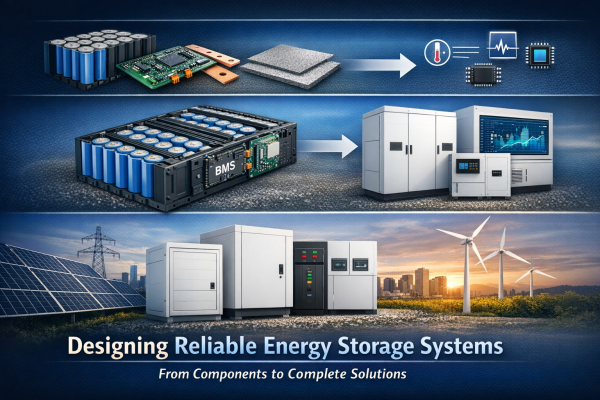
A practical ESS for communication towers should follow a stable and modular architecture:
2.1 System Architecture Overview
Core components:
- Battery Pack (LFP preferred)
- Tower Power Control Unit (inverter or DC/DC depending on site voltage)
- Automatic Transfer Controller (ATS) or hybrid controller
- Remote monitoring module (SNMP/Modbus)
- Distribution & protection panel
- Optional: Small PV array for battery maintenance or partial powering
This creates a stable two-tier emergency power system:
Tier 1: Instant Backup (Battery)
- 0 ms switchover
- Keeps radio units alive during outages
- Supports high peak loads from 4G/5G equipment
Tier 2: Extended Backup (Generator or PV/ESS hybrid)
- Takes over during long outages
- ESS ensures generator starts under low load
- Avoids brownouts and voltage dips
2.2 DC vs AC ESS Configurations
DC-Coupled (48V ESS)
Most common for telecom towers.
Advantages:
- Direct connection to existing 48V DC bus
- No inverter required
- Lower conversion loss
- Higher reliability
AC-Coupled ESS
Used when tower load includes AC lighting, security cameras, routers, etc.
Advantages:
- Flexible for multi-tenant equipment
- Can support full AC microgrid if needed
Both configurations can be built with the same battery modules—important for scalability and inventory management.
3. Key Design Principles for Emergency Tower ESS
3.1 Fast Response = Zero Interruption
Lithium batteries respond in milliseconds—critical for:
- 5G radio units
- Microwave backhaul
- Baseband units (BBU)
- Edge computing nodes
No reboot = no outage.
3.2 High Temperature Tolerance
Communication towers often operate in:
- Outdoor shelters
- 45–55°C daytime peaks
- Regions with poor ventilation
LFP chemistry is preferred due to:
- Better thermal stability
- Longer cycle life at high temp
- Lower risk of thermal incidents
3.3 Long Cycle and Calendar Life
A typical tower experiences:
- 150–500 cycles per year (depending on grid quality)
- Standby operation most of the time
- Deep cycles during severe outages
A good emergency ESS must support:
- ≥ 4,000–6,000 cycles @ 80% DoD
- ≥ 10-year design life
3.4 Intelligent Battery Management
Reliable emergency power requires strict supervision:
- Temperature and cell balancing
- State of charge (SoC) learning
- Fault prediction (early warnings)
- Remote disabling for safety
- SNMP alarms integrated with NOC systems
Modern BMS + cloud monitoring drastically improves uptime.
3.5 Modular & Field-Swappable
Telecom operators require:
- Quick on-site replacement (under 30 minutes)
- Uniform module sizes across regions
- Spare battery and BMS modules that swap seamlessly
Modularity lowers downtime and O&M cost.
4. Case Example: Modular ESS for a Multi-Operator Tower
Location: Southeast Asia
Grid Stability: 6–10 outages/day
Load: 1.2–1.8 kW (shared by two operators)
Problem
Frequent micro-outages (0–5 minutes) caused radio resets and communication gaps. VRLA batteries degraded within 1 year and failed to hold charge.
Solution
A modular 48V LFP emergency ESS with:
- 5 kWh battery module
- DC/DC telecom controller
- Remote SNMP monitoring
- Small 400W PV array for self-charging during outages
Results
- Zero communication drops over 9 months
- Reduced generator run time by 35%
- VRLA battery replacements eliminated
- Remote monitoring reduced O&M visits by 40%
This “micro-upgrade” became the standard for 18 additional sites.
5. Implementation Template (Replicable for EPCs)
A standard deployment workflow:
Step 1 — Load Analysis
- Identify 48V DC loads
- Identify AC loads (if any)
- Determine minimum backup time (2–8 hours typical)
Step 2 — Select ESS Size
- 2–3 kWh for light 4G sites
- 5–10 kWh for 4G + 5G hybrid sites
- ≥ 10–15 kWh for off-grid or generator-heavy sites
Step 3 — Integration Method
Choose one:
- DC-coupled 48V ESS
- AC ESS with inverter
- Hybrid AC/DC architecture
Step 4 — Configure Emergency Logic
- 0 ms switchover
- Load priority (radio units first)
- Remote alarms + SNMP traps
Step 5 — Commissioning & Validation
- Runtime test
- Generator coordination test
- Remote monitoring handshake
- Automatic SoC recalibration
This makes the system repeatable for hundreds of sites across regions.
6. Why Modular ESS is Becoming the Standard for Tower Backups
✓ Higher reliability
✓ Lower total cost over 10 years
✓ Better performance under harsh conditions
✓ Seamless O&M integration
✓ True zero-interruption emergency power
✓ Supports both grid-tied and off-grid sites
Telecom operators increasingly see ESS as long-term infrastructure rather than consumable backup hardware.
Emergency power for communication towers must prioritize:
- Instant response
- High-temperature stability
- Predictable long-term reliability
- Modular and scalable deployment
- Integration with existing 48V telecom systems
With the right architecture, even small storage systems can dramatically improve uptime and reduce operational costs across large tower networks.