As battery systems become more energy-dense and widely deployed—from EVs to stationary storage—thermal management is no longer optional. It is a core design function that directly impacts safety, cycle life, and system reliability. Effective thermal management solutions in battery modules ensure stable operation under varying loads, environments, and charge/discharge conditions.
Why Thermal Management Matters in Battery Modules
Battery cells, especially lithium-ion chemistries like LFP and NMC, are highly sensitive to temperature. Poor thermal control can lead to:
- Capacity degradation and reduced cycle life
- Uneven aging across cells (cell imbalance)
- Increased internal resistance
- Risk of thermal runaway
Maintaining an optimal temperature range (typically 15°C–35°C) and minimizing temperature gradients (<5°C across the module) are key design targets.
Core Thermal Management Strategies
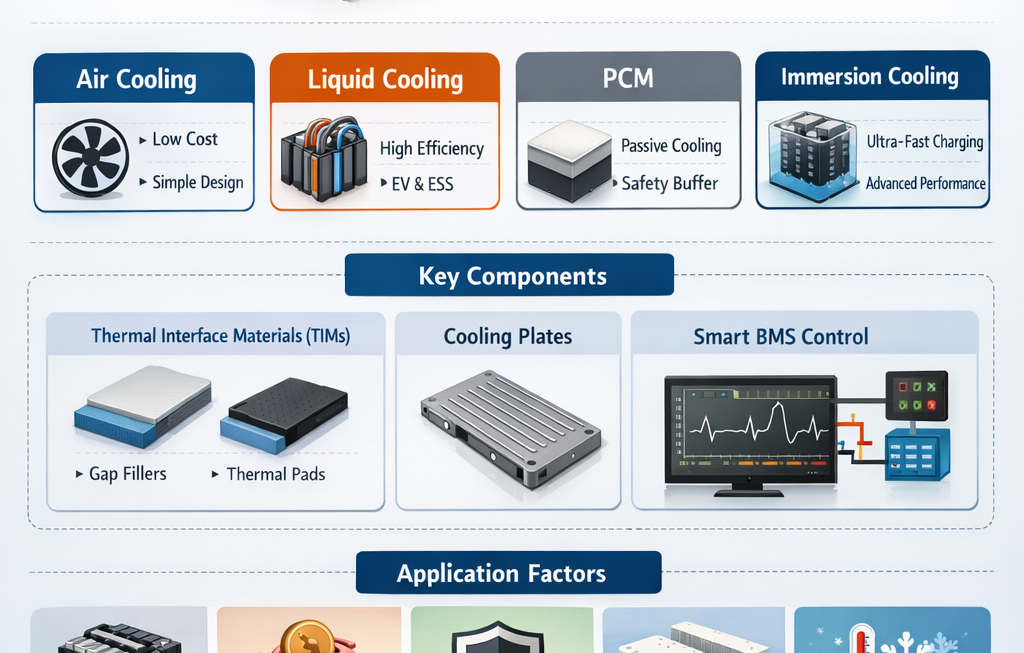
1. Air Cooling Systems
Overview:
Air cooling uses forced or natural convection to dissipate heat via airflow channels integrated into the module.
Advantages:
- Simple design and low cost
- Lightweight and easy maintenance
- No leakage risk
Limitations:
- Lower heat transfer efficiency
- Limited scalability for high-power applications
Best Use Cases:
Residential storage systems, low-to-medium power battery modules
2. Liquid Cooling Systems
Overview:
Liquid cooling uses coolant (water-glycol or dielectric fluids) circulated through cold plates or embedded channels.
Advantages:
- High heat transfer efficiency
- Excellent temperature uniformity
- Suitable for high ენერგy density systems
Limitations:
- Higher system complexity
- Requires sealing and leak prevention
- Increased cost
Best Use Cases:
EV battery packs, high-power ESS, fast-charging infrastructure
3. Phase Change Materials (PCM)
Overview:
PCM absorbs heat during phase transition (solid → liquid), stabilizing temperature without active cooling.
Advantages:
- Passive system (no energy consumption)
- Reduces peak temperature spikes
- Enhances safety buffer
Limitations:
- Limited heat dissipation over long cycles
- Requires integration with active systems
Best Use Cases:
Backup systems, peak shaving scenarios, hybrid cooling designs
4. Direct-to-Cell / Immersion Cooling
Overview:
Cells are directly exposed to dielectric cooling fluids, enabling efficient heat extraction.
Advantages:
- Superior thermal performance
- Uniform cooling across all cells
- Supports ultra-fast charging
Limitations:
- Complex material compatibility requirements
- Higher upfront cost
- Fluid management challenges
Best Use Cases:
Next-generation EVs, AI-integrated energy storage, high-performance battery systems
Key Design Considerations
Thermal Interface Materials (TIMs)
Efficient heat transfer between cells and cooling components depends on high-performance TIMs, including:
- Gap fillers
- Thermal pads
- Graphene-enhanced composites
These materials reduce thermal resistance and improve system efficiency.
Module Architecture Optimization
Thermal performance is closely tied to mechanical and electrical design:
- Cell spacing and arrangement (prismatic, pouch, cylindrical)
- Cooling channel placement
- Structural integration of cold plates or heat sinks
A well-designed module ensures uniform cooling and avoids hotspots.
Smart Thermal Control Systems
Integration with Battery Management Systems (BMS) enables:
- Real-time temperature monitoring
- Predictive thermal control algorithms
- Adaptive cooling strategies
This is increasingly important in intelligent and distributed energy systems.
Emerging Trends in Battery Thermal Management
1. Graphene-Based Thermal Materials
Graphene-enhanced coatings and composites are gaining traction due to their ultra-high thermal conductivity and lightweight properties.
2. AI-Driven Thermal Optimization
Machine learning models optimize cooling strategies based on usage patterns and environmental conditions.
3. Modular and Scalable Cooling Designs
Standardized cooling interfaces enable flexible deployment across different system sizes.
4. Integration with Energy Management Systems
Thermal management is becoming part of a broader system-level optimization, especially in hybrid and distributed energy networks.
Choosing the Right Thermal Management Solution
The optimal solution depends on application-specific factors:
| Factor | Consideration |
|---|---|
| Power density | Higher density requires liquid or immersion cooling |
| Cost constraints | Air cooling offers lowest cost |
| Safety requirements | PCM and immersion enhance safety margins |
| System size | Large systems benefit from scalable liquid cooling |
| Environment | Extreme climates require robust thermal control |
Thermal management solutions in battery modules are critical to achieving safe, reliable, and high-performance energy systems. From simple air cooling to advanced immersion technologies, each approach offers unique advantages depending on system requirements.
As battery technologies evolve, thermal management will increasingly integrate advanced materials, intelligent control systems, and modular architectures—becoming a defining factor in next-generation energy storage design.