



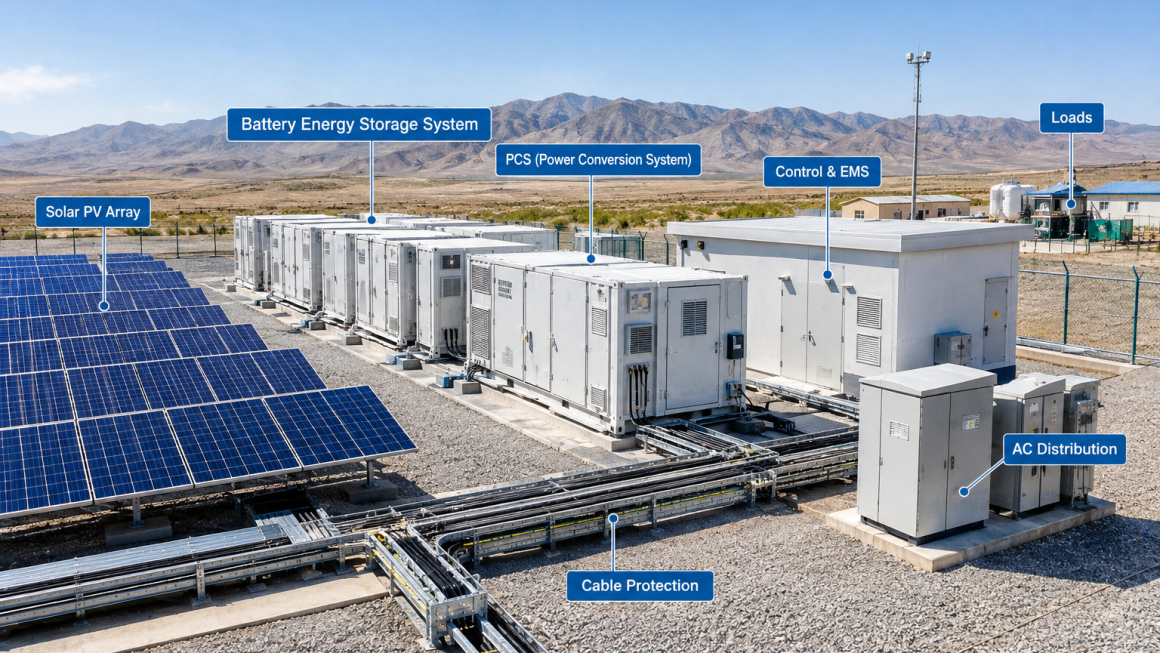
Small-scale microgrids are often presented as straightforward energy projects: combine solar PV, battery storage, power conversion equipment, energy management, and local loads into one coordinated system.
In practice, however, successful microgrid deployment depends on much more than selecting the right generation and storage technologies.
Small projects frequently reveal problems that become much more expensive at larger scale. A slightly oversized battery, poorly protected cable, inaccurate load assumptions, inadequate environmental protection, or an overly complicated control strategy can all affect system reliability and operating costs.
For this reason, lessons from small-scale microgrid projects are highly valuable for developers, system integrators, equipment suppliers, and operators planning larger distributed energy systems.
This article examines the most important lessons learned from small-scale microgrid deployment and explains how they can be applied to future projects.
1. Start with the Load, Not the Technology
One of the most common mistakes in microgrid planning is starting with technology.
Project teams may begin by asking:
- How much solar should be installed?
- How large should the battery be?
- Which PCS should be selected?
- What type of EMS should be used?
A better starting point is the load.
The microgrid should first answer a fundamental question:
What loads need to be powered, when do they operate, and how critical are they?
Small commercial buildings, remote facilities, telecommunications sites, industrial workshops, agricultural facilities, and isolated communities can all have very different load profiles.
Two sites with the same average daily energy consumption may have completely different peak-power requirements.
For example:
Site A
Low daytime demand → high evening demand → relatively predictable load
Site B
Low average demand → short-duration high-power loads → significant demand peaks
The optimal battery and power conversion architecture can therefore be completely different.
Lesson Learned
A reliable microgrid design should begin with measured or realistically modeled load data rather than average annual energy consumption alone.
Important parameters include:
- Peak load
- Average load
- Minimum load
- Daily load profile
- Seasonal variation
- Critical loads
- Motor-starting loads
- Short-duration peak loads
- Future load growth
The quality of the load model often has a greater impact on system performance than simply increasing installed capacity.
2. Small Batteries Can Be More Effective Than Oversized Batteries
Battery sizing is another area where small-scale projects provide important lessons.
It is tempting to install a large battery because additional storage appears to provide greater energy independence.
However, a larger battery does not automatically create a better microgrid.
Oversizing can increase:
- Capital expenditure
- Cooling requirements
- Footprint
- Auxiliary power consumption
- Replacement costs
- Maintenance requirements
At the same time, an oversized battery may spend significant periods operating at low state of charge or low utilization.
The more useful question is not:
“How much battery can we install?”
but:
“What energy and power services does the battery actually need to provide?”
For example, the battery may primarily be required for:
- Peak shaving
- Solar energy shifting
- Backup power
- Frequency stabilization
- Renewable smoothing
- Short-duration power support
- Grid outage management
Each application creates a different battery-sizing requirement.
Energy Capacity vs. Power Capacity
A microgrid battery must be evaluated using both:
Energy capacity → kWh / MWh
and
Power capability → kW / MW
A system may have sufficient energy capacity but still fail to support a high-power load if the PCS and battery power capability are insufficient.
This distinction becomes especially important when microgrids supply motors, pumps, compressors, HVAC systems, or industrial equipment.
3. Renewable Energy Forecasting Is More Difficult Than Expected
Solar PV is an attractive component of small-scale microgrids because it can reduce fuel consumption and grid electricity demand.
However, actual PV output rarely follows the theoretical generation profile.
Cloud movement, temperature, dust, shading, seasonal changes, and weather conditions can create substantial variations.
This creates an important operational challenge:
The battery and EMS must respond to variability rather than simply follow a fixed schedule.
A microgrid therefore needs sufficient flexibility to handle situations such as:
Solar forecast:
100 kW → 80 kW → 30 kW → 90 kW
Actual output:
100 kW → 45 kW → 20 kW → 75 kW
If the battery is already near its operating limits, the system may need to curtail PV or import additional electricity.
Lesson Learned
Small-scale projects demonstrate that renewable generation should be treated as a variable resource rather than a guaranteed power source.
Better forecasting, real-time monitoring, and flexible battery operation can significantly improve renewable utilization.
4. EMS Configuration Matters as Much as Hardware
A microgrid can have excellent hardware and still perform poorly if the energy management strategy is poorly configured.
The EMS is responsible for coordinating different assets, potentially including:
- PV
- Battery energy storage
- PCS
- Grid connection
- Diesel generators
- EV chargers
- HVAC
- Building loads
- Industrial loads
The control logic must determine which asset should operate and when.
For example, during the day:
PV generation → local loads → battery charging → grid export
During the evening:
Battery → critical loads
During a grid outage:
Battery + PV → islanded loads
The actual operating strategy can become considerably more complicated when demand fluctuates unexpectedly.
Lesson Learned
A microgrid EMS should not be designed around an idealized operating scenario.
It needs to account for:
- Forecast errors
- Communication failures
- Equipment availability
- Battery SOC limits
- Grid outages
- Sudden load changes
- Generator start-up delays
- Fault conditions
- Manual override requirements
Simple and robust control logic can sometimes outperform an unnecessarily complex optimization model.
5. Critical Loads Should Be Separated Early
One of the most valuable lessons from small microgrid projects is the importance of load prioritization.
Not every load requires backup power.
For example, a facility might contain:
Critical loads
- Emergency lighting
- Communication equipment
- Control systems
- Refrigeration
- Security systems
- Medical equipment
Non-critical loads
- Nonessential HVAC
- Water heating
- General-purpose equipment
- EV charging
- Optional industrial loads
If all loads are treated equally, the battery must be sized for the worst-case scenario.
If loads are prioritized, the microgrid can maintain critical services with significantly less storage capacity.
This creates a powerful design principle:
Load prioritization can reduce battery requirements without reducing resilience.
6. Black Start and Islanding Must Be Tested
A microgrid is not truly resilient simply because it contains batteries and renewable generation.
The system must be able to transition between operating modes reliably.
Typical operating states include:
Grid-connected → Grid outage → Islanded operation → Grid restoration
Each transition creates control challenges.
For example, when the grid fails, the system may need to:
- Detect the outage
- Disconnect from the utility
- Establish local voltage and frequency
- Supply critical loads
- Coordinate PV generation
- Manage battery SOC
- Prevent overload
- Reconnect safely when grid power returns
This process is often more difficult than normal grid-connected operation.
Lesson Learned
Black-start and islanding functions should be tested during commissioning rather than assumed to work because the individual components are technically capable of doing so.
7. Cable Management Is a System-Level Issue
Small microgrids often contain many interconnected components within a relatively compact footprint.
This creates a dense network of:
- DC cables
- AC cables
- Communication cables
- Control wiring
- Grounding conductors
- PV cables
- Battery connections
Cable management can therefore become a significant reliability issue.
Poorly routed cables can experience:
- Mechanical abrasion
- Excessive bending
- UV exposure
- Heat exposure
- Water ingress
- Dust contamination
- Connector stress
- Vibration
- Corrosion
These problems are particularly important in outdoor and remote microgrids.
Lesson Learned
Cable protection should be considered part of the microgrid architecture rather than an installation detail.
Depending on the environment, protection may include:
- Cable glands
- Conduits
- Protective sleeves
- Cable trays
- Sealing systems
- Strain relief
- UV-resistant protection
- Waterproof connectors
- Corrosion-resistant components
A small component failure can interrupt an entire energy system.
8. Environmental Conditions Can Dominate Reliability
A microgrid operating in a controlled building environment has very different requirements from one installed in a desert, coastal region, agricultural site, or remote industrial facility.
Environmental factors can include:
High temperature
High ambient temperatures increase thermal stress on batteries, PCS equipment, cables, connectors, and electronic components.
Dust and sand
Dust can restrict ventilation, contaminate filters, reduce cooling performance, and accelerate mechanical wear.
Humidity
Condensation and moisture can contribute to corrosion, insulation degradation, and electrical faults.
Salt exposure
Coastal environments can accelerate corrosion of metallic structures, connectors, cable glands, and electrical enclosures.
UV radiation
Outdoor cables, polymers, seals, and protective materials may degrade under prolonged UV exposure.
Lesson Learned
Environmental protection should be specified during the initial design stage.
Retrofitting protection after installation is usually more expensive and less effective.
9. Auxiliary Energy Consumption Should Not Be Ignored
Microgrid discussions often focus on energy produced and stored while overlooking energy consumed by the system itself.
Battery cooling, ventilation, pumps, controls, communication equipment, lighting, and other auxiliary systems can consume meaningful amounts of energy.
The actual energy balance is therefore closer to:
Net usable energy = Generated energy + imported energy − load consumption − system auxiliary consumption
For small systems, auxiliary consumption can represent a surprisingly large percentage of total energy use.
This is particularly important for systems operating at low loads for long periods.
Lesson Learned
Microgrid performance should be evaluated using net system efficiency, not simply PV efficiency or battery round-trip efficiency.
10. Communication Failures Need a Backup Strategy
Microgrids depend heavily on communication.
The EMS may need information from:
- PCS
- BMS
- Smart meters
- PV inverters
- Protection devices
- Environmental sensors
- Load controllers
If communication is lost, the system must still remain safe.
A robust architecture should define what happens when:
- A sensor stops responding
- Communication latency increases
- The EMS loses connection with the PCS
- A meter provides incorrect data
- A remote monitoring connection fails
Lesson Learned
Not every function should depend entirely on cloud connectivity or centralized software.
Critical protection and basic equipment-level control should remain capable of operating locally.
This creates a useful hierarchy:
Protection → Local control → Site EMS → Remote monitoring
The higher levels should enhance the system, not become single points of failure.
11. Modular Architecture Makes Small Projects Easier to Scale
A small microgrid may initially require only a limited amount of generation and storage.
However, many projects eventually expand.
Load growth may come from:
- New production equipment
- Additional buildings
- EV charging
- Electrification
- Data and communication equipment
- HVAC expansion
If the original architecture cannot accommodate additional capacity, expansion can become expensive.
Modular design can provide a better pathway.
For example:
Initial deployment
100 kW PV + 100 kWh BESS
↓
Phase 2
200 kW PV + 300 kWh BESS
↓
Phase 3
300 kW PV + 500 kWh BESS
The exact values are project-specific, but the principle is broadly applicable.
Lesson Learned
Future expansion should be considered even when the initial project is small.
Electrical interfaces, cable routes, protection systems, communication architecture, and physical space should ideally accommodate future modules.
12. Commissioning Is Where the Real System Is Validated
Factory testing confirms that individual components work.
Site commissioning determines whether the complete microgrid works as a system.
Important commissioning tests can include:
- PV output verification
- Battery charge/discharge testing
- PCS response testing
- EMS control testing
- Grid synchronization
- Islanding
- Black start
- Load transfer
- Emergency shutdown
- Communication failure
- Protection coordination
- Alarm verification
- Remote monitoring
A system can pass individual equipment tests but still experience problems at the interfaces between components.
This is why system-level commissioning is critical.
13. O&M Should Be Designed Before the Microgrid Is Built
Another important lesson from small projects is that operation and maintenance should not be treated as an afterthought.
Operators need to know:
- Which components require regular inspection?
- Which filters need cleaning?
- Which connectors should be checked?
- How frequently should thermal equipment be inspected?
- Which alarms require immediate intervention?
- Which spare parts should be stocked?
- How can failed components be replaced?
For remote microgrids, these questions become even more important.
A component that costs only a few dollars may create a major operational problem if replacement requires a technician to travel hundreds of kilometers.
Lesson Learned
The true cost of a component includes not only its purchase price but also:
Installation + inspection + maintenance + replacement + downtime
This is why maintainability should be considered alongside initial equipment cost.
14. Small-Scale Projects Reveal the Importance of Simplicity
One of the strongest lessons from microgrid deployment is that more technology does not necessarily mean better performance.
A system containing multiple controllers, communication platforms, sensors, optimization algorithms, and operating modes may provide sophisticated functionality.
But every additional layer introduces:
- Configuration requirements
- Communication dependencies
- Potential failure points
- Maintenance requirements
- Cybersecurity considerations
For smaller installations, the best architecture is often one that provides the required functionality with the fewest unnecessary dependencies.
The objective should be:
Reliable → Maintainable → Scalable → Intelligent
rather than:
Complex → Highly automated → Difficult to troubleshoot
15. The Most Important Lesson: Design for Real Operating Conditions
Small-scale microgrids provide a valuable testing ground for larger distributed energy projects.
They reveal that successful deployment depends on the interaction between:
Energy resources + storage + power electronics + controls + loads + environment + protection + maintenance
A microgrid is therefore not simply a collection of equipment.
It is an operating ecosystem.
The most successful projects typically share several characteristics:
- Accurate load assessment
- Appropriate battery sizing
- Flexible renewable integration
- Robust EMS logic
- Clear load prioritization
- Reliable islanding capability
- Proper cable protection
- Environmental protection
- Local fallback control
- Modular architecture
- Thorough commissioning
- Practical O&M planning
Small-scale microgrid projects offer lessons that are highly relevant to larger energy infrastructure.
The biggest lesson is that microgrid performance depends on system integration rather than individual equipment specifications.
A high-performance battery cannot compensate for poor load modeling. A sophisticated EMS cannot solve inadequate cable protection. High-efficiency PV cannot eliminate the need for proper thermal management. And advanced monitoring cannot replace practical maintenance planning.
The most effective microgrid strategy is therefore to design the complete operating system around real-world conditions.
As distributed energy systems become more modular and increasingly incorporate renewable generation, battery storage, EV charging, and intelligent energy management, the lessons learned from small-scale deployments will become increasingly important.
Good microgrid design is not about installing more equipment. It is about making every component work reliably together.
Frequently Asked Questions
What is the biggest lesson from small-scale microgrid projects?
The biggest lesson is that system integration is more important than the specification of any single component. Load profiles, controls, storage, protection, environmental conditions, and maintenance must be considered together.
How should a microgrid battery be sized?
Battery sizing should consider both energy capacity and power requirements. Critical loads, peak demand, renewable generation profiles, backup duration, and operating strategy should all be evaluated.
Why is load prioritization important?
Separating critical and non-critical loads can significantly reduce the required battery capacity while maintaining essential services during grid outages.
What environmental factors affect microgrid reliability?
Temperature, dust, sand, humidity, salt exposure, UV radiation, and thermal cycling can all affect batteries, power electronics, cables, connectors, and enclosures.
Why is cable protection important in microgrids?
Microgrid cables can be exposed to mechanical stress, UV radiation, moisture, dust, vibration, and temperature variations. Appropriate cable protection helps reduce failures and maintenance requirements.
What should be tested during microgrid commissioning?
Commissioning should include equipment operation, EMS control, grid synchronization, islanding, black start, load transfer, emergency shutdown, communication failures, alarms, and protection functions.
Why is modular architecture useful?
Modular architecture allows generation, storage, and other components to be expanded as site requirements grow, reducing the need for major system redesign.
How can microgrid O&M costs be reduced?
O&M costs can be reduced through accessible equipment layouts, standardized components, predictive monitoring, appropriate environmental protection, spare-parts planning, and clear maintenance procedures.