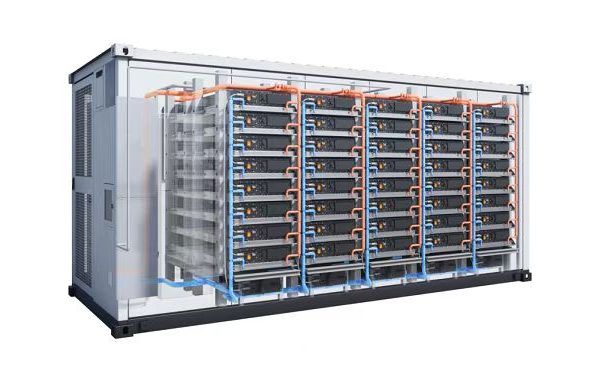

Battery Energy Storage Systems (BESS) contain extensive electrical cable networks connecting battery racks, battery management equipment, power conversion systems (PCS), auxiliary power supplies, monitoring devices, and distribution equipment.
These cable networks must remain protected throughout the operating life of the installation. However, protection should not make inspection, troubleshooting, repair, or future modification unnecessarily difficult.
In many projects, cable protection is selected mainly according to its initial installation cost and mechanical or environmental performance. Less attention is given to what happens when a cable needs to be inspected, a connector needs to be replaced, or an additional circuit needs to be installed.
A maintenance-friendly cable protection system addresses these issues from the beginning. It combines suitable protection materials with accessible routing, removable or openable structures, clear identification, and practical replacement procedures.
This article explains how to design cable protection systems for BESS that support both cable safety and long-term maintenance efficiency.
1. Why Maintenance-Friendly Cable Protection Matters in BESS
A BESS installation may contain hundreds or thousands of cable connections, depending on its size and configuration. These cables may run between battery containers, rack-level equipment, PCS units, transformers, auxiliary systems, and monitoring devices.
During operation, maintenance teams may need to:
- Inspect cable jackets for abrasion, cracking, or deformation.
- Check cable supports and fastening points.
- Access connectors and terminal interfaces.
- Investigate abnormal temperature readings.
- Replace damaged cable sections or protective accessories.
- Add or reroute cables during system expansion.
- Inspect cable entries and enclosure sealing.
If cable protection is permanently enclosed or difficult to remove, even routine inspection can become time-consuming.
A maintenance-friendly design helps reduce unnecessary dismantling and makes it easier to identify and address local problems.
Importantly, cable protection is not a substitute for electrical protection, correct cable sizing, proper installation, or qualified maintenance procedures. Its purpose is to reduce exposure to specific mechanical and environmental risks while maintaining practical access to the cable system.
2. Key Design Principles of Maintenance-Friendly Cable Protection
A good cable protection system should balance protection performance with accessibility.
2.1 Accessibility
Maintenance personnel should be able to reach relevant cable sections, connectors, and inspection points without removing large portions of the cable installation.
Protection should be selected according to the access frequency and the maintenance requirements of each cable route.
2.2 Removability
Where periodic inspection or modification is expected, removable protection products can be more practical than permanently installed solutions.
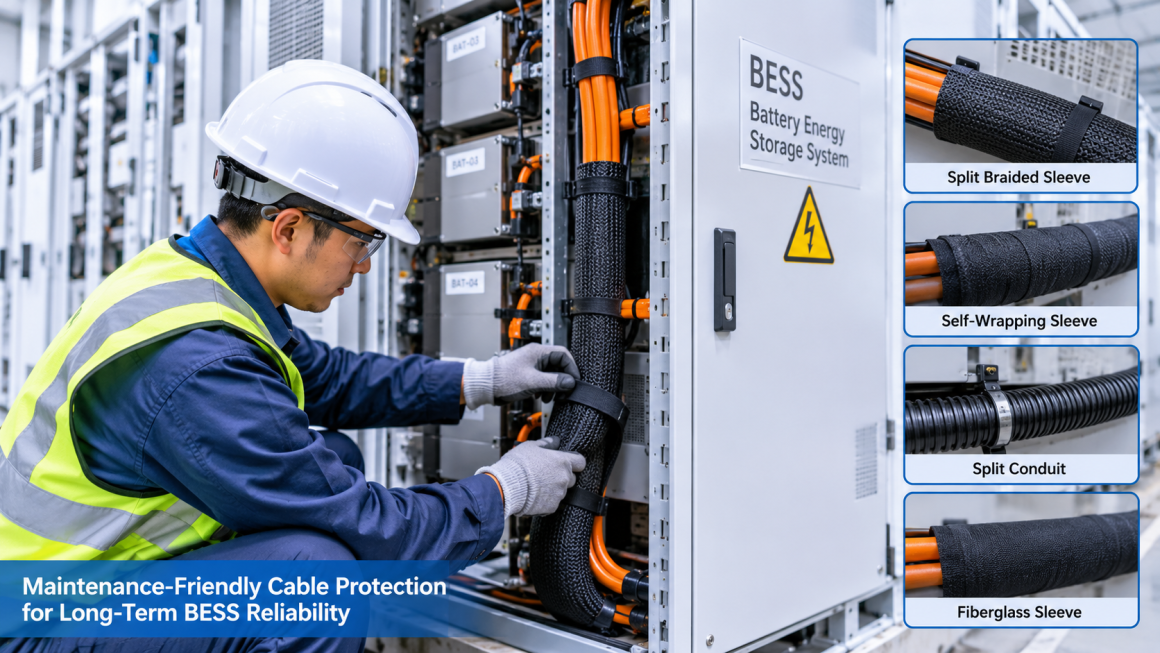
Examples include split braided sleeves, self-wrapping sleeves, and suitable openable conduit systems.
2.3 Modular replacement
Damage is not always distributed across an entire cable route. A localized protective sleeve or conduit section may need replacement while the remaining installation is still serviceable.
A modular approach allows maintenance teams to replace selected sections rather than dismantling an entire cable bundle.
2.4 Secure installation
Easy access should not mean loose or unstable protection.
Protective products must remain securely positioned under expected vibration, cable movement, temperature variation, and operating conditions.
2.5 Identification and documentation
Cable protection should not obscure essential cable identification, warning labels, inspection markings, or maintenance reference points.
The routing and protection arrangement should be documented so that future technicians can understand the installation.
3. Cable Protection Products Suitable for Maintenance-Friendly BESS Installations
Different products serve different purposes. Selection should be based on cable dimensions, routing geometry, exposure conditions, and required maintenance access.
| Protection product | Typical application | Maintenance advantage | Key consideration |
|---|---|---|---|
| Split braided sleeve | Existing cable bundles and retrofit work | Can be opened and installed around existing cables | Check closure security and abrasion resistance |
| Self-wrapping sleeve | Irregular bundles and branching cable routes | Allows access to selected sections | Confirm overlap and retention performance |
| Hook-and-loop cable sleeve | Frequently accessed cable bundles, where suitable | Can be opened and reclosed without cutting | Verify temperature, retention, and environmental ratings |
| Split corrugated conduit | Routes requiring structured mechanical protection | Openable designs can simplify cable access | Confirm joint integrity and suitable fittings |
| Non-split corrugated conduit | More continuous cable routing | Provides organized routing with compatible accessories | May require cable disconnection for installation or removal |
| Fiberglass sleeve | Selected high-temperature exposure areas | Can be replaced as a separate protective section | Verify continuous and intermittent temperature ratings |
| Aluminum-foil/fiberglass protection | Selected radiant-heat exposure areas | Can be installed locally where thermal shielding is needed | Not a universal fire barrier or substitute for fire-rated system design |
| Cable glands and grommets | Enclosure entries and panel openings | Replaceable accessories can simplify localized repair | Match cable diameter, enclosure opening, and required ingress protection |
Not every product is appropriate for every BESS location. For example, a flexible textile sleeve may be suitable for a cable bundle inside an enclosure but may not provide the impact resistance required for an exposed outdoor route.
4. Split Sleeves vs. Fully Enclosed Cable Protection
One of the most important design decisions is whether a cable route should use an openable protection product or a fully enclosed solution.
4.1 Split braided sleeves
<escape> </escape>
Split braided sleeves are designed to wrap around cable bundles without requiring the cables to be disconnected.
<escape> </escape>
Advantages:
- Convenient for retrofit installation.
- Can be opened for inspection.
- Suitable for cable bundles with multiple branches.
- Local sections can be replaced independently.
- Available in different materials and diameters.
Limitations:
- The split or closure area must remain secure.
- The product may not provide the same degree of containment as a continuous conduit.
- It should not be assumed to provide waterproof or gas-tight protection.
4.2 Self-wrapping sleeves
Self-wrapping sleeves overlap around the cable bundle and are useful where cables branch or where access is required along the route.
They can simplify installation because the cables do not always need to be threaded through a closed tube.
However, the overlap must be suitable for the application. Movement, vibration, cable bundle diameter, and installation orientation should be considered.
4.3 Fully enclosed conduits
Fully enclosed conduits may be appropriate where cables need more structured mechanical protection.
They can help protect against contact, abrasion, and selected environmental exposure when properly specified.
However, maintenance access may be more complicated if the conduit is not designed to open or if fittings cannot be removed without disturbing adjacent equipment.
4.4 Choosing the right approach
A practical BESS installation often uses more than one protection type.
For example:
- Use suitable enclosed conduits for exposed routes requiring structured mechanical protection.
- Use split sleeves for cable bundles that need periodic inspection.
- Use self-wrapping sleeves around irregular sections and branching points.
- Use appropriate glands and grommets at enclosure entries.
- Use thermal protection only where the assessed heat exposure requires it.
The objective is to select the least complicated protection arrangement that satisfies the actual installation requirements.
5. Designing Cable Routes for Easy Inspection and Replacement
Maintenance-friendly protection starts with cable routing, not just material selection.
5.1 Avoid unnecessary cable congestion
Overcrowded cable routes make inspection difficult and can create installation problems.
Cable routing should allow adequate space for:
- Cable bending requirements.
- Heat dissipation where applicable.
- Access to connectors and terminals.
- Separation of circuits where required.
- Installation and removal of protective sleeves.
- Future cable additions.
The required spacing and separation should follow the electrical design, cable manufacturer guidance, and applicable standards.
5.2 Use accessible fastening points
Cable ties, clamps, brackets, and supports should hold the cable route securely without creating excessive pressure on cable jackets.
Where regular access is expected, fastening arrangements should allow controlled release and reinstallation.
Avoid fastening methods that damage the cable insulation or make the protective sleeve impossible to remove without cutting it.
5.3 Provide access at branching points
Cable branches are common locations for maintenance work.
Protection should not make it difficult to identify individual circuits or access branch connections.
Where suitable, separate protective sections can be used for the main bundle and branch cables.
5.4 Protect enclosure entries properly
Cable entry points can be vulnerable to abrasion, edge damage, dust, and moisture ingress.
Suitable glands, grommets, edge protectors, and sealing accessories should be selected according to the enclosure design and required ingress protection.
An openable cable sleeve does not replace a properly designed enclosure seal.
6. Cable Identification and Maintenance Documentation
A cable protection system should make maintenance easier, not hide information needed for troubleshooting.
Useful practices include:
- Retaining circuit identification at accessible points.
- Using consistent cable numbering and routing references.
- Recording sleeve or conduit types used in each zone.
- Documenting cable entry and exit locations.
- Marking inspection points on installation drawings.
- Keeping records of replaced protective components.
- Photographing cable routes before enclosure closure.
For complex BESS projects, a cable routing schedule can record the cable reference, origin, destination, protection product, installation location, and inspection requirements.
This information is particularly useful when maintenance is performed by a team different from the original installation contractor.
7. Environmental Requirements for BESS Cable Protection
Maintenance-friendly products must still meet the environmental conditions of the installation.
7.1 UV exposure
Outdoor cable routes may be exposed to direct sunlight for many years.
Select cable protection products with documented UV suitability where required. UV resistance should be verified for the actual material and product construction rather than assumed from appearance.
7.2 Temperature exposure
BESS installations may contain areas exposed to elevated temperatures, including locations near power electronics, ventilation outlets, or other heat-producing equipment.
Selection should consider:
- Continuous operating temperature.
- Short-term temperature exposure.
- Heat source distance.
- Cable temperature rating.
- Whether the protective product may restrict heat dissipation.
A high-temperature sleeve does not automatically make an unsuitable cable safe for a high-temperature environment.
7.3 Dust and moisture
Dust can accumulate inside enclosures and around cable routes. Moisture may enter through enclosure openings, condensation, or damaged seals.
Cable protection products should be selected according to the exposure level and the required enclosure protection.
A textile sleeve may provide mechanical protection but should not be treated as a waterproof enclosure.
7.4 Corrosion and chemical exposure
Some BESS installations are located in coastal, industrial, or chemically exposed environments.
Check the compatibility of protective materials, fasteners, and sealing accessories with the expected exposure. Consider the complete installation rather than evaluating the sleeve material alone.
7.5 Vibration and movement
Cable bundles connected to equipment may experience vibration or movement during operation.
Protective sleeves should not create additional stress at connectors, terminals, or cable bends.
Appropriate supports and strain-relief arrangements remain essential.
8. Maintenance-Friendly Protection During Retrofit Projects
Existing BESS installations may require cable protection upgrades after several years of operation.
In these situations, removing and reinstalling complete cable routes can be expensive and disruptive.
Split and self-wrapping sleeves can be useful because they may be installed around existing cables without disconnecting every cable in the bundle.
A typical retrofit workflow includes:
- Inspect the existing cable route and identify exposed or damaged areas.
- Determine the source of the problem, such as abrasion, UV exposure, heat, or vibration.
- Confirm cable dimensions and the required protection level.
- Select a compatible openable sleeve or conduit system.
- Check whether installation can be completed without interfering with electrical connections or equipment ventilation.
- Install the protective product according to manufacturer instructions.
- Verify closure security, fastening, bend radius, and access to inspection points.
- Update the maintenance records and installation photographs.
Important: Protective sleeves should not be installed over damaged cable insulation as a substitute for electrical repair. Damaged cables must be assessed and repaired or replaced by qualified personnel according to the applicable procedures.
9. Inspection Checklist for Maintenance-Friendly BESS Cable Protection
The following checklist can support routine visual inspections. It should be adapted to the equipment manufacturer’s requirements and the project’s maintenance procedures.
| Inspection item | What to check | Potential action |
|---|---|---|
| Sleeve condition | Cracks, cuts, fraying, deformation | Replace damaged sections |
| Closure or overlap | Open seams, loose closures, displacement | Refit or replace the product |
| Cable support | Loose clamps, excessive movement | Correct the fastening arrangement |
| Cable bends | Kinks, excessive bending, tension | Review routing and support |
| Enclosure entries | Damaged glands, loose seals, sharp edges | Replace compatible accessories |
| Environmental exposure | UV damage, dust, moisture, corrosion | Review material suitability |
| Identification | Missing or hidden cable labels | Restore identification |
| Maintenance access | Obstructed connectors or inspection points | Improve local routing and accessibility |
| Thermal protection | Displacement or deterioration | Inspect and replace where necessary |
Visual inspections do not replace electrical testing, thermal assessment, or other required maintenance activities.
10. Common Mistakes in BESS Cable Protection Design
Mistake 1: Selecting protection only by price
A low-cost product may be difficult to remove, unsuitable for the environment, or unable to withstand the expected mechanical exposure.
Evaluate total lifecycle cost, including inspection and replacement.
Mistake 2: Using permanent protection everywhere
Not every cable route needs the same degree of enclosure. Fully enclosed protection may be appropriate in some locations, but openable solutions can be more practical where regular access is necessary.
Mistake 3: Covering cable identification
If labels and circuit references cannot be accessed, troubleshooting becomes more complicated.
Plan identification points before installing sleeves or conduits.
Mistake 4: Ignoring heat dissipation
Adding a protective layer may change the thermal conditions around a cable bundle.
Check cable current-carrying capacity and installation conditions rather than assuming that additional protection is always beneficial.
Mistake 5: Using unsuitable products for outdoor exposure
A sleeve designed for indoor use may deteriorate under prolonged UV exposure, moisture, or temperature cycling.
Check product specifications and test data.
Mistake 6: Replacing the entire route for localized damage
Where the cable itself remains serviceable and only a protective section is damaged, a compatible modular replacement may reduce unnecessary work.
However, any cable insulation damage requires separate assessment.
Mistake 7: Failing to consider future expansion
BESS installations may be upgraded or modified. Cable routes that leave no space for additional circuits can make later work unnecessarily difficult.
11. How GR-NEWenergy Supports Maintenance-Friendly BESS Cable Protection
GR-NEWenergy focuses on supporting products and services for energy storage installation and operation and maintenance.
For BESS projects, maintenance-friendly cable protection can be developed around practical requirements such as accessibility, local replacement, retrofit installation, and environmental suitability.
Relevant product categories include:
- Split braided cable sleeves.
- Self-wrapping and wraparound sleeves.
- Hook-and-loop cable protection sleeves, where application conditions permit.
- Split corrugated conduits.
- High-temperature fiberglass sleeves.
- Aluminum foil and fiberglass thermal protection materials.
- Cable glands, grommets, and sealing accessories.
- Cable routing and fastening accessories.
For project evaluation, useful information includes cable diameter, bundle configuration, installation location, temperature exposure, UV exposure, mechanical risks, and required maintenance access.
This allows the appropriate protection product to be selected according to the actual application rather than relying on a one-size-fits-all solution.
GR-NEWenergy does not position itself as a battery, PCS, BMS, EMS, or complete BESS system supplier. Its focus is on installation support, cable protection, and O&M-related accessories.
A maintenance-friendly cable protection system is an important part of long-term BESS installation planning.
The most effective solution is not necessarily the most enclosed or the most complicated. It is the one that provides appropriate protection while allowing technicians to inspect, access, replace, and maintain cable routes efficiently.
Split sleeves, self-wrapping sleeves, openable conduits, suitable glands, and modular fastening arrangements can all contribute to more practical maintenance when correctly selected.
By considering cable routing, environmental exposure, identification, accessibility, and replacement procedures from the design stage, project teams can reduce unnecessary maintenance work and improve the long-term serviceability of BESS installations.
Frequently Asked Questions
1. What is a maintenance-friendly cable protection system for BESS?
It is a cable protection arrangement designed to provide suitable mechanical and environmental protection while allowing convenient inspection, access, repair, and replacement of protective components.
2. Which cable sleeve is best for BESS maintenance?
There is no universal best product. Split braided sleeves and self-wrapping sleeves are useful where cable bundles need periodic access. Fully enclosed conduits may be more suitable where structured mechanical protection is required.
3. Can split braided sleeves be installed without disconnecting cables?
Yes. Split braided sleeves can generally be wrapped around existing cable bundles, subject to the product’s design and installation instructions. This makes them useful for many retrofit applications.
4. Are cable protection sleeves waterproof?
Not necessarily. Most textile cable sleeves provide mechanical protection rather than waterproof sealing. Waterproof or ingress-protection requirements should be addressed through suitable enclosure design, glands, seals, and compatible components.
5. How often should BESS cable protection be inspected?
Inspection frequency depends on the site environment, equipment manufacturer’s recommendations, operating conditions, and maintenance risk assessment. Outdoor, high-vibration, or dusty locations may require more frequent inspections.
6. Can a damaged cable sleeve be replaced without replacing the cable?
Often, yes, if the cable itself remains undamaged and the replacement protection product is compatible. If the cable insulation is damaged, qualified personnel must assess whether cable repair or replacement is required.
7. What should be considered when selecting cable protection for outdoor BESS?
Important factors include UV resistance, operating temperature, moisture exposure, dust, abrasion, vibration, cable diameter, bend radius, and maintenance accessibility.
8. Why is modular cable protection useful for BESS?
Modular protection allows selected sections to be opened, inspected, or replaced without necessarily dismantling the entire cable route. It can be particularly useful for retrofit work and installations requiring regular maintenance access.
Q: What makes a BESS cable protection system maintenance-friendly?
A: A maintenance-friendly BESS cable protection system combines suitable environmental and mechanical protection with accessible routing, removable or openable sections, clear cable identification, and practical replacement procedures.
Q: Which cable protection products are useful for BESS retrofit projects?
A: Split braided sleeves, self-wrapping sleeves, suitable openable conduits, cable glands, and grommets can be useful depending on cable dimensions and installation conditions.
Q: Why should BESS cable protection be designed for replacement?
A: Localized damage to a protective accessory does not always require dismantling the entire cable route. Replaceable sections can simplify maintenance and reduce unnecessary installation work.
Q: Do cable sleeves replace waterproof cable glands in BESS?
A: No. Cable sleeves generally provide cable coverage or mechanical protection, while compatible glands and sealing accessories are used to maintain the required enclosure entry protection.
Q: How can maintenance-friendly cable routing reduce BESS downtime?
A: Accessible routing and removable protection can make inspections, fault investigation, and localized replacement more efficient, although actual downtime depends on the nature of the fault and the maintenance procedure.