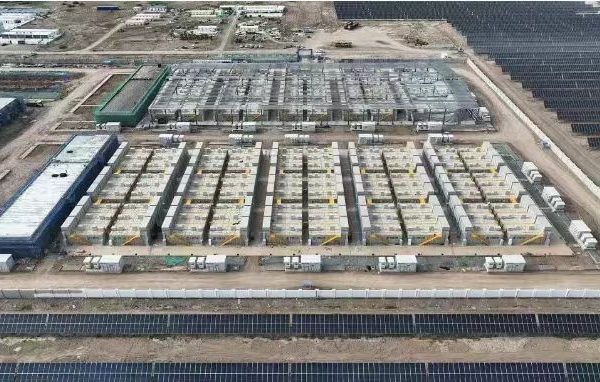




Battery Energy Storage Systems (BESS) are increasingly being deployed in deserts and other arid regions because these locations often provide excellent solar resources and large areas for utility-scale energy projects.
However, desert environments create a major challenge for battery thermal management: sand and dust.
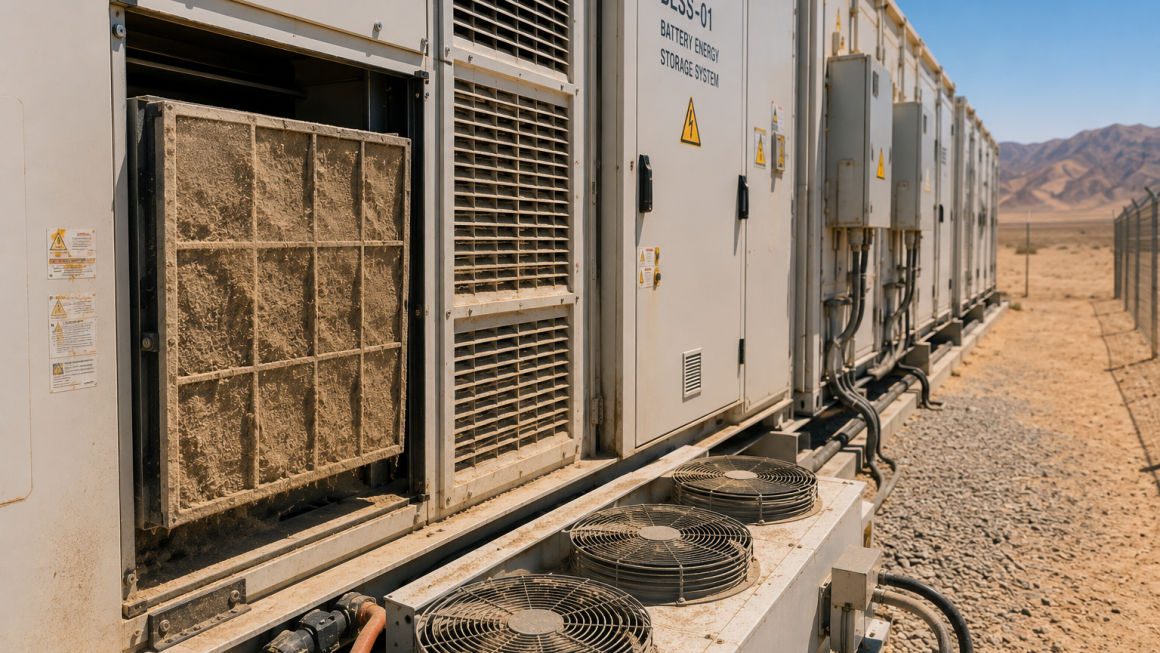
Fine dust can accumulate on air filters, cooling coils, ventilation openings, heat exchangers, fans, and external equipment surfaces. Wind-driven sand can also enter equipment through poorly protected openings and gradually reduce the effectiveness of cooling systems.
As dust accumulation increases, airflow and heat transfer can decline. Cooling equipment may then need to operate for longer periods or at higher power to maintain the required battery temperature.
For this reason, understanding how sand and dust affect BESS cooling performance is essential for system reliability, energy efficiency, battery life, and long-term O&M.
Why Cooling Performance Matters in BESS
Battery cells generate heat during charging and discharging.
The amount of heat depends on factors such as:
- Charge and discharge power
- Current
- Internal resistance
- Battery chemistry
- State of charge
- Ambient temperature
- Operating conditions
If this heat is not removed effectively, battery temperature can increase.
High battery temperatures can accelerate degradation and create temperature differences between battery modules.
A BESS thermal management system therefore needs to maintain the battery within an appropriate operating temperature range while keeping temperature differences under control.
Cooling systems may use:
- Forced-air cooling
- Liquid cooling
- Refrigeration-based cooling
- Cold plates
- Heat exchangers
- Fans and ventilation systems
Regardless of the cooling technology, the external environment can influence thermal performance.
In desert applications, sand and dust are particularly important environmental factors.
How Sand and Dust Enter BESS Cooling Systems
Dust does not necessarily need to enter the battery enclosure to affect cooling performance.
It can accumulate on external surfaces and cooling components.
Typical entry or accumulation points include:
- Air intake vents
- Cooling fans
- Filters
- Heat exchangers
- Condenser coils
- Radiators
- Ventilation ducts
- Cable entry points
- Equipment gaps
- HVAC systems
Wind can carry very fine particles over long distances.
During dust storms or periods of strong wind, the concentration of airborne particles can increase dramatically.
This creates a much greater environmental load on outdoor BESS equipment.
1. Dust Clogging Air Filters
For air-cooled BESS, air filters are one of the first components exposed to airborne dust.
The filter is designed to capture particles before they enter the cooling system.
However, as dust accumulates, the filter becomes increasingly resistant to airflow.
The relationship can be summarized as:
Dust Accumulation → Higher Pressure Drop → Lower Airflow → Lower Heat Removal
When airflow decreases, the cooling system may have difficulty removing the same amount of heat.
Fans may then need to operate at higher speeds to compensate.
This can increase auxiliary electricity consumption.
If the filter becomes severely blocked, the cooling system may no longer have sufficient capacity to maintain the required temperature.
2. Dust Accumulation on Heat Exchangers
Heat exchangers rely on effective heat transfer between surfaces and a moving fluid.
Dust accumulation can reduce heat transfer in several ways.
A layer of dust can act as an additional thermal resistance.
At the same time, dust can block airflow passages between fins.
The result can be:
Dust Layer → Reduced Airflow + Increased Thermal Resistance → Lower Heat Transfer
This problem is especially important for finned heat exchangers and radiators with relatively narrow air passages.
Even a relatively thin layer of contamination can affect thermal performance when it is distributed across a large heat-transfer surface.
3. Reduced Fan Performance
Cooling fans are another critical component of air-cooled BESS.
Dust can accumulate on:
- Fan blades
- Fan guards
- Motor housings
- Bearings
- Air passages
Dust accumulation can increase mechanical resistance and alter the aerodynamic characteristics of the fan.
Over time, this can contribute to:
- Reduced airflow
- Higher fan power consumption
- Increased vibration
- Bearing wear
- Higher operating temperature
- Shorter fan service life
A cooling system that depends on multiple fans can therefore experience gradual performance degradation as environmental contamination increases.
4. Dust and Cooling Efficiency
Cooling efficiency is not only about whether the cooling system is operating.
A BESS cooling system may continue running even when its thermal performance has already declined.
For example, a cooling system may initially remove a certain amount of heat at a given fan speed.
After dust accumulation, the same fan speed may produce significantly less effective airflow.
The system may compensate by increasing fan speed or cooling output.
This creates an important operational relationship:
Dust Accumulation → Cooling Capacity Reduction → Higher Cooling Demand → Higher Auxiliary Power Consumption
Therefore, dust can indirectly reduce the overall energy efficiency of a BESS.
5. Higher Auxiliary Energy Consumption
Battery storage systems consume energy not only through the main battery charging and discharging process.
Auxiliary systems also consume electricity.
These can include:
- Cooling
- Heating
- Ventilation
- Pumps
- Fans
- Controls
- Monitoring systems
- Fire protection systems
In hot desert environments, cooling can represent a significant auxiliary load.
If dust reduces heat-transfer efficiency, cooling equipment may need to operate more frequently or at higher output.
Over the lifetime of a large BESS, this additional auxiliary energy consumption can become an important operating consideration.
6. Dust Can Increase Battery Temperature
The ultimate concern is not simply dirty equipment.
The more important issue is the effect of reduced cooling performance on battery temperature.
A simplified relationship is:
Reduced Heat Transfer → Higher Battery Temperature → Increased Thermal Stress
Battery temperature affects several important characteristics, including:
- Degradation rate
- Available capacity
- Charging performance
- Efficiency
- Safety margin
- Battery lifetime
Maintaining a stable thermal environment is therefore an important part of BESS lifecycle management.
7. Uneven Cooling Across Battery Modules
Dust-related cooling degradation does not necessarily affect every part of a BESS equally.
Some air pathways may become more restricted than others.
This can create uneven cooling.
For example:
Clean Air Path → Higher Airflow → Lower Temperature
while:
Restricted Air Path → Lower Airflow → Higher Temperature
This can result in temperature differences between battery racks or modules.
Temperature uniformity is important because uneven thermal conditions can contribute to uneven aging.
A good thermal management strategy should therefore monitor not only average battery temperature but also temperature distribution.
8. Dust Problems in Air-Cooled BESS
Air cooling is particularly sensitive to environmental contamination because it requires continuous movement of external or conditioned air.
The cooling chain may be:
Outdoor Air → Filter → Fan → Heat Exchanger → Battery Compartment → Exhaust
Every stage can potentially accumulate dust.
For air-cooled BESS installed in deserts, designers should therefore consider:
- Filter efficiency
- Filter pressure drop
- Filter replacement frequency
- Air intake location
- Airflow path
- Fan capacity
- Heat exchanger accessibility
- Enclosure sealing
- Maintenance requirements
The objective is to balance environmental protection with sufficient airflow.
9. Dust Problems in Liquid-Cooled BESS
Liquid cooling is less directly dependent on large volumes of external air flowing through the battery compartment.
This can provide an advantage in dusty environments.
However, liquid-cooled systems are not completely immune to desert conditions.
Dust can still affect:
- External heat exchangers
- Radiators
- Condensers
- Cooling units
- Fans
- Pumps and auxiliary equipment
- Outdoor HVAC components
For example, the battery side may use a liquid coolant loop, while the external heat-rejection system still relies on airflow.
Therefore:
Liquid Cooling Reduces Some Dust Exposure, But Does Not Eliminate the Need for Environmental Protection.
This distinction is important when evaluating cooling architectures for desert BESS.
10. Dust and Cooling System Filters
Filters are essential in many outdoor cooling systems, but they also become maintenance components.
A filter must balance two competing requirements:
High filtration efficiency
and
Low airflow resistance
A filter that captures large amounts of fine dust but becomes blocked quickly may create significant maintenance requirements.
The selection process should therefore consider:
- Particle size
- Dust concentration
- Required airflow
- Pressure drop
- Filter efficiency
- Filter capacity
- Replacement availability
- Maintenance accessibility
In extremely dusty environments, filter design should be treated as part of the overall thermal management strategy.
11. Enclosure Design and Dust Protection
The enclosure itself plays an important role.
A BESS enclosure should protect internal equipment while still allowing the thermal management system to remove heat.
This creates a fundamental engineering trade-off:
More ventilation → Better potential heat rejection
but:
More ventilation → Greater potential dust exposure
The solution is not simply to maximize airflow.
Instead, the system needs a controlled airflow path combined with appropriate filtration, sealing, and heat rejection.
For outdoor BESS, enclosure design and thermal management should therefore be developed together.
12. Air Intake Location Matters
The location of cooling air intakes can influence dust exposure.
Air intakes positioned close to the ground may be exposed to higher concentrations of dust and sand, particularly during strong winds.
Where practical, designers can consider:
- Elevated air intakes
- Protected intake locations
- Wind direction
- Local terrain
- Equipment spacing
- Dust barriers
- Filter access
The goal is to reduce unnecessary exposure to airborne particles before they reach the cooling system.
13. Sandstorms Create Short-Term Thermal Risks
Normal dust accumulation is a gradual process.
Sandstorms are different.
During a severe dust event, large amounts of airborne particles may enter cooling system intake areas within a relatively short period.
This can cause rapid filter loading and temporary reduction in airflow.
A BESS operating at high power during such an event may therefore face a particularly difficult thermal condition:
High Battery Load + High Ambient Temperature + Reduced Cooling Airflow
This combination can significantly increase thermal stress.
BESS control systems should therefore consider environmental conditions when defining operating strategies.
14. Monitoring Cooling Performance
Regular monitoring can help identify cooling degradation before it becomes a serious problem.
Useful parameters may include:
- Battery temperature
- Temperature difference between modules
- Cooling unit output
- Fan speed
- Pump speed
- Airflow
- Filter differential pressure
- Coolant temperature
- Heat exchanger temperature
- HVAC operating time
- Auxiliary power consumption
A change in these parameters can provide an early indication of cooling system deterioration.
For example, if fan speed continuously increases while battery temperature remains unchanged, the system may be compensating for increasing airflow resistance or declining heat-transfer performance.
15. Predictive Maintenance for Dust-Exposed Cooling Systems
Traditional maintenance may rely on fixed filter replacement schedules.
However, dust conditions can vary significantly between locations and seasons.
A fixed schedule may therefore result in:
Too Early Replacement → Unnecessary Maintenance
or:
Too Late Replacement → Reduced Cooling Performance
Predictive maintenance can use operational data to identify when cooling performance begins to deteriorate.
Potential indicators include:
- Increasing pressure drop
- Increasing fan speed
- Increasing cooling energy consumption
- Increasing battery temperature
- Increasing temperature differences
- Increasing HVAC operating hours
This allows maintenance teams to respond to actual system conditions rather than relying exclusively on calendar-based maintenance.
16. Cleaning Strategies for Desert BESS
Cleaning requirements depend on equipment design and environmental conditions.
Potential maintenance activities include:
- Filter replacement
- Filter cleaning where permitted
- Heat exchanger cleaning
- Fan inspection
- Vent inspection
- External equipment cleaning
- Dust removal from cooling surfaces
Cleaning procedures must be carefully designed.
Improper cleaning can damage fins, electrical components, seals, or sensitive equipment.
Maintenance teams should follow equipment manufacturer requirements and site-specific procedures.
17. Cable Protection and Cooling Performance
Cable protection also has an indirect connection with BESS thermal management.
Large BESS installations contain substantial DC and AC cable infrastructure.
Cable routing must prevent cables from blocking cooling airflow or interfering with ventilation equipment.
At the same time, cable glands and sealing systems must prevent unnecessary dust ingress.
This creates an integrated design relationship:
Cable Routing + Enclosure Sealing + Ventilation + Thermal Management
Good system design considers these elements together.
18. Desert BESS Requires a Lifecycle Approach
The impact of dust should not be evaluated only during initial equipment commissioning.
A BESS may operate for 10 years, 15 years, or longer.
During this period, environmental contamination can gradually change equipment performance.
Therefore, thermal management should be evaluated across the full lifecycle:
Design → Installation → Commissioning → Operation → Maintenance → Retrofit
A cooling system that performs well when new may require different maintenance strategies after years of exposure to dust and high temperatures.
19. Designing BESS Cooling for Dusty Environments
A robust desert BESS thermal management strategy can include several layers of protection.
Layer 1 — Environmental Assessment
Evaluate:
- Ambient temperature
- Dust concentration
- Sand exposure
- Wind conditions
- Seasonal variations
Layer 2 — Cooling Architecture
Select an appropriate cooling technology based on the environmental conditions and system requirements.
Layer 3 — Airflow Management
Design controlled airflow paths and avoid unnecessary dust exposure.
Layer 4 — Filtration
Select filters according to particle size, airflow requirements, pressure drop, and expected dust loading.
Layer 5 — Sealing
Protect sensitive components and interfaces against dust ingress.
Layer 6 — Monitoring
Continuously monitor temperature and cooling performance.
Layer 7 — O&M
Establish inspection, cleaning, and replacement procedures based on actual site conditions.
This layered approach can significantly improve long-term cooling reliability.
20. The Future of Dust-Resistant BESS Thermal Management
As BESS projects move into increasingly challenging environments, thermal management systems will need to become more adaptive.
Future systems are likely to combine:
- Advanced filtration
- Improved enclosure sealing
- High-efficiency cooling
- Liquid cooling
- Intelligent fan and pump control
- Environmental sensors
- Predictive maintenance
- AI-based thermal optimization
- Remote O&M monitoring
AI can potentially identify relationships between weather conditions, dust exposure, cooling performance, and battery temperature.
For example, an intelligent EMS or BESS monitoring platform could recognize that cooling efficiency consistently decreases following periods of high dust exposure.
The system could then recommend inspection or maintenance before battery temperature reaches a critical condition.
Sand and dust can have a significant impact on BESS cooling performance, particularly in hot and arid environments.
The most important mechanism is straightforward:
Dust Accumulation → Airflow Restriction → Reduced Heat Transfer → Higher Cooling Demand → Higher Battery Temperature
For air-cooled BESS, filters, fans, ventilation pathways, and heat exchangers are particularly sensitive to dust accumulation. Liquid-cooled BESS can reduce some of these risks, but external heat-rejection equipment may still be exposed to airborne particles.
Effective desert BESS thermal management therefore requires more than selecting a powerful cooling system.
It requires an integrated strategy covering filtration, sealing, airflow design, heat exchangers, thermal monitoring, cable routing, preventive maintenance, and predictive O&M.
As utility-scale energy storage continues to expand into desert regions, cooling performance should be treated as a lifecycle reliability issue rather than simply an HVAC specification.
The best BESS cooling architecture is not necessarily the system with the largest cooling capacity.
It is the system that can maintain stable battery temperatures efficiently and reliably despite changing environmental conditions over many years of operation.
Frequently Asked Questions
How does sand and dust affect BESS cooling?
Sand and dust can clog filters, restrict airflow, contaminate fans and heat exchangers, and increase thermal resistance. These effects can reduce cooling efficiency and increase battery temperature.
Does dust affect air-cooled BESS more than liquid-cooled BESS?
Generally, air-cooled systems have greater direct exposure to airborne dust because they rely on airflow through filters and heat-transfer surfaces. Liquid-cooled systems reduce some of this exposure, but external radiators, condensers, and heat-rejection equipment can still be affected.
Can dust increase BESS energy consumption?
Yes. When dust restricts airflow or reduces heat-transfer efficiency, fans, pumps, or cooling units may need to operate harder or for longer periods. This can increase auxiliary energy consumption.
Can dust shorten battery life?
Indirectly, yes. If dust accumulation reduces cooling performance and causes batteries to operate at higher temperatures for extended periods, battery degradation can accelerate.
How can BESS cooling systems be protected from desert dust?
Common strategies include high-efficiency filtration, controlled airflow paths, sealed enclosures, protected air intakes, appropriate heat exchangers, regular cleaning, and continuous thermal monitoring.
How often should BESS cooling filters be replaced?
There is no universal replacement interval. The appropriate frequency depends on local dust concentration, filter type, airflow requirements, operating conditions, and manufacturer recommendations. Monitoring pressure drop and cooling performance can support condition-based maintenance.
Is liquid cooling better for desert BESS?
Liquid cooling can offer advantages in high-temperature and high-density applications because the battery thermal environment is less dependent on large volumes of dusty outdoor air. However, the complete cooling system still requires protection and maintenance because external heat-rejection equipment can remain exposed to dust.
What is the best way to manage BESS cooling in a desert?
The most effective approach is a layered strategy combining appropriate cooling architecture, filtration, enclosure sealing, airflow management, thermal monitoring, predictive maintenance, and regular O&M.